New Years rituals. What are yours?

Do any of you have New Years’ rituals (regardless of when you celebrate the new year?)

I’ll share a few of mine. First of all, I do not go out and party New Years’ Eve, even when I was younger and could drink more than one alcoholic beverage a year. I don’t stay up till midnight these days because I turn into a pumpkin after 9 PM.  But every year, my husband and I do a silent worship-sharing in the manner of Quakers to tuck the old year in to sleep.

The next day, we eat good luck foods — noodles for long life, pickled herring, black beans and greens (I love Hoppin’ John!), things like that. I think Richard is attempting Japchae, a Korean dish, this year.

I also have a ritual in which I do a little work on everything I want to accomplish this year.  So, a little blogging, a little query-writing, a little work, a little play, a little walk, a little writing, a little prepping my seedling room for the winter seed-starting season, a lot of petting cats …

This is a little short today because I’m prepping for classes, which can be nerve-wracking, especially since I need to tweak some classroom material.  This means you can respond with your own New Years rituals!

I love you all.

Writing with Cats

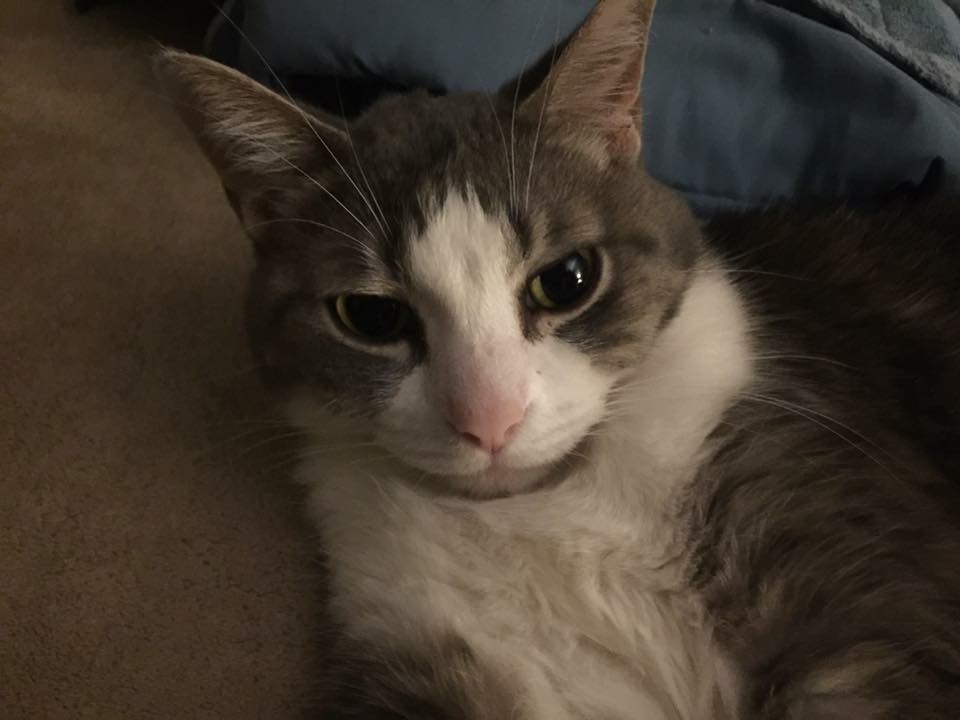
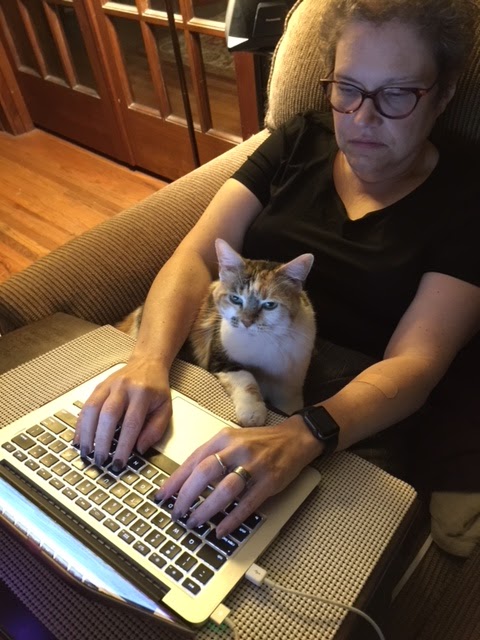
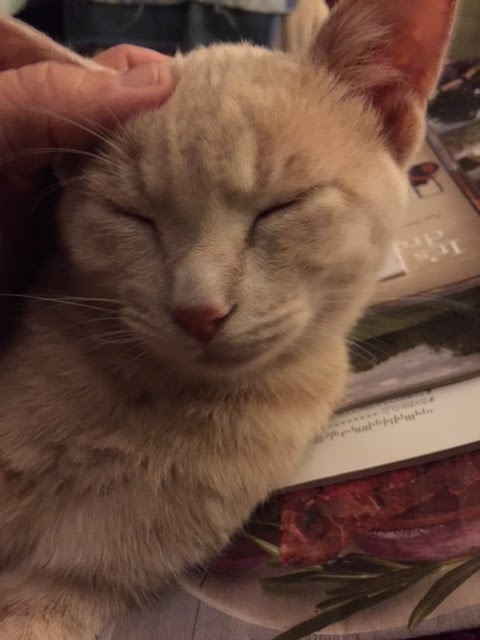
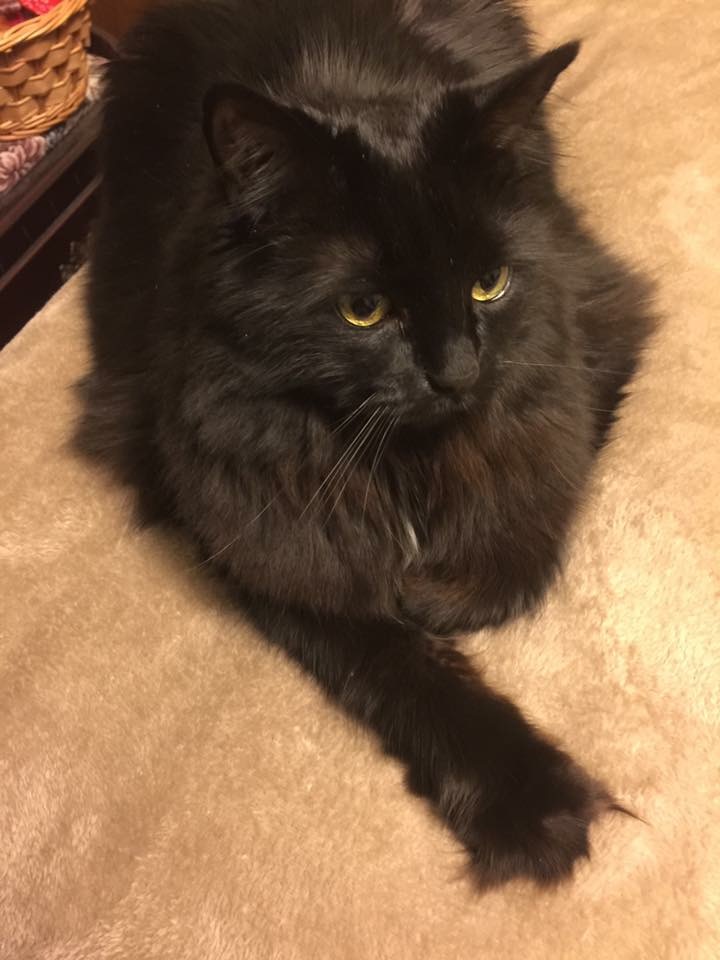
One of the things that doesn’t become obvious when you read my blog is that I have five cats: Stinkerbelle, Me-Me, Snowy, Girlie-Girl, and Charlie. Each of them have multiple nicknames:

  • Stinkerbelle: She’s the rotund black-and-white cat. She goes by Stinky, Soccerballee, Turnip Head. She’s 11 years old and lives next to the food dish. We have to prod her every now and then to see if she’s still alive. She’s not sick — she’s just that lazy.
  • Snowy: Almost pure black longhair. She goes by Ironic Cat, Snewy, and No-ee. She’s the prima donna of the batch, sitting with paws politely crossed.
  • Girly-Girl is a patched tabby. We call her Squirelly-Girl, Twirly-Girl, Cattywumpus and Butterbutt. Very prosaic, as if she were a farm cat in her last life. She can jump four and a half feet from the loveseat to the couch and jump over me on the couch with minimum effort.
  • Me-Me is a petite blue tabby and white. We call her Meemerz, Weemerz, Meemer-butt, Wiggle-butt and Weebles. Pretty little con artist, but pretty independent.
  • Charlie is a six-month-old buff tabby and the only male in the bunch. He goes by Chuckie, Chuckles, Chuckroast, Chuckie Monster and No! As you might expect, pure energy and mischief.
Snowy, AKA Ironic Cat 

Stinkerbelle when younger

Me-Me, who looks like she took this selfie. 

Girlie-Girl, my editor

Charlie, in a rare non-evil moment.
The average morning early writing goes like this:
  1. Snowy sits on the arm of the couch next to me. A few minutes later, she gives me The Paw. Then both paws.  On my right arm while I’m typing. This is a signal to drop everything I’m doing so I can pet her. One hand is now occupied.
  2. Girlie jumps on the couch on the other side of me and plasters herself against my leg and purrs, even though I’m not petting her. Just wait.
  3. Girlie starts giving me The Paw. Only one paw, but she pokes at me in her rapid Kung Fu fighting strike. I pet her with the other hand.
  4. Snowy feels neglected because I’m not petting her hard enough, She starts headbutting up against my arm. I pet her twice as hard.
  5. Me-Me lounges on the floor, waiting expectantly for something. Charlie saunters down the stairs; Me-Me jumps up. They touch noses, the equivalent of shaking hands in the ring. Then they start whacking at each other.
  6. Girlie jumps off the couch to turn the twosome into a free-for-all MMA match, employing her Kung Fu fighting strike to the middle of the pile. Nobody is yowling, which makes me wonder if they like to fight.
  7. Snowy jumps off and saunters to the loveseat, where she sits on the back, since she doesn’t have to compete for attention anymore.
  8. The three-way fight on the floor breaks up with three cats scampering. Girlie jumps on the loveseat with Snowy, Me-Me sprawls on the ground, and Charlie bites my toes, then scrambles off.
  9. Snowy runs over to me for reassurance, with both paws and headbutts. 
  10. Richard turns on stereo.
  11. Snowy stands on my lap, in my face, meowing, headbutting my face. 
  12. Charlie sharpens his claws on the speaker. Richard yells, “No!” 
This is life with my cats.

When I became a writer: A bio of creativity

I started writing in third grade — poetry, it turned out. My third grade teacher, Mrs. Kuh (an unpleasant sort for the most part) taught us poetry — difficult, advanced poetry. Diamante and haiku and limericks — although we were too young for the most amusing examples of the latter form, dirty limericks.

My first poem, a haiku:

Come here, small firefly.
Let me see your glowing light
shining bright and gay.

Note the six beats in the first line where there should be five. I didn’t quite have the hang of haiku in third grade.  Blessedly, I do not remember my third-grade diamante.

In fifth grade, my mother unwittingly put me up to collaborate in plagiarism. My neighbor in high school had to write a poem for Mrs. Schobert’s class, and his mom asked my mom to ask me to write a poem for him to hand in. I was scared not to comply, so I wrote him a poem. I earned an A on his poem, although Mrs. Schobert may have wondered why he wrote like a fifth grade girl.

In sixth grade, I wrote very amateurish stories about the guy I had a crush on. (He came out of the closet after graduation.)

I gave my junior high (Middle School for you youngsters) English teacher everything I wrote throughout seventh and eighth grade, because my mother didn’t seem too interested in them. At the end of junior high, she returned them to me in a folder and told me to keep writing and to work toward getting published. Thank you, Miss Myers, for giving me a goal.

In high school, I took a creative writing class with Mrs. Schobert, who didn’t recognize that my writing style looked like a high school boy’s writing of several years before. I learned the very basic basics of everything — diamante and haiku, descriptive writing, short stories, and playwriting. I wrote a short fantasy play based on a story my mother had told me about the year her family couldn’t afford a Christmas tree. The reviews in my head ran: “A heartfelt but saccharine attempt to catch the magic of Christmas.”

In college, I wrote many, many poems. Most of them related to the ups and downs of being in love. One of my exes, who broke up with me for a girl he met at a party, explained to his new girlfriend, “She wrote poems. I never understood them.” After that, I wished I could pull off the Goth look to emphasize my feeling of being misunderstood.

My college poetry class almost killed my desire to write when the published poet who taught it lauded a student for her “original”  — “like a moth to the light”. On the other hand, he called my work “greeting card trash”. My poems might not have been great, but how could I have improved them from that screed?  Mr. Guy Whose Name I’ve Forgotten, you created my hatred of being critiqued.

When I was in grad school, I dated a folksinger. (He hurt me badly; I kill him off in this current book I’m editing). He played a combination strum/fingerpicking style and composed beautiful, intricate pieces. He’d play around with a tune, and the following conversation would ensue.

         Me: I have a work in progress that would work with that tune.

         Him: How? It’s 5/4 time with syncopation!
 
         Me: Try me …

So we composed music and performed together, and we had a fan or two and earned $2.50 busking. More importantly, I got to sing about my heartbreak and trauma and crushes and people listened. Many had their favorites — the most popular song was “World’s Worst Blues Song,” which is exactly as advertised. We married, we divorced, and I have a handful of songs I can’t perform because I can’t learn guitar and my voice (husky contralto) isn’t what it used to be. So, Adam, thank you for helping me get my words heard. Do not, under any circumstances, contact me. I’ve killed you off, after all.

I didn’t write novels until about five years ago. I couldn’t comprehend writing novels because they required an extended and gripping plot, a certain amount of continuity for many, many pages, and attention span. (I may have ADHD. Never diagnosed, but watched carefully by the school district.)

But then I fell in love with a world and its characters. I first met them, I believe I said once, by interpreting a dream, then by interrogating the dream by questioning its characters.  I kept writing short stories about the same people and the same world, tracing the progression of their very strange relationship in a background of present-day spirit activity. Richard (my second and real husband) said, “You might as well write a book,” and I wrote one. And then more, because I kept getting ideas about where this world and its people were going. Thank you, Richard, for appealing to my best self, the one who dares.

I am editing that first book for perhaps the third time. That first book has always seemed problematic, and I would fix things one at a time (search for places that needed more description, search for places that needed better verbs, etc.) and I still felt dissatisfied with it. For the past few days, I’ve dug deeper. I’ve culled sections that distract from the action and added more hints a là Chekhov’s Gun. I’ve added more menace, more potential dire consequences for the protagonists and a foreshadowing into the next books in the series. I’m less shy about Josh and Jeanne’s relationship (but still just as shy about the sex. I’m not a prude, honestly, just not happy about how sex ends up on paper).

Yesterday, I felt joy at ripping this novel apart and reassembling it. Joy from editing, from improving, from making this novel solid and not tentative, making it menacing and joyous.

Yesterday, for the first time in my life, I felt like I could own the identity of “writer”.

Thank you, all of those in my past and all of you in my present, for supporting me along the way.

Josh and Jeanne: Telling their stories truthfully

As I re-re-edit Gaia’s hands in a number of ways for a number of reasons, I’ve learned a surprising lesson — it’s possible to be scared of your own writing.

There are some things about the book I’ve understated — too much, in fact — because I didn’t know how people would react to them. The biggest one, I guess, is the relationship between Jeanne Beaumont, a tenured professor and Josh Young, a student (but not one she’d ever have in class) at a midsized university. I looked at the rules at her university, and there is nothing in the conduct code that would present this, as he will never be her student.

Note how I try to justify myself already? If that first part didn’t startle you, they fall in love with each other, despite the difference in their ages and the differences in where they are in life. She’s settled in her faculty responsibilities yet starting a new venture in permaculture design. He’s at the beginning of his adulthood, but focused on getting a PhD in creative writing and a writing career. She tries to avoid problems while he tries to breeze past them, but they go toe-to-toe with each other because their relationship is too important to evade.

I’m not sure the above is even the most startling part — the most startling part may be that Jeanne and Josh are attracted to each other. This includes sexual attraction, even though he’s a slender 20-year-old and she’s a zaftig 50-year-old. In short, they are the two groups of people we regard as least sexy in the US — a young, small-boned Asian American man and a large, older woman. And the younger one, not the older one, is the pursuer. (There are, however, no explicit sex scenes in this book because I thought you should use your imaginations there.)

I created the characters like this on purpose — to challenge the reader, to expand societal notions of what is possible, to give a view different than our notions that Asian men are sexless and women of a certain age are desperate.  My books are full of oddballs — perhaps because oddballs are my people — for better or worse. I could have put ordinary characters against the subtly extraordinary events of the book, but I was afraid they’d wash out. Jeanne and Josh are not ordinary.

If I myself cannot face my characters — good and bad — my writing loses power and coherence. It’s possible that this book will never get published because I believe an older woman/younger man relationship is not only possible, but believeable. There may be people out there who think a semi-sentient vine and a plant superpower are more believable than Jeanne’s and Josh’s relationship, but I will not try to erase them or their relationship from this story. The story deserves better, Josh and Jeanne deserve better, and I deserve better.

Teaching in Writing Fiction

Writers have to provide a certain amount of solid grounding in their world, whether it be realism in an “ordinary world” or explaining the rules in a world of magic. But they have to do it carefully — not enough grounding and readers shake their heads at fancy words with no meaning; too much explanation and it comes off like sitting in a lecture in a stuffy classroom.

I wrote that “sitting in a lecture in a stuffy classroom” metaphor very deliberately, because grounding a reader in the rules of the world is, in effect, teaching. Doing this grounding not only helps the reader understand the world, but teaches them something new.

I remember a Jayne Ann Krentz book I once read (yes, I have read fantasy, and some of it is quite good) where the lead male owned a winery. At one point, he strides through the winery checking up on things. That’s about the only detail Krentz provided about the winery — he could have been touring an aircraft carrier for all we knew. This really stood out to me because I used to make wine at home and had considered starting a commercial winery at one point. My character would have stopped by the lab to discuss pH levels and brix — sugar levels — of grape must going into the process and the percentage alcohol and residual sugar of a batch waiting to go into oak barrels if it was red wine or bottling if it was white. He would tour the barrel stock and take a sample from a 55-gallon barrel with a wine thief and taste how it began to mellow under the influence of the oak. With these details, the reader understands more about wine — and the male protagonist is portrayed as having a keen eye on details, an understanding that winemaking is as much a craft as a business, and a rapport with his workers. That’s the beauty of teaching — done right, it develops the rest of the story — character, plot, theme, or all three — as well as teaching the reader about something new.

I do a certain amount of teaching in my own writings — I am, after all, a professor. I write what would be called magical realism if I wrote literary fiction instead of genre fiction (e.g. romance, science fiction, fantasy, Westerns, erotica). Sometimes what I write just has to be revealed rather than explained because there is no logical explanation — for example, the mystical aspects of my writing such as seeing visions and hearing the voices of the Gods (sounds epic, but the recipients of these preternatural events are a twenty-year-old college student and a fifty-year-old architect.)

Some extraordinary things need to be explained — such as the rules around time travel:

p.p1

“Ahh, the rock principle.” Ian referred to the fact that when Travellers exacted non-significant changes in a time period — not interactions with major players or major objects — an innocuous change would be made in terms of those non-essential players and objects. For example, if a Traveller picked up a rock in 1620 that an ordinary human of the time would trip over, the timeline would substitute another rock to compensate. In my case, I supplanted the red and white airplane. Significant changes would not be allowed according to the rock principle.

And sometimes I teach the most prosaic things:

p.p1

Her permaculture guilds for Barn Swallows’ Dance would be bigger, more complex. Daunting, even. Two acres of six-layer guilds centered on apple trees, surrounded with hazelnut and sea holly and various cane berries, where the tree’s dappled shade would benefit them. Perennial herbs and greens such as scorzonera and chicory would be planted toward the tree’s drip line where they would get enough water.  Groundcovers like bunchberry and violets, which would block weeds, and edible vines that grew up the trees, would complete the scene.

When I pick up a book, sometimes I want it to broaden my world. Maybe it’s just me, because I teach college for a living. But if the book can explain something in a non-didactic (non-lecture-y) way, I’m all for it. I hope I’m doing a good job of it. 

The Stories We Tell: Oral Tradition

Before the development of writing systems, storytelling was one of the only methods of communicating the wonder of the world.  Storytellers would regale the gathered people with tales about gods, about successful or unsuccessful hunts, about their history. Someone in the next generation would memorize the stories so he could take the storyteller’s place around the fire someday.

The tradition continued around the world even after the invention of writing, with the Gaelic shanachie, family stories at holiday gatherings, sermons in churches all over the world. Even social gatherings have their share of swapped stories.

I grew up in a family with a rich oral tradition. My father’s side, a mix of Welsh, French Canadian, and Ojibwe, told stories about their lifestyle, which centered around the North Woods and hunting, reckless adventures growing up poor in Milwaukee, and a certain amount of bravado and subsequent error.  My mother’s family told stories with word play and puns, with my grandmother serving as the straight man.

A hunting story on my father’s side:

Grandpa had decided to teach his sons how to hunt pheasant. “Boys,” he said, “What we do is line up in this field here, and spread out aways from each other. The dog’ll flush up a pheasant, then each of us has a try to shoot the pheasant flying by.

“Unless it’s a hen pheasant — they’re the brown ones. You’re not supposed to shoot hen pheasants. So if you see a hen, shout down the line so that nobody else tries at it. Got it?”

All three boys nod.

It was a bad day hunting — the hunting dog stayed listless and quiet. The spirits of the hunters drooped, because the pheasant was to be their dinner.

Suddenly the dog yipped, running toward a tussock. A pheasant burst out of the grass.

The youngest, my Uncle Larry, who was no more than four and wasn’t even armed, yelled “Hen” in a quavering voice.

The middle son, my Uncle Ron, at 7, again not armed, yelled “Hen!” miserably.

My father, age 9, kept his shotgun down and sighed, “Hen!”

Grandpa thought for just a moment, raised his gun and shot —

“Hen! Heh heh heh.”

The family had supper that night.

A story from Mom’s side of the family:

Seventeen-year-old Aunt Marie approaches Grandma with a proclamation: “I’m going to marry Wayne.”

“I forbid it,” Grandma snapped.

“Then I’ll elope,” Aunt Marie countered.

“You can’t elope!”

“You watermelon!”

(If you don’t get this, read it aloud.)

I have changed these stories by writing them down. I have tried to use the language of the people involved, but my writing techniques have crept in.  In the spoken story, I could merely use tone of voice and gesture and not provided cues to emotion. However, these changes would have happened even in the transmission of the stories from generation to generation. For example, a Native American cautionary tale about white animals being sacred, one passed down in my family, has morphed into a story about a hunter shooting a white deer and being arrested by Wisconsin Conservation.

I have changed these stories by writing them down in a way that freezes them in time and place. When you read a written story like these, you read an “official” version of the story, and you will go back and read this again to get the story right. It has no way to adapt to the needs of the generations to come — a change in the settings, a change in the consequences.  Grandpa will always be the one to shoot the hen. The elopement story will always be between a mother and daughter.

This is why, when someone suggests I collect my family stories and save them so others can read them, I am reluctant to do so.

You Are a Writer

Dear Readers — this is for all of you. All of you are writers whether or not you think you are.

Becoming a writer requires only one thing: That you write.

You suspect it’s not as simple as that. You’re right, of course.

You may stare at the page, clutching your lucky pen, but no ideas come to mind.  There are many ways to break that impasse: take the pressure off and just write, freeform, on whatever comes to mind. Interrogate a dream (my favorite method). Do word sprints — a method where you use a prewritten suggestion and write on that topic, exercising your mind in a non-threatening way. Because writing is threatening — you risk internal reflection, growth, exploration of disconcerting topics. And maybe, possibly, recognition. Give yourself a pep talk — you are a writer! You can withstand the threats of reflection and exploration.

Then, you follow the flow of writing, and you feel the flow of ideas — until you don’t. You stare at the page in front of you, where words abruptly stopped in the middle of the page. You have several options at this point: create an outline and fill in the plot points so you know where to go. Write what you know. Research the details you’re not sure of. Take a break. Think of a future, more exciting scene and write that.  Give yourself a pep talk — you are a writer! All writers face that moment when ideas run dry.

When you’re done with your manuscript, you face the most important and most difficult part — editing. You need to edit because, while your words flowed, your grammar, punctuation, and continuity did not. You may find that your characters ended up on a yacht with no indication why. Or one of your characters practices “elf-defense” and there are no elves in the story.  Maybe your protagonist changed race. Little things like that. This part of editing you may be able to do yourself. Give yourself a pep talk — you are a writer! Tedious as this is, you can do it.

The other type of editing you will find more challenging, and that is reading for plot, flow of ideas, and readability. You may be so used to your story by then that you can’t recognize problems with description, plot holes, characterization, and other aspects that will make or lose the reader’s interest. You may feel threatened by someone else reading your manuscript — “oh, G-d, what if they don’t like it?!” Give yourself a pep talk — you are a writer! You can bear the criticism and use it to make yourself better.

Writing is not just a creative process — it’s a journey of growth. Few writers get their first work published — I thought I would, but I have since edited it so many times, it’s no longer my first work! I sent that revised, revised, and revised document out on queries later this week, and I’m holding my breath that an agent takes the hook. I’m giving myself a pep talk — I am a writer! I can withstand rejection again!

Cats and the Writer

Someday I will write about writing about sex — but today is not that day.  I’m feeling silly today, so instead, I’ll write about cats.

If I believe the memes on Facebook, all writers have cats. I’m pretty sure not all of them do, but the number of cat/writer memes far outstrip the number of dog/writer memes.

I have four cats — the luxurious Snowy (pure black; named for the irony value); the mischievious Me-Me,  a petite grey and white; the caterwauling calico Girly-Girl, and the rotund black-and-white grump Stinkerbelle. They help me write as you might imagine — when I sit in the living room at my computer desk, they interrupt me by biting my toes (Me-Me), butting my arms (Snowy), and yelling at me (Girly). Think of these as enforced work breaks.

Exhibit 1: My cats: Snowy, Me-Me, Girly-Girl, and Stinkerbelle

I thought I could involve them in the writing process — “Me-Me, could you proofread this passage for me?” (Me-Me stares at me with her huge, adorable eyes and licks my nose.) Ok, maybe not.

Many writers love cats. My favorite example was Ernest Hemingway, who loved cats so much he let them wander his estate. Due to the high number of polydactyls (extra-toed) cats on his estate, extra-toed cats became known as “Hemingway Cats”.

Perhaps cats inspire writers to imagine. After all, their faces — darling, elegant, curmudgeonly, bewildered — display character traits that can be used in our stories. People personify cats in cat memes — for example, Diabeetus cat (who looked like Wilford Brimley, who starred in commercials about diabetes.)

Exhibit 2: A picture of Wilford Brimley and Diabeetus cat:

Writers even sneak cats into their stories. Robin D. Owens, in her Celta science fiction, writes a collection of telepathic cats who pick their owners. (She also has other animals, but I’m ignoring that for the sake of my thesis here). Cats have become detectives, as in Lilian Jackson Braun’s The Cat Who… series. The same things that drive cat-haters up the wall — their fickleness, their curiosity, their dignity, their mischief-making — make them good characters.
Why cats and not dogs? Dogs have different characteristics — they are usually perfect companions, and we associate them with hunting and with sitting by the fireplace. We don’t associate them with something that will break open a plot or withstand being gifted with anthropomorphic traits (like Diabeetus Cat above. 
I have to go now — Girly-Girl has arrived for my enforced distraction …

For the Love of Coffee

On Facebook, coffee is a sacrament. Have you noticed this? Coffee jokes, coffee witticisms, coffee mugs. If you subscribe to writing-related pages on Facebook, you’ll quickly become convinced that coffee is the fount of all inspiration. For many of us, it is. (Those of you in the United Kingdom don’t understand this because your coffee usually is Nescafe instant and some boiling water. That is not coffee.)

Some of you reading this don’t fancy coffee and prefer your caffeine another way. For example, tea — sweet, unsweet, green, oolong, Earl Grey. Most of the people I’ve met who drink Earl Grey were English majors or Star Trek: Next Gen fans. Or Mountain Dew — all the people I’ve met who prefer Mountain Dew are computer programmers. Read on, because it may help you understand us coffee drinkers.

Why do so many writers prefer coffee? It could be because of the allure of coffeehouses* as places to write. Perhaps it’s knowing the mystique of the coffee’s journey from coffee cherry to processing method to grinding to brewing. Maybe it’s just that coffee is a socially sanctioned form of stimulants.

Coffee drinkers, like writers, appreciate the history of coffee. The apocryphal story of the discovery of coffee goes like this: An Arabic shepherd, feeling weary, sat under a bush to rest after making a fire to boil water. After he let the water cool, he notices one of his goats take a drink and then bound around the pasture with leaps and hops. The shepherd witnessed this, took a drink of the water, and no longer felt tired.**

Can you write without coffee? Yes — any ritual will help you get in the mindset, and writers have plenty of rituals — Using a fountain pen to write, writing in a dedicated Moleskine book, writing in a blog as a warmup, listening to music … Coffee is just another ritual. With caffeine added.***

*****

*  You will find the best ambience in indie coffeehouses. Consider yourself lucky if you have access to these. Chain “stores” that sell nationally recogized brands, not so much. Only one Starbucks in the US, in my opinion, has true coffeehouse ambiance, and it’s the Starbucks at Northwest Missouri State University, in the library. I work at that university and hold some of my office hours here.

**  I question this account for a couple reasons: 1) I’ve seen goats. They dance like they’re overcaffeinated ALL THE TIME. (Meet the crazy goats at Goats Gone Grazing Acres for an example.) 2) The herder boiled his water to be sanitary, only to drink it after a goat slurped it up? I prefer the story without the dancing goat.

*** Full disclosure: I am a coffee snob. In this household, we buy small lot green coffee beans and roast them at home in a small-batch drum roaster. We brew in a French press. We check for flavor notes. It’s really quite obnoxious. Really.

Procrastination

We procrastinate for several reasons:

  1. Because the tasks lack challenge (Housework, for example)
  2. Because the tasks are too challenging (Getting up in the morning?)
  3. Because the tasks are monotonous (Housework, for example)
  4. Because of fear of failure (Why I have five manuscripts that I haven’t marketed aggressively)
  5. Because of fear of success (Honestly. Success changes lives)
  6. Because we just dislike the task (Housework, for example)

In other words, we want to perform tasks that are challenging but not too challenging, have enough novelty to engage us but utilizes our skills, and offer reasonable success that doesn’t fall outside our comfort zone. If we don’t perceive that the task will grant us all that, we procrastinate.

Many factors inside and outside ourselves can create an atmosphere ripe for procrastination. Illness and worry can ramp up our belief that tasks are too challenging. Depression can enhance our feelings of failure. Jarring background music may burden us with more challenge, while bland or crowded surroundings may increase our perception of monotony.

The process of writing yields all sorts of procrastination pitfalls.  Some tasks — proofreading, for example — can be boring. Revising a novel or poem can challenge writers to the point of stress. Search and replace on a document can be monotonous (Scrivener, which is what I use to compose my writing, has no automatic replace). The difficulty in breaking into the market with one’s writing can enhance fear of failure, and daydreaming can enhance fear of success. Some parts of writing, such as writing a synopsis, can be annoying.

We can trick ourselves out of procrastination. Some tricks I use are:

  1. Breaking the task into smaller pieces. For example, I lay out the outlines for my books in quarter-chapters. Instead of feeling that sense of accomplishment only after finishing a chapter, I feel it with every quarter-chapter. (Small, frequent doses of accomplish reduce the fear of failure and the monotony).
  2. Switching up where I write (this is why writing retreats are so popular)
  3. Skipping forward to a more rewarding part of the book (more challenge, more motivation)
  4. Skipping forward to a less challenging part of the book (in my current book, that means writing in the Michigan hideout part of the story — less challenging than piecing together the malls in Gdynia (which is pronounced Goo-DOON-ya for you English speakers)
  5. Starting my writing day by promising myself I can quit writing after 10 minutes (I’m dealing with minor depression today — this is my best strategy for writing with depression).
Procrastination is not our friend, but we can negotiate a cease-fire with it.
Thanks for reading. I love you all.