Day 39 Lenten Meditation: Mercy


The first dictionary definition of mercy is “showing compassion or forgiveness toward someone we have the power to punish”. This makes me wonder about the Mercy Hospital in the college town where I used to live, as punishment doesn’t seem to be the purview of hospitals as far as I know. 

But that’s okay, because the third definition, and the one most used today is “something performed out of a desire to relieve suffering; motivated by compassion.”  I want to focus on the first definition, however, to make the point that mercy is not simple compassion or simple forgiveness.


    People talk about a merciful God, and that makes sense if their notion of God is one who forgives all. But when they turn around and gloatingly remark about how the “sinners” (i.e. people not like them) will spend eternity in Hell, they have declared their God without mercy. 

    If God is a merciful God, She must weigh the good in everyone as the bad falls away at the end of our days. If God is not a merciful God, I do not want anything to do with him. 

    Day 38 Lenten Meditation: Awe

    I looked at today’s topic with frustration. How does one put words to awe without sounding pedantic? Yet we writers do this all the time:


    • He stared at the great canyon, feeling humbled by its immenseness.
    • They stood in the great, empty cathedral, surrounded by history that took their breath away.
    • She considered the heavens and felt dwarfed by their glory.
    Awe overcomes us at the presence of the unfathomable, the magnificent, the breathtaking. Awe reminds us that there is something greater than ourselves, greater than our personal sense of power. It reminds us of how small our place is in the universe. 


    Day 37 Lenten Meditation: Forgiveness


    I’m not going to accept the common wisdom of this concept, which says that you should readily and automatically forgive those who have wronged you. That advice is simplistic and does hot honor the situation of those who have been wronged.

    Forgiving means to stop being angry for some harm or fault. For everyday mistakes and small infractions, forgiveness is merited because the need is to move on with life.

    However, for victims of aggression, anger is a powerful emotion that can give power to the powerless. It can motivate toward justice for the wronged. Automatic forgiveness relinquishes power to the wrongdoer. Anger, and thus lack of forgiveness, becomes healing.

    For the victim of great injustice, of abuse, of violence, they need only forgive when they feel their lives are held back by their anger, when they no longer see themselves as victims but as survivors. They should wait until the point where they feel they have personal power without the anger. Until then, they need anger’s power.

    I’m not sure anyone has the right to tell someone else when to forgive. Forgiveness is very personal, and our entreaties to “forgive and forget” often come out of our fear of anger and our desire to smooth over conflict. 

    Forgiveness is powerful, but only if the forgiver finds that forgiveness lightens, rather than diminishes, the soul.

    Day 36 Lenten Meditation: Acceptance


    At the risk of sounding cliche, I don’t think I can start this better than using the Serenity Prayer:

    Lord, help me to accept the things I cannot change,
    the courage to change the things I can,
    and the wisdom to know the difference.

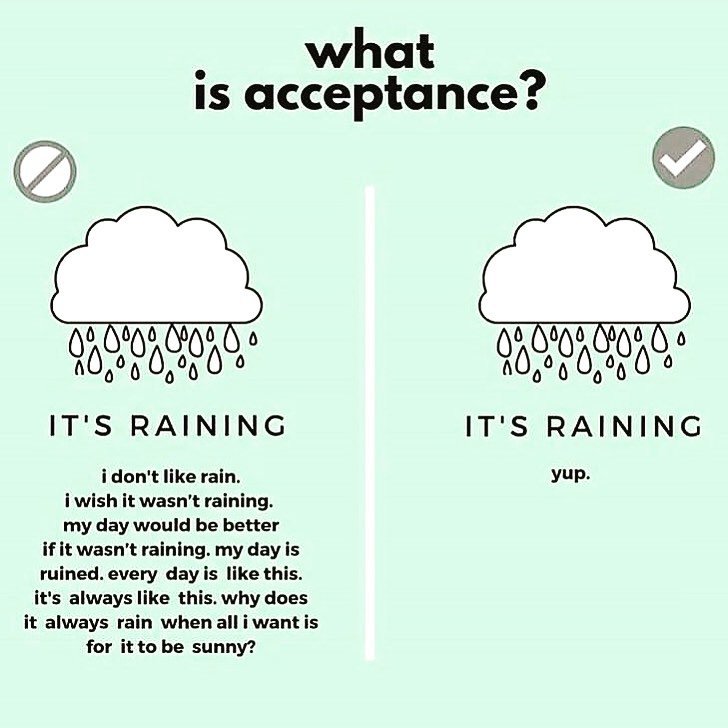
    In the time of pandemic, we have a lot we cannot change. We cannot change the fact that the virus is out there or how virulent it is. We can’t change that we’ve been put under a shelter-in-place ordinance. We can’t change the shortages in the stores.  All we can do is accept.

    But we can change some things. We can plan our shopping to minimize our exposure to others. We can keep our hands clean and wear masks to keep from getting the contagion. We can take care of ourselves physically and mentally. We can spread love through social media. 

    How do we know the difference? After all, there are people out there breaking social distancing rules, some of whom now have COVID-19 and are regretting their actions. Their bravado didn’t change the contagion. Some people are raging at the situation, which is the opposite of acceptance. Knowing the difference requires self-examination and the question “How?” How can my actions change the situation? How can my influence create a new path? If there’s nothing you can do, then it’s time to accept.

    Day 35 Lenten Meditation: Confession

    I consider myself a mystic, but I don’t know whether I believe in the God I’ve been been presented with.


    I struggle. I think of all the expectations we put on God — we pray for riches, for good health, for winning the football game. Then when we get our way, it’s a miracle, but when we don’t, it’s God’s will. It’s almost as if we apologize for God when things go badly.

    I can’t imagine God as a being who goes through the minutiae of our lives — “yes, here’s your keys” and “no, your grandmother isn’t going to survive this heart attack.” Nor do I think God’s taking notes on whether we’re naughty or nice.

    I can’t believe in that God. If there is a God, I imagine a force bigger than all of us, a Gestalt which contains the souls of everyone or everything who has ever lived. When we die, we go back into this vast Gestalt, and are in communion with an existence so pure our spirits laugh and cry, and we are comforted by the Gestalt. I expect there to be spirits of every religion and no religion at all. 

    I believe that God comforts and braces us, and gives us strength for another day. God doesn’t save our grandmother; God gives us strength to get through. God doesn’t launch my writing career; God helps me see where I need to improve.

    So perhaps I believe in God, just not the God I grew up with. God pulls me out of the panic I’m feeling over the pandemic and presents me with my own strengths. God doesn’t help me find the keys; God helps me remember where I put them.

    I confess, though, that I don’t know, any more than anyone else does. Even the Bible is full of allegory and conjecture and translations that obscured the holy and promoted the status quo. Not knowing, I do what humans do and make God into my own image.

    Day 35 Lenten Meditation: Rain

    I could use a good spring rain right now. A real gullywasher, where there’s no question of going out in it unless one wants to get drenched. And then I would go out into that rain and feel it drench me to my skin. 

    There is something purifying about standing in a torrential shower. From the skin to the soul, rain washes away all the dirt of the day. It chills my skin, reminding me that I am alive. 


    Day 33 Lenten Meditation: Love


    What can I say that hasn’t already been said about love?


    The Greeks a long time ago talked about different types of love, which I spoke about on Valentines’ Day. Here they are as a refresher:

    • Agape – love of humanity.
    • Storge – love of family
    • Philia — love of friends
    • Pragma – love which endures.
    • Philautia – self love
    • Ludus – flirtatious/playful love
    • Eros – romantic and erotic love.
    Love, as an emotion, has the power to motivate. Storge motivates us to care for and protect our families; eros motivates us to take the risk to commit; philautia motivates us to take care of our bodies.

    Love has the power to transcend. Agape moves us to do our best for others. Ludus finds us gifting others with our moments of dazzling brilliance — or our clumsy attempts at wittiness. Pragma transcends the ravages of time.

    Love is one of the forces that changes the world. The other is anger; however, anger without love can become destruction rather than creation.

    I’ve said nothing that’s not already been said; perhaps that is the curse of being a writer. But I write with love, and maybe that makes the difference.

    Day 32 Lenten Meditation: Surrender


    This is a difficult column for me to write, because I am the sort of person who wants to fix things, to do things, to make things happen. I don’t like getting into situations where I can’t make things happen.

    I don’t surrender easily. I am convinced that if I beat my head against something long enough, I will accomplish it.

    Some things, however, don’t lend themselves to beating one’s head against something long enough. A pandemic, for example. I sit here, helpless. I can do nothing. I can’t even sew well enough to make masks.  

    This is the point where I have to surrender. I’ll be honest, I don’t believe that God will take away the pandemic, or that it’s His will that millions of people will get this disease. My God, when I believe in him, gives comfort and strength and the clarity for us to use our minds to solve things. So I don’t surrender to God’s will. I surrender to my own imperfect humanity.

    Day 31 Lenten Meditation : Support


    One of the most enduring traits of humanity is its ability to support each other during times of crisis. Just some of the supports I have seen during shelter-in-place are the following:

    • Education units (pre-K through higher education) quickly mobilizing to online without a break, and with sensitivity to students’ needs
    • Textbook publishers allowing free access to online textbooks over the duration of the sheltering
    • Internet Archive offering free access to their library
    • Local Facebook groups helping each other meet needs
    • Outreach by the Instagram cat community reminding us to take care of ourselves (I suppose there are others, but I tune into the cat community)
    • Countless others
    • Harbor Freight’s donations of N95 masks and face shields to hospitals
    • People on social media reaching out to the more vulnerable
    • And so many I’m not aware of
    I’m not counting the millions of businesses, small and large, who are adapting their businesses to face our current reality — online and curbside. The businesses who are adapting their production to fit our current needs. (I’m only not counting them because there’s a profit motive).

    The way humanity gets through these calamities — pandemic, natural disaster, war — is through supporting each other. We much each be supported, and we must each provide support.

    Day 30 Lenten Meditation: Inspiration


    As a writer, inspiration is where the universe and my imagination connect, whether that be the world outside my door or the world inside my head. And where the two interact, sparks fly, and I am driven to put pen to paper and translate the gestalt impressions of the interaction.

    Inspiration is open to all of us, not just creatives. It still marks the intersection point of internal and external worlds even if one is inspired to clean the kitchen or plant a garden. 

    How can we encourage inspiration? We can by being open to the world outside our heads. We have already experienced, and are always experiencing, the world inside our heads. We need something new to reflect on and to ruminate on.

    A change of scenery helps. Sheltering in place during the pandemic makes for a monotonous experience, but one’s scenery can also be changed by reading or watching videos. All that is needed is inducement of the spark by external experience.

    Open-mindedness certainly helps. We all interpret the world according to an inner framework, a set of rules that governs our perception of reality. Don Juan Matus, in Carlos Castaneda’s writings, called this the tonal, but that’s not important. What is is that our inner construct of reality filters our world for us. If we let go of it, even a little piece of it, just for the briefest moment, we can see our world differently and be inspired. 

    Right now, we need to feel inspired. We need to feel that spark to motivate us, whether toward mundane or glorious tasks. Inspiration will help us see our social isolation as opportunity and allow us to remodel our inner and outer spaces to be more creative, more pleasing, and more nurturing.