I am an associate professor of human services at a regional Midwestern university. I am also a writer of fantasy and romance, hoping to get traditionally published. I have one husband and am owned by four cats.
The prompt is, “Do lazy days make you feel rested or unproductive?” The answer is “Yes.” I feel rested and unproductive at the same time.
I’ve been needing a lot of lazy days lately. Not that it’s a hard semester at work, but that it’s a somewhat busy one. I have lots of grading to do, lots of students to visit, and lots of meetings. I jealously guard my free time these days.
Yet I still feel guilty when I take a lazy day. I could be writing. I could be doing housework. How dare I be unproductive!
I relish my lazy days and feel guilty about being unproductive. Not a way to enjoy lazy days. I need to either take the day off and not feel guilty or do something.
I’m tempted to have AI blog for me today, because I’m tired from lack of sleep. But I would never do that, because I know what generative AI is: a plagiarism of what’s available on the Internet.
Artificial intelligences such as Chat GPT are “trained” on Internet content. That means the AI studies composition, word usage, style, and content. It captures the writing itself and uses it in other combinations for its own work. What makes my writing unique is my choice of usage, style, composition, and content.
I’m a writer. I don’t like that generative AI can take my work and make it theirs. It seems like an appropriation of my creativity and that of others. I especially don’t like what it does to visual artists, because stealing pieces of images seems more blatant than just stealing words.
Somewhere, an artificial intelligence is scanning this and putting the information in with other writings it’s scanned. And maybe it will spit it out verbatim into someone else’s writing. I don’t know, and maybe that’s the worst part.
I don’t think I felt like a grownup until I hit my late 50s.
I’ve spent much of my adult life exuberant, incautious, playful. Despite the Ph.D. I was the one who laughed when I heard something funny or delightful in a meeting, who walked barefoot in rainstorms, who gravitated toward the carousel. It wasn’t that I was immature; it’s just that I didn’t reject childish ways.
This has only changed in the past few years. I don’t seem to have as much curiosity, as much glee in just living. I’m cautious, almost fearful, as if I can see all the ways in which things could go awry. I seem to have become staid. I am disturbed by this. I feel like I’m missing an important part of me.
Maybe (probably?) I have been a grownup all along, but I’m now missing this aspect of myself that tempered all the work it took me to get a Ph.D. and tenure. I want my childlike character back; it could help me through the aches and pains of old age.
I have been putting off writing. This is surprising because it’s my flow exercise, the thing that keeps me going. Still, I haven’t written in days. I can tell that I’m reaping the effects of not writing in lower well-being and some anxiety attacks.
Why am I not writing, if it’s such an important thing for me? Frustration with my stories. I don’t like where either of my stories are going, and I don’t know how to fix them. So I’ve been avoidant.
I feel like I need to start a new story, that my current stories are so flawed that I can’t continue. But I don’t feel inspired for a new story. I’m not sure what to do.
It’s probably a day for free-writing. I keep saying this, but I keep putting that off as well. Time to quit procrastinating.
Me-Me, my seventeen-year-old kitten, died yesterday afternoon. She had been aging for a while, going through what looked like a bout of feline senility, so it wasn’t unexpected.
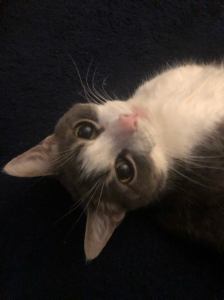
We adopted her as a kitten from the neighbor’s. One afternoon, there was a knock on the door and my husband and I answered it to two little girls who wanted to know if we wanted a kitten because the local tom had killed all the male kittens in the litter and they wanted to save these kittens. I decided on the grey-and-white kitten, and we named her Me-Me, because she liked to be the center of my attention.
Meemerz was a one-person cat for much of the time, and that one person was me. She would hiss and bite Richard, until one day she warmed up to him and became our cat.
She was always a bit — flaky. Ditzy. Flighty. Spacy. Whatever word you choose to denote a cat who seems a little … vacant up there. She wasn’t cognitively impaired, just an airhead. Like she didn’t have a thought in the world. We imagined her saying things like “Why are clouds?” and “Food?”
This morning seems a little empty without my geriatric cat sitting on the couch.
What do I do when I don’t like where the story is going?
I have this problem with the two works in progress that are not currently in progress. One of them has a main character problem. The main character is a cipher, which is as it should be, as he is keeping a big secret. The thing is that the progression of their relationship seems vapid as a result. Which it might well be, given that he’s keeping a secret, but it’s not good storytelling at the moment.
The other book? The plot got so convoluted that not even I know what’s going on. Why are they going to the planet where they expect the bad guys to be waiting for them? I’m not sure I’ve given them compelling reasons to do something this stupid.
So what do I do? The first thing I do is avoid writing for a while. This is obviously not a good strategy, but this is a blog post about what I do, not what I should do. I’m edging toward the end of my writing hiatus, so I have to try the next step.
Next I start doing some writing exercises. I need to interrogate the two characters in Walk Through Green Fire, explore where they’re at right now and how they feel about it. Interrogating the character is interviewing the character, except for the tricky part that they don’t exist. It helps me get into the character’s motivations.
Then, hopefully I’m in the space to write. If not, I abandon the book and start on another project. I’ve already done this with Walk Through Green Fire once. It may be a fundamentally flawed work, I’m not sure. Or something I’m not willing to write because reasons. In which case, I need to find a new novel. Maybe it’s time to do the Kringle novel for this year.
I remember life without computers, because I grew up in the Sixties and Seventies, and the first DOS computers came out just before I went to college. DOS computers didn’t have the Internet or beautiful, intuitive interfaces, and composing a letter on one meant staring at a black screen with green letters. I used a typewriter to type my masters’ thesis because attractive typefaces were a blip in the future and things typed on a computer looked like they had been typed on a computer. And I was one of the more computer literate people I knew.
I would not want to go back there. I didn’t write a novel because it would have taken tens of hours to search for information on desert flora and fauna. I knew American deserts weren’t made of sand, and that’s about it. Years later, after the Internet, I wrote the novel with information I found on the Internet in mere minutes. I use the computer to communicate, to entertain, to research, to compose. My life without it would be difficult and tedious.
On the other hand, expectations of quality and speed were less back then. The one typeface of a computer was acceptable, and the time limitations of snail-mail were tolerable. A writer could get away with fewer books written further apart. My expectations, though, are shaped by the era of fast, aesthetically pleasing, versatile computers that expand the limits of what we produce.
Life without my computer would be tedious and bland. I don’t want to go back there.
Sierra DuBois doesn’t know what to do with the Grinch thrown into her holiday gala plans. It doesn’t help that the Grinch is the sweetest guy she’s met in Rolling Hills. Wade Nelson, the Grinch, finds himself getting into the role — and Sierra, the event planner. He’s a nerd with a side of geek, and she keeps a secret she feels is a deal-breaker. For two people worried about their baggage, it will take much honesty and some Santa Magic to get to a happily ever after.
I don’t think most of my readers go for Christmas romances, but give it a try. It’s a light romance with the trappings of the Christmas season, Hallmark as if a geek girl had written it.
The question comes up in inspirational writing, as a prompt on the Internet, as a thought piece. ‘What’s something you would attempt if you were guaranteed not to fail?’
I have a list. An endless list. Why would I squander the opportunity to accomplish things?
My list starts with ‘get traditionally published’, with an agent and everything. I would be crazy not to try for that if I couldn’t fail. ‘Try for full professorship’ would be second, although I would have to do more important research if I wanted to do that. ‘Skydive’ might be the third, but I’m not sure about that, because I do have a fear of hitting the ground. But I wouldn’t fail, so what would there be to be scared of?
Learn carpentry. Walk the Illinois-Michigan Canal trail (that would take a lot of work getting ready, but if I can’t fail — ?) Clean the house, I mean REALLY clean the house, which can be overwhelming. Kiss Viggo Mortensen.
I’m just getting started, but I’ll stop for now. You don’t want to read the full list.
I think about this question a lot lately. Between teaching a disaster psychology course and thinking about the aftermath of the hurricane on America’s southeast portion, the vision of devastation haunts me.
I have too many possessions, some of which are junk that I haven’t bothered to throw away. Some possessions are useless kitchen gadgets, some things I have intended to use someday. Some are collectibles I treasure, some are items for everyday use.
If I lost all my possessions, I would mourn. I would mourn the symbols of my life, the house and the collectibles and the sentimental items. This is typical for someone who has lost everything.
Then, eventually, I would attend to the practical matters of replacing the items in my life. I have homeowners’ insurance with a replacement cost rider, so I would receive the amount of money it would take to replace my possessions. I would own less, focusing on the necessities. I would not have the antiques anymore or the sentimental items, but I would have what I need to function in my life.
I suppose I would always mourn a little. But, like disaster survivors do, I would learn to live with the new normal.



















 Words Like Me