Long Break

I haven’t gotten back into my writing routine, and that worries me.

Maybe I’m tired at the end of the day, facing new classes and old challenges. It’s more likely to be that I’m stymied about my current writing projects, pantsing projects that seem more often than not to run themselves into walls.

Maybe I need a break from writing right now, but I’m afraid my break is going to turn into a forever break. I can’t believe that a couple months ago, I said that writing was my flow activity and I could never see myself not writing. Right now writing is not flowing at all, but jolting like riding a bike with square wheels.

I know I’ve written this before. Many times, in fact. This time is not different. I will get over this.

If I Were a Carpenter …

Daily writing prompt
What skill would you like to learn?

I have always wanted to learn carpentry. I think it would be a satisfying skill to have because it’s very useful. Building furniture and boxes so I didn’t have to buy them? I would love that.

Assorted work tools on wood

My dad made me a cabinet from a packing crate and scavenged glass from old windows. It’s beautiful. I’d love to make something like that.

What’s keeping me from becoming a carpenter? Very poor proprioception. What does that mean? It means that I have very little sense of where my body is at in space. I sometimes sit down and miss the chair. I have been known to smack myself in the face. Life with poor proprioception is a bit challenging. Carpentry with poor proprioception? Tragic, because carpentry is fraught with very sharp objects, some of which whirl at high speeds.

In addition, I have poor hand-eye coordination. There’s no guarantee that saw is going to end up where I intend it to go. I’m likely to run it over the hand I don’t know where it is (see above).

Therefore, my choice not to learn carpentry is an exercise in self-preservation. I like my limbs where they are, thank you.

My Creative Mind

Daily writing prompt
What’s the trait you value most about yourself?

Without my creativity, my world would be a much less interesting place.

Tangled line leads to yellow light bulb, creative idea. Problem solution, concept. Think differently. Leader and success

Creativity comes into play at every point in my life. Solving a problem, writing a homework assignment, making a decision — these are rational pursuits, but how I solve them requires my creativity. I must turn the thing around in my mind, thinking about the angles of the pursuit, and my mind looks for the most elegant solution.

Other activities, such as writing, designing my book covers, telling stories, obviously use creativity. These are part of what make my life worthwhile, so I can’t overestimate the importance of creativity to me.

If I lacked creativity in my life, I would not know what I was missing, but my life would be less rich. I would be minus the method by which I attack life’s challenges.

Storytelling in my Family

Daily writing prompt
What aspects of your cultural heritage are you most proud of or interested in?

For an American, this is a tough question to answer. In the US, when someone asks this question, the answer often involves cultural heritage of one of our strains of ancestry rather than dominant American culture. We do not see US culture as culture but as the default against which our ancestors’ cultures play.

For example, people in the US talk in terms of hyphenates. They are Greek-American, Polish-American. African-American. Or they say “I have German ancestry”. The people who say this often experience their cultural heritage at holidays or in public festivals, or they live in an enclave where many people with that ancestry live. They notice differences from their classmates growing up; their classmates didn’t eat olebollen or pickled herring on holiday.

Which brings me to what I like about my cultural heritage. I am, like many Americans, a ‘mutt’. I have German, Dutch, Polish and Irish on Mom’s side and French, German, and probably Welsh on Dad’s (among others), according to Ancestry.com. Of these, I’m most cognizant of the German/Polish on Mom’s side and the French on Dad’s. The German/Polish on Mom’s side was a matriarchy of sorts that tried to ignore the Polish ancestry for bewildering reasons. The French on Dad’s side was what is known as ‘trapper French’, or the Canadian French who lived through hunting, trapping, and trading wild animals.

What I really like about my cultural heritage on both sides is the storytelling. The storytelling techniques of each side of the family are totally different, which is why I feel there’s a cultural component. My father’s side of the family told hunting stories with escapades often fueled by alcohol or naivete. Very often the stories started with “Do you remember when …” and end in an absurdity. For example, “Do you remember the time when Ronnie shot the owl up the tree? He ran up to Larry and said, ‘Hey, can you help me get this rabbit out of the tree?’ Larry looked up and saw a dead owl. ‘Ronnie, that’s an owl.’ ‘I wondered how that rabbit got up the tree.'” It’s funnier in person, honestly.

With my mom’s side of the family, the stories often involved word play or other witticisms, and often featured my grandmother as the ‘straight man’ in the joke. My grandmother was confronted with her seventeen-year-old daughter Marie, who said, “I’m going to marry Wayne.” “You can’t marry Wayne,” Grandma said. “Then I’ll elope.” “You can’t elope.” “You watermelon!”

I tell the stories of my family on occasion. I also tell my stories in their ways. One story, as it spread across my peer group, became a friend’s anthropology project in a class. Others can be evoked by their punchlines.

Cultural heritage is a complicated topic in the US, but I can find mine in the stories I have grown up with and the stories I tell.


Not Brands, but Reference Groups

Daily writing prompt
What brands do you associate with?

I don’t associate with any commercial brands, but I do associate with what this question is getting at.

I don’t believe people associate directly with brands, except perhaps with trucks — there are “Chevy people” and “Ford people” in the US, and a few deranged “Tesla bros”. People associate with reference groups, which they use to identify themselves as a part of. This is something I learned in a consumer behavior class many, MANY years ago.

Bangkok, Thailand – April 16, 2022 : Stanley of pink stainless steel thermos travel mug to keep the drink warm or cold. Stanley Go Vacuum Bottle 12.5 OZ

Reference groups can be associative — “I am a member of this group”. For example, one of my reference groups is “college professor”, which makes me prone to buying gas-efficient vehicles and Starbucks coffee. Reference groups can be dissociative — “I would not be caught dead being a member of this group”. I am vehemently not a member of the reference group that listens to Kid Rock and drinks Budweiser beer. Last, they can be aspirational — “I would like to be a member of that group.” I would like to be a member of the upscale ecologically conscious consumer who has a home composter and a butterfly garden landscaped by someone else.

We buy brands because of their association with reference groups, because we want to be a member of that reference group. We refuse to buy certain things from our dissociative reference groups. We don’t so much say “I’m a Ford person” — unless we’re talking about trucks, and even then, we buy them largely based on our perceptions of who’s in that group. I will excuse myself to drink my home-roasted coffee, which marks me as part of the aspirational group “coffee snobs” now.

Ten Days till Publication!

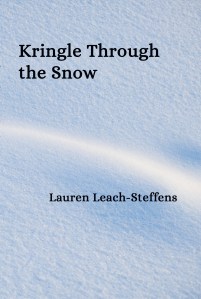
Ten days till I publish Kringle Through the Snow! As the link says, it’s on Amazon Kindle, available as e-book and paperback.

I’m proud of this one, not surprisingly. (I could say that about any of my books). This one involves a genuine nerd, Wade Nelson, who falls for his neighbor, Sierra DuBois, who is a successful event planner. Just as their romance is progressing, Sierra’s sudden change of heart leaves them estranged. It will take good communication and some Santa Magic to bring them back together.

What I like about this story are the characters. Wade isn’t the stereotypical nerd who plays Dungeons and Dragons. Yes, he plays Dungeons and Dragons, but he’s not the unwashed stereotype. (Stereotypes aren’t cool). Likewise, Sierra isn’t your stereotypical Type-A event planner, although she is driven to excel. They, like my other characters, are a bit quirky and not what you’d see on the Hallmark Channel.

Maybe that’s the point. My Kringle Chronicles romances feature protagonists who usually get relegated to the role of quirky sidekick in other stories. Nobody is the homecoming queen; nobody is a millionaire. The wish fulfillment doesn’t have to include wishing you were someone more impressive.

Remember, the book comes out ten days from today. And if you have a hankering for a signed version, we can arrange something.