A Touch of Darkness

I shy away from writing about dark subjects in my blog. It’s strange because I’ve had several dark times in my life. I don’t want people to think I’m pandering for attention, even though the reason writers post their works in the first place is to get attention.

 I won’t write dark for dark’s sake, nor will I use gratuitous trauma as a shortcut to character development. Yes, someone’s past will contribute to their character. But I won’t use trauma as the only character trait or even the main one, and only if it’s pertinent to the story. (See also the “fridging” phenomenon—killing a girlfriend character to motivate the main male character.)

Photo by Pixabay on Pexels.com

Writing about dark topics in my stories is something I must work my way up to every time. For example, the body count in Apocalypse. I had trouble killing anyone, but a developmental editor told me that the last battle had to look hopeless, so I killed eight characters. I also, ironically, edited that book for gratuitous darkness because I had tried the cheap way to make it darker.

Sometimes an entire book is dark. Carrying Light, one of the two I’m currently writing, is a dark novel, being that it’s written at the cusp of the collapse of the United States. Apocalypse is dark, because the fate of humanity hangs in the balance. But it was hard to write these dark enough at first.

In the end, I think darkness needs to balance light. That’s just me; I know there are people who write dark all the time, with lots of death, depersonalization, and alienation. I can’t write there, because all my writing adopts a quote from ee cummings: “The single secret will still be man.”

How It’s Going Book-wise

Kringle Through the Snow is going pretty well. I keep writing on it, and it’s lively and fun. Sierra and Wade are about to have a nice evening analyzing The Grinch. And sitting next to each other on the couch because Shadow Lord, the immense Newfie, will take up the rest of the couch. Shadow Lord has an agenda.

Carrying Light is languishing in the bottom of my To Be Written pile. I just don’t know why that isn’t flowing, except it has nothing to do with characters. I don’t think it is plot. It is picky little details, like “Where is Janice going to work if the gift shop is no longer open and she’s getting no orders for pottery?” I feel sorry for Janice, but the collective can’t fix that problem for a while, for the good of the plot.

Photo by Matheus Bertelli on Pexels.com

Okay, one book at a time, 750-1500 words at a time. I’ll finish the Kringle book first, then worry about Carrying Light. Oh, and fix the other book, the one I want to publish in December. Who, me busy?

Playing with the Pen

According to National Pen, handwriting has benefits over typing. From higher cognitive engagement to memory recall, the slower process of handwriting engages the mind more. Admittedly, National Pen may have a bias, given that they’re in the business of selling pens. However, a recent report in Frontiers in Psychology spells out similar findings.

As a writer of novels, I find writing 70,000 plus words by hand painful (literally — arthritis) and the thought of typing all that handwriting into its necessary digital form is daunting. I foresee handwriting the first draft of a novel doubling my process time, and I don’t feel like my writing is suffering that much by typing the story.

I think there has to be a way I can harness the power of handwriting. I used to do free writing when I was stuck with a scene or a character, and I haven’t done that as much recently because I haven’t felt I needed to. But what if I free-wrote before sitting down at the computer as a general practice, to gather my thoughts and project them forward? A writing ritual?

Photo by Ylanite Koppens on Pexels.com

My husband bought me two composition books to start the ritual. I have fountain pens to write with, which gives this more of a ritual air. The idea is to consider and write about the upcoming scene and free-write, then see if it makes getting those words more smooth.

I’ll let you know how it goes.

Animals in Writing

Every now and then, animals find their way into my writing. The current book I’m writing, Kringle Through the Snow, has a highly intelligent Newfoundland named Shadow Lord. The other book I’m writing, Carrying Light, has the preternatural cat Bergeron. The last book I wrote, Kringle on Fire, has a not-so-bright orange cat named Doofus.

At this point I’m supposed to talk about why I put animals in my stories. I think humor is a big part of it. Shadow Lord is so big and so well-behaved, yet he still detains Sierra long enough for Wade to talk to her. Doofus loves everyone like a drunken bro, even the child in the middle of his terrible twos. Bergeron flies — sometimes causing a traffic jam, in front of people who are not to know of her existence.

If I had to find a similarity among these pets, it’s their ability to communicate with humans. In pet-like ways, of course. Except for Bergeron, who speaks with telepathy to other telepaths. How many of you would like a telepathic cat? I’m not really sure myself. How many interruptions a day would I tolerate, especially if the transmission is “I’m starving! I can see the bottom of my food dish!”?

Photo by Pixabay on Pexels.com

I should mention that another reason to include animals is because it makes protagonists look more soft-hearted. Unless the pet is a wolf, and then it accomplishes exactly the opposite.

Animals as characters can make for fun in writing and in reading. I’m going to have to write them in more often. Kittens, anyone?

Using Templates to Shape a Book

I use templates to remind me of the shape of a book as I’m writing it.

Templates are scripts of a sort that one can use to structure writing to fit readers’ expectations. Readers expect a story structured such that the action rises to climax and then subsides. Other techniques can be added to this, such as interactions between a character and other characters to highlight tensions.

Well-written book guides offer plotting systems. Save the Cat Writes a Novel is an example of one, and one I highly recommend as a method to organize one’s plot. But I go one step further with templates that writers can load into Scrivener, the writing software I use.

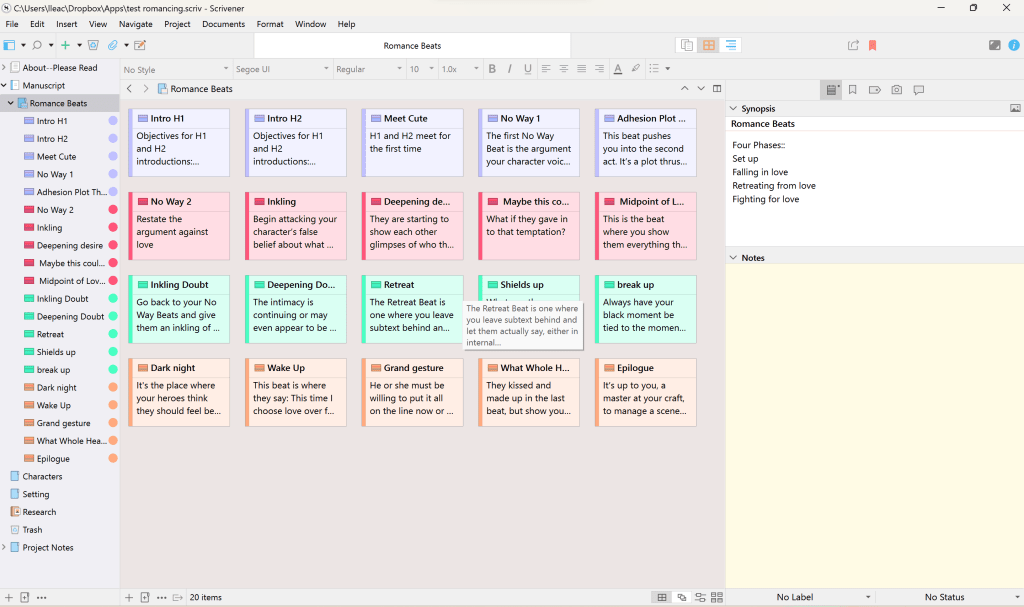
One of these is Romancing the Beat by Gwen Hayes. In twenty chapters, she lays out a romance novel’s structure with uncomplicated prompts for the reader. For example:

The column at the left shows the chapter outline with evocative titles. In the notecard view here, you can see each chapter’s prompt. When you are in chapter view (writing the chapter), you will see the full prompt in the upper right corner area called synopsis (seen below).

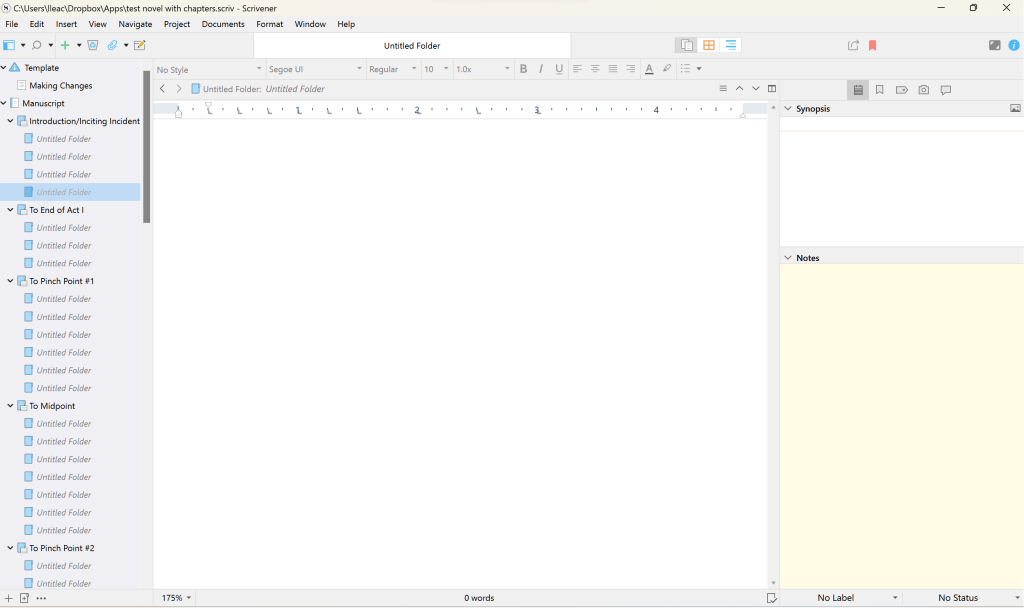
This is my go-to for writing romance novels. My go-to for writing fantasy novels is a template that no longer can be found on the internet (or if you can find it please let me know so I can give the writer credit). It’s based on the timing of Save the Cat templates, but it does the math for you. It looks like this:

In the left-hand column are the basic parts of the book, and the number of chapters is their relative weight in the book. Given roughly equal chapters, these distributions of chapters should give you the recommended pacing.

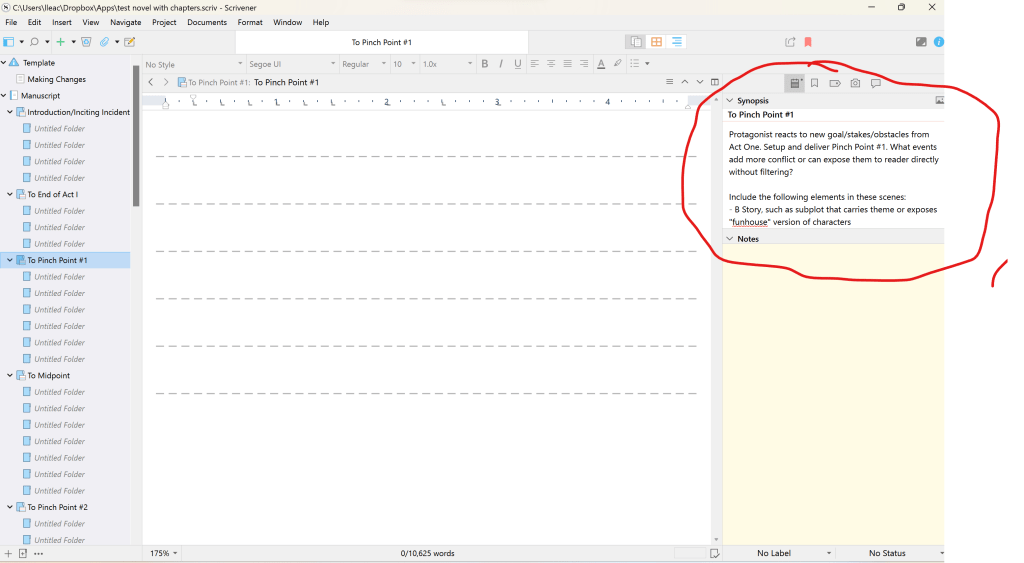
The template also gives guidance:

At the far right, there is a description in each section for what should happen in a section.

These are the templates I currently use for writing. I like using templates because I’m a plantser — someone who likes some structure but likes to flow within the structure. These templates allow for that. I write my chapter synopses within the guidance of the template and I’m ready to write.

Realism in Fantasy

I write fantasy romances and romantic fantasies. Obviously, fantasy is part of what I write. But does fantasy mean unrealistic?

Not really. Fantasies have their own internal rules so that they don’t stretch realism past incredulity. For example, any magic user will not be invincible — that will make the story unrealistic. The character has to have magic for a reason, which the writer can reveal as simply as “he’s a magic-user” to a long, descriptive back story.

There has to be internal consistency to the magic system. Readers will balk at inconsistencies, especially convenient inconsistencies that favor the hero or villain. If you defy gravity, do so consistently.

I write contemporary fantasy, which means a lot of realism as modern culture, geography, physics and the like. So there’s a lot of reality around the fantasy, but I still have to make sure there’s some internal consistency in the structure. Nephilim fly, Archetypes teleport. Humans don’t get more than one gift from the trees. Archetypes can’t teleport split-second and everyone’s gifts have practical limits. Gaia’s presence does not pass beyond the borders of the Garden.

World-building accomplishes a lot of these rules and boundaries. I do a lot of world-building in conversations with my husband in conversations like: “Do you think Forrest can knit wool if he can knit bones together?” (We decided yes.)

Fantasy is more fantastic when there’s a point of reference, when there are winners and losers (even with the possibility to change in the story), and no power goes completely unchecked.

Photo by Pixabay on Pexels.com

Writing in the Winter

It’s been cold, windy, and snowy. We haven’t had a winter like this for a while. I’ve felt snowed in lately; I haven’t spent time at Starbucks for two weeks. I blame my difficulty in writing right now on this.

My personal sanctum at home is not available to me either. Ever since I got a new computer, the dock to the dual monitors no longer works. And there’s the fact that my darling Me-Me peed on my old computer in there and I’m afraid of the waterworks once more.

What I’d like is some time at Starbucks. Preferably with my husband, so I can talk things over with him. Someplace with noise, with people. I need noise to write, which is why I’m probably ADHD (I’m serious about this; no one has diagnosed me but I do not sit still well).

I sound cranky. I am cranky. What to do?

Photo by Allan Mas on Pexels.com

New Computer

After the incident with the cat peeing on my Surface, and wrestling with a used replacement Surface, I wanted a new computer for my work on books (writing, editing, formatting, creating covers, creating advertisements, etc). The computers I was working on were over three years old, and I could see their end-of-life coming soon.

So, confronted with a $500 off sale on out-of-box Galaxy Book 3 Ultra, we bought it. After a day of playing with it, I have a few observations:

  • Out of the box, it’s heavy. The specs said 4 lbs, but they forgot to mention the weight of the power brick, which is a metal power adaptor that, if thrown, could kill someone. It is apparently lighter than its direct competitors (mid-level suitable for most graphics tasks).
  • It has one TB storage and an i7 processor. And a graphics card. So it’s set up for the graphics I do (designing book covers and advertisements). I might push my knowledge base further and see what else these graphics are good for (within my meager ability).
  • The screen has visually stunning clarity. The book covers my niece designed for me positively glow on it. I’m hoping this clarity reduces eyestrain.
  • It’s fast. See also i7 processor. (I suppose I could have gotten the i9 model, but it’s too expensive and I don’t know if my skill level deserves that power).
  • It doesn’t have a touchscreen. Why would it? It’s not a tablet like my Microsoft Surface was. To be honest, I never used my Surface as a tablet. But I used the touchscreen when the Surface got one of its occasional glitches.

So far, so good. No weird glitches (as I have suffered with a few times on the Surface.) Working smoothly. Looks great.

Time for me to go play with it some more.

Getting to Know My Characters

I occasionally throw my characters into other situations where they have to have a close interaction with another character. This is the way my characters teach me who they are. These also become short stories to be included in short story collections (such as Stories Within Stories, which will be out January 1st.)

For example:

  • What does a vision quest look like in a big city?
  • How do two enemies interact when one is having a very bad day?
  • How do two characters navigate a cultural divide?
  • How do a human and an immortal negotiate having a child?
  • How do you confront a mythical creature?

There are hundreds of ways to write these, and I’ll argue that what really determines where the story goes are the characters. Two enemies that have millennia of conflict may have a rapport. How to confront that mythical creature may depend on whether it has kidnapped your grandma — and, for that matter, whether your grandma can take care of herself.

The thing, though, is that not only do the characters make the story, but the story turns around and makes the character. I learn new things about my characters from writing these stories, especially things like their vulnerabilities and idiosyncracies. Things that make my characters real.

I need another story to write!

Photo by Taryn Elliott on Pexels.com

Author Fair

My local library is going to have an Author Fair this weekend, and I will be there. In fact, I will read an excerpt from one of the Kringle romances; I still haven’t figured out which. I’m tempted to read from It Takes Two to Kringle. In this scene, a beleaguered junior faculty member discovers that the attractive man who treated her to coffee is a Christmas fanatic who will create extra tasks for her. I’m going to have to figure this out by Saturday morning.

Author fairs are unnerving. I have never sold over three books at an author fair, because I’m an indie writer and my novels are quirky. My male leads are college professors, professional Santas, and pacifist warriors. My female leads are college professors, accountants, and former labor organizers. The immortals are not elves or angels, although they’ve been mistaken for both.

So I sit there and watch people walk by, and sometimes they stop and peruse. Sometimes I get to answer questions, and I feel like anyone could answer these questions better than me. But despite my impostor syndrome, I enjoy getting questions. I just wish I was more articulate on the “summarize the plot” questions.

Photo by cottonbro studio on Pexels.com

So I’ll be setting up Saturday morning for a two-hour session with my books and my table trappings. Wish me luck!