I didn’t have to deal with failure in my childhood (except for those crushes that were never requited). I wasn’t quite a child genius, but I was gifted. I managed to get to college almost entirely on scholarships including a National Merit Scholarship. I got on the honor roll despite the most perfunctory study habits.
I came to failure late and hard. Particularly in submitting my writing, particularly novels. I have received enough rejection to paper my room.
Don’t take it personally. If I have given my best, after reading guides on how to write, writing, editing, beta-reading, revising, and the like, it’s probably that my writing doesn’t fit the agent’s list or the journal’s theme I have learned, for example, that my poetry is not High Concept, as it doesn’t get published in high concept journals. This doesn’t surprise me because my Ph.D. is not in English/Creative Writing. My short stories are also not High Concept, being firmly lodged in the category of fantasy, romantic fantasy, and space opera. There are some places I’m more likely to get published in than others.
See what you can learn from it. I have had to grow as a writer by asking myself, “What is the takeaway from this?” I had to get rid of my perfunctory habits once I realized that one didn’t turn in one’s first draft (in my defense, it had very few grammatical or spelling errors). I read a lot of material on writing because of rejection.
Sorry I’ve been gone for almost a week, but I’ve been busy with Camp NaNo. I’ve been putting 3 hours a day in editing Reclaiming the Balance, which means almost no free time to journal. Today I will make my 30k goal for camp, but I will likely continue editing once I’m done with the goal, because I haven’t yet gotten Reclaiming the Balance where I think it can be.
I’ve done a lot of editing lately between Gaia’s Hands and Reclaiming the Balance, but these are a couple of my first books, so it’s expected.* I’ve learned much about writing novels from editing previous novels and don’t want these past novels to go to waste because their characters deserve to see the light of day.
So what have I learned about writing from editing? Let me think …
Structure really helps guide the reader and satisfies their expectations. I use two systems now:
And some things I’ve learned about editing from editing***:
Sometimes I have to cut one of my favorite scenes or chapter because it didn’t fit the flow of the book. This happens more if I didn’t use a structuring scheme
Sometimes a sentence that made perfect sense to me when I wrote it makes no sense when I read it later
I need help — developmental editors, sensitivity readers, beta readers.****
* I’ll admit that both novels are basically romances with somewhat “non-standard-reality” plots. I really don’t know how to classify the fantasy version. Contemporary fantasy? Magical realism? I certainly don’t write elves, sword and sorcery, or vampires. I like to think of my stuff as anthropological fantasy.
** The collective featured in Apocalypse, Gaia’s Hands, and Reclaiming the Balance has 60-70 members given the time period. Apocalypse was a third-person omniscient point of view. I had to pare point of view characters to about 9.
*** I’ve learned more than I’ve written here (action verbs, some description, because vs since, transitions) but those are more about words than writing
**** I proofread really well after the second or third pass, so copy editors and proofreaders are not on my list. They might be on yours.
PS: If anyone can help me with the footnote add-in (Easy Footnotes), I would greatly appreciate it!
I want to remake myself. This is the reason I think I try so hard to get published, because I want to think of myself as an author. It would give me an identity beyond the one I have currently (professor) that I will lose when I retire.
It’s not a good reason to write, but I think it’s a fine reason to try to get published. I think remaking oneself is a noble pursuit, unless one is trying to remake oneself as Harley Quinn (As opposed to Harley Quin, for all you Agatha Christie fans).
I admire people who make themselves and remake themselves, flowing with the changes in the world. On the other hand, I believe that my writing is good and worthy of publishing, but I’m not apparently writing what agents want. Changes to flow with. Do I learn how to promote myself better and self-publish? Do I try to tailor my writing to the market — no. Then it would not by my writing. I will not remake myself by becoming someone else.
Have I already remade myself? I have written five or so books — Kringle in the Night, The Kringle Conspiracy, Apocalypse, Gaia’s Hands, Reclaiming the Balance, Whose Hearts are Mountains, and Prodigies. Ok, that’s seven, not five. I have put them through developmental editors and (most of them) through beta/alpha readers. One of them (The Kringle Conspiracy) has been self-published. Maybe I am already an author. Maybe I have remade myself.
This is the question every writer gets asked. Usually the response is vague dread, because many of us don’t know on the spot where we get our ideas. The answer comes only after a good session of introspection, and at the moment the question gets asked, we can’t reflect on the question rapidly.
Over the years I’ve done this introspection, and these are the answers I’ve come up with:
From other books I’ve read. But I need to be careful not to plagairize.
From dreams/daydreaming. This is my favorite source. I often take a dream and interpret it using Jungian methods, which I call interrogating the dream.
From conversations with my husband, which often start with “What if?”
From observation. I don’t know if I’ve ever written a story entirely from observation, but scenes and characters often come from this
From what I’ve written previously. Sequels!
Sometimes I don’t have any ideas. Right now I feel like I need to write a new novel (after revising a couple) and I don’t have any ideas. Ok, actually, I have three ideas based on series I have going, but I don’t know how excited I’m getting about them. Not all ideas are workable:
One of the books would require living in Poland for at least three months to get the flavor of the place. I have no money, no knowledge of the Polish language, and no tour guide.
Another which is part of my Archetype universe, and for some reason it’s not grabbing me.
Yet another in the Archetype universe that’s too nebulous to write about.
I think I need some dreams or daydreaming right now to inspire me. My dreams last night were stupid and not worth writing about. In my dreams, an actor friend of mine got a nose job and I got really angry because he had succumbed to dominant culture beauty standards. That’s it. Unless I’m writing a warped version of The Picture of Dorian Gray, I don’t see much use in this dream.
I have a somewhat tenuous relationship with time, and nowhere does it show up more than when I’m writing. Even though I write fast-paced plots that run over a few weeks or a month, I lose track of the time and suddenly two different plot points are happening at the same time.
I used to sit with a calendar and make notes on the Scrivener file, chapter by chapter, but then I didn’t get the full picture; I had no one document where I could look at the whole timetable. And flipping back and forth between chapters makes it hard to remember the sequence.
Then I discovered Aeon Timeline, a program that helps you organize a timeline by chapters or individual events, characters involved, and other potentially important characteristics. It organizes itself around two concepts: events and entities.
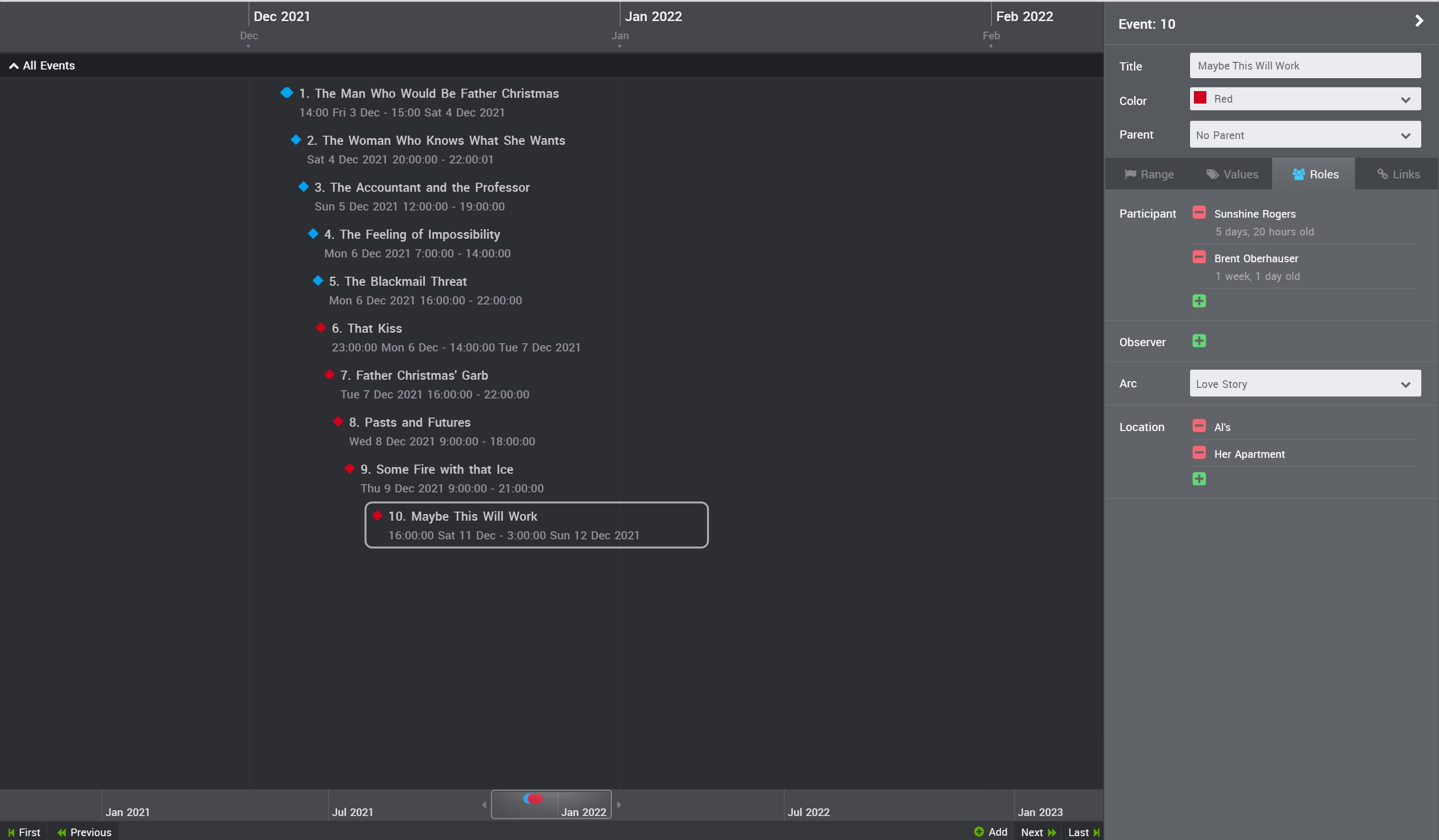
Here is a screenshot of my current project:
On the left, you can see the timeline. In my case, it’s color-coded to match a template I have for romance writing. On the right, you can see an event (the one highlighted on the left). On the event side, you can see at the top the event data — title, color, and parent. I do not use ‘parent’ because it ties everything to a preceding event and my mind doesn’t function that way. Below that to the right there’s data such as participants and observers, story arc, and location. Those are used as sorting prompts, and I haven’t found myself gravitating toward that function yet.
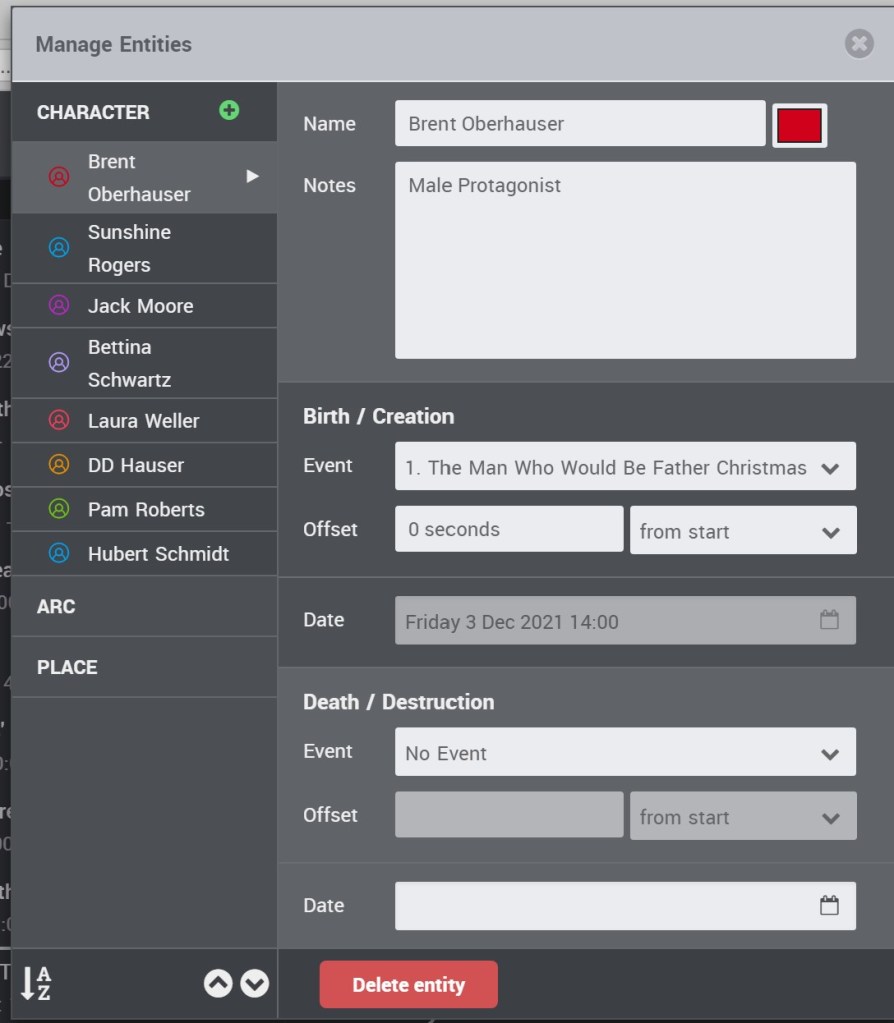
Below is what the ‘entity’ window looks like:
This is the ‘manage entity’ window. You can add entities here (to add anywhere, click a ‘plus’ button) and edit them. I recommend using this box rather than the ‘add entity’ box because you can manage things better here. Note on the left the window will also let you define story arcs and enter different places.
Notice I don’t use the birth/death blanks because I’m not writing epic fantasy. If I ever make the unified timeline for all my novels, I could use that. (But it would be an unwieldy timeline spanning 6000 years.)
The good thing about Aeon Timeline (to me) is that I can see that timeline, and in making it, I can ‘feel’ that timeline. I often make it after writing the book in my proofreading stage. This is probably the wrong way to use it. If I set it up before, I could actually import it into Scrivener (my writing software) and the timeline would show up. Somewhere. I have to try that.
The bad thing about this is all the data entry. I feel possessed to put in all the entity data and use all the categories when developing the event, and this can be a lot of work. Being a plantser (planner/pantser) writer, I don’t know that I would know all the events before using this tool such that I could use it at the beginning. I would advise to enter what is needed and leave the other bells and whistles alone.
I’m halfway through entering my Christmas romance for the year, Kringle in the Night, as I edit it one more time to make it ready for the Christmas season. It’s helping greatly. I’ll let you know about the Scrivener integration later.
I will be participating in #PitMad again on Thursday.
#PitMad is a semi-annual Twitter pitch contest for writers. Writers pitch their books in one tweet, and they get three tries to tantalize agents and publishers with their pitch. Hopefully, an agent/publisher sees a pitch they like and send a request for a full manuscript, which is the first step to a pathway that may lead to traditional publishing.
I have three different books I will be pitching right now, and I hope that I will have luck this time. I’ve rewritten the pitches from past #PitMads, so they’re fresh and new.
Here are my pitches:
Adam and Lilith, star-crossed lovers in a 6000-year-old play, meet again at the brink of apocalypse. Humanity’s fate rests on a collective of pacifists facing immortals and their armies. Lilith’s life is at stake – and if she dies, so do all women on earth. #A #F #FTA
Anthropologist Anna Smith crosses the war-torn remains of the US to chase a legend. Amidst attempts on her life, Anna finds her past entwined with the story she found. Who she is – old and new – could be the key in stopping genocide. #A #F
Dr. Jeanne Beaumont’s life escapes logical, scientific notions – there’s a monstrous vine in her lab and a man half her age courting her. Josh Young sees his crush naked in a vision of a riotous garden. Together they find things don’t have to be logical to be true. #A #R #CR
#PitMad happens four times a year, so there’s plenty of times to participate.
Sorry I didn’t write yesterday, but I have been struggling with a catastrophic tooth infection (as in half my lower jaw) and I’m on hydrocodone to deal with the pain.
In short, I am seriously out of it.
I thought about leaving the typos in here to show how seriously out of it I am, but I can’t stand leaving spelling and grammar errors in a piece, so I’m revising errors as I go along. Believe me, there are many errors happening.
I hope to be out of pain soon, after which I’ll see whether I have any teeth left from this.
The cover blurb (if I get that far) for Gaia’s Hands:
Dr. Jeanne Beaumont’s life has escaped her logical, scientific notions – a seedling in her lab has grown into a monstrous vine, and a man half her age courts her.
Josh Young’s world of spirits and visions informs his writing but isolates him. Then in a vision of his current crush naked in a lush orchard of trees and vines, he realizes he wants more.
As Jeanne and Josh discover each other, pieces fall together: the vine’s lush growth, Josh’s visions, the attacks on Jeanne’s life’s work. What brought them together threatens to push them apart, unless they realize that things don’t have to be logical to be true.
I’m bad at writing book cover blurbs, and not that great at writing cover letter blurbs. It’s hard for me to find the essential pieces, keep the suspense in place, and communicate the gist of the book in as few words as possible. I’m lucky that this blurb only took two tries (but I thought the first, too long draft was perfect. Go figure.).
I might have learned something from this, however. Don’t repeat, don’t tell the whole story. I need to go over all my cover letters now and see if I can capture what I learned there. Wish me luck.
I don’t think I would have become a semi-serious writer before the Internet. I like to be correct over details, and before the Internet, I would have had to do much more difficult research to write anything, even a fantasy novel. I would have spent hours in libraries, searching for books and hoping the titles yielded the information I was looking for. I might search through an encyclopedia or two to glean some data about my topic. I would have spent so much time researching that I wouldn’t be able to experience the fun of writing. It would have been a lot like writing my dissertation. Urgk.
For example, in Whose Hearts are Mountains (my favorite book to illustrate the wonders of an Internet search), my online searches included:
Imagine having to go to a library for this search. Imagine telling the librarian you need a book on ricin poisoning. Imagine taking notes on all these items (and because we’re talking about the days without the Internet it’s also the days before a laptop) with pen and paper, and trying to arrange all those notes.
Imagine trying to juggle all these notes while writing.
Imagine feeling like writing after all that. I don’t know how anyone did it.
Using the internet, though, creates a responsibility to the writer. I must check the validity of all my sources to make sure the information is correct. Here is a source that explains the process of assessing the quality of information on the Internet. I use a lot of my college training to do this process, but anyone should be able to walk through the process outlined in the website above. (The process is also handy for sounding out claims of mysterious cures, deep state conspiracies, and urban legends.)
Whose Hearts are Mountains is a story I wanted to write about thirty years ago, but I found the research too daunting. It wasn’t “writing what I know” — it had to happen in the middle of a desert, and I knew nothing about deserts. I had that dissertation to write. But I could write it thirty years later simply because of the advent of the Internet.
As a writer, it’s good to examine what my personal symbolism is — first, because it may provide universal symbolism for my stories. Second, because sometimes my personal symbolism is so personal that it just confuses my readers.
I feel nostalgic seeing cars driving by in the early morning. It comes from being up very early in the morning as a child when my mom had to drive my dad to a pickup point so he could get to work. Mom would wake my sister and I up early and we would eat cereal in front of the tv watching the hog futures with Orion Samuelson (this is a 1970’s Chicago area TV reference) as it was the only thing on TV. Then Mom would bundle us up for a 20-mile car ride in a blue Buick station wagon, during which we would often fall asleep. The occasional car driving by in the dark reminds me of a moment when I felt the rest of the world was sleeping around me. I don’t know that this image would speak to anyone else.
Another thing that makes me feel nostalgic is antique auctions. I spent several weekends a year in my childhood at junk auctions as my parents searched for treasures. From rain-damp backyards to big, dusty antique barns, drinking small styrofoam cups of hot chocolate and eating hot dogs for lunch. I remember feeling special as very few children got to sit through auctions with their family. I once bought a box of junk for 50 cents and later sold the cookie jar from it (a primitive with blue cobalt glaze) for $9. Is there anyone else out there who would pull up a feeling of boredom and curiosity from the images of a junk auction?
Then there’s my experience with certain rock songs that use harmonica or sax. Think “Whatever Gets You Through the Night” by John Lennon or “Helpless” by Neil Young. I remember the first time I heard the former on the car radio (AM radio) half asleep in the car on the south side of Ottawa IL as an adolescent. The first time I heard “Helpless” was on an AM radio in my bedroom, and I was a few years younger. Very prosaic memories, yet these songs call up a portentous feeling of the past.
The caution here is that I could build these into my stories and believe I am communicating such things as nostalgia, such feelings as isolation or boredom, such universal moments that the reader will experience, but the truth is that these would speak only to me and maybe a rare reader. This is why I have to be careful as a writer to not depend on instant nostalgia to speak for me.
I’m adjusting to the fact that I write romantic fantasy or fantasy romance. Fantasy romance is romance with fantasy conventions; romantic fantasy is fantasy with romantic elements. Given this dichotomy, Gaia’s Hands (the bastard child of my works that I’m currently editing) is fantasy romance, while the others are romantic fantasy.
I think I’ve internalized a subgroup’s perception of romance as tacky and trivial. I admit titles like “The Billionaire’s New Secretary” make me cringe because of the obvious and outdated gender roles (but at the same time they’re making more money than I am).
Romance sells like popcorn at a movie theater, at the same time that the readership of other genres are decreasing. Because it sells, I might have a better chance at getting my books read. At the same time, there’s part of me (the egotistical part) that thinks my books have to Mean Something. At this point I would best chat with my ego and point out that High Art sitting on my computer isn’t doing any good.
I’m not writing Books That Mean Something. I hopefully am writing books that people care about. That’s where I want to be, and my ego better clear out and let me do it.









 Words Like Me