I’ve been feeling uninspired by writing today, even in my blog. I’ve spent the morning and much of the afternoon doing laundry, writing emails to students, and drinking a Starbucks venti brown sugar oatmilk shaken iced espresso (which reminds me of this.)
I enacted one of my writing rituals, incense. Not those cute little incense sticks or cones you see (so I’m told) at the local head shop, but the real thing: frankincense tears. The kind you have to burn on self-igniting charcoal. Church incense (if that church is hard-core; most of the church incense I’ve been seeing is myrrh and rose).
It’s a fine ritual: get the goblet-shaped censer (or the thurible if you’re high church), put a puck of charcoal in it and light it, let the sparks burn through, and add the incense.
I put the usual amount of incense in, the amount that gives a small trickle of smoke, but that’s not what I got. I must have accidentally found the formula for optimizing the amount of smoke, because that’s what I got — billows of smoke. So much smoke I thought the smoke alarm was going to go off. So much smoke that the Brothers at the Abbey would tell me to knock it off. So much smoke that I was getting a contact frankincense high.
It was lovely.
Growing up Catholic, I remember the thurible brought out on special occasions by the priest. A thurible has long chains and the priest can swing it back and forth. I remember smelling the incense and wishing more would waft into the back of the church where I invariably sat. My friend Les, not a priest, had a thurible and would swing it 360 degrees, but only in my peripheral vision so I didn’t see it. (The little imp.) I got my love of incense from him, and still have a couple ounces of myrrh incense from him I only use on very special occasions.
The quality of my day has changed because of the incense. I haven’t written any more yet, but there is a softness to the day I didn’t notice before.
I’m going to find time to write today. I will not be a writer if I neglect the writing. First, I have to take the dead bat that my cats were all playing with to the Health Department to make sure it doesn’t have rabies. Good jolly morning we’re having here, especially if you’re the poor dead bat.
I’ve been thinking of Gaia’s Hands, and that one of my friends considered it “a fun read”. I never thought of it as a fun read, but I guess in some ways it is. A sentient monster vine, a rampant green thumb, an unlikely romance, a bad folksinger*, a little snark.
It also has escalating acts of aggression within academia, scientific method**, a breakup, a menacing presence, and computer espionage.
Ok, honestly, I can see how it would be a fun read. My favorite line in the book is when Josh, the male main character, says “Everyone has to start somewhere” at what might be an inconvenient time. Read it if you want to know how inconvenient a time.
Wow, when was the last time I wrote here? I think it’s been a few days. I’ve been busy scheduling internship visits and going on internship visits and recovering from internship visits — in other words, summer as usual.
I’m struggling to write. This might be because I skipped to the last chapter of my book, hoping it would be an easy write, and it has been anything but. Maybe I need to go back to a hard chapter and start setting up for the final battle. There’s a few chapters of setup there to happen. Maybe it’s those doubts about writing creeping up again.
I’m not going to get out of those doubts any way but to start writing again. Even this short entry is writing, and I can do this again and again until I get out of the rut.
I’m here in KC for a change of scenery and some writing time at my favorite cafe in town. I’m hoping I feel motivated to write on the story, because I’ve been struggling with that lately. I’ve skipped ahead to the last chapter to write on that, and maybe that’s the problem. Not much happens in the last chapter of a book except the tie up the loose ends. And in this case, a baby is definitely front and center.
I don’t really understand babies. I’m childless by choice; I have never been graced with a maternal instinct. But enough of that; I am sitting in the best cafe in Kansas City.
Broadway Cafe is the real thing, with worn chairs and scuffed walls and young baristas. I don’t know if they do latte art because I’m drinking their coffee of the day, Guatemala. The coffee is roasted and brewed so well that it has notes. It doesn’t just taste like dark roast. If we hadn’t just had breakfast at AC Hotel, we would have some pastries
So from here, I write on the book. Damn babies. What do babies do at 3 months old? They eat, poop, cry, burp and squeeze your finger. How hard can that be? They smile, which is how they get away with eating, pooping, crying, and burping all the time.
And people make burbling noises at them.
Ok, back to grounding myself in my surroundings. I have coffee, and I’m about to write. I’m about to write the sappiest chapter in my life. All it needs is a cute dog. (It’s not going to get a cute dog).
I have become sleepy lately (extending the metaphor). No Big Audacious Goals, just work and writing on a novel I’m afraid is sleepwalking across the countryside. No exciting plans this summer. No tempting opportunities. Nothing that gives my soul a psychic jolt of caffeine (this extended metaphor is getting silly).
I know I should be able to wake myself up, but inertia is so difficult to break. Which is why I need an assist from the Universe. I want this to be a good morning wake up, not a wake-up call in the colloquial sense, or a wake up and smell the coffee. A good gentle shake, or a cat plopping on my chest. Or fireworks, I’d take fireworks. Or someone yelling from the doorway.
In the meantime, I will see if I can make myself that metaphorical coffee.
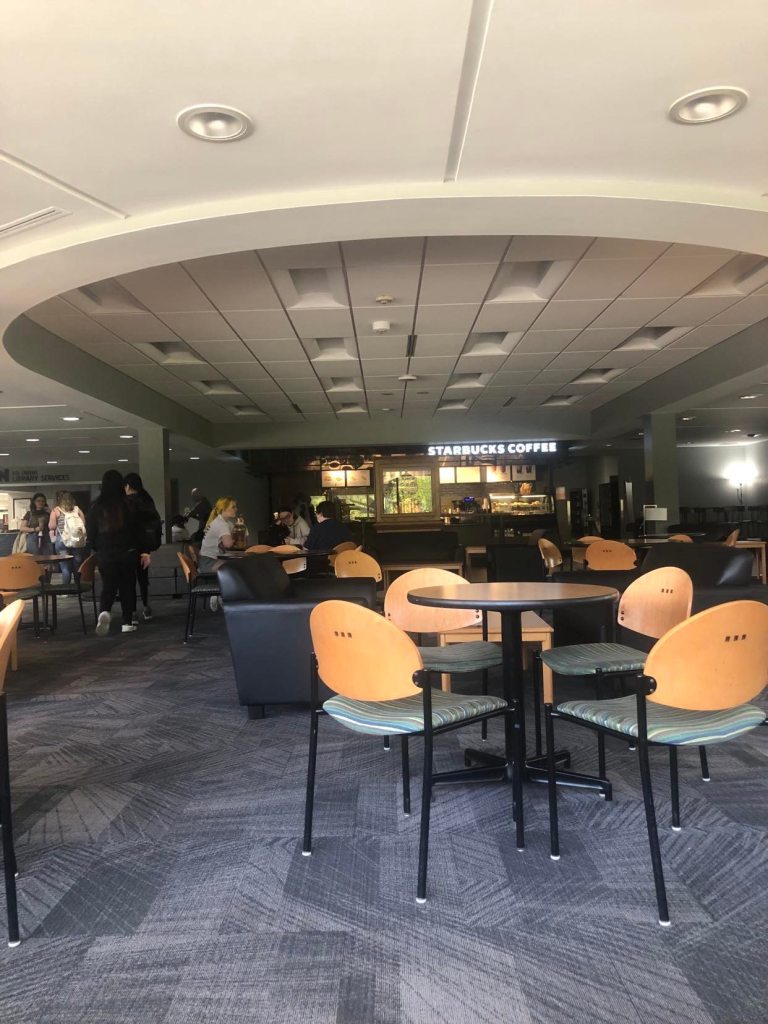
I’m sitting in the campus Starbucks, which is in the library, perhaps the coolest Bux in the US (or the nerdiest). My semester is over, which means flowers and warmer weather and more relaxed schedules are ahead of me.
I’m sitting in one of the coveted low upholstered chairs, which is what the early bird gets to sit in. The short table fits me perfectly, and I’m set up to write. Except I don’t feel motivated to write.
I have a novel to write on, and I’m on the first draft. All I can see is the imperfections — to where I’m reading the first half and putting huge comments on it. I haven’t even written the second half. NaNoWriMo and other guides suggest one gets the first draft written first, then edits.
I look up from my computer where I’ve been staring at the screen, and a tall, slender young woman sits in the chair across from me. Not one of my students, but I know her. She shouldn’t be here; she’s not real —
“Just because you wrote me doesn’t mean I’m not real,” Leah Inhofer points out as she pushes a wayward blond braid back. “I hear you’re having some problems.”
“Not really,” I say. “I just need to motivate myself.”
“Partially true,” Leah comments. “You need to motivate yourself. And you’re having problems.” When your character is a walking lie detector, lying to them is inadvisable.
“I don’t know if I like what I’m writing,” I confess. “I’m not even done writing, but I want to revise it. And I don’t know how.”
“First, you need to develop me and Baird better. Yeah, we’re sneaking around a bit at first, but we end up in love. Make us believable. Make our dilemma hefty enough that my pregnancy puts us in a spin.”
“You can’t be too much in love at first, or else there will not be the tension. You need to doubt the other person, not want to impose. Catch up to yourself before you admit to being in love.”
“I see where you’re coming from.” Leah leans forward to whisper. “It’s not like I know how Baird would be as a father. He seems so — clueless. I suppose that comes from having been born three years ago.”
“Was he really born, though? He’s a Nephilim — it’s more like he showed up fully adult to his birthday. Not like how your baby’s going to show up.”
“Just what I need. Morning sickness.” She takes a deep breath. “Boy or girl?”
“Girl,” I assure her.
Leah pumps her arm. “Sweet. Another generation to break the mold. My mom’s going to be thrilled.” She makes a sour face. “Will my mother ever forgive me for believing in the Maker religion?”
“Let’s just say you’ve given her a lot to think about.”
“Good. I should go find Baird. We’ve got a few minutes before my dad misses us.” And she stands quickly, braid swinging, and disappears.
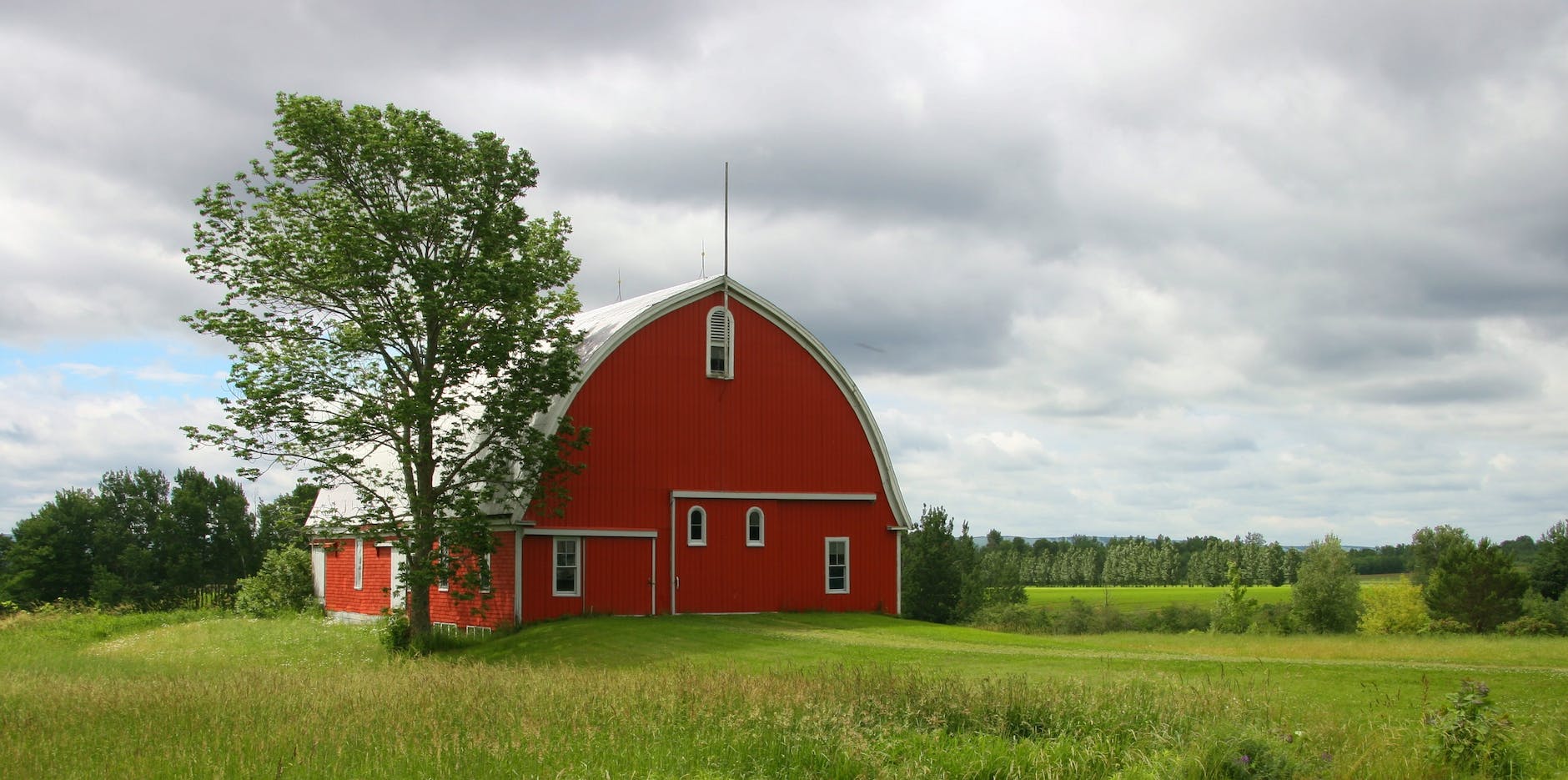
A week later, Brock and Leah sat in the livestock barn, hiding from the rain, which had broken out as they finished trimming the hooves of the Welsh Mountain sheep. The two sat on old folding chairs swiped from the Commons building.
“Leah, are you okay?” Baird asked as the rain hammered the metal roof.
“You keep asking me that!” Leah stood up and peered out the door at the rain. “I’m okay.” She didn’t want to talk about it — the feeling of foreboding that settled in her bones like a chill she couldn’t shake.
“No, you’re not,” Baird observed. “If you were okay, then you’d be able to laugh at me being so clueless.”
“I’m okay!” Leah turned away from Baird.
“Leah!”
“What’s the matter with you, Baird?” Leah turned to him, hands on her hips. “Why are you getting into my business?”
“I’m not getting into your business,” Baird shouted, standing up. He sat just as quickly, burying his head in his hands.
“Baird, what’s wrong with you?” Leah asked, standing and striding over to Baird.
Baird raised his head. “I’m not used to snapping at you. I’m not used to snapping at anyone. But it’s part of my nature, this anger. And I’ve learned to ride herd on it, to become a person instead of the soldier they tried to make me. I’m not the calm, meditative person you think I am.” He paused. “Or I am, but it takes work. Like right now. I know there’s something wrong — you look pale and wiped out. But you won’t talk.”
Leah sat back down, pulled her chair closer to Baird. “I’ve been feeling like something bad is going to happen for days. I’ve not talked about it with you because I’ve not talked about it with anyone. I don’t want anyone to think I’m crazy.”
“You think anyone here would think you’re crazy? We have Trees that give talents, and if I heard correctly, Josh foresaw the Apocalypse, didn’t he?”
“But that’s just it.” Leah fidgeted with her hair, taking it out of its hair scrunchie and pulling it back again. “Josh’s vision quickly made sense because the Triumvirate announced they’d attack us and kill Lilith. But we have nothing to tie my vision or my foreboding to. The vision looks nothing to do with Barn Swallows’ Dance if it means anything at all.”
“You need to tell someone. What if it means something?” Baird reached for her shoulder, then pulled his hand back.
“You don’t understand.” Leah raised her hands in resignation. “My parents grow increasingly uncomfortable about this place. They’re not comfortable with their talents, or with the presence of the Nephilim —“
“You’re telling me.” Baird snorted. “Oh, sorry — go on.”
“I’m afraid —“ Leah paused, staring down at her hands.
“Afraid of what?” Baird prompted.
“I’m afraid they’re going to disown me. For being what they’re afraid of.” The words came out in a rush; their weight lingered.
“They wouldn’t disown you, would they?” Baird asked to break the long pause.
“If they thought I willfully walked away from God, they might,” Leah fretted. “I don’t even know if I believe in their God anymore.” Leah fell silent, waiting for their God to strike her down. Nothing happened.
“Who is your parents’ God?” Baird asked, clasping his hands.
“Well, God.” Leah snorted. “Ok, the Christian God.”
“Do humans believe in other gods?” Baird leaned back in his chair, ready to learn more about humans, a thing he pursued with enthusiasm.
“Well, Aasha Kaur’s Sikh, and she calls her deity Ek-Ongkar. The Hindu have a pantheon of Gods and Goddesses, and Jeanne and Josh believe in nature spirits. But I can’t —” “You can’t believe in another God?” Baird guessed.
“Because our God is — “ Leah sighed. “It was comforting to grow up and feel we had the lock on salvation because we’d been born to the right God. It’s not so easy now, living at Barn Swallows’ Dance with so many beliefs.” Leah turned to Baird. “What do you believe?”
“Many of the Nephilim believe as the Archetypes do — in a creator we call the Maker.”
“Well, that’s original. But then again, we call our God ‘God’”.
“Anyhow,” Baird raised his eyebrows at her, “We don’t worship so much as acknowledge the Maker, who we believe constructed your world with its geography, its climate and weather and seasons, its ecosystems, and the Archetypes, held apart from humans by their immortality and their task to hold humans’ cultural underpinnings safe. And then They left to create another world.”
“So no sitting in judgment?” Leah asked. “That must be nice.”
“No. They’re pretty hands-off.” Baird cocked his head and listened — for the rain? Or for Leah’s father?
“They? I thought there was only one Maker,” Leah groused.
“The Maker has no gender. Or both genders. Nobody really knows.” Baird shrugged. “We haven’t heard from Them in thousands of years. Many thousands of years. We observe no rituals, we don’t pray. We are not the people of a deity.”
“That must be a relief.” Leah put her hands on her hips. “Beats being disowned by your parents for something you have no control over.”
“You need to tell someone. Besides me, that is — “
“I can’t tell Luke. Luke is — well, he looks at me like he knows something he’s not telling. I feel judged by him. It would be as bad as telling my parents.”
“Is there anyone else you can tell?”
“No. It would get back to my parents.” Leah grimaced. It would be so easy to let go her burden were it not for that.
“Okay,” Baird said. “Back to trying to make sense of the vision. Have you seen any visions since the one?”
“No, just the one. I feel like everything’s about to go wrong, however.”
“Back to the vision. What exactly did you see again?”
Leah shifted in her chair and closed her eyes, recalling to herself the vision. “I saw two lines of people facing each other, some in light armor, some with weapons. No guns, and as far as I could tell, no bombs. Just swords, and maces, like this was going to be a big man-to-man fight. They stood there, glaring at each other.”
“Did you recognize anyone in these lines?”
“No, but now I remember a man who commanded one line, pacing along the line, galvanizing them. He stood tall, and he taunted the men and women in line. Let me see — he said, ‘Do you want to be worthless? Do you want to be diminished as — he said some four-digit number — was? Do you want to be walking dead, trying to slit your own throats? We can stop this!’”
“That’s further than we’ve gotten before. What were they wearing?”
“To be honest, they looked like they dressed for a street fight. Or a gladiator ring. Both, kinda. Like I said.” Leah felt the dread like a miasma again. “Can we not talk about it?”
“I don’t know if we have that luxury, Leah.”
Leah tried to read Baird’s face, came up with concern and something she thought was puzzlement. “I just need to quit talking about it now.”
“Ok,” Baird said. “I’ll let it drop for now.” He looked out the door; Leah’s eyes followed his, and she noted the rain had stopped. “Let’s see if we’re needed in the food forest to pick fruit.” They left the barn and walked silently toward the food forest, through browning grass sloppy with rain.
National Today is a website which introduces the reader to the myriad declared days that grace the national and international calendars. Some of these holidays seem directly related to food industries (National Pickle Day is November 13) while others put into the forefront of people’s minds for a good cause (National Crime Victims’ Rights Week, April 23-29). But today I’m here to write about International Pixel-Stained Technopeasant Day and how to celebrate it.
The day started with a Howard V. Hendrix, a member of the Science Fiction and Fantasy Writers of America, who called people who published their work for free on the Internet as ‘pixel-stained technopeasants’ and stated that no writer should do so. Jo Walton, another writer and member of the SFWA, encouraged writers to do exactly what Hendrix disdained. And a holiday was born. (National Today, 2023)
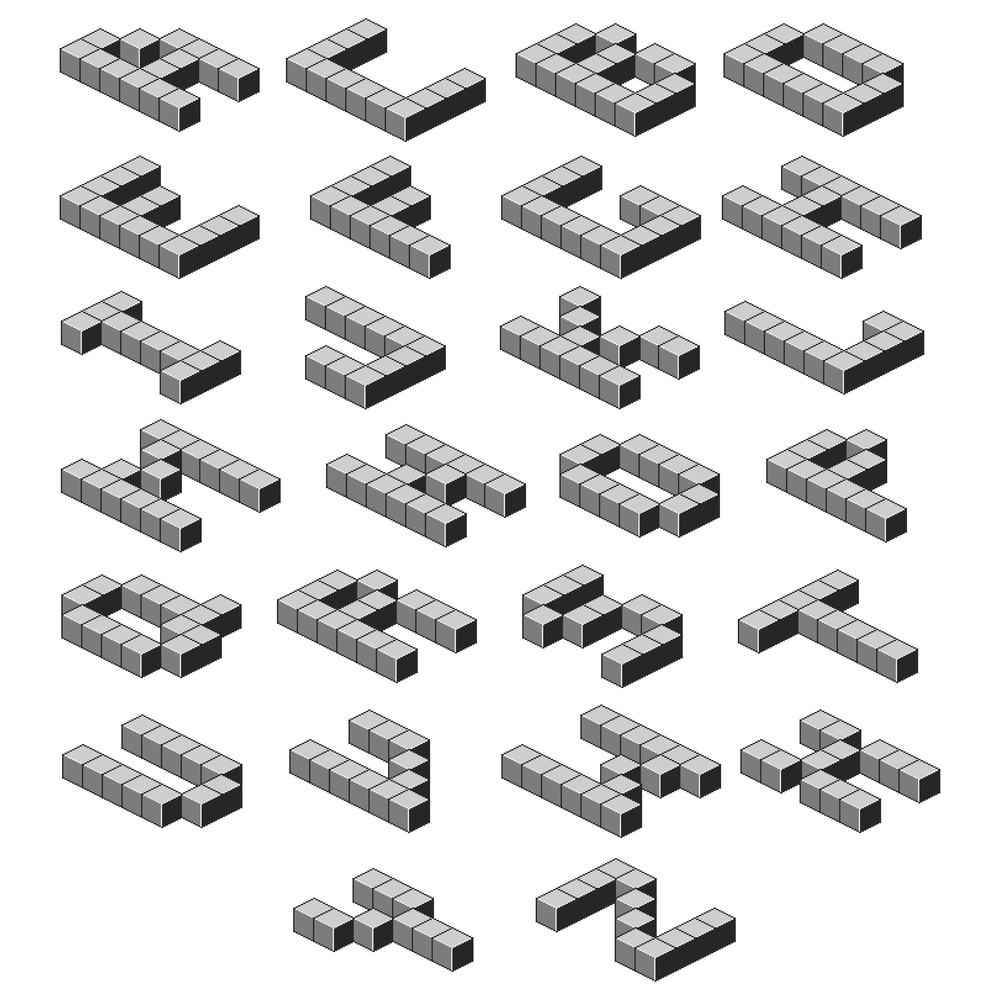
Isometric alphabet. Black and White abc. Volumetric letters. Vector Illustration
I don’t know the details, but this sounds like a more modern debate between self-publishers (which I am) and those traditionally published. The debate seems to be whether self-published works are legit because they don’t have an industry gate-keeping the publication process. But those who have been mistreated by the traditional process look at the issue differently.
Turns out I’m a pixel-stained technopeasant and I didn’t even know it. I even write in the fantasy genre, so I am one of those pixel-stained techopeasants of which Hendrix spoke, although not an original technopeasant. I have published in online contests and journals which, although they had a gatekeeper, did not pay. Most Internet journals, in my experience, do not pay, just as most print journals do not.
How, according to National Today (2023) does one celebrate this day?
Read a blog
Publish for free online
Post a social media post
Here’s the free creative work:
Limerance
There’s a push to ask you for your name,
And a pull ‘cause I have no right to know,
As I stand in the corner of the venue
With nothing in my mind except the color of your eyes.
Venturing into the attic as my father worked to restore it. The entire neighborhood late for school because my cat is having kittens. A gully washer sending rain cascading down the steps across the street. The hospital with its old wood panels and cordovan leather. The evening when I played in the street with my neighbor and my sister. Fishing in the park with my father, the first time I threaded a worm on a hook. When I finally got a boyfriend.
Going off to college unprepared and coming home again. Going back and staying there even through summers and Thanksgiving breaks. Growing microbes in Petri dishes and cooking pound cake in the food lab. Classes I skipped to sit on the Quad and watch people.
Walking to my graduate classes barefoot and scandalizing my professor. Skinny dipping at the St. Joseph’s Sportsman’s Club on a skinny September night. Watching Star Trek with my friends. Losing Thanksgiving Break to a class project. Walking across the stage to get my PhD.
Exploring my new home across the country, walking everywhere. Being betrayed by a husband and breaking up. Spending a week in an inpatient facility that saved my life. Falling in hopeless, chaste love with a rock band. Moments I felt like the sky was falling down, but I persevered. Driving to the Adirondacks to camp by myself and feeling freedom.
Moving back to the Midwest to be with someone I thought was the one — he wasn’t. Buying a house as an act of solidarity with single professional women. Learning how important laughter was to a relationship. Driving for miles and miles before getting to the next town. Watching coffee shops pop in and out of existence. Finding the right man and marrying on St. Patrick’s Day. Watching my mother die nine months after our wedding.
Appearing in a dunk tank for charity. Traveling to visit interns across Missouri and across state lines. Getting diagnosed with bipolar disorder and spending a few days at the hospital. Recuperating. Being moved into a bigger house. Spending a pleasant day with my father while he was in hospice.
And now I sit in the greying afternoon, having reviewed almost sixty years of life. All these memories are mine. I cling onto them as the things that define me.





 Words Like Me