Book covers

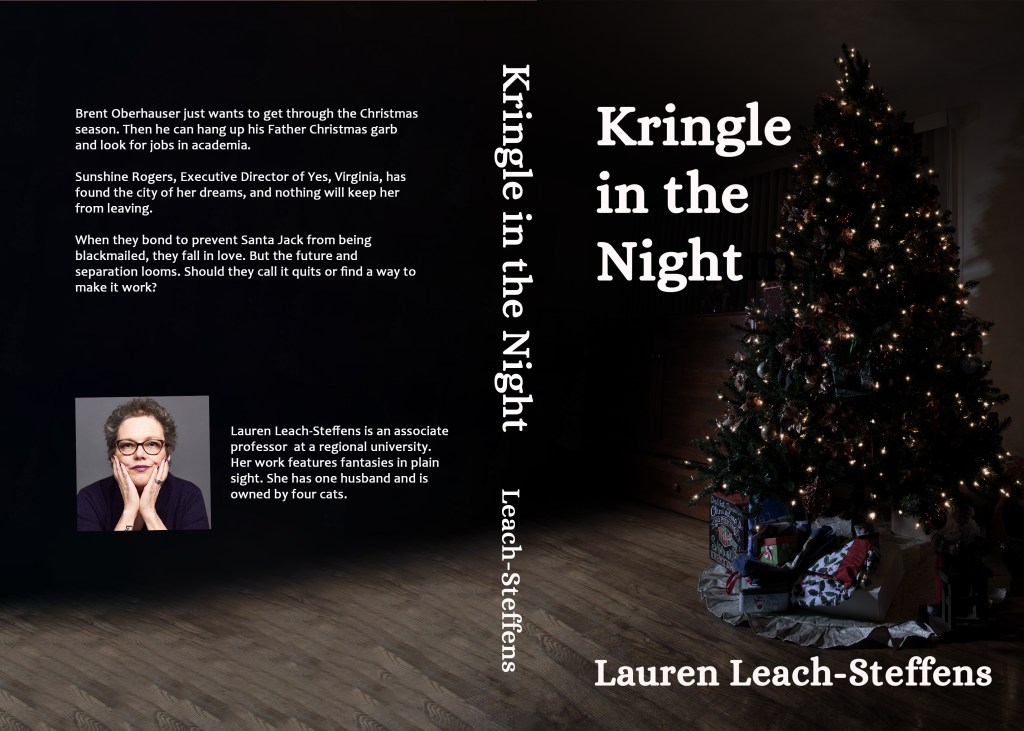
Yesterday I spent my morning making a book cover for this year’s Christmas romance, Kringle in the Dark. I can’t draw to save my life, but I can work pretty well with photos and Photoshop, which works fine with the Kringle novels. Get the rights to a picture, tweak the photo, set the photo just right. Make the back cover with cover blurb. Orient the spine title/author verbiage.

Here’s the mockup:

It was a stroke of luck getting the photo to expand to the back cover; I’m not sure I will ever be able to do that again.

“Where do you get your ideas?”

Photo by Pixabay on Pexels.com

This is the question every writer gets asked. Usually the response is vague dread, because many of us don’t know on the spot where we get our ideas. The answer comes only after a good session of introspection, and at the moment the question gets asked, we can’t reflect on the question rapidly.

Over the years I’ve done this introspection, and these are the answers I’ve come up with:

  • From other books I’ve read. But I need to be careful not to plagairize.
  • From dreams/daydreaming. This is my favorite source. I often take a dream and interpret it using Jungian methods, which I call interrogating the dream.
  • From conversations with my husband, which often start with “What if?”
  • From observation. I don’t know if I’ve ever written a story entirely from observation, but scenes and characters often come from this
  • From what I’ve written previously. Sequels!

Sometimes I don’t have any ideas. Right now I feel like I need to write a new novel (after revising a couple) and I don’t have any ideas. Ok, actually, I have three ideas based on series I have going, but I don’t know how excited I’m getting about them. Not all ideas are workable:

  • One of the books would require living in Poland for at least three months to get the flavor of the place. I have no money, no knowledge of the Polish language, and no tour guide.
  • Another which is part of my Archetype universe, and for some reason it’s not grabbing me.
  • Yet another in the Archetype universe that’s too nebulous to write about.

I think I need some dreams or daydreaming right now to inspire me. My dreams last night were stupid and not worth writing about. In my dreams, an actor friend of mine got a nose job and I got really angry because he had succumbed to dominant culture beauty standards. That’s it. Unless I’m writing a warped version of The Picture of Dorian Gray, I don’t see much use in this dream.

So where do I get my ideas? Sometimes, nowhere.

Aeon Timeline Review

I have a somewhat tenuous relationship with time, and nowhere does it show up more than when I’m writing. Even though I write fast-paced plots that run over a few weeks or a month, I lose track of the time and suddenly two different plot points are happening at the same time.

I used to sit with a calendar and make notes on the Scrivener file, chapter by chapter, but then I didn’t get the full picture; I had no one document where I could look at the whole timetable. And flipping back and forth between chapters makes it hard to remember the sequence.

Then I discovered Aeon Timeline, a program that helps you organize a timeline by chapters or individual events, characters involved, and other potentially important characteristics. It organizes itself around two concepts: events and entities.

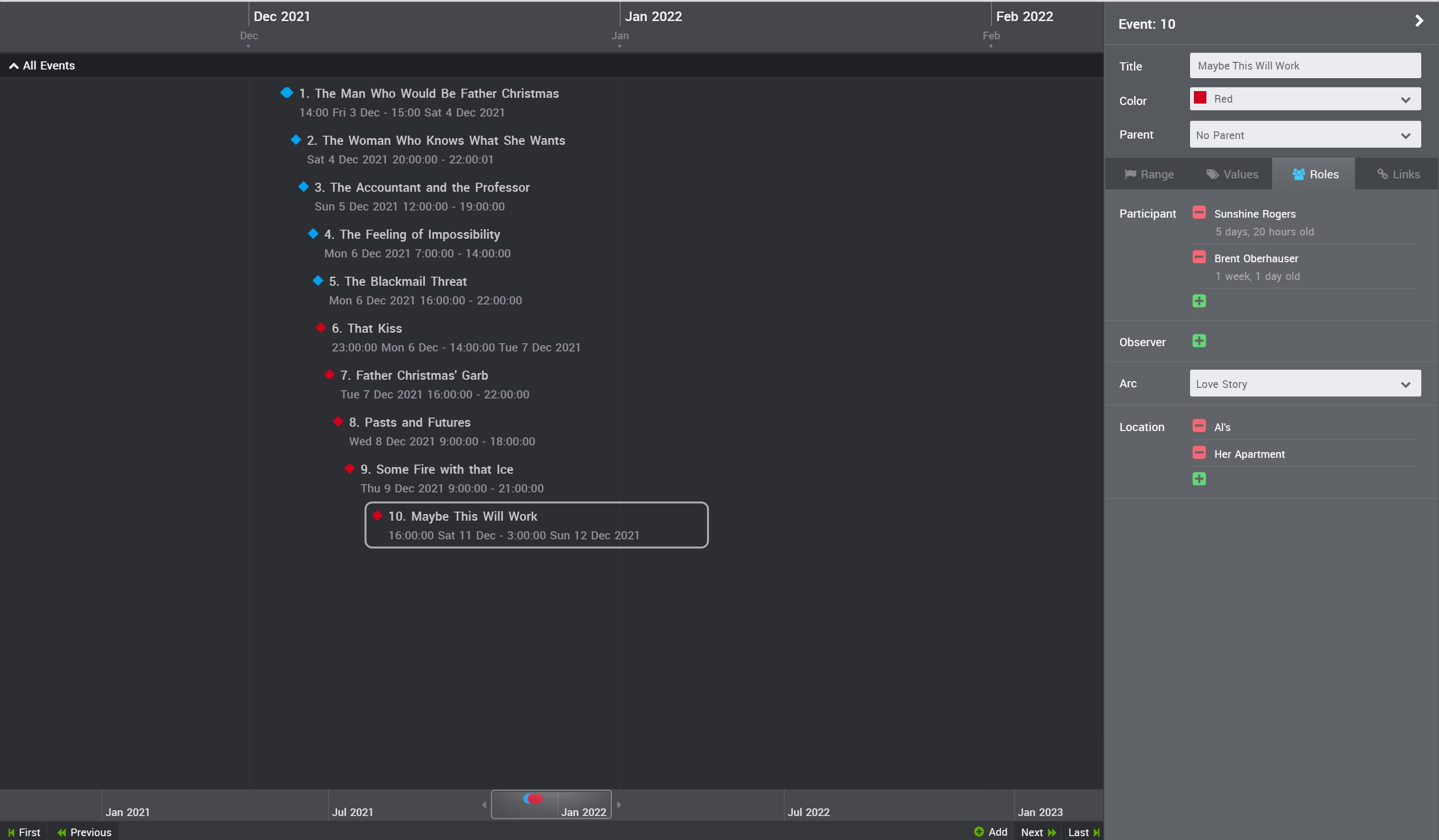
Here is a screenshot of my current project:

On the left, you can see the timeline. In my case, it’s color-coded to match a template I have for romance writing. On the right, you can see an event (the one highlighted on the left). On the event side, you can see at the top the event data — title, color, and parent. I do not use ‘parent’ because it ties everything to a preceding event and my mind doesn’t function that way. Below that to the right there’s data such as participants and observers, story arc, and location. Those are used as sorting prompts, and I haven’t found myself gravitating toward that function yet.

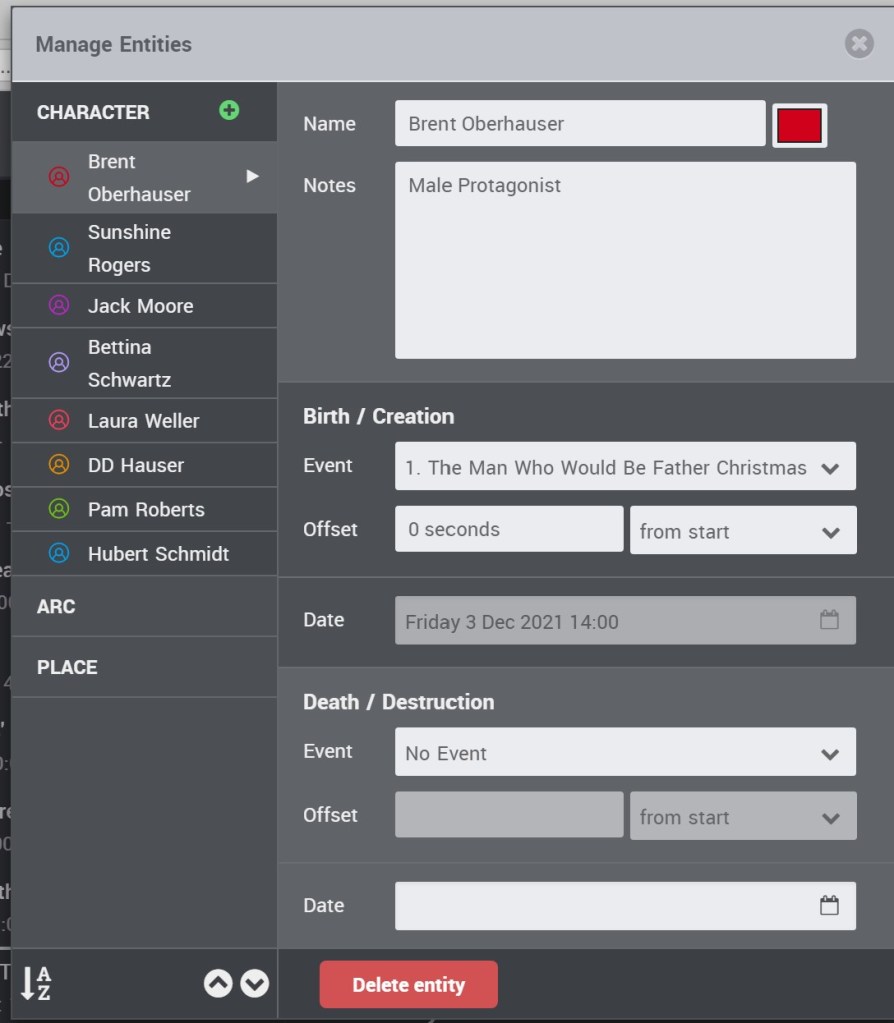
Below is what the ‘entity’ window looks like:

This is the ‘manage entity’ window. You can add entities here (to add anywhere, click a ‘plus’ button) and edit them. I recommend using this box rather than the ‘add entity’ box because you can manage things better here. Note on the left the window will also let you define story arcs and enter different places.

Notice I don’t use the birth/death blanks because I’m not writing epic fantasy. If I ever make the unified timeline for all my novels, I could use that. (But it would be an unwieldy timeline spanning 6000 years.)

The good thing about Aeon Timeline (to me) is that I can see that timeline, and in making it, I can ‘feel’ that timeline. I often make it after writing the book in my proofreading stage. This is probably the wrong way to use it. If I set it up before, I could actually import it into Scrivener (my writing software) and the timeline would show up. Somewhere. I have to try that.

The bad thing about this is all the data entry. I feel possessed to put in all the entity data and use all the categories when developing the event, and this can be a lot of work. Being a plantser (planner/pantser) writer, I don’t know that I would know all the events before using this tool such that I could use it at the beginning. I would advise to enter what is needed and leave the other bells and whistles alone.

I’m halfway through entering my Christmas romance for the year, Kringle in the Night, as I edit it one more time to make it ready for the Christmas season. It’s helping greatly. I’ll let you know about the Scrivener integration later.

Within and Outside a Literary Universe

I’ve been having a fruitful period of revising old works in the Archetype universe. I’m almost done with the Problem Child #2 (I can finish today and give it a good second pass) and have edited the short stories that go with the world.

Almost every novel I’ve written so far has been in that universe, one indirectly. (A total of five novels.) It’s a fascinating universe, with a group of immortals known as Archetypes, tethered to the human world by their responsibility of holding humans’ racial memories so humans are less consumed by their pasts. A few of the immortals get involved with humans as their protectors; others rage against the humans and plot genocide. Most Archetypes live outside of relationships; a few stumble their way through relationships. The Archetypes are super-fertile, and must abstain from sex, but rarely they make the decision to bring other Archetypes and the half-human Nephilim into the world, for good or evil purposes.

View Posts

Photo by Roy Reyna on Pexels.com

Within this universe, I have fit a number of genres and storylines: fantasy, romantic fantasy, and fantasy romance; Dude with a Problem, Golden Fleece; Buddy Love, Rites of Passage, Superhero.

I like writing within the universe because its characters and settings are so interesting to me. But I need a change, and I need it by Camp NaNo.

Everything, Anything, or Nothing?

My horoscope says my brain is worth of chatter. It is, if what you mean by chatter is “I really should doing this/that/the other thing” instead of coming up with any sort of new story ideas. And to some extent it’s right, given that I have an important assignment to grade, two interns to visit and two classes to prep for tomorrow. I will be busy today.

But I will manage some time for — what? I have to come up with an idea for Camp NaNo in April. Camp NaNo is like the training wheels version of NaNoWriMo — you can set a minimum of 10k words for a goal, there’s a lot more acceptance of doing something other than a novel during this time — it’s overall just a good warmup to a major project.

I have some back projects I could work on, if I can get engaged in them again. The main one is Gods’ Seeds, which deals not with gods per se, but the immortal Archetypes who have held societies’ cultural memories. The death of these memories will kill the people they represent. And now, as their leaders want to give cultural memory back to humans, a civil war between Archetype factions threatens widespread extinction across the Earth. One woman, one who touches mortality and the deity of the Archetypes, must realize her role and stop the immortals from fighting.

The other one would be fascinating, if I could spend six months in Krakow. This is not going to happen.

Part of my lack of ideas is this frustration with the idea of traditional publishing. I am beginning to consider self-publishing the rest of my catalog — fantasy and romantic fantasy, even as I struggle with the whole “your stuff will be considered better if you go through the gatekeepers.” It’s a big issue in the publishing industry, because self-publishing is confused with vanity publishing. But many famous authors started with self-publishing. I don’t think I will be famous, but I don’t want these books languishing in my computer files.

Or I could resubmit one of my works to another set of agents (or the same set of agents). That will take some work.

I don’t know what to do right now. Everything, anything, or nothing?

#PitMad

I will be participating in #PitMad again on Thursday.

#PitMad is a semi-annual Twitter pitch contest for writers. Writers pitch their books in one tweet, and they get three tries to tantalize agents and publishers with their pitch. Hopefully, an agent/publisher sees a pitch they like and send a request for a full manuscript, which is the first step to a pathway that may lead to traditional publishing.

I have three different books I will be pitching right now, and I hope that I will have luck this time. I’ve rewritten the pitches from past #PitMads, so they’re fresh and new.

Here are my pitches:

Adam and Lilith, star-crossed lovers in a 6000-year-old play, meet again at the brink of apocalypse. Humanityโ€™s fate rests on a collective of pacifists facing immortals and their armies. Lilithโ€™s life is at stake โ€“ and if she dies, so do all women on earth. #A #F #FTA

Anthropologist Anna Smith crosses the war-torn remains of the US to chase a legend. Amidst attempts on her life, Anna finds her past entwined with the story she found. Who she is โ€“ old and new โ€“ could be the key in stopping genocide. #A #F

Dr. Jeanne Beaumontโ€™s life escapes logical, scientific notions โ€“ thereโ€™s a monstrous vine in her lab and a man half her age courting her. Josh Young sees his crush naked in a vision of a riotous garden. Together they find things donโ€™t have to be logical to be true. #A #R #CR

#PitMad happens four times a year, so there’s plenty of times to participate.


Sorry I didn’t write yesterday, but I have been struggling with a catastrophic tooth infection (as in half my lower jaw) and I’m on hydrocodone to deal with the pain.

In short, I am seriously out of it.

I thought about leaving the typos in here to show how seriously out of it I am, but I can’t stand leaving spelling and grammar errors in a piece, so I’m revising errors as I go along. Believe me, there are many errors happening.

I hope to be out of pain soon, after which I’ll see whether I have any teeth left from this.

Talking About My Books

The cover blurb (if I get that far) for Gaia’s Hands:

Dr. Jeanne Beaumontโ€™s life has escaped her logical, scientific notions โ€“ a seedling in her lab has grown into a monstrous vine, and a man half her age courts her.

Josh Youngโ€™s world of spirits and visions informs his writing but isolates him. Then in a vision of his current crush naked in a lush orchard of trees and vines, he realizes he wants more.

As Jeanne and Josh discover each other, pieces fall together: the vineโ€™s lush growth, Joshโ€™s visions, the attacks on Jeanneโ€™s lifeโ€™s work. What brought them together threatens to push them apart, unless they realize that things donโ€™t have to be logical to be true.

***********************

Photo by Suzy Hazelwood on Pexels.com

I’m bad at writing book cover blurbs, and not that great at writing cover letter blurbs. It’s hard for me to find the essential pieces, keep the suspense in place, and communicate the gist of the book in as few words as possible. I’m lucky that this blurb only took two tries (but I thought the first, too long draft was perfect. Go figure.).

I might have learned something from this, however. Don’t repeat, don’t tell the whole story. I need to go over all my cover letters now and see if I can capture what I learned there. Wish me luck.

I see the light at the end of the edit!

I am done with the revision of Gaia’s Hands! I think I finally have it in a place where I like it, although it definitely needs some revision on the revision as any good novel would.

This is momentous, because Gaia’s Hands is the first novel I ever wrote.

To give you some background — I had a dream. And it was a pretty raunchy dream, raunchier than the book finally ended up, but it was also romantic. So I kept interrogating the dream, and particularly its characters, and it kept developing further.

I kept writing excerpts of the dream and its spun gossamer threads, and I kept making my husband read them. (My husband is very patient.) After maybe a half-dozen of these, Richard said, “If you’re going to write all these stories on the same topic, you might as well write a novel.”

Photo by Olenka Sergienko on Pexels.com

“I can’t write a novel!” I squeaked. “It’s too long! I don’t know how to write plots!”

“Try,” he said.

So I wrote the first draft, and didn’t like it. I then wrote several other drafts, adding voiceovers and deleting them, adding a couple new characters, deleting them, turning it into a novella, giving up on that. and leaving the story in the metaphorical drawer for a while only to start again. Toward the end of the process, I handed it off to a writing coach, who pointed out that there were so many editing errors from having gone through it so many times my eyes bled, She also informed me that Gaia’s Hands was, in fact, a romance novel and I should emphasize that.

This was a revelation. I knew there was a romance involved, but there was also this fantasy element of Jeanne’s talent and Josh’s visions and the build toward a miracle at the end. Primary to the book, however, was Josh and Jeanne’s unorthodox relationship with its age difference.

So I emphasized that romance, not forgetting the fantasy elements, but using the romance as the backbone of the story. Jeanne and Josh, it turns out, make a great couple. They fight and break up in a totally believable style, and come back to each other within a week just as believably. And they make sense as the unprepared wielders of talents that come from — Japanese spirits? Gaia?

I think I’m happy with Gaia’s Hands. I think.

The Internet Created My Writing Career

I don’t think I would have become a semi-serious writer before the Internet. I like to be correct over details, and before the Internet, I would have had to do much more difficult research to write anything, even a fantasy novel. I would have spent hours in libraries, searching for books and hoping the titles yielded the information I was looking for. I might search through an encyclopedia or two to glean some data about my topic. I would have spent so much time researching that I wouldn’t be able to experience the fun of writing. It would have been a lot like writing my dissertation. Urgk.

For example, in Whose Hearts are Mountains (my favorite book to illustrate the wonders of an Internet search), my online searches included:

Photo by Brooke Lewis on Pexels.com
  • Underground dwellings
  • Owyhee Desert
  • Wilson’s Sink
  • desert flora
  • desert fauna
  • dry land crops
  • water reclaiming
  • biodiesel
  • jatropha diesel
  • castor diesel
  • ricin poisoning symptoms
  • castor pomace
  • sage tea
  • smallpox
  • bubonic plague
  • bioweapons
  • guanacos
  • mules

Imagine having to go to a library for this search. Imagine telling the librarian you need a book on ricin poisoning. Imagine taking notes on all these items (and because we’re talking about the days without the Internet it’s also the days before a laptop) with pen and paper, and trying to arrange all those notes.

Imagine trying to juggle all these notes while writing.

Imagine feeling like writing after all that. I don’t know how anyone did it.

Using the internet, though, creates a responsibility to the writer. I must check the validity of all my sources to make sure the information is correct. Here is a source that explains the process of assessing the quality of information on the Internet. I use a lot of my college training to do this process, but anyone should be able to walk through the process outlined in the website above. (The process is also handy for sounding out claims of mysterious cures, deep state conspiracies, and urban legends.)

Whose Hearts are Mountains is a story I wanted to write about thirty years ago, but I found the research too daunting. It wasn’t “writing what I know” — it had to happen in the middle of a desert, and I knew nothing about deserts. I had that dissertation to write. But I could write it thirty years later simply because of the advent of the Internet.

Ego, or Facing My Prejudice About Romance

I’m adjusting to the fact that I write romantic fantasy or fantasy romance. Fantasy romance is romance with fantasy conventions; romantic fantasy is fantasy with romantic elements. Given this dichotomy, Gaia’s Hands (the bastard child of my works that I’m currently editing) is fantasy romance, while the others are romantic fantasy.

I think I’ve internalized a subgroup’s perception of romance as tacky and trivial. I admit titles like “The Billionaire’s New Secretary” make me cringe because of the obvious and outdated gender roles (but at the same time they’re making more money than I am).

Photo by Trung Nguyen on Pexels.com

Romance sells like popcorn at a movie theater, at the same time that the readership of other genres are decreasing. Because it sells, I might have a better chance at getting my books read. At the same time, there’s part of me (the egotistical part) that thinks my books have to Mean Something. At this point I would best chat with my ego and point out that High Art sitting on my computer isn’t doing any good.

I’m not writing Books That Mean Something. I hopefully am writing books that people care about. That’s where I want to be, and my ego better clear out and let me do it.