Me and Automobiles

Daily writing prompt
What’s something most people don’t know about you?

One thing that people don’t know about me is my relationship to cars and driving. I learned how to drive rather late in my life (age 32). This is not usual for the US where a driver’s license at sixteen is a rite of passage.

I was different. Behind the wheel of a car, I was a hazard. Among the things I managed in driver’s ed: stopping in the middle of the railroad tracks to check for trains, butting the car into a snow drift in an otherwise empty parking lot, and making a 180-degree turn into a parking lot when all I intended was to turn the corner. Needless to say, I did not get my driver’s license in high school.

I took drivers’ ed again, and that time got through it. I didn’t, however, get my driver’s license because my parents were too scared to take me to the testing facility to get tested. I didn’t blame them. Eventually, when I had taken a break from college, I got the license but never drove on it, and my skills extincted. It didn’t help that I got hit by a car in my late 20’s, breaking my leg and resulting in a bar in my left tibia to hold it together.

When I was in college and grad school, I lived in a city with excellent public transit, so I didn’t miss having a car. It wasn’t until I lived in Oneonta, New York, my first teaching job, that I felt the pinch of not being able to drive. Oneonta was a rural town in the foothills of the Catskill Mountains, and there was an arts scene in the area — all spread out from Oneonta to West Kortright to Delhi to Franklin. Only accessible with a car.

I took driver’s ed with the best person I could have found, a laid-back man named Lee Fisher. He taught adults how to drive, and thus he knew how to deal with people who struggled to drive. It turned out that, when I drove, all the little pieces of driving wanted to happen in my head all at once. Think of all the actions needed for a right-hand turn: slowing down, activating the turn signal, braking at the stop sign, looking both way, accelerating slowly while turning the wheel, straightening the wheel … my mind couldn’t sort them in order. I learned to drive by reciting all the moves in order just before doing them. When I no longer needed to say them out loud, I went to get my driver’s license, and succeeded.

I didn’t let those skills extinct, instead getting myself a car to drive. I made a lot of mistakes, had a couple accidents, and spent a couple years in the assigned risk pool with expensive insurance coverage. But I got used to driving.

I have never become an excellent driver. I balk at interstate driving, although I can and will do it if necessary. But driving is a part of my life now.


Not Brands, but Reference Groups

Daily writing prompt
What brands do you associate with?

I don’t associate with any commercial brands, but I do associate with what this question is getting at.

I don’t believe people associate directly with brands, except perhaps with trucks — there are “Chevy people” and “Ford people” in the US, and a few deranged “Tesla bros”. People associate with reference groups, which they use to identify themselves as a part of. This is something I learned in a consumer behavior class many, MANY years ago.

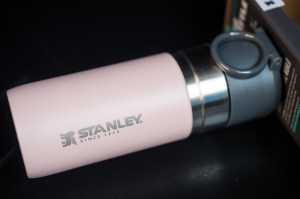
Bangkok, Thailand – April 16, 2022 : Stanley of pink stainless steel thermos travel mug to keep the drink warm or cold. Stanley Go Vacuum Bottle 12.5 OZ

Reference groups can be associative — “I am a member of this group”. For example, one of my reference groups is “college professor”, which makes me prone to buying gas-efficient vehicles and Starbucks coffee. Reference groups can be dissociative — “I would not be caught dead being a member of this group”. I am vehemently not a member of the reference group that listens to Kid Rock and drinks Budweiser beer. Last, they can be aspirational — “I would like to be a member of that group.” I would like to be a member of the upscale ecologically conscious consumer who has a home composter and a butterfly garden landscaped by someone else.

We buy brands because of their association with reference groups, because we want to be a member of that reference group. We refuse to buy certain things from our dissociative reference groups. We don’t so much say “I’m a Ford person” — unless we’re talking about trucks, and even then, we buy them largely based on our perceptions of who’s in that group. I will excuse myself to drink my home-roasted coffee, which marks me as part of the aspirational group “coffee snobs” now.

Testing my Theory

I have a theory that posting at 8 AM on a Tuesday morning (Central Daylight Time, UTC +5) will yield very few hits. I’m testing it here.

Photo by Anni Roenkae on Pexels.com

In the app Loomly, the app can tell you which times are optimal for posting to each platform. It’s a strategy I use for determining when to post. Not always, but often. Loomly does not connect to WordPress, so it’s not useful for determining times.

Another thing is that WordPress has a more world-wide spread. I have readers on occasion from India, Cameroon, the UK, many other African nations, Bangladesh … This is not the case on other platforms. What is the optimal time for these places?

So consider this a test. Let’s see if I get even my normal amount of visitors.

A Useful Topic

Daily writing prompt
Which topics would you like to be more informed about?

The prompt asks, ‘Which topics would you like to be more informed about?’ I can think of one topic I’ve perused Wikipedia about. I have never studied it in greater detail but would love to learn about it.

The topic is molecular biology. I am fascinated because we came from single-celled organisms way back in the primordial soup days; our cells have organelles that mimic the productive functions of our most basic organs. I keep forgetting the organelles’ names except for the mitochrondia, the powerhouse of the cell. That’s memorable for me because of all the things that could go wrong there and cause genetic diseases.

(See this picture? I don’t know all the parts.)

I would love to know molecular biology at least at a basic level; I don’t know if I’d go as far as the ATP cycle (which I vaguely remember from a nutrition test at the undergraduate level) but just remembering the parts of a cell and knowing how they work. DNA would be a pleasant bonus.

Knowing molecular biology will change nothing in my life. I do not need it for my vocation (associate professor of human services) or my avocation (writing). In fact, I don’t need to know for any reason except for my curiosity. But that’s enough.

A Lack of Pattern

I’m trying to analyze which posts of mine are most successful — prompted posts? My own ideas? Short posts? Long post? Personal posts? Posts about writing? I have come to the conclusion that I can’t predict what will get me more viewers.

Dice on grey background

I’ve always thought prompted posts performed better than non-prompted posts, long posts better than shorter posts, and posts about writing better than personal posts.

Yesterday, a short prompted post about what personality traits I disliked — with no title — performed better than any post I’ve had in the past couple weeks. This is expected because the prompted posts appear to get more circulation. Yet I’ve had other prompted posts only get as many likes as one I’ve written without a prompt.

My best performing post of all time had to do with my wedding anniversary. Other posts (even about birthdays) have gotten little attention.

There seems to be a randomness to what plays well and what does not, which means I’m learning nothing about how to improve my traffic.

NaNoWriMo and Generative AI

The controversy in the writing world currently is that the NaNoWriMo organization has issued a statement not only supporting use of generative AI in its events, but dismissing opposing viewpoints as ‘ableist’ and ‘classist’.

To understand the impact of this, let me start with NaNoWriMo. This organization sponsors a world-wide writing festival every November which encourages people to write a 50,000 word novel in one month. Admittedly, 50k is somewhat short for today’s expectations of a novel, but it’s 50k more than most people feel they can write. In 2020, 383,064 people participated in NaNoWriMo, the latest statistic available (Wikiwrimo, 2024). For full disclosure, I have participated in NaNoWriMo for several years.

The issue with generative AI is more complicated. Not all AI is generative AI; that is, not all AI is used to generate or create content. The fear of writers is that generative AI creates content, and it creates it from the materials it’s been trained on, which are existing works. This goes beyond analyzing patterns in grammar use and spelling (which I would argue are acceptable) into creative aspects. In other words, training generative AI is mass plagiarism of ideas without crediting sources. An entity like NaNoWriMo supporting mass plagiarism of ideas seems antithetical to its principles.

In addition, artists and writers fear being replaced by the much cheaper generative AI. The quality of generative AI is not as good as the actual creations of human beings; but if generative AI takes over in commercial outlets, the public will become inured to lower quality. The loss of revenue to real live writers will become the loss of creativity to the wider world.

To address NaNoWriMo’s charge that opposing their approval of generative AI is classist and ableist, it is classist and ableist to assume that people with disabilities or of underrepresented social classes would need to use generative AI to compete in the marketplace of ideas. I suspect that the issue here is a lack of distinction between AI used to proofread and suggest grammar (such as in ProWritingAid, one of their sponsors) and the AI that creates entire segments or whole stories. I see a big difference between supporting a tool for improving form and a system for writing content. If this is NaNoWriMo’s dilemma, then they need to do some soul-searching and make a clear ethical statement as to where the line gets drawn between composition tools and content creation.

This is where I am in my ethical processing of the issue, that use of AI for translation, proofreading, or grammar correction is not at the same level as AI to generate ideas and content. The former is predicated on objective rules; the other on skimming subjective creative works. My struggle to define what is permissable is the struggle of the entire society in dealing with AI.


Wikiwrimo (2024). NaNoWriMo statistics. Available: https://www.wikiwrimo.org/wiki/NaNoWriMo_statistics#cite_note-3 [September 3, 2024].

A Round-up of Writing (and Layout) Tools

I haven’t written about writing tools for a while. I haven’t written about them all in one place. Here’s a round-up of tools that take me from first draft to publication-ready. (Note for all my International readers — these are all English language programs):

Photo by RDNE Stock project on Pexels.com
  • Scrivener. This is the program I use to compose my writing. Think of it as a writing environment that organizes your work by chapters, allows a way to outline your work, take notes on it, set goals, and many other things. Even those people who compose using pen and paper will eventually have to transcribe their work on the computer, and this program is the one you want to use. Competitors in this function are programs like Storyist and online services such as Campfire. Skip those; use this full-featured program. You can find Scrivener here; they also have versions for your iOS gadgets.
  • ProWritingAid. ProWritingAid will point out your misspellings, your poor comma usage, and much more. I have learned many writing habits over sixty years, some of which I didn’t know were bad habits. For example, I sometimes use too many adjectives, rely heavily on adverbs instead of the perfect verb, or write subjects and objects that don’t agree. All of those grammar rules I failed to absorb in grade school come back to haunt me in my writing. ProWritingAid has matured my writing these past couple years, and I don’t regret getting a lifetime membership. You can find ProWritingAid here.
  • Atticus. Although you can use Atticus for composing your text, that’s not its strength unless you find Scrivener too complicated. Where Atticus shows its strength is in formatting for publication. You can import a Word document from Scrivener into Atticus, and give it proper page size, section breaks, and chapter titles. It takes a Word document and turns it into the look and feel of a proper book. You can find Atticus here.
  • Photoshop. As an indie author, I design my book covers. I use either stock photos (and pay for them) or original pieces by my talented niece (I pay for those as well). I need to design these into a 5×8 book cover with a front cover, a side spine with book information, and a back cover with a blurb and author information. Adobe Photoshop does this very well. There is a bit of a learning curve, because Photoshop has so many features that are beyond my skill set. But it also does what I need to do. Photoshop is expensive, so maybe you’d be better off hiring someone for cover production, but that adds up after a while. Here’s the link to Photoshop.
  • Amazon KDP. Publication platforms will depend on what publishing platform you wish your book to be on. I use Amazon KDP, which means I place my books on Amazon and occasionally other platforms. I find their interface pretty easy as long as I have done my due diligence on Atticus and Photoshop. The biggest challenge has always been tweaking my book cover to fit the number of pages/width of the book. Here’s a link to Amazon KDP.

Buying these at once can get expensive; I recommend prioritizing these and deciding based on your budget and needs. Scrivener only costs $60 US and KDP is free; the others are priced with annual fees and, often, lifetime purchases. In the US, these are eligible as work-related tax deductions if you are working to sell your books, so you save roughly 25% of your expenditure in taxes.

After publishing eight books (mostly the Kringle romances), I don’t know where I’d have gotten without these.

The Tyranny of the 24-day Writing Streak

In WordPress, I click on the purple bell at the right corner of my home page to find the announcement:

You’re on a 24-day streak on Words Like Me!

I never intended to blog for 24 days straight. Normally, I don’t have enough ideas for 24 days in a row of content. But after the first four days of steady content, I found I didn’t want to break my writing streak, and so I kept writing. Now I’m looking at my 25th day, and I feel chained to my laptop for the next update.

I am naturally a competitive person, and the person I vie with is myself. Write a novel? (There was a time when I had never written one, and that was only 12 years ago at age 48.) Walk 60 miles in three days? (I’ve done that too, at age 40.) So that writing streak counter in WordPress makes me want to write another day.

The horrible part is that if I decide to not write one day, my streak goes down to zero. That didn’t bother me when I only wrote every other day. A 1-day writing streak broken doesn’t feel like a tragedy. A 100-day streak? Or even a 20-day streak? Much more impactful.

Oh, no! What if I run out of words?

My husband assures me I will never run out of words, as I have never managed to during long car trips. (He’s correct.) But what more do I have to say about writing?

I haven’t let you read any of my writings lately. That’s certainly one thing I could blog about. I haven’t written down a character interrogation lately, either. Or talked about any one of a dozen other things. I want to stay interesting, though, which is a pressure that almost equals the pressure to write another day. Almost.

I’ll write daily as long as I can stay interesting, and I’ll try to write about writing as much as possible, because I think it’s more interesting than hearing about my very uneventful life.

Submitting to CRAFT’s First Chapter contest

I haven’t used Submittable for quite a long time — three years, according to my list of submissions. Submittable, as I’ve explained it before, links creatives with contests and calls for publication. It’s another of those amazing computer assists that I don’t know how writers did without.

Photo by Pixabay on Pexels.com

I can’t remember why I quit writing short pieces for publication. I think I tired of rejections, even though I got ten publications from it over a couple years. But, given that I’m all noveled out right now, I think it might be time to risk submitting again.

Toward this end, I got an email from CRAFT, whose first chapter contest I entered a couple of years ago. That’s how I got on their mailing list. I didn’t win, which is how my life didn’t change a couple of years ago. I decided I could get back into publishing short pieces with this contest.

I’m publishing the first 5000 words of Whose Hearts are Mountains, a future novel in the Hidden in Plain Sight series. That story has an interesting background, having been the result of a bout with pyelonephritis (kidney infection) in 1984. It took me almost 30 years to write down, after I had worked on at least a couple other novels. It might be my best novel, yet there are other novels to get through before I publish it. Unless a miracle happens.

I have to allow for the possibility of miracles happening.

Background Research

We got up early to write this morning, having arrived at Starbucks by 6:15. I’ve written 500 words done in two and a half hours, which is slow, but I’ve had to do several searches on Google in the process. I searched mostly on the nutrition status of several wild greens. I’m happy to say that garlic mustard is high in Vitamin C, so after shipping and imports in the US have broken down, people will still be able to get Vitamin C by eating weeds.

I’m writing about the collapse of the United States, after all. How does one prepare for that? Self-sufficiency (which is impossible, it turns out) and barter arrangements. If one anticipates the worst, one can prepare. A collective with a high number of educated individuals can anticipate, so this is not the tension in the group. Instead, they struggle with the fact that they will weather the catastrophic failure of the economy. Their battle is whether to share with others vs hide within themselves. With preternatural entities and a miraculous garden, this is not a trivial matter. A value conflict, with a side of fear.

I have had to do a lot of searches to write this book. Everything Barn Swallows’ Dance does to adapt to a calamitous change, I have to research. Questions like ‘How much wheat do 65 people eat in a year?’, ‘Dry-wash media for biodiesel’, ‘Nutrition in garlic mustard’, and ‘How much tannerite needed to collapse a building?’. (The latter question is one of those that writers have nightmares about, fearing the FBI will show up on the doorstep.)

It took the Internet to entice me to write. Before, I had the same questions to answer, but no way to do it quickly. Whose Hearts are Mountains was a story I started in graduate school, but never finished because I didn’t know what life in a desert was like. Once the Internet matured to the point where I could ask questions, I could write.

I need to go back to writing, but first, I need to find a recipe for garlic mustard pesto.