The Writing Slump Continues

Daily writing prompt
What have you been putting off doing? Why?

I have been putting off writing. This is surprising because it’s my flow exercise, the thing that keeps me going. Still, I haven’t written in days. I can tell that I’m reaping the effects of not writing in lower well-being and some anxiety attacks.

Why am I not writing, if it’s such an important thing for me? Frustration with my stories. I don’t like where either of my stories are going, and I don’t know how to fix them. So I’ve been avoidant.

I feel like I need to start a new story, that my current stories are so flawed that I can’t continue. But I don’t feel inspired for a new story. I’m not sure what to do.

It’s probably a day for free-writing. I keep saying this, but I keep putting that off as well. Time to quit procrastinating.

In Memory: Me-Me

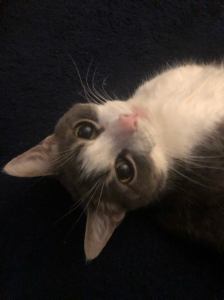
Me-Me, my seventeen-year-old kitten, died yesterday afternoon. She had been aging for a while, going through what looked like a bout of feline senility, so it wasn’t unexpected.

We adopted her as a kitten from the neighbor’s. One afternoon, there was a knock on the door and my husband and I answered it to two little girls who wanted to know if we wanted a kitten because the local tom had killed all the male kittens in the litter and they wanted to save these kittens. I decided on the grey-and-white kitten, and we named her Me-Me, because she liked to be the center of my attention.

Meemerz was a one-person cat for much of the time, and that one person was me. She would hiss and bite Richard, until one day she warmed up to him and became our cat.

She was always a bit — flaky. Ditzy. Flighty. Spacy. Whatever word you choose to denote a cat who seems a little … vacant up there. She wasn’t cognitively impaired, just an airhead. Like she didn’t have a thought in the world. We imagined her saying things like “Why are clouds?” and “Food?”

This morning seems a little empty without my geriatric cat sitting on the couch.

A Very Difficult Life

Daily writing prompt
Your life without a computer: what does it look like?

I remember life without computers, because I grew up in the Sixties and Seventies, and the first DOS computers came out just before I went to college. DOS computers didn’t have the Internet or beautiful, intuitive interfaces, and composing a letter on one meant staring at a black screen with green letters. I used a typewriter to type my masters’ thesis because attractive typefaces were a blip in the future and things typed on a computer looked like they had been typed on a computer. And I was one of the more computer literate people I knew.

I would not want to go back there. I didn’t write a novel because it would have taken tens of hours to search for information on desert flora and fauna. I knew American deserts weren’t made of sand, and that’s about it. Years later, after the Internet, I wrote the novel with information I found on the Internet in mere minutes. I use the computer to communicate, to entertain, to research, to compose. My life without it would be difficult and tedious.

On the other hand, expectations of quality and speed were less back then. The one typeface of a computer was acceptable, and the time limitations of snail-mail were tolerable. A writer could get away with fewer books written further apart. My expectations, though, are shaped by the era of fast, aesthetically pleasing, versatile computers that expand the limits of what we produce.

Life without my computer would be tedious and bland. I don’t want to go back there.

Just One Thing?

Daily writing prompt
What’s something you would attempt if you were guaranteed not to fail.

The question comes up in inspirational writing, as a prompt on the Internet, as a thought piece. ‘What’s something you would attempt if you were guaranteed not to fail?’

I have a list. An endless list. Why would I squander the opportunity to accomplish things?

My list starts with ‘get traditionally published’, with an agent and everything. I would be crazy not to try for that if I couldn’t fail. ‘Try for full professorship’ would be second, although I would have to do more important research if I wanted to do that. ‘Skydive’ might be the third, but I’m not sure about that, because I do have a fear of hitting the ground. But I wouldn’t fail, so what would there be to be scared of?

Learn carpentry. Walk the Illinois-Michigan Canal trail (that would take a lot of work getting ready, but if I can’t fail — ?) Clean the house, I mean REALLY clean the house, which can be overwhelming. Kiss Viggo Mortensen.

I’m just getting started, but I’ll stop for now. You don’t want to read the full list.

The New Normal

Daily writing prompt
What would you do if you lost all your possessions?

I think about this question a lot lately. Between teaching a disaster psychology course and thinking about the aftermath of the hurricane on America’s southeast portion, the vision of devastation haunts me.

I have too many possessions, some of which are junk that I haven’t bothered to throw away. Some possessions are useless kitchen gadgets, some things I have intended to use someday. Some are collectibles I treasure, some are items for everyday use.

If I lost all my possessions, I would mourn. I would mourn the symbols of my life, the house and the collectibles and the sentimental items. This is typical for someone who has lost everything.

Then, eventually, I would attend to the practical matters of replacing the items in my life. I have homeowners’ insurance with a replacement cost rider, so I would receive the amount of money it would take to replace my possessions. I would own less, focusing on the necessities. I would not have the antiques anymore or the sentimental items, but I would have what I need to function in my life.

I suppose I would always mourn a little. But, like disaster survivors do, I would learn to live with the new normal.

Long Break

I haven’t gotten back into my writing routine, and that worries me.

Maybe I’m tired at the end of the day, facing new classes and old challenges. It’s more likely to be that I’m stymied about my current writing projects, pantsing projects that seem more often than not to run themselves into walls.

Maybe I need a break from writing right now, but I’m afraid my break is going to turn into a forever break. I can’t believe that a couple months ago, I said that writing was my flow activity and I could never see myself not writing. Right now writing is not flowing at all, but jolting like riding a bike with square wheels.

I know I’ve written this before. Many times, in fact. This time is not different. I will get over this.

If I Were a Carpenter …

Daily writing prompt
What skill would you like to learn?

I have always wanted to learn carpentry. I think it would be a satisfying skill to have because it’s very useful. Building furniture and boxes so I didn’t have to buy them? I would love that.

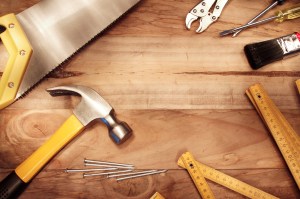
Assorted work tools on wood

My dad made me a cabinet from a packing crate and scavenged glass from old windows. It’s beautiful. I’d love to make something like that.

What’s keeping me from becoming a carpenter? Very poor proprioception. What does that mean? It means that I have very little sense of where my body is at in space. I sometimes sit down and miss the chair. I have been known to smack myself in the face. Life with poor proprioception is a bit challenging. Carpentry with poor proprioception? Tragic, because carpentry is fraught with very sharp objects, some of which whirl at high speeds.

In addition, I have poor hand-eye coordination. There’s no guarantee that saw is going to end up where I intend it to go. I’m likely to run it over the hand I don’t know where it is (see above).

Therefore, my choice not to learn carpentry is an exercise in self-preservation. I like my limbs where they are, thank you.

My Creative Mind

Daily writing prompt
What’s the trait you value most about yourself?

Without my creativity, my world would be a much less interesting place.

Tangled line leads to yellow light bulb, creative idea. Problem solution, concept. Think differently. Leader and success

Creativity comes into play at every point in my life. Solving a problem, writing a homework assignment, making a decision — these are rational pursuits, but how I solve them requires my creativity. I must turn the thing around in my mind, thinking about the angles of the pursuit, and my mind looks for the most elegant solution.

Other activities, such as writing, designing my book covers, telling stories, obviously use creativity. These are part of what make my life worthwhile, so I can’t overestimate the importance of creativity to me.

If I lacked creativity in my life, I would not know what I was missing, but my life would be less rich. I would be minus the method by which I attack life’s challenges.

Storytelling in my Family

Daily writing prompt
What aspects of your cultural heritage are you most proud of or interested in?

For an American, this is a tough question to answer. In the US, when someone asks this question, the answer often involves cultural heritage of one of our strains of ancestry rather than dominant American culture. We do not see US culture as culture but as the default against which our ancestors’ cultures play.

For example, people in the US talk in terms of hyphenates. They are Greek-American, Polish-American. African-American. Or they say “I have German ancestry”. The people who say this often experience their cultural heritage at holidays or in public festivals, or they live in an enclave where many people with that ancestry live. They notice differences from their classmates growing up; their classmates didn’t eat olebollen or pickled herring on holiday.

Which brings me to what I like about my cultural heritage. I am, like many Americans, a ‘mutt’. I have German, Dutch, Polish and Irish on Mom’s side and French, German, and probably Welsh on Dad’s (among others), according to Ancestry.com. Of these, I’m most cognizant of the German/Polish on Mom’s side and the French on Dad’s. The German/Polish on Mom’s side was a matriarchy of sorts that tried to ignore the Polish ancestry for bewildering reasons. The French on Dad’s side was what is known as ‘trapper French’, or the Canadian French who lived through hunting, trapping, and trading wild animals.

What I really like about my cultural heritage on both sides is the storytelling. The storytelling techniques of each side of the family are totally different, which is why I feel there’s a cultural component. My father’s side of the family told hunting stories with escapades often fueled by alcohol or naivete. Very often the stories started with “Do you remember when …” and end in an absurdity. For example, “Do you remember the time when Ronnie shot the owl up the tree? He ran up to Larry and said, ‘Hey, can you help me get this rabbit out of the tree?’ Larry looked up and saw a dead owl. ‘Ronnie, that’s an owl.’ ‘I wondered how that rabbit got up the tree.'” It’s funnier in person, honestly.

With my mom’s side of the family, the stories often involved word play or other witticisms, and often featured my grandmother as the ‘straight man’ in the joke. My grandmother was confronted with her seventeen-year-old daughter Marie, who said, “I’m going to marry Wayne.” “You can’t marry Wayne,” Grandma said. “Then I’ll elope.” “You can’t elope.” “You watermelon!”

I tell the stories of my family on occasion. I also tell my stories in their ways. One story, as it spread across my peer group, became a friend’s anthropology project in a class. Others can be evoked by their punchlines.

Cultural heritage is a complicated topic in the US, but I can find mine in the stories I have grown up with and the stories I tell.