I’ve written this fantasy book that hasn’t been “discovered yet”. Part of the reason it hasn’t is that I haven’t done a good job of selling it. Maybe it’s impostor syndrome; maybe it’s my inability to write good taglines. But here goes:
Gaia’s Hands
Professor Jeanne Beaumont designs oases of edible plants. Josh Young, English instructor, sees visions of danger approaching Jeanne and her talent for making plants grow inches overnight. Josh’s visions prove true as Josh and Jeanne install her dream garden — to face trial by fire.
Professor Jeanne Beaumont’s plants grow impossibly lusher and taller when she talks to them. Josh Young sees visions of Jeanne surrounded by a vast garden with a violent storm on the way. Josh and Jeanne must weather dire events and their eerie adversary — and they will face fire in Jeanne’s most ambitious garden.
Josh Young sees a vision of horticulturist Jeanne Beaumont standing in a lush garden, facing a deadly storm. He must work with her to help her face her talent of making plants grow inches a day. Soon they face an ever-increasing threat which will try them by fire.
So, any of these? None of these? I’ll try longer ones later.
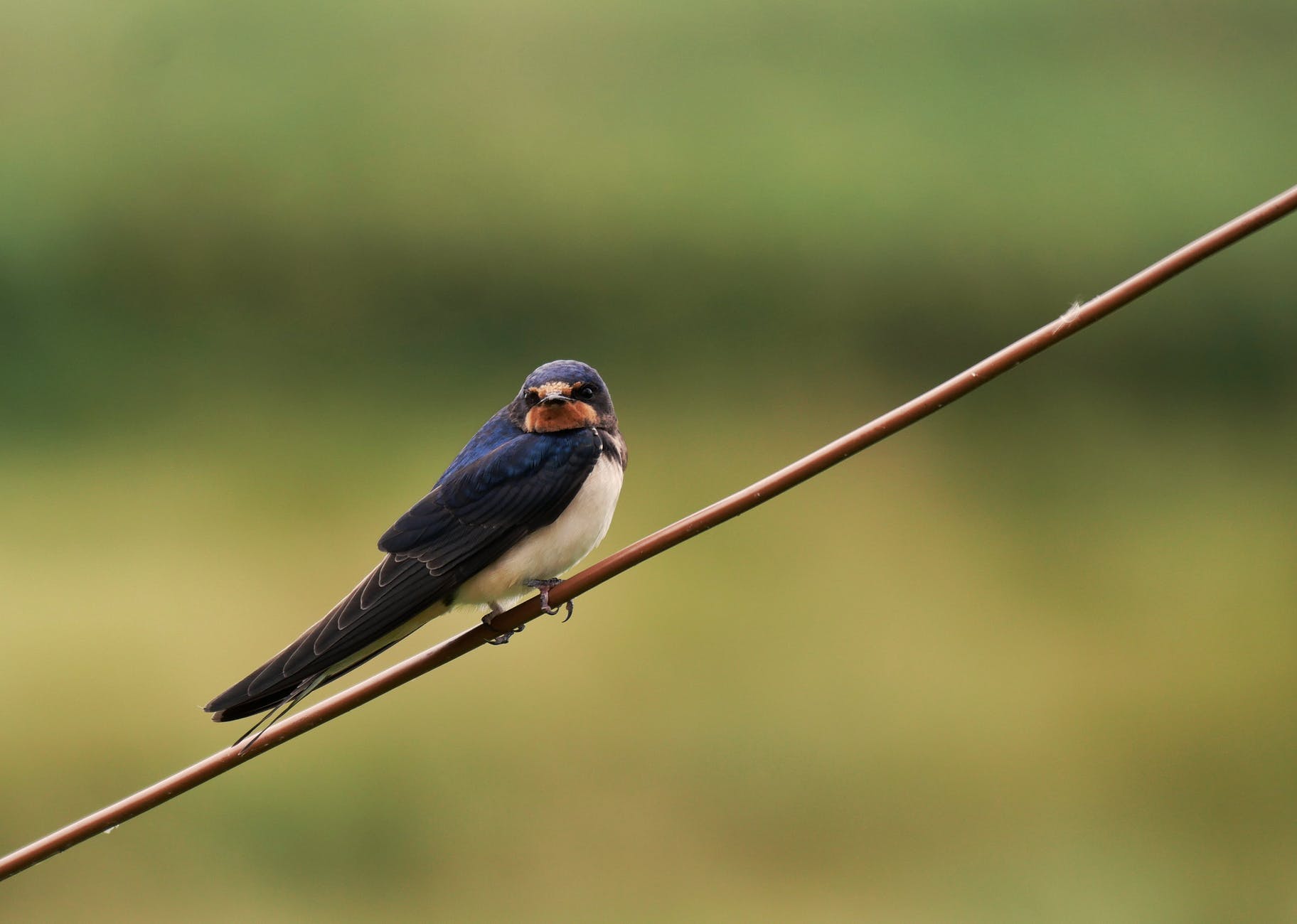
Out the window of the cabin, I watch the barn swallows preen themselves. Blue-black shoulders and rusty chests. They soar and flutter to catch their daily quota of bugs, and then they preen.
A big guy has arrived to weed whack in the backyard, startling the swallows. He’s wearing a Bearcats Football t-shirt. He’s probably a football player. Football players don’t get cushy jobs here in Bearcat Nation. That’s part of why we have the best Division II football program in the US —
Richard is not here — he’s at work. I’m at work, too, if you count the emails I have been answering. It’s hardly a job; I’m down to about 3-5 per day from the 40-some during the school year. Hence the mini-vacation.
Hence the writing retreat.
I will only be here a day or so; I relish a mini-vacation, a writing retreat, a hope that I will reclaim myself as a writer. Small steps, this blog first. A cognitive exercise if I need to dissipate my feelings of mediocrity. And at least a few words of writing.
Inertia is the supreme force of human nature. Remain still, and one will find the couch incredibly tempting. Force oneself off the couch, and movement and industry flow. I am not a vegetative sort; I enjoy making things happen.
Right now, I am facing my nightmare of inertia: I am away from my other time demanding activities, the gardening and the researching thereof, and I don’t know if I want to get off the couch. It’s like being tired of the thing that gives one identity.
One of those procrastination tricks.
I will now trick myself into writing. Richard says I only need to write a little, so I will promise myself 15 minutes. If I can’t write more than that, I’ve done my bit of writing. If I can write longer than that, then I’m breaking the barrier of inertia.
(Bonus: What does the above line come from and what does it mean?)
My plan is not working
I put prompts in my calendar to remind me to write in this blog every other day and post a TikTok every other day. So far, I’m three blogging days behind, although I did my TikTok this morning, after a fashion. This self-promotion thing is not going very well.
Next to tackle — my fears
I know what’s impeding my writing — any of my writing. All of my writing, from books to blogs to Facebook posts — the fear that I’m not good enough at writing. The fear that I am, in fact, boring.
Therefore, the block to my writing is psychological, and since I teach in a behavioral science department at the local college, this should be easy. Except that my discipline is not psychology. And I don’t do well psychoanalyzing myself. Oh, and things that hinder me erect roadblocks that make it harder to resolve them.
For example, I think I don’t write interestingly enough. In my heart, I feel it. The lack of sales/readership seems to support my feelings. I know I don’t promote enough, and I know that focusing on the bad is confirmation bias, but my mind still fixates on the failure and my suspected reasons for it.
What my psychology friends would tell me to do
I don’t consult my psychology friends at work, because 1) Most of them aren’t clinical psychologists, or psychologists who see patients; 2) It’s not cool to ask psychologists for therapy for free; and 3) I would end up with messy dual relationships — therapist AND friend? Ugly. So, truly, they would tell me to F* off if I asked. (You didn’t expect this paragraph to go like this, did you?)
But I know better, because I’ve had Therapy with a capital T, owing to the lifespan of baggage that comes from childhood trauma and bipolar disorder. And, as therapy at its best provides a set of tools one can use to manage themselves, I can go back to the learning experiences of therapy and find a tool to use with myself.
Today’s tool is called cognitive-behavioral therapy, specifically the journaling piece. The aim of the journaling is to contradict what are called cognitive distortions, which are thought processes that do not make logical sense. I will illustrate below:
Thought: “I must be a boring writer.”
What I would have said before: “You’re not a boring writer. Some people have read you. It’s just a matter of marketing. You’re really not a terrible writer.” I can counter-argue everything I just said because it’s a combination of opinion and not-very-comforting facts.
Placation doesn’t work. Try demolishing the illogical:
“I must be a boring writer.”
This is an all-or-nothing statement: There’s a lot between boring and best-seller. Are you saying everyone thinks you’re boring?
This is a mind-reading statement. How do you know how people think about your writing?
This statement is “awfulizing”. Is “boring” a realistic assumption regarding your writing?
Note that I’ve argued the merits of the statement this time, not perceptions of reality.
Now, I replace these thoughts with new thinking:
I have come a long way since I started writing and have clearly gotten better.
The people who haven’t read my book can’t call it boring.
And finally, a call to action:
I will make a promotion/marketing plan and stick to it.
I will continue to write.
It’s been pretty therapeutic to type this out, suggesting that I could use this more often. Maybe I’m ready to write today.
This past week was everything a finals week could be: Students missing finals because I told them the wrong time, students sleeping in, potential academic dishonesty (it wasn’t), a good annual review, a lovely lunch with my colleagues, plants coming into the mail to remind me that there will be gardens … a great finals week.
Now for the existential crisis
I can’t postpone my confrontation with my writing any longer. I make excuses: I have to make a batch of bokashi to raise my compost game. After the semester, I should take a break.
No, it’s going to happen now. I’m going to confront my feelings about writing right here and now.
This is the first issue for me as a writer: who I am. I write fantasy with some relationship elements. I write fantasy romance.
Most of what I have let out to the public, however (as opposed to most of what I’ve written) is the fantasy romance Kringle Chronicles. Those books are fun, relaxing, and put me in the holiday mood.
The problem is that I am not a romance writer. I have hung out with romance writers, and they talk about (in harmony) things I do not at all want to read or write: alpha males, shape-shifters, explicit sex scenes (I’m not anti-sex, I’m anti-unrealistic-sex), BDSM, and just everything over the top.
It’s about fantasies. And I can fantasize a lot about things, to where I’ve had my writing considered very original, but I want my relationships to be reasonably, well, healthy. I want my readers to think about the possible.
And this is where the crisis starts
We writers are told to write from the heart. My heart, whether in fantasy or romance, wants the people to be real and complex. In my fantasies, we have realistic characters thrown into fantastic situations. In my romance, same thing, except that the developing relationship is the primary plot point.
And I’m not sure what I’m doing sells. People apparently want alpha werewolves who are deadly but just and protective toward their mate, who until they showed up was the bullied and rejected waif (this is the synopsis of about 14 novels advertised to me on Facebook).
The crisis is that I can’t write this.
I write with the attitude that the alpha werewolf and the beleaguered waif don’t need a story. They’ve had a story for millennia. If I’m going to write Cinderella, I’m going to write it in a way that someone hasn’t done before — Cinderella is a librarian who has nothing but hard work and her garden, until a mysterious neighbor named Dane Prince sweeps her off her feet — but then she has to save him from the land of Faerie. (Actually, I am writing that story — it’s one story I’ve taken a break from).
But that’s the lingering feeling. I don’t know if the world needs my stories. I don’t know if I care about that, if my stories are good. If I found out that my stories nourished people, but the stories that sold were popcorn stories, I would want to keep writing nourishing stories.
But I don’t even know if my stories are nourishing, because I’ve had trouble selling them.
Which brings me to the other thing: marketing
I don’t sell books because I am terrible at marketing. I am terrible at bringing myself to carry out the strategies of marketing and pretty bad at the strategies themselves. Post on Twitter 12x/day? Write an interesting newsletter? An eye-catching visual on Instagram? Heaven forbid, a video on Tik tok?
Again, I write what my heart tells me to, and I’m afraid it’s boring.
What it boils down to
I know what this boils down to: I think too much, and more than anything, I think I’m boring. If anyone has a solution to that, let me know.
I’ve just been very busy. That’s something built in to the month of April at a university — finishing class instruction, grading end-of-semester assignments, shepherding interns through the search and sign-up processes. And then there are the plants and the gardens. I think I have over-committed, but as always, it’s how I roll.
Feeling the breezes of Spring
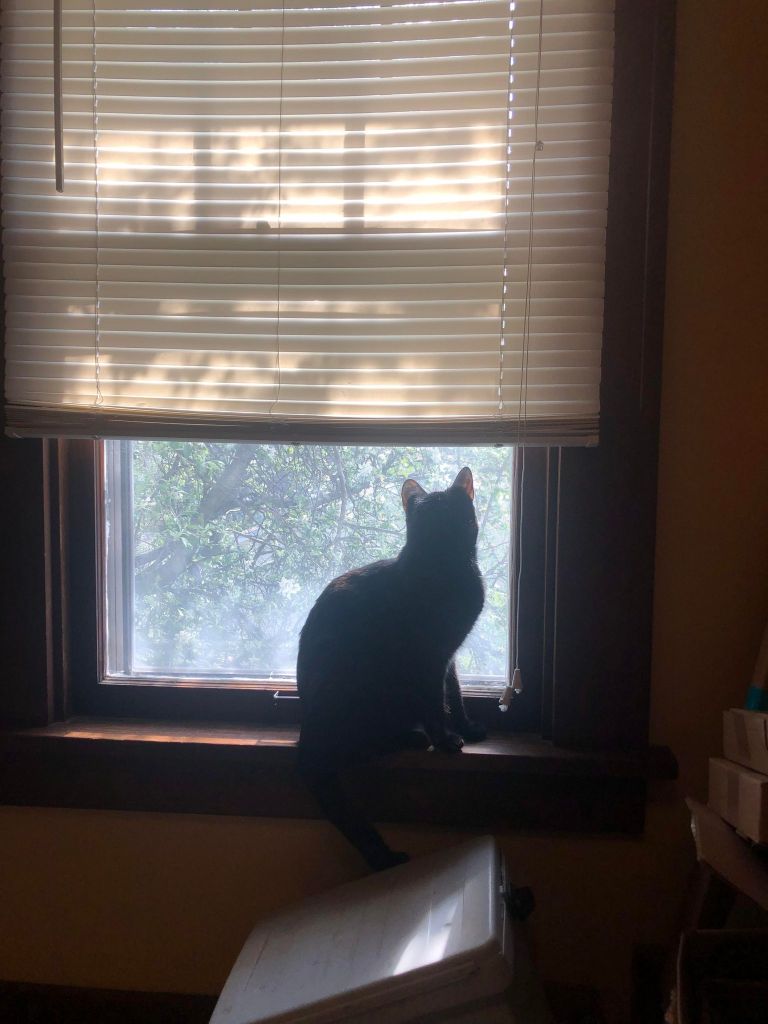
This is the first Spring semester I can say has flown by quickly, even though we had inconvenient snowfall through March and even into April. Today the apple blossoms sway outside my office window and my youngest cat, Chloe, stares out.
Chloe turns 1 today, so perhaps she’s celebrating.
I’ll be celebrating soon. By the end of the week, I will be in full summer mode, where I have about 1/4 of the work I normally have, with a largely open schedule for three months. This means time to blog, to organize my thoughts, and to get past thinking about writing into actually writing.
I teach a class in positive psychology. However, I am very skeptical about it. Toxic positivity is often mistaken for positive psychology. It’s not positive psychology that possesses us to walk up to the depressed and say “Don’t feel so bad, it’s a beautiful day out!” or to the woman who has lost a child and say “You can have another one!” That is toxic positivity, and true to its name, it’s toxic to the well-being of the person who has every right to be angry or sad. The person spreading toxic positivity does so to not have feelings themselves, and they shut down the feelings of the sufferer as if they have no right to exist.
A Magic Conversation
I had something happen to me yesterday that was the opposite of toxic positivity, and I’ll describe it to answer why. As my readers know, I am in the middle of experiencing the 10-year anniversary of a time in my life where a psychiatrist diagnosed me with bipolar II and the emergency room referred me to inpatient. The behavioral health ward is a pretty quiet place, but the lack of autonomy — no cell phone, no computer, no shoelaces — accentuated the feeling that I was a pariah. (I don’t even want to talk about the worst bed I have ever slept on, and I have slept on the floor on an air mattress). I mourn my life before its complications, even knowing that I suffered from deep depression.
Yesterday, I ran into a friend for the first time in a while (she stuck her head in my office) and we caught up. I told her I was in the middle of my 10-year anniversary of my hospitalization, and she paused for a moment to share that feeling with me, and then she said something that totally surprised me. She said, “You need to go out and celebrate.”
My first reaction was a moment of incomprehension. Celebrate? Celebrate what? I must have looked confused, because she said, “Most people (with bipolar) can’t say that.” A glee bubbled up in me. I was not a sufferer, I was a survivor! Suddenly, I knew where I wanted to celebrate and what item on the menu I wanted.
A Cause for Celebration
Why was her statement positive psychology and not toxic positivity? First, because she gave me space to feel. That’s important, because toxic positivity shuts down feelings. Second, because her suggestion to celebrate acknowledged my bipolar rather than demanding an escape from it. Third, because the positive related to my effort to stay out of the hospital instead of fatuous praise.
The conversation was an alchemical moment, and I now look at the hospitalization as the first step in living a stronger life.
I have progressed as far as looking at my outline and making minor notes — mostly wrong names. I’m trying to figure out when Leah gets pregnant, because that’s a dramatic beat. Leah should get pregnant at a place where tension increases, because that’s how this is done.
I need to decide to build this story into a Save the Cat framework and move things as needed. By a Save the Cat format, I mean a story structure that walks the writer through a build-up, a tension state, the climax, and the aftermath. But I feel so much torpor, much dragging of feet. I need a good session with my husband and plenty of coffee or tea (or coffee and tea).
I hope to motivate myself to write through Camp NaNoWriMo in April. I won’t get the story done, but I will get it started. Maybe I’ll fall in love with my characters and find the energy to write the story. I hope.
I had two good things happen to me yesterday, neither of which had to do with writing. One was an invitation to a focus group that resulted from a leadership class I took nine years ago, and one was a request to do moulage for the city of Albany, MO’s high school docudrama (think staged car wreck with all the resultant carnage). Both requests made me feel wanted and worthwhile, and I marveled at how much better I felt at the meeting I ran for the Human Services committee for my department at school.
All this time, I thought that what I wanted was recognition, what I called “cookies” in my mind. But I realize I feel ambivalent about cookies, because they too often result from the rewarder’s motives rather than intrinsic work. I received a National Merit Scholarship Award from AT&T in 1981, and I realized quickly the banquet was more about AT&T than about my award. Several more situations like that make me feel ambivalent about cookies.
Being in demand, however, says “We called you because you’re the local expert.” (Or perhaps the cheapest, but I know my reputation for doing moulage). I enjoy sharing my expertise and getting praise for it. I enjoy showing my talent off.
It feels especially good that I get this attention when I’m worried about mood swings coming up on the 10th anniversary of my hospitalization. It reminds me that there’s more to me than the depression.
I read a Facebook Time Hop today in which, ten years ago, I wrote about the last Family and Consumer Sciences banquet at Northwest Missouri State University. It was the last banquet because my department got axed that spring for reasons that never quite made sense. Our enrollment was healthy; what was not healthy was the scorn society heaped on our existence. For we were the very unsexy formerly known as home economics. That, I think, was enough to cause our demise.
It’s also ten years since the most horrible semester I’ve had here at Northwest, because as my department’s demise brought a very clear fear of being left in the unemployment line, I also had my definitely hypomanic moment. I was hardly sleeping, putting large amounts of work into a project that wasn’t supported by the leader. My gradebook was a mess. I was going fishing at 2 in the morning by myself. I was angry — at the university, at my coworkers, at Richard. This led to a Bipolar II diagnosis and a few days in inpatient care to level out my meds. My semester ended early, but I had become passive, inert from a medication that didn’t work for me, and which incapacitated me all summer before my new psychiatrist and I realized that the tiniest dose made me into a zombie. My husband and I bought a house somewhere between the end of the semester and the internships I would not be allowed to supervise; I was one thing we moved into the house.
I have been pretty stable with the meds for the past ten years, if “stable” means having periods of moderate depression (but no suicidality) or months of hopeless crushes (but no stupid midnight dates with catfish — real catfish — at Mozingo Lake). Sometimes I feel like a nut, sometimes I don’t, but I’m pretty stable. The gradebook is always neat in case I become unstable again.
But I’m superstitious. I have been stable for ten years, but this year’s an Anniversary. When I see the light through the curtains, I worry about my job falling apart. I smell Spring and remember growling at Richard until he let me go fishing before the sun came up. Beauty is suspect, because the greens of mania scintillate with colors brighter than life.
It’s been 10 years, and I still feel like that Spring long ago broke me. Who I am now seems diminished, and my writing was a way to transcend the mousy older woman I’d become. It hasn’t worked.
It seems like I’d have gotten used to the “New Normal” by now, but having spent 48 years in at least cyclothymic and bipolar 2 state, those highs and lows were my personality. Now I need to find the personality that remains when the highs and lows are taken away.
I looked at the chapters so far for unknown title (formerly God’s Seeds) through ProWritingAid to acquaint myself with what I’d already written and to fix my idiosyncratic style before proceeding.
It went well. I got rid of all of those unusual dialog tags I excel at. The problem is, I don’t know where to do from there. It’s not like I’m pantsing, where I am making things up as I go along. No, I have an outline, but it’s so long since I’ve touched it I don’t know where to go with it.
I need my assistant (husband Richard) to help me sort this. But he’s sacked out on the bed.






 Words Like Me