I can be found on Facebook, which to me feels like my small town, only populated with nerds like me. And on Instagram, which feels like going to a petting zoo, since I follow mainly celebrity cats. Those, for the longest time, were my only social media.
But then, because I’m a writer who needs to promote books (well, book anyway), I’ve been encouraged to seek out other media.
And now
Maybe it’s because I’m a Boomer, or perhaps it’s because I grew up in a small town, but the digital world suddenly seems too big to me. I have almost 5000 followers on Twitter (writers’ Twitter is very generous with its likes), and that was the size of the town I grew up in.
And now I’ve been advised to go on Tik Tok. Tik Tok seems like a really crowded circus sideshow in which I’m one of the performers but I can’t find my booth and I don’t know what I’m supposed to do. I’m overwhelmed, and wonder what one would do with 180k followers if one could get them.
So I’ve joined Tik Tok anyhow
I joined Tik Tok yesterday and will be putting up my first video today. I don’t know that I’ll be exciting — I’m a nerd who likes coffee and cats and writes occasional novels. I have four friends on Tik Tok. I have followed three internet famous cats. I have ordered a light ring. I remembered where I put my makeup so I look good (as good as I can) on camera.
We shall see.
Here’s a question:
Are any of you on Tik Tok? My username is @lleachie. Drop me a line!
It’s been a busy morning. I’ve prepped four signed copies of The Kringle Conspiracy for the mail today — I have friends that want my signature. It took extra coffee to get me on task today, because I had nightmares about getting the wrong signed book in the right envelope. I swore, with that, I would complete the task first thing before I psyched myself out. Task completed; now to mail them.
Which brings me to my topic
How is it we let fear of failure get in the way of our dreams? It’s common enough that Harvard Business Review has an article on how to overcome fear of failure. So do others, but I like HBR’s version because it fits with my world view. (wise words or confirmation bias? You decide.)
Here’s their list with my musings:
Refine failure. This fits in with the SMART model of goal-setting. I covered the other day — goals should be attainable. I set a goal of “getting traditionally published”, and given the market, that might have been aiming too high for a first-time author. I still have that goal, but I set other goals like “self-publish one book”, and I feel satisfied with self-publishing The Kringle Conspiracy and its sequel coming out in November, Kringle in the Night.
Set approach rather than avoidance goals. This is the difference between “avoiding rejection” and “get published”. Or, for another dichotomy, “losing weight” vs “making healthy habits. If I accentuate failure, I start the journey to success cranky and hopeless.
Make a “fear list“. This is one I hadn’t heard of, and I’m going to start doing it. The technique is: 1) write what you’re afraid of, 2) write what you’ll do to keep it from happening; 3) write down what you’ll do if it happens. I’m thinking about how I might use this in my life.
Focus on learning. This one I love the most — because I believe my purpose in life is to always be learning. Those messy first drafts became polished novels with the help of experience. I managed to stumble through self-publishing. I’ve gotten tons of rejections, but it’s okay because I’ve learned. Success or failure, we will hopefully always learn.
The question
Drop me a line — how do you deal with favor? And which of these pieces of advice do you think will work in your life?
The only thing standing between me and summer is one final due today at noon. All I have to do is grade it, turn the grades in, and I am done with this school year.
The trouble with free time
What do I have planned? Not enough. I have sixteen interns to supervise over the summer, and I have a lot of time to do things. But the problem with a lot of time to do things is that it’s too easy to do nothing. The old saying is that work expands to fill the time. My experience is the opposite: Nothing expands to fill the time. I watch reruns on my computer, surf for hours, and engage in ‘horizontal snoring meditation’ (i.e. naps).
This is a question I’m going to keep asking myself over the summer — “Is this the best use of my time”? This question, if I’m being honest with myself, is the best motivator. Sometimes horizontal snoring meditation is the best use of my time; other times, it’s a waste. Many times, writing or the like will be the best use of my time. But this should keep me from too much dawdling.
Setting goals
I need to set some goals for the summer. Goals should be SMART. Which means:
Specific
Measurable
Action Oriented
Relevant
Time-bound
Goals help motivation by giving focus and standards and deadlines. I have not made my goals SMART yet, but here’s the beginning:
I will work on writing/plotting at least 2 hours a day
I will finish a short story or poem once a week
These may be overly ambitious, but I need to push myself or else I will get sucked into the void.
My work cut out for me
If I can stick with the goals (and if they’re realistic) I should have a fruitful summer. We shall see.
Getting (traditionally) published seems like an endless bout of submit, rejection, revise, repeat. Like Sisyphus with that rock he kept pushing up that hill. I admit that, when I get a rejection, I feel like that boulder has rumbled over me. But then, after a few minutes mourning, I appreciate the opportunity to try again.
Then hope sets in
I can’t stay sad for too long when there are revisions that can be made (to my document or to my query materials), submissions to make, and new possibilities that I have to check out. What pushes me forward is hope — hope that I have a better product, that someone sees promise in it, and that I will finally get the chance to show my stories to other people.
Hope carries me past the rejections, past the self-flagellation, past the desire to give up. With hope, each round of submissions is new as I try something else. Perhaps I will give up and self-publish, but self-publishing doesn’t push me toward excellence as much as trying to get traditionally published does. Hope is a heady sensation, like the sunlight on a June day, whispering “Maybe this time … “
My mind is simultaneously antsy and lazy — I should be DOING something! I have an exam to grade! I could be creating advertising materials for my book! I should be — my brain can’t focus. I feel like laying in my bed all day watching House episodes on my phone.
The tired part — end of the school year
I understand the tired part — I just got off a full semester without any Spring Break, after a year of severely restricted activity due to COVID. I made it without more than one or two sick or mental health days all year (due to the ability to teach over Zoom). With finals all that are left, I find myself slumping my shoulders and relaxing.
The antsy part — in need of flow
It occurs to me that the antsy part is the craving for flow. Flow is a psychological concept that refers to the state of being completely captivated in an activity that uses your abilities at an optimal level. Writing is a flow activity for me, as is editing. Designing (with my limited abilities) is another. Most of my flow activities happen at a computer and fit in with my writing, which is probably why I write.
No challenge is optimal when I’m just coming off a brain-numbing school year. I’ve been challenged out. I’m still dealing with three exams to grade this week and unhappy students.
Antsy part 2 — in search of accomplishment
Another part of my always needing to do something is the feeling of satisfaction I get from accomplishment. I delight in making things happen. I love finishing a chapter, a novel, a cover letter. I get motivated by the finished product as well as the process (the flow). Again, my mind is having none of that.
How to take care of myself
This is a time where perhaps doing nothing (or next to nothing) would be the best thing to do. It’s hard for me to do, because I’m always trying to wrap myself in flow activities and completing projects when I’m not working. Although I’m addicted to flow and accomplishment, maybe I could use something more relaxing but inspiring like daydreaming or meditating. Or maybe I should just read reruns of House and see if I can diagnose those disorders.
I had my annual evaluation meeting yesterday, and I did good. I met expectations in all categories, and I was very happy. I was happy because I managed this two years in a row. I was happy because it seemed like I was settling into a new normal that was, in fact, satisfactory.
My former messy life
For anyone who has not been following me, I have bipolar II disorder. I wasn’t diagnosed until 9 years ago at age 48. The problem that brought me to the psychiatrist was a frightening lack of sleep — at least a month at 2 hours of sleep a night. I dragged myself through days yet had racing thoughts, half-finished projects, and broken promises. And a feel like I was about to accomplish something great.
This is what hypomania looks like, at least in me. Overcommitment, sleep disturbances, slight grandiosity — but a brilliant ability to shine in those things I finished. I accomplished three things for each thing I abandoned.
Until I was depressed, and then I barely managed things. I would slump into deep depressions, barely making it to classes to teach.. My course evaluations would go down just as they went up during mania. During the last depression before the big crash, which I experienced near-simultaneously with the high, I would write these long, self-flagellating notes on Facebook, worrying everyone I knew.
After the crash
The inevitable crash sobered me. I spent a week in the behavioral health unit getting stabilized on my meds and walking off the most hideous side effect I’ve ever encountered (see akathisia). This is when I realized that I couldn’t go on as I had, and that I had to stick with the meds and find a new normal.
Learning to live with the new normal, however, was difficult for a person who had lived with effortless energy for a good part of her life. On meds, I didn’t feel the exhilaration of new projects that would buoy me up, so my productivity compared to my manic moments. My self-esteem went down, and I had trouble adjusting to this “new me” who didn’t get kudos for accomplishment.
Good enough
For a while, I didn’t do enough. Because I would get seasonal depression with a certain mix of meds, my fall evaluations would be down, and I didn’t do research because I had fallen out of the habit while my free-wheeling moods had taken over me before my diagnosis. Then, finally, my new department chair marked me as “not meeting expectations” in my annual report.
This shocked me. Other than gym class, I had never been marked unsatisfactory at any point in my career. I had had the fall/spring semester discrepancies, I had quit doing research, but I had never had an unsatisfactory mark in course evals. I panicked.
And then I set some things in place, knowing that I could no longer coast nor could I accomplish the wild amount of work effortlessly as I had in the past. I explained my bipolar disorder to my boss (I am protected by the Americans with Disabilities Act as long as I do the expected amount of work. I explained to him that the course evals might continue to be cyclical but that I would work on concerns. And I informed him that I would do enough work to get satisfactory scores, but would not be going for full professorship.
I have been working toward improving course evaluations and research. Some years have been better than others because I still seem to get seasonal depression. But for the past two years I have done good enough, and that’s the best outcome.
How about you?
What does a job well done look like to you? Feel free to answer in the comments.
I used to be a lucky person — you know, the person who wins random (small contests, not the lottery) and could be in the right place in the right time. Not that I never had setbacks or rejections, but that occasionally something delightfully unexpected would happen.
For the past few years, I feel like all my luck has gone, especially in the area of writing. Getting published is, to some extent, a matter of luck — having the right materials in the right place in the right time. This has so far, not happened to me. And I think it’s because I gave away my luck.
I did it for the purest of reasons, or the most obsessive of reasons. I was trying to be a good Christian and sacrifice myself for the good of others. There are ways of doing this that are helpful for the world, but I didn’t choose one of those. I instead decided I was unworthy of luck, given my privileged status, and so I gave up my luck. I said, “God, I don’t deserve my luck, please take it away from me.”
I brainwashed myself into believing that I didn’t deserve luck, and that other people deserved to have my luck. I believed that luck was a scarce commodity.
Photo by Miguel u00c1. Padriu00f1u00e1n on Pexels.com
A Fanciful and Superstitious — and Conflicted Person
Writing this down in pixels, it all sounds very stupid, I admit. I am, however, a fanciful and superstitious person. I don’t believe in The Secret (a book about the “law of attraction”) because it’s very materialistic and I don’t believe the universe could or should shower that type of abundance on individuals.
I do believe, however, that my negative attitude may keep me from seeing the good side of things and might blind me — ok, fine, I believe that giving up my luck is refusing to see what the divine could be calling me to find. As I said, I’m hopelessly superstitious. I honestly believe that I had luck, I rejected luck, and I am now less lucky than I used to be. Or at least, I believe myself less lucky than I used to be. I don’t know what I believe.
I am a fanciful and superstitious and rational and really conflicted person right now.
A Ritual Would Be Nice Right Now
I am not a witch or a Wiccan or any sort of pagan, but I still see the value of ritual. How do I divorce ritual from religion? The same way millions of people across the world do. People who wear lucky socks are performing a ritual. Traditions are ritual. Going out to a prime rib dinner the night the COVID vaccination takes hold is a ritual (one I did the other night). So what do I have to lose?
Luck, if one thinks about it, is a type of optimism. It’s an optimism that the unexpected good thing can happen, that one does not have to exert infinite effort for something good to happen. Not like effort isn’t necessary, but that there comes a point where effort doesn’t work any longer, and that’s a great place for luck to intervene.
A luck ritual, in my opinion, would:
Reattach me to my optimism that good things can happen without my control
Tell me it’s okay to have good things happen to me
Emphasize that optimism is self-care
What Does This Ritual Look Like?
Again, this is a psychological ritual (like lucky socks and Christmas china) rather than a pagan ritual, so I’m not calling up any spirits as much as I’m trying to make a break with old thought patterns. What I plan to do is:
Take a bath in milk and honey bubble bath
Write some journaling on luck using my favorite fountain pen
Eat some bread with butter and honey (the milk and honey symbolism is deliberate symbolism)
Find one of my four-leaf clovers in a book (or better, find one in the yard. We have some.)
What Do I Expect This to Do?
What I expect is that this will help me stop declaring myself unlucky, I will likely suffer less from griping about my bad luck this way. That itself would be an improvement. I hope that my better attitude will help me to see opportunities and make me resilient to adversity. I will believe that I am deserving of good things. And maybe, just maybe, I will be (or believe I am) luckier.
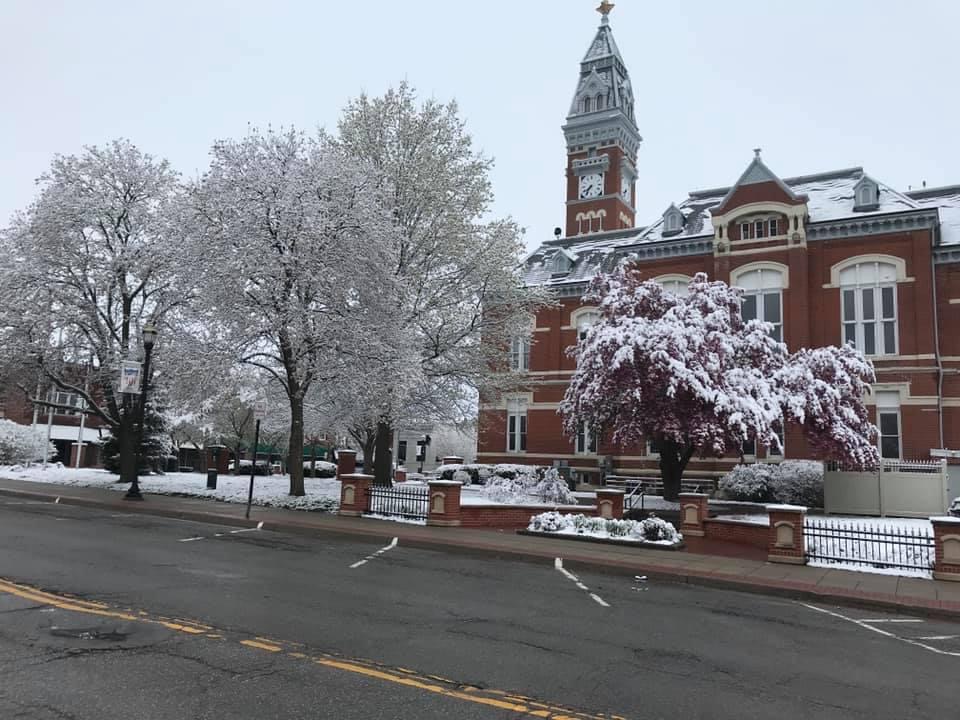
Yesterday, I woke up to a winter wonderland. In April.
As I walked out my door to head toward work, I faced wet, sloppy snow, clumped on trees, melting off sidewalks, covering the grass. Not the sort of thing you want to see when the daffodils and apple blossoms are out.
Missourians tend to face spring snowstorms with a combination of outrage and pride — “Nobody has shitty weather quite like ours!” Nebraskans and Arkansans say the same thing, but they’re wrong — Missouri bas bragging rights to fickle weather.
I did not worry about the snow. Snows in April are temporary, and the spring flowers shake off the snow and shine just as brightly when it melts. A spring snowstorm is, like so many setbacks, temporary.
As we say in this house, I have 50% cattitude. Girlie-Girl , a senior citizen at 13 is sleeping next to me, and Me-Me, another senior at 13, sleeps on the back of the loveseat where I sit. Cats sleep a lot, it turns out, but they don’t sleep soundly. Either one of these little critters will wake up grudgingly.
The loveseat is not only the favorite of the cats, but it’s my favorite. I do all my writing here, because the stereo is here, there’s a window next to me, a Nespresso pot in case I have a coffee emergency. And my husband sits on the couch and I bounce ideas off him.
Is this the perfect place to write? It’s close. I don’t like writing in the office, because it’s really cluttered and small, and there’s a sort of sensory deprivation.
My perfect place to write? In the lobby of a boutique hotel. There’s just enough movement that I feel comfortable writing, yet not enough to disturb me. These are my writing retreats, and here are a few of my favorites:
Starved Rock Lodge’s Great Hall
Starved Rock Lodge, Starved Rock State Park, Utica, Illinois. The CCC-built, log construction lodge is the gem of the Midwest, sitting in the middle of the best state park in Illinois. The Great Room, rustic and towering, attracts visitors who have just come in from hiking or just come out from the lodge-inspired restaurant. The chairs are just comfortable enough that sitting in front of the fireplace makes a cozy writing place. The old section of the hotel part of the lodge has, tucked in a corner, old-fashioned writing desks. Book one of the fireplace cabins (if you can) for added ambiance, although they’re too small to comfortably write in. Massages are optional. Highly recommended, especially at Christmas, when it’s beautifully decorated and families come to exchange gifts
The Elms Spa and Hotel, Excelsior Springs, Missouri. This has to be my favorite writing retreat. A lobby which evokes the 1930’s, seats by the fireplace, and a spa with a relaxation room and a hot tub/sauna/steam room/hot shower room called the Grotto, this is the place where I not only write, but recuperate. Facials, massages of various types, and hydrotherapy (I might be wrong about the last part) are available. There’s a café on site and an excellent restaurant that plays Sinatra music, as it should. Again, rooms are a little small to write in, but they are light and elegant.
Lied Lodge, Nebraska City, Nebraska. Lied Lodge honors the founder of Arbor Day, and is located on Arbor Day Farm. As one might expect, the theme is trees, and the lobby has high ceilings, wooden beams, and world-affirming quotes on the walls. Although the massive fireplace makes the lobby a little crowded, the section behind the fireplace yields comfortable rocking chairs and just enough neighbors in seats to stimulate thought in those who prefer background noise. The restaurant is excellent and inspired. Lied has the most spacious rooms of the three, with more wood beams to provide ambience, but still too small to write in in my opinion.
I haven’t been on retreat for a year, having kept much to myself during COVID. Now that I’m vaccinated, I feel safe enough to schedule a writing retreat at The Elms for just before Memorial Day. Whew! All I need now is something to write.