Welcome to My Winter Morning

Sunday morning, and Richard and I sit on the couch over coffee and Baroque music.

Our living room provides comfort with cream and burgundy and dark wood. Clutter from projects and plant catalogs litter the coffee table as garden planning helps us through the winter days. I sit on the couch next to Richard with a lap desk on my lap, tapping on the keys of a Microsoft Surface. Words come slowly today; maybe the coffee hasn’t taken effect yet.

The beans that Richard roasted came from Malawi, and the coffee brews up rich and brown sugar sweet with a slight herbal note. Yo-Yo Ma plays Bach on cello over a set of old yet functional speakers.

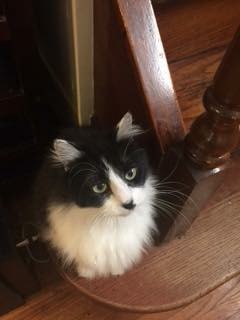
Chucky, the big butterscotch-colored cat, races upstairs chasing an unseen sprite. Me-Me, grey tabby and white, regards us with her huge, wondrous green eyes. Snowy, pitch-black and ironically named, sits in front of the fake fireplace warming herself by electric heat. Girlie-Girl, calico patched, demands something. Richard shrugs his shoulders and tells the cat he has no idea what she wants.

I light a candle, and the scent of sandalwood wafts to me. I drink my second cup of coffee and think about the seeds cold-stratifying in the refrigerator and other seeds in their packets waiting for the right time to be introduced to soil and water. It’s winter outside, and the weather forecast says it will get even colder, but for now I sit in my warm house on a Sunday morning.
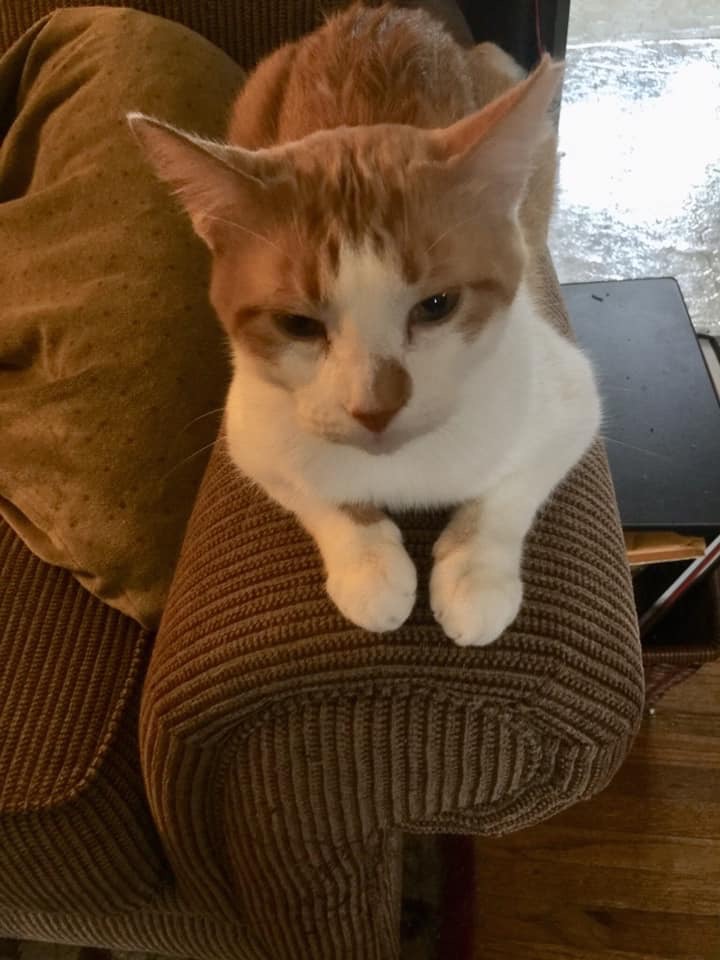
Buddy the Cat writes a guest column

Hey, I’m Buddy. I’m a cat, as you may have gathered from the title. Suspend your disbelief for a moment and accept that you’re reading a furry creature’s thoughts.

My people found me in their garage one day hanging out. Most people would be like, “Hey, there’s a strange cat in our garage. Let’s call Animal Control.” My people put out a food dish instead, so I stuck with them, patrolling their yard for intruders and snacking on their food. I let them pet me, of course.

Then one day I cut myself on something in the garage, big cut at the base of my tail that looked like I tried to skin myself. No big deal; I’m an outdoor cat and we’re tough. But my people caught me and loaded me up and took me to someone they called “the vet”, who stuck me a few times and stitched up my tail. But then the vet said, “Keep him indoors for at least three-four days,” and that’s how I became an indoor cat.

Indoors is warm, but it comes with five other cats. I’ll sit near them sometimes, but I’m not an overly emotional guy. The big cat likes to chase me around, but I set him straight, and now he respects my need for space.

It’s nice living with my people. I still go outside sometimes, usually by making a break for it through the basement door before they can catch me. It’s important that I guard the yard from miscreants, because my people don’t know how to. It’s up to me to take care of them.

Gotta go now. It’s petting time.

The inertia of a warm bed

Right now in northwest Missouri, it’s -8 degrees Fahrenheit (for the rest of the world, -22.2222 degrees Celsius).  In other words, it’s very cold. My blankets are warm. There’s a cat curled up with me. I don’t want to leave this warm bed to go to work even though I will spend no more than a minute or so from doorstep to workplace in the cold.

In other words, I suffer from inertia — a word which came from physics, meaning the inability of an object to change velocity or direction without a force acting upon it. In the human sense, it means the tendency to do nothing or stay unchanged (Wikipedia, 2019). I have to admit it’s going to take a force acting upon me to move me out the door today.

What are the forces that move humans? To continue the physics metaphors, we can group these forces into pushes and pulls. In our case, pushes are the repelling factors that relate to necessity and adverse consequences if we don’t leave the bed; pulls are the attracting consequences of getting out of bed.

So as I lie here in bed, I think about the pushes — if I don’t get out of bed, I don’t meet my classes, my division chair gets mad, my students miss out on class material. I think about the pulls — if I get out of bed, there’s breakfast and coffee and people and time to write. We feel more satisfied by responding to pulls than to pushes — it’s more gratifying to make something of the day than to avoid disaster.

So I climb out of bed, disappointing my cat, and start my day, responding to the pulls more than to the pushes. It’s going to be a good day.

Beyond the Naivete

When I first started writing, I felt the world needed to hear my story. Now I recognize the many thousands of stories out there and know not all will be heard.

I mistakenly believed my technical skills precluded the need for thorough editing; despite my considerable score on the SAT many, many years ago, I found that I not only needed to edit, but I needed an editor to point out the many places I made errors.

I believed my writing would rise above the other queries out there; however, I like so many others have not found an agent yet.

Optimism or arrogance, I do not know.  Naivete? Certainly. I do know what remains is that writing is a lot of hard work with no guarantee of return other than the satisfaction of creating.

I still have my dreams of being published, hopefully with a traditional publisher because I feel ill-equipped for self-promotion. I have my dreams of being read by others and being well-regarded, and I admit that I would love to sign books for readers. But those are dreams, and the reality is that I need to keep trying, keep improving, keep losing my arrogance if I’m to get published.

Self-doubt

I am re-editing Apocalypse, which originally was two novels until I realized the first novel would fit into the second one nicely. I intended this to be the next developmental edit until I got swamped with self-doubt during the editing:

Is the premise asking people to suspend disbelief too readily? Is the plot evolving too fast? Did I lose too much in the edit? Should I just give up writing?

Any writers who read this will understand self-doubt, the plague of writers everywhere. Or is it?

If self-doubt becomes the cloud of negative self-talk with generalizations like “I can’t write”, “I’ll never get the hang of it,” and “my work sucks”, self-doubt is a plague that should be banished along with overcooked green beans and day-long meetings. Cognitive distortions (overgeneralization, all or nothing thinking and name-calling in the example presented) provide no real information to help us improve and only serve to make us feel bad.

But there’s healthy self-doubt, the part that helps us edit the self-indulgent pieces out of our writing, the ones that help us bridge gaps in plot, flesh out characters, and make our books better than we thought they could be.

May we only have good self-doubt.

******************
Today’s weather (snow and ice) has left me with an unscheduled writing retreat at home. I’m not complaining at all.

For my cat Stinkerbelle

Stinky bit me in the nose last night.

Stinky — Stinkerbelle in full —  earned her name as a kitten by crawling up my chest and sweetly punching me in the eye. Adopted as a feral kitten out from under a friend’s porch, she hasn’t mellowed in her fourteen years on earth.

Stinky has not come a long way since we adopted her. She chooses to stay upstairs, mingling only with our other five cats when wet food is served. She hogs the food and now rather resembles a soccer ball — black and white and round. She hisses at the other cats, at us, at inanimate objects. She likes to have her back scritched — until, suddenly, she doesn’t, hence the bitten nose. All in all a disagreeable cat.

But Stinky will sit on the bed sometimes, close to my head, purring just out of the happiness of being near me. She will rub up against my hand ecstatically when I pet her and eventually bliss out into a cross-eyed state. She doesn’t hate — she just doesn’t know what to do with herself. 

So we love Stinky in the way one loves their problem children. Awkward, unbeautiful, cranky, at times lashing out. She reminds me of me as a child — roly poly and uncoordinated, unaware of how my intelligence put off people. I did not believe myself lovable, and told the school psychologist only the monsters were my friends.

I study Stinky and find my inner child, runny-nosed and crying, yet still worthy of love.

My Relationship with Coffee

I grew up with the same coffee served across the country in the 1970’s and 1980’s — coffee in a can from the grocery store, left to oxidize once opened to the air, brewed in an automatic drip machine which made a weak, brown, bitter brew that I doctored with lots of cream and sugar as an adolescent.

I discovered real coffee late in high school, when I spent the weekend with my dad in the college town where he’d been assigned to install some electronics for AT&T. I was sixteen then; he took me to a coffeehouse called The Daily Grind, and we sat down to some coffee. I took one sip of that cup and decided two things: I would go to school at the University of Illinois, and I would drink more of that coffee. Both of those things would come to pass.

When I arrived at college, I had a yard-sale percolator and a can of Folgers among my belongings, but I quickly abandoned them for coffeehouse brew. One day, I realized that one could actually buy beans at the coffeehouse and take them home to brew. I bought some for myself and for my parents, and although my parents proclaimed my coffee “too strong”, they appreciated the difference right before they went back to canned coffee from the store.

Once I left college 11 years later with a Ph.D., the coffee renaissance had begun. When I had started college, Champaign-Urbana had one coffeehouse; there were at least 5 when I left. Starbucks had not opened up the corporate coffee scene, but it was lurking in the wings. I ground my own coffee and brewed it in a press pot; this attention to detail (and deep, bold coffee) marked me as a coffee snob.

What the coffee renaissance really opened up, however, was home experimentation. Ways of brewing coffee thought previously lost — cold toddy brew with its smoothness, the aforementioned French press coffee, moka’s near-espresso richness, the fullness of vacuum pot coffee — found their adoptees. Home coffee roasting –using everything from air poppers to expensive drum roasters — appealed to the most experimental. Single-origin beans followed, and coffee drinkers became connoisseurs much like wine drinkers

Today, I drank a single-origin Malawi coffee that my husband roasted in the basement. It was as fresh as could be drunk; coffee is best if given a two-day rest after roasting. As precious as this sounds, the coffee beans are cheaper than those already roasted in the stores, and the nuances between coffees make each cup an exploration.

I don’t know if my relationship with coffee could get any better with this.

beans are cheaper

Becoming My Own Muse

What is the nature of a muse? A muse reaches into a creator’s soul and pulls forth the creator’s best work. As such, the muse is both the supporting angel and the demon lover, illustrated by the character of the Phantom in the musical Phantom of the Opera. Of course, all of this is in the mind of the creator; the muse himself might be a compelling person at the coffeehouse who asks about how the work in progress is doing and actually cares.

I had a muse once. Kind of a crazy thing, but he was an artistic type whose work appealed to me. And it didn’t hurt that he was beautiful in an ethereal way. He inspired me with his verve and his persistence, and my mind went on flights of fantasy and ended up in very vivid stories.

I had to give him up eventually. The problem with flights of fantasy is that they make one beholden to the subject. I had given the fantasy so much of my thoughts that I craved something back, even if it’s something as simple as recognition or support or friendship. Recognition, support, and friendship themselves feed creativity — anyone who creates needs connection and support, for creating is hard, lonely work sometimes. The muse remains a muse by being there.

My muse never made the transition.

In reality, though, people — even muses — will always disappoint us. In reality, people will not always be there when we need them. They will not understand what we need if we ourselves can’t articulate it. They can’t read our minds. They may not be able to see our beauty.

This is why I need to become my own muse.

Is it possible? The nature of a muse is intrigue and unpredictability and challenge, love and danger. How does one give that to oneself?

The Beginnings of a Novel

The outline for the new book is going very slowly …

Let me explain the general idea of the book. This is in the Archetype series, none of which has gone to developmental edit yet. A little background: Archetypes are near-immortal beings who are tasked with holding humanity’s cultural memories. If the Archetype for an ethnicity dies, all of the people whose patterns they hold die, so that an entire ethnic group (and, more likely, a large group of people of mixed ethnicity that includes that group) die.  This is why Archetypes have been held apart from humans and each other.

My series covers the interactions between one particular renegade family (unique in that Archetypes don’t generally have family bonds) and humans. The humans have their own uniqueness in that they have been gifted with abilities by (depending on who you ask) Gaia, the Maker of the Archetypes, God, or genetic enhancement.

The story I’m writing, tentatively called Gods’ Seeds, involves two threads that will come together as the story develops. But here’s a first attempt at synopsis:

The Council of the Oldest, the ruling body of the Archetypes, has announced that humans’ genetic and cultural memories will be gradually divested back to their humans, as humans have been found fit to retain them. Meanwhile, a young woman on Earth named Leah Inhofer sees horrific visions of Archetypes battling each other, with thousands of human casualties resulting. The Archetypes grow restless, knowing that their reason for existence is being taken away, and they will take desperate measures to keep this from happening. The conflict draws battle lines between Archetype and Archetype, and Leah must find the strength to stand between the two — or watch the decimation of humanity.

****

There’s a lot of writing in-between this paragraph and a novel. There’s character, there’s subplots, there’s relationships between characters. And there’s a lot of words — about 80,000 words on average. That’s why I’m going to write an outline, to help me find my way through the plot of the novel.

Wish me luck, and let me know if you’d read this novel!

Dear Reader:

Dear Reader:

Thank you for reading this blog.

I know you as data — what country hits come from. I know what posts are being read (but not who is reading what posts), and I know what times random people are posting. Here’s what I know about my readers:

1) I have about thirty hits a day on average. About half of those are from the United States. The rest are from a variety of countries, with Germany holding second place. Other regulars have been from France, Canada, Ukraine, Portugal, and Unknown Region are the most regular.

2) Some of you find me through Facebook, which means I probably know you. Some of you find me from Twitter, and I don’t know if I know you or not.  Some referring links are from bit.ly and IFTTT. I’d love to know how the IFTTT link works.

3) Some of you are probably bots. For example, I get about three hits a day from a web address that specializes in “web cam girls”.  I don’t follow those links anymore.

4)  I don’t know WHO you are. I would love to know who you are. If you’re a regular reader, you know I have said this before, because I mean it. I’m the sort of person who would not only like to sign autographs for readers someday, but chat with readers.

Please, if you know someone who would like this blog (writers, readers, my aunt Edna*) please amplify this and pass it on to them!

Love, Lauren

* I don’t have an Aunt Edna.