The desire to write is returning. I’m not sure I’m ready to pick up the problems with Avatar of the Maker yet; I may actually go toward Walk through Green Fire, a romantic fantasy of the quest variety and an older woman’s love story. Or I can write something new, although I haven’t had that inspiration yet.
My perverse mind (No, not that kind of perverse!)
What is leading me to write? Not an awakening inspiration, as I am still struggling with the muse in my life. No, it’s something that happens to me whenever important work comes my way — I want to write again. If I have all the time in the world, my brain goes torpid and luxuriates in bed. If I have deadlines or appointments, my brain suddenly explodes with the desire to write.
I think it has to be the type of work where I’m involved with my 9-5. When I spent the first couple of weeks this summer working in the garden, I didn’t feel compelled to write. But now that I have internship visits this week, now I want to write.
How this works
There’s a lot of pressure to write when one’s a writer. If one’s a self-published and self-paced writer like myself, there seems like there would be less pressure to write, but the desire to soar is always there, and it plays against the rejections and setbacks of being a writer.
When all one has is the drive to write, unchecked by the rest of reality, the setbacks can loom big, and failure taunts in the silence. As part of a more complete, even a more pressured life, I think about writing the way others think about vacations. I daydream, and then I write.
This morning, I said to my husband, “I think I liked it better when grocery stores looked a little bit beat up.” Richard didn’t know what I was talking about, not unusual when talking to me. But I explained.
When I was young, grocery stores weren’t shiny. They had been renovated in the optimistic late 50s, weathered bravely through the Bay of Pigs invasion and Kennedy’s assassination, and visited by mothers with Green Stamp books at hand…
I stop here, and realize I’ve gotten old enough to reminisce.
The stores of my childhood seem foreign even to me now. The genteel and struggling drug store with its soda fountain, sitting across the street from a corporate store that would itself later struggle to survive. The cluttered dime store, where my sister and I spent too much money on fragrances in child-friendly lemon and lilac. The department store we meandered through, its subdued light stealing the color from the merchandise.
I reminisce, and maybe I didn’t like the world of my childhood after all, the one reflected by those stores. It was as if my community had given up when the post-war bounty faded. Maybe we hadn’t learned our lessons in small towns, nor were we immune to the edict that rules the world: “Change or Die”. We did not open our eyes to the world or touch the hands of people who came from different places than we did. We stayed uninfluenced by new ideas. Our stores reflected us.
I will look at that shiny store differently now, as I try the cafeteria’s latest concept (which may fail, as new things sometimes do) and walk down the aisles where people say hello and not everyone comes from the same place I do.
Postscript — My home still has problems despite this metaphor. Although we have a university with an appreciable international student population, Black peoples still face discrimination and harassment here. Things are not shiny, but there is a glimmer of hope.
The advice about understanding one’s writing market seems to be what’s screwing up m y identity as a writer.
My identity crisis started when a developmental editor told me I was writing romance. ‘Ok,’ I thought, ‘I guess that’s what I’m writing.’ But I wasn’t writing the same type of storylines as the romance writers around me wrote. I couldn’t put my finger on it, but my writing wasn’t as outrageous as theirs. No ultra-rich bosses, no reverse-harems, no bad boys saved from a lonely, incorrigible future, and no alpha wolf shapeshifters redeemed by the love of the pack’s reject. No space aliens of exceptional prowess. I will not disparage these, as these genres make buckets of money, and I do not.
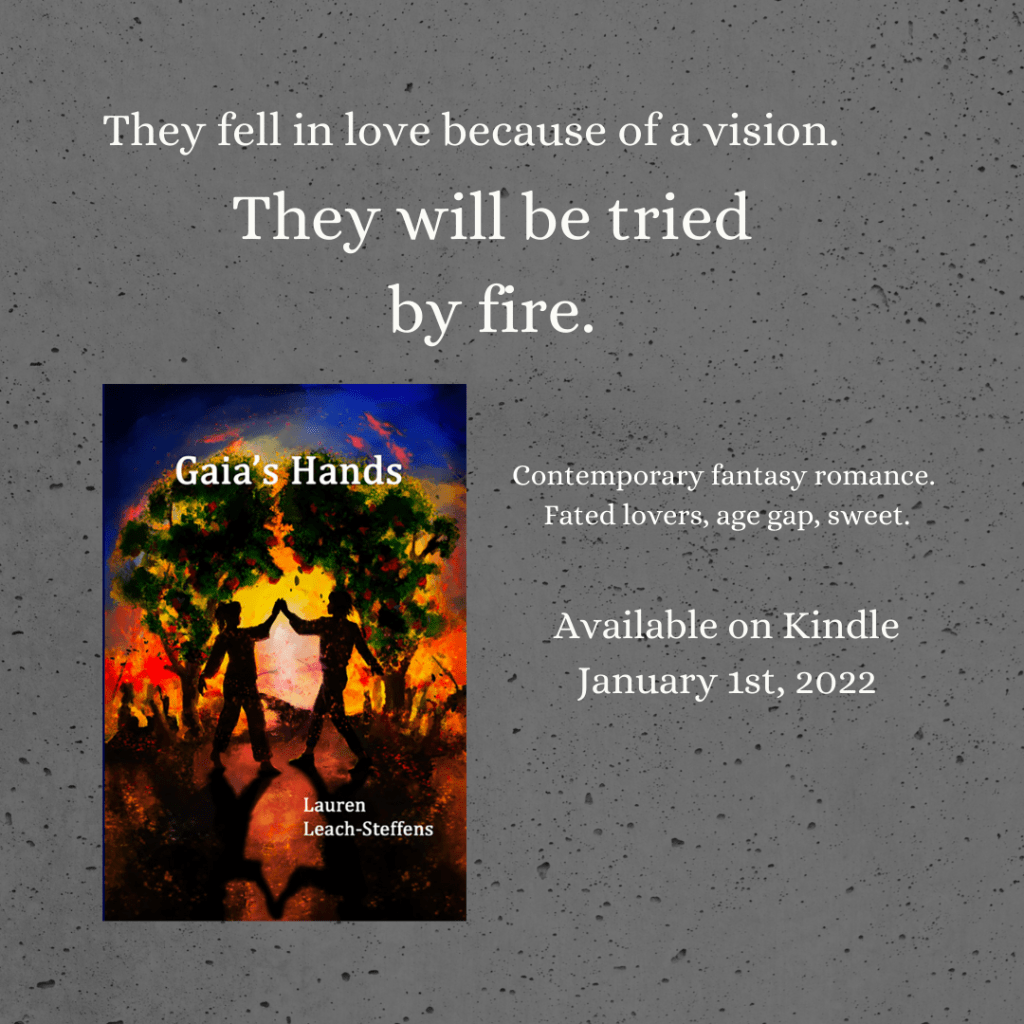
The thing, though, is that those topics don’t speak to me. I write fantasy grounded in the real world, with a few variables tweaked. Sometimes there is a romantic subtext; in one case (Gaia’s Hands) the main story line is a relationship framed by unusual happenings and a personal vendetta against the protagonists. There is one commonality in my writing: The fantasy world hides in plain sight among the familiar. I don’t write escapist fantasy or romance.
Today I heard the phrase ‘literary romance’ as a contrast to ‘escapist romance’, and suddenly I felt like I had found a home. Literary romance, literary fantasy. Something to hold on to, something to be, after feeling totally out of place in (escapist) romance.
I have a writing market, and I have to learn the rules of the market, once I figure out if I actually belong there. Literary romance, literary fantasy. Now there’s the problem — I don’t know if my work truly fits there. I’m not sure it matters as much to me as it does to the writing markets. At least I hope not.
I guess I haven’t resolved my identity issues yet.
I am 5 hours away from summer. My office hours (which I’m sitting in right now) are deathly quiet as students are taking exams or packing to leave. Some will graduate this week and find new lives. Others will return, and I will have a small portion of them in my classes. The cycle of my life, organized around the school year, turns again.
Then again
It turns out that my calendar has filled in, at least for tomorrow morning. One interview with the local news channel about Biden’s student loan initiative and my annual review with my boss. I took a break from writing this to answer the phone, which shattered my glorious plans for doing nothing tomorrow. Oh well, maybe I can eat a peaceful lunch today.
I haven’t written in almost a month. It’s been a rough month, a month of remembering, a month of irrational fear. It’s the ten-year anniversary of being diagnosed as bipolar. The tenth anniversary of being hospitalized. The tenth anniversary of not believing in myself.
It’s a harsh thing realizing that one’s invincibility is simply a state of hypomania. That one’s optimism is a mood swing. (Admittedly, it’s good to know that one’s suicidality is just a depression, but it’s hard to remember the lows when one is on a high like I was ten years ago).
Ten years later, I’m pretty stable, except for some depression in late winter and some giddiness early Spring. And superstitious worry that I will become unstable again every year at this time.
It’s a new normal for me, especially when writing, because I don’t feel overwhelmed by emotions when I write anymore. I wonder if my writing’s as flat as I feel compared to my amped-up days.
I am plagued with second-guessing my writing. I have strayed away from it. If you feel like sending good wishes, vibes, etc., please do!
Tomorrow is the last day of Spring Break, with six weeks left till Summer and the calmer time of my life. When I look at it that way, the best use of my time is to rest. I look at Monday and think, “I’m not ready for the grind again.”
I’ve rested this whole week except for the day I thought I lost 3/4 of a manuscript. Luckily I found a backup that even had the corrections I had made. But that day made me cry, and I have done little work since then. I’ve written a couple times in the blog and rejected one blog post because of TMI. (And if you’ve been following, you might have noticed that it takes a lot for something to be TMI.)
My cats beg to differ.
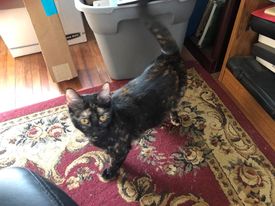
Chloe (otherwise known as Itty Bitty Bitty Bitty Baby Baby Girl) doesn’t want me to work. She wants to use me as a piece of furniture as she stares chirps at the double monitors in the office. Girly-Girl (known as Squirrely Girl) is arguing out in the hallway, probably because Itty Bitty Bitty etc. has taken over the office. Me-Me (otherwise known as Me-Merz) is sitting near Richard with that Overly Attached Girlfriend look on her face. I’m not in the bedroom; I just KNOW. 320pooooooooooo0222222llllllllllllllllll.kkk.kq (Chloe said hi)
Ideas on the next book.
I have a next book. It’s taking shape on the outline. It involves Luke Dunstan, a 6000-year-old immortal Archetype, who finds that The Maker has taken away the Archetypes’ sole reason for existence away from them. Leah, a seventeen-year-old woman, sees visions of the oncoming civil war, and feels called to stop it despite the odds of surviving are against her. Leah feels torn between Luke, who sees her as the Avatar of the Maker, and the father of her child, Baird, a Nephilim.
It doesn’t seem to matter what religion or spirituality one belongs to — it’s difficult to believe. In oneself, in one’s deity, in one’s face, in one’s calling. Faith does not exist without the humanity involved — the struggle to believe.
We pray, we talk to ourselves, or we talk to respected elders, or do rituals. We connect to the avatars of our beliefs, even if they are a quiet place in the woods. And we ask for reassurance, for calm, for help, for confidence, and for support when we tune in. The answers do not fix our fate (for those who believe in a deterministic outcome) or the factors we can’t control (for those who feel they have more control of their fate). But they may give us hope that something better comes down the road for us. Or that our pain will lessen. Or that there’s comfort.
With a PhD and years of academic writing, I have developed a rational bent, as evidenced by the above paragraphs. (Ugh, that academic writing again!) I think people need comfort, need to know about the afterlife, need to feel there’s a sense of justice, and need to feel that there’s a force beyond themselves. I even teach that in a class.
Still, I have some irrational beliefs, embarrassingly irrational.
I believe in superstitions.
Moreover, I believe in curses.
Curses!
When a string of bad things happen to me, I decide I am being cursed. I do not know who’s cursing me — I have suspected everyone from God to the old Italian grandmother who thought I was defiling her great grandson (it was his idea to take me on a tour of the backyard on his dirt bike for what it’s worth). It doesn’t matter — it’s a curse.
People can think of curses as bad luck, a losing streak, “someone hates me up there”, terrible fates, unfair consequences, or “the devil’s trying to beat me”.
And nothing is going to get better until one breaks the curse.
How are curses broken? That depends on one’s belief system. Prayer, ritual, good luck tokens, a visit from a shaman — all are ways one breaks curses.
For me — a strange and convoluted story I’ll leave for another time — I use a ritual of burning all the bad things out of my life after writing them on a piece of paper.
To be truthful, I felt better. More importantly, from a strictly psychological view, I quit framing every minor annoyance as another terrible proof of the curse.
That may be the only result of the ritual, but hey, it works.
One Friday, in a college classroom that had seen a hundred years, Brent Oberhauser stood in front of his class, a tall and lean man in jeans and an ice-blue sweater that matched his eyes. He ran a hand across the side of his head, a habit he retained from before he’d started shaving his head against his prematurely and fast-receding hairline.
Students, heads bowed, wrote rapidly in examination books, answering questions about Medieval and Renaissance European history. History, Brent considered as he proctored the exam, wasn’t just about what happened, but what one had learned from what happened. More than once, he wondered what he had learned from his twenty-nine years thus far. He’d think about that later, when his obligations were over and before he settled down for the night. First, he would need to go to the office to pick up a couple books, then drive into Denver to work his barista shift at the Book Nook. If he timed it right, he could have a cup of espresso Romano before work.
The exam proceeded uneventfully, with students silently scribbling, and he wished his students a happy holiday as they wandered off one by one toward winter break. He gathered up the exams and walked briskly down a hallway with its dark wood and stark white walls, dodging students who waited for the next exam. He passed the statuesque Renee Porterfield, also a PhD candidate, who wished him a happy holiday in her rush down the hall in the other direction. Soon, Brent stood in his cubicle in the small grad students’ office, putting books into his worn leather messenger bag in which he’d already stuffed the last of the exams for the semester. One book he packed to help him double-check the last-minute corrections his dissertation committee requested after he defended two weeks before; the other book was a history of Father Christmas he had written a few years earlier and published on Amazon, and it was that volume that caused him much frustration at the moment.
Brent pulled on his fleece-lined denim jacket and slung the messenger bag over his shoulder. Father Christmas, he thought as he turned off the lights of the office on his way out. Survival of old pagan customs. Symbol of English Christmas. Topic of endless Victorian postcards. But which Father Christmas?
His cell phone rang. He checked the readout to find out who his caller was, and he answered the call. “Kris.” He felt his cheeks flame. “I don’t know if I can do it.”
The pleasant voice on the other side spoke calmly. “Brent, you wrote the book. You understand Father Christmas better than anyone else in — in the world, perhaps.”
That was the rub. Brent’s medieval reenactment group had lost their Father Christmas when Kris Kriegel moved to Missouri to be with his true love. Kris, the former Father Christmas, had decided that Brent should take over as Father Christmas for the Yule Ball.
It was two weeks till the Yule Ball, and Brent didn’t know how he could fit in Kris’s boots.
“You can do it,” Kris repeated. “I have a sense about you.”
“A sense,” Brent echoed.
“Yes. I’ve been playing Father Christmas long enough that I get a sense of who would be good at playing him. And that’s you, Brent. I can’t explain it. Trust me.”
“But I’m not you. They’re used to you.”
“I can’t come back and do it. Marcia’s going to have that baby any minute.”
“Oh, yeah.” Brent seized upon the change in conversation. “How’s she doing?”
“Fine. She thinks she’s huge, but that’s the way pregnancies happen. She’s healthy, and our daughter Noelle should show up right on time. Whenever that is.” Kris chuckled. “I’m doing Santa gigs with my phone at hand in case she goes into labor.”
Ten minutes later, after closing the call, Brent didn’t feel any better about playing the spirit of Christmas for the medieval reenactment group that hosted the Yule Ball, of which he’d been a member for ten years. I am not Kris. Brent grimaced. I am not Father Christmas.
What I’m learning in therapy
I’ve been going to therapy online to get over the uncomfortable feeling that I don’t know who I am now that I’m successfully getting treated medically for bipolar. I’ve had this nagging feeling for years.
What I have learned so far:
I have good boundaries. But I have boundaries around my boundaries
I believe (or have been led to believe) that my inner child is a monster
I have walled off inner child from rest of me.
I don’t quite believe all of this. I believe it’s more nuanced, as if the inner child isn’t so much walled away but quarantined. I have a sense of myself as inner child but I don’t trust it. It’s probably right to not blindly trust its judgment, but I treat it as if it were my bipolar tendencies.