Just Write

I can’t get my thoughts to coalesce.

I’ve tried three times to write on topics — the beginning of the semester, growing older, expecting more from people — and the topics keep winding around in circles until I don’t know what the topic is anymore.

It could be because I haven’t had my coffee yet, I suppose.

Ever have one of those days? “There’s something … bothering me … but I can’t for the life of me figure out what.” It’s that sort of feeling. There’s an elusive topic, something my heart needs to write about, but I don’t know what it is and my brain’s having none of it.

Now I have my coffee — home-roasted and fresh-ground, so you can feel jealous of me — and I’m still not sure what the topic is.

The ideas to write aren’t always there. At five in the morning, I’m not always there, either.

The idea, though, is to write and keep writing. Even if the words aren’t flowing, even if you don’t know if you’re making any sense, keep writing. Keep your pen ready, keep your fingers warmed up. Write something.

You’ll have to go back and edit it anyhow.

Dreaming of Green Again

I’m starting to plan my summer garden. As anyone who gardens knows, this consists of getting glossy catalogs with beautiful and fascinating plants, ordering the seeds. planting them, and becoming disappointed that one’s results are not the same as in the catalogs. In my opinion, all catalogs should have “Your Results May Vary” in fine print next to the pictures.

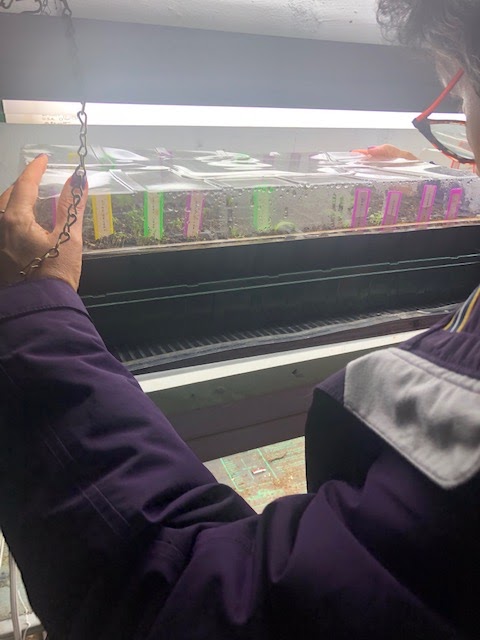
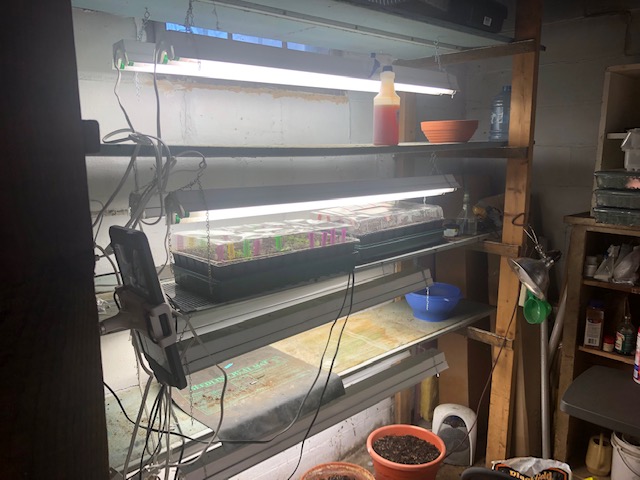
I wish I had a warm greenhouse to spend the winter in. Instead, I have a magnificent grow room in the basement with shelves and fluorescent lights and heat pads. Not quite as nice as a greenhouse, but it’s mine. I sometimes worry that I’m going to have my tomato plants confiscated by DEA (Drug Enforcement Agency, for my foreign friends). I’ve already been visited by an agent of the USDA (US Department of Agriculture, for all my foreign friends), who confiscated some seeds I could have sworn were legal in the US.

I’m just beginning seed-starting season. It’s too early to start most seeds, but I have a few seeds with — well, advanced skill requirements, such as “Violets: warm stratify for 60-120 days, then cold stratify for two weeks, then plant.” I hope 60 days is enough warm stratifying, because I don’t want to have to wait till September to plant them. So the cold stratifying seeds (yucca, semi-wild rose) are in the refrigerator in dampened peat moss, the warm stratifying seeds are in the grow room, and I’m waiting a couple more weeks to plant my first seeds.

If past years are an indicator, I will have everything from abject failure to stunning success to “why the heck did I do that?” An example of the latter was the perilla that I planted in a 72-cell mini-trainer (which I will not use again, even though I’ve used them for years) –they got nine inches tall in a root ball that grew out the bottom of the one-tablespoon sized root pot, and all the roots tangled. So I had One big 72-stemmed perilla that lacked leaves on the bottom six inches of the stems and that I coiuldn’t get out of the pots. Note to self: You don’t need that much perilla. Also note to self: bigger start pots and transplanting sooner.

I’ll tell you more about the secret of my garden later.

Writing Every Day

I have been writing this blog for 21 months on nearly a daily basis, and in a few cases, more than once a day. I’ve missed a week at a time during times I was fighting depression, but for the most part I’ve stuck to this blog. It’s become part of my being, part of my definition as a writer.

Writing this blog wasn’t always part of my definition of myself. Neither, for that matter, was writing in general. What it took was a discipline of writing every day.

Writing every day is not an easy thing. First of all, one has to commit to an action that may not feel natural. I write every morning, generally between 5:30 and 6:30 AM (today is an exception; I didn’t get up at my usual 5 am because it’s a snowy weekend). I can guarantee that, at first, writing a blog first thing in the morning was not something I felt moved to do. Now, because of the scheduled habit, I write my blog almost every morning.

Writing in general wasn’t a habit at first. But after a NaNoWriMo or two, I discovered that 2000 words a day (most days; I think my average per day is more like 1500) wasn’t difficult. So I ended up with somewhere around six novels to play around with, and I’ve been writing for seven years.

Right now I’m not writing because I discovered editing time is as important as writing. So I have the goal of editing at least an hour a day, and so far I’ve been pretty successful (but I have about 5000 more words to add to Voyageurs, and this will be a bit tough. Whee.

Habits aren’t very sexy. It’s much more compelling to be that writer who does nothing but write for days, forsaking everything but coffee (or in the case of Coleridge, some prime hash), who shuns responsibility while feverishly writing. In reality, most writers are not that person, nor can they be. So writers need habits to take the slow, sure course of writing.

Although writing binges, within reason, are a good thing, because it’s fun to feel like the crazed stereotype at times.

Trusting the Process

I have been trying to lose the last twenty pounds of weight for over a year.

I’ve lost 65 pounds so far, doing it responsibly with well-balanced eating. No go; I’m still 20 pounds heavier than I want to be. After a year of eating a well-balanced 1350 calories a day and seeing no progress, I talked to my doctor, who sent me to a healthy lifestyles educator. I met with her last week, and she hooked me up to a machine that measured my metabolism.

The conclusion: I wasn’t eating enough calories. She put me on a well-balanced 1633-calorie diet. In a week, I lost three pounds — and gained it right back again.

I could, at this point, give up because of the lack of quick results, or I could trust the process and keep going. It’s early days yet, and I haven’t truly lost any ground, so I’ll trust the process.

I face a similar thing in my writing. I have learned to use dynamic words when writing, lessen my dependence on is/was/were/has/had, read my draft out loud while editing, found beta readers and developmental editors, learned to write a better query letter, organized my queries using Query Tracker, sent more queries than I can count, and I haven’t found an agent to latch onto me. For now, I’m trusting the process of writing well and marketing well through queries. This might change — I’ve set my date to self-publish at January 2, six months after I sent that first three chapters to Tor in a fit of bravado.

Trusting the process is hard. I want instant results. I want my reward for working hard and utilizing new skills. I want this twenty pounds gone and I want to be published. But sometimes, I have to sit back and trust that the process is working its magic behind the scenes.

6000 Words

I’m in the difficult position on figuring out where to put 6000 words back into Voyageurs.

This is harder than it sounds. Or, rather, doing it well is harder than it sounds. More dialogue might be a good thing, but it has to be the right dialogue — developing character or plot without sounding like the words were crowbarred into the text.

Adding words, to me, is harder than editing. I’ve edited my professional papers for years — the real challenge in academic writing is editing a synopsis of the paper to fifty words, which reads something like this:


Researchers hypothesized that subjects would be more likely to buy the pre-owned car than the used car. One hundred and twenty-three students in a convenience sample received either a used car or the pre-owned car catalog entry.  Subjects viewed both cars with equal likelihood of buying.


There’s so much more I could have said about the research this synopsis came from. This, by the way, is the type of writing one has to do for the summary a book in a query letter. You get one, maybe two paragraphs in a query letter (but more than fifty words) to describe your book. If the author wants to participate in #pitmad on Twitter — a big event where authors pitch their books on Twitter — you get one sentence to sell your novel, a statement called an elevator pitch.

Well, back to adding words. I’m really apprehensive about adding words. I did add some descriptions throughout and one whole chapter, which is why I only need 6000 words. That’s the equivalent of two-three chapters, which is what I cut out by advice of my developmental editor. I can understand why those chapters got cut — they were action-packed chapters in a story that had quite enough action. My dev editor is looking for places where I can add stuff, so I may have to patiently wait to see what she has to say.

Getting from goals to accomplishments

Sometimes I write in this blog when I don’t seem to have a lot to say. It’s not because I love to hear the sound of my “voice”, although some would argue I do. Rather, it’s to keep a routine going so I don’t lose a good habit.

Routine is what helps us develop good habits. That, and a reward for doing them, since in the short run doing what we’ve always done feels better. Habits, as unglamorous as they are, are what turn long term goals into accomplishments.

As a professor teaching positive psychology and behavioral economics, I have an interest in the whole idea of how to change habits. The behavioral economics idea behind behavior is that we’re naturally going to choose the immediate reward over the long-term benefit. There’s proof behind this; behavioral economists (including my favorite, Dr. Dan Ariely) do research to support their hypotheses, like any good professor.

I am trying out a program called Fabulous, which helps people develop good habits. It is based on behavioral economics, and Dan Ariely is one of its driving forces. The program uses environmental cues (such as putting your sneakers by the door if you’re training yourself to exercise), social cues (reminders on the app and encouragement), repetition, and rewards (praise and leveling up). I’m not necessarily going to recommend it, because membership costs $50 a year, but I think the reasoning behind it is sound, having read some of the research myself.

To go back to my blogging habit — I have writing on my daily to-do list, along with one hour of writing activities daily. I set aside some time each morning to write; my computer is my environmental cue.

And my reward? Reading the stats on my Blogger page to see people from many different countries reading this blog.

A good rejection

Yesterday I got another rejection, but I didn’t feel too bad about it.

I sent the query out for Mythos at least a year ago, and since then, I’ve learned a lot about writing. I’ve learned about developmental editing and beta-reading and about taking out the cherished bits that don’t do anything to further character or plot.

 In fact, Mythos as a book doesn’t exist any more — part of it has been cannibalized for the book Apocalypse, which is the next book to go into dev editing. There’s been lots of editing there already. So I’ve gotten a rejection on a book that no longer exists.

Every time I think I’ve learned nothing, I can look back on what Mythos was before its editing and incorporation into Apocalypse. In effect, Mythos was an idea with a lot of character development and a plot driven by nebulous bad guys and disconnected portents. The bones, however, were good enough to develop into a different story.

So all in all, this was a good rejection.

Courting Change

I don’t know what I want to write today. I’ve changed this topic three times since I’ve started. The first three topics were dirgelike, full of confessing my hubris.

That’s not where I want to be today. I’m sitting on the couch, a purring Girly-Girl beside me, drinking some truly magical coffee. Beginning-of-semester meetings start Wednesday; I have to start transitioning out of my vacation.

Things change, and there is always hope.

***********

My life hasn’t changed much lately. I embrace change; I’m at my best when I’m evolving. My frustration lately has been that I’ve been changing my manuscripts but still seeing the same results in query rejections. But tomorrow, or even today, could be different, and I may swim in change again.

I got a little nervous writing this, because changes can be bad as well. I’m aware of that, but I’m writing about GOOD change here.

Trying too hard

It’s Sunday morning over very good coffee (Bub’s Blend, a limited edition coffee by L’il Bub; full of science and magic), and it’s a good moment to philosophize.

My topic: The seeming paradox of my weight loss. To fill in, I lost 63 pounds over a year and a half period eating a well-balanced 1350: 1500 calories a day, and then I stopped. My plateau has lasted for over a year, so I went to my doctor who referred me to a healthy lifestyles specialist. His words: “It’s possible that you’re not eating enough.”

I go to the specialist, and she has me breathe through this funky machine for ten minutes, and tells me “You aren’t eating enough.” She raised my calorie goal to 1633 (yeah, odd number) and reminded me I need to exercise, too. I have lost over two pounds in the past four days.

So let me wax philosophical: Is it possible to try too hard? That was my problem with my weight loss; although in my defense, I didn’t know that I wasn’t eating enough. I didn’t know that adding a little more nutrition would nurture my body.

So, in what ways am I trying too hard? That’s an interesting question, and one I think I need to ask myself about my writing. When have I edited enough? When can I accept that my work is good enough even if agents aren’t biting on it?

A very good question, and one I will be exploring…

The Plan

I have a plan for how I’m going to handle the whole querying thing. Bear with me:

  1. I will continue dev editing and re-editing my existent books one at a time because that’s just good practice wherever I’m published.
  2. I will wait for six months for this querying cycle on Prodigies to complete, researching self-publishing and self-marketing as I go.
  3. If at the end of those six months I don’t have any takers, I will self-publish Prodigies. You will hear a lot about this and hopefully you will read it. 🙂
  4. I will query other books as they get edited — Voyageurs will probably be the second book in the pipeline, followed by Apocalypse. And so on.

This plan doesn’t include writing. I have not written since I finished Whose Hearts are Mountains, which I am sure needs serious dev editing as do the others.  That’s only been a month and a half. I haven’t been inspired to write lately, but there are various directions I could go — a sequel to Prodigies, a sequel to Voyageurs, another book in the Archetype series, a faerie adventure/romance novel … I have enough books that need to go through the dev cycle, though, that I wouldn’t have to write for a while. But I don’t want to get rusty.

I am hoping, of course, that this hard work pays off. I don’t know why I’m getting rejections from agents except for the usual “…I’m very selective … I don’t know if I can represent this novel with the enthusiasm it deserves.” (Question: If it deserves enthusiasm, why aren’t you — oh, never mind.) But at least I have a plan so that I’m not at the mercy of judgments about “what sells”. I just know that I write for a reason, and I want to see what that reason is.