Another (Moulage) Gig in my Future

When I talk about “gigs”, I’m not talking about music (I play Irish bodhran, but not well), comedy (my comedy career is restricted to teaching), or acting (my theatre career began and ended in high school). I’m talking about my other creative outlet, moulage.

Moulage is, as I may have said before, casualty simulation — or as I like to say it, gorifying people. Injuries are rendered by a combination of theatre makeup materials, homemade makeup, props, fake glass, sticks and pipes for impalements, and lots of skill and imagination.

This is done for the benefit of training community emergency response team (CERT) members, first responders, nurses, and humanitarian aid workers. I also provide my skills to high school safety docudramas, active shooter training, and creating zombies (although I’m not nearly as good at the latter as is my friend Rod Zirkle.)

I am entirely self-taught. I was recruited for moulage crew as an assistant in Missouri Hope (one of the CHSE exercises below) in 2013. I dithered around a lot, and the next year I was recruited as the moulage coordinator for Missouri Hope. With absolutely no real training, I studied injury pictures and makeup and that DVD from Simulaids where they practice all the techniques on a straight-faced student.

This gig is a big one — a major humanitarian service training program in Florida. You can learn a little about Atlantic Hope and the Consortium for Humanitarian Service and Education (CHSE) here.  I will spend three days sleeping on the floor, eating beans and rice and bad coffee, and modeling burns for free (but I love it!) I will be trying to report from the field Wednesday-Monday.

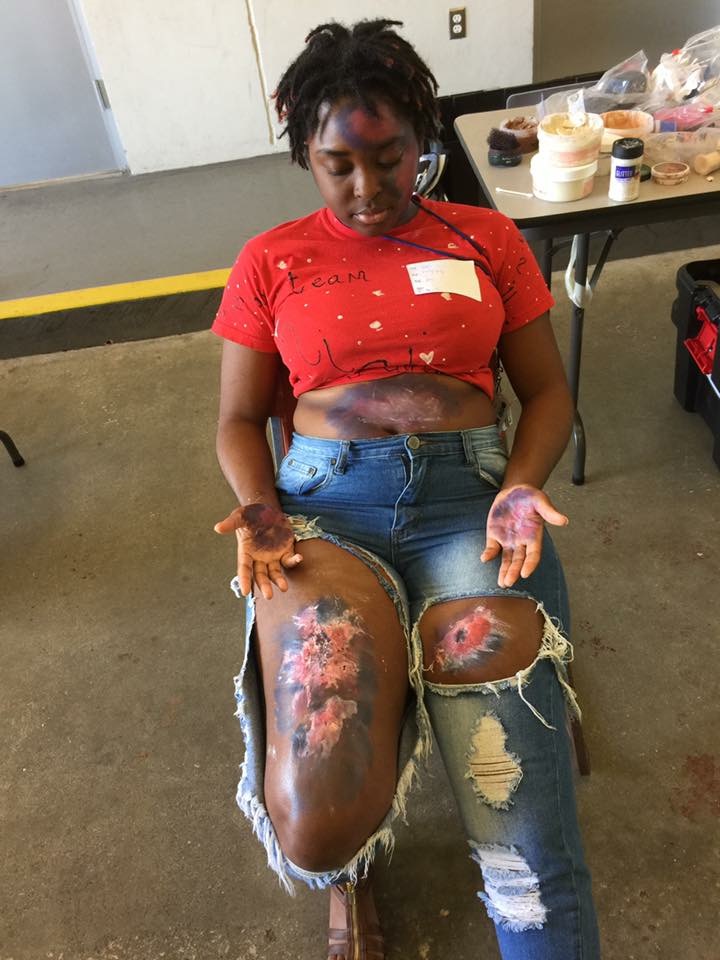
Here’s an example of my work from last year’s Atlantic Hope:
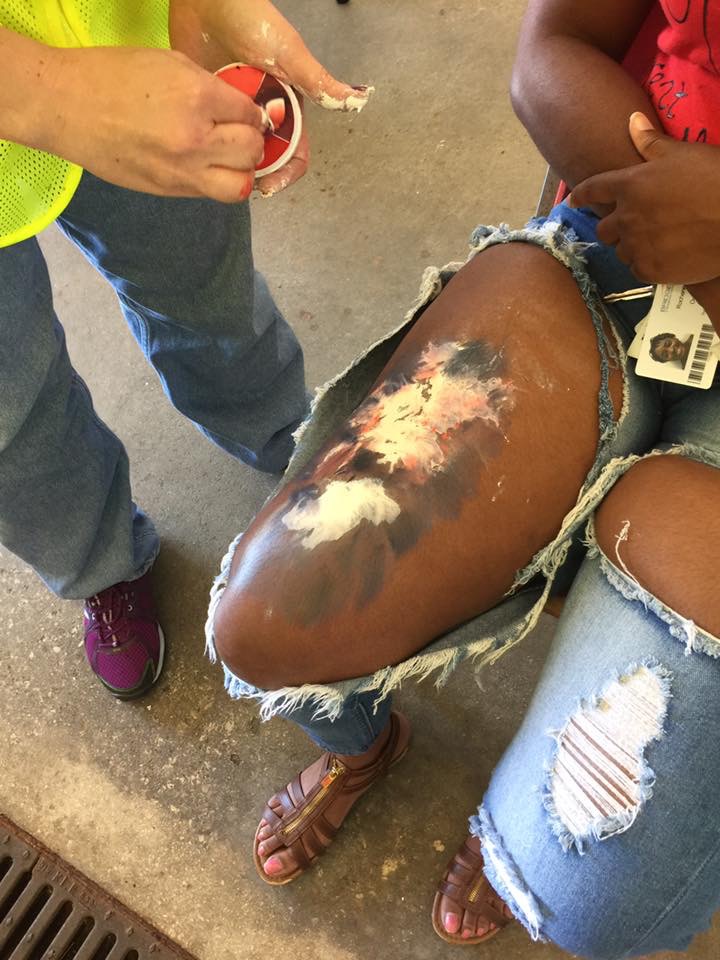
Building up a burn. 
Finished product. Beneath the skin, we’re all pinkish. This is not meant to be a profound statement.
I’m a perfectionist. If I had to do this again, I would not put the black at the outside, because it doesn’t look like soot, but third-degree burn (which it isn’t if it’s at the outer edge. I would slather it in thick gelatin around the edges and over the pink parts to give it a more three-dimensional look and maybe build up some blisters with gelatin. 
I’ll be honest — I think I keep getting gigs because nobody’s found anyone else locally who claims to do moulage. I think I have about six gigs a year. Let’s see: Missouri Hope, New York Hope, Atlantic Hope, CERT training in the spring, the prison simulation and night training for the Emergency and Disaster Management students, and the high school docudrama. I guess that’s seven. I sometimes also do moulage for the Emergency Medical Responder testing, nurses’ training, and the active shooter training on campus.
It’s a lot of fun and I feel appreciated when I do this. I lead a crew of about 4-6 people (including my husband), I create better and better works through learning and studying moulage, and my time goes toward the greater good. It’s a largely anonymous job — you’ll never see pictures of me in any of the CHSE promotionals, and I’m subsumed as a member of the “moulage crew”. But when people compliment the moulage, I know that I’ve contributed my skills in moulage and teaching to the rest of the crew.

One step forward — Kindle Scout

I have taken an intermediary step between agents and self-publishing for one of my books — I have submitted my book details to Kindle Scout, and this is what should happen:

  1. In 1-2 days, I should hear whether they’ve approved the book for eligibility
  2. Then they submit it to a “campaign” where I see how many upvotes I get. 
  3. At the end, if the book gets enough votes, it gets published.
The best book cover free editing software can buy.
Why this process? Because it’s vetted. Self-publishing otherwise seems like throwing the book on the sea and hoping it floats. If it comes to that, I don’t know if I can do it. I don’t dream of being a NYT bestselling author. I dream of someone reading my book and liking it.
Face it, though, I’m afraid of rejection again. I’m confident that I write well, but wonder if my ideas are publishable or whether I can stand up to a popular vote. I’ve never been popular, after all.
The book may be too gentle for people who read things like “The Meth Chronicles” and vampire stories. I’m a flower child at heart. I believe in the Peaceable Kingdom and the strength of small groups to change the world. I love people in both the general and specific sense. 
I’m not going to beg you to support me on Kindle Scout if I get that far. But I want you to think about it, because it’s my dream. And please, please, any support you can give me (preferably something that reaches my eyes or ears) would make me feel better about the process.

Considering self-publishing

I’d like some feedback from my readers:  Would you read my e-book? Click the comment link below and comment. You can stay anonymous so you can honestly say, “I wouldn’t read your book. I don’t even know why I’m reading your blog except that I’m your long-lost great grandma and I’m so proud of you!”

I’m actually considering self-publishing for the first time, even though my books will probably languish there without anyone reading them except my friends (and I have few close friends who will go out of their way to read my work). Why?

  1. Because I need some sense of closure.*
  2. Because I can’t make an intelligent decision of whether to continue writing unless I get feedback**
  3. Because I can’t change the world, even a little, with them on my cloud drive.
  4. Because, although agents appear to disdain self-publishing, I imagine they disdain my queries, so I’m not behind.
  5. TWO HUNDRED REJECTIONS.
  6. Because, in a fairy tale, I might get discovered in e-book.
  7. Because I believe in what Quakers call leadings***.
The book I would self-publish would be Gaia’s Hands, a prequel to my Mythos series. It doesn’t touch on that series directly — no Archetypes — but involves the origin of the modern Garden of Eden, and the influence of Gaia, the Earth-soul. It also involves two unlikely protagonists — a professor of plant biology and her much younger poet suitor — and a seemingly sentient bean stalk. If you squint closely, you’ll recognize the terrain as Central Illinois, my childhood home. (Aunt Peggy, Carla, and others who read a previous draft — this has been edited and rewritten extensively.

* Books on one’s cloud drive don’t feel like finished works.

** Again, why I keep hoping people will comment.

*** (Sorry to get minority religious here). Quakers don’t necessarily believe everything happens for a reason, so we’re not going to tell you God needed a little angel when your kid dies. However, they strongly believe God tells us to pursue something, and when we get that feeling, we seek clearness committees of our peers to sound out our leading. I never had a clearness committee on my leading to write, which may be the problem. I haven’t been able to suss out a meaning myself, because of my bad luck in getting an agent/getting published.

A poem about a hard truth

Attention is the Currency in the Marketplace of Ideas

Young white girls’ stories get told
When they disappear from the jogging path;
Young black girls just disappear.
Massacred teens’ stories get told
Until shouted down by rich white men.
The mentally ill are known only by their rampages,
and black men only by their records.
Black women are not heard, even in numbers.

Attention is the currency in the marketplace of ideas,
But its distribution is skewed.

Finding my Characters Again

I haven’t written much in a while. I find I’m barely writing more than a sentence at a time in either of my works in progress for at least a month. This is what depression and medication reactions (Today’s vocabulary word: Parasthesia) and rejections do to my motivation. No muses either. But I’m not going to whine about that.

I’m going to try to write today, though, because there’s not much else to do. A minor ice storm has packed a punch beyond its reputation, making roads slick enough that several semis and a MODOT (Missouri Department of Transportation) truck went into ditches. I wanted to go to Kansas City River Market to pick up some unusual Asian vegetables and see if I could find a Keiffer Lime tree, and to see if Planters had some intriguing plant stuff. It’s not happening today.

I think what I need to do is get introduced to my characters again.

In Prodigies, my main character is Grace Silverstein, a teenage mixed-heritage (black/Jewish) viola prodigy with a gift for influencing the emotions of her audiences. She’s been in residential music schools all her life and has had very little contact with her family before they died in a plane crash. She tends to be sardonic, probably as a cover for the very real loneliness she has faced all her life. She is currently on the run from shadowy forces that call themselves Second World Renaissance. They want to use Grace for her talent — or kill her if she will not cooperate.

Ichirou, another teen prodigy, has become her ally in their escapes. Ichirou, from Japan, is a former hikikomori, or recluse, which he entered into at a very young age.  Through the residential program Renesansu, he has developed skills and resilience, but he is still a soft-spoken introvert. He has the unusual talent of evoking states of comfort, threat, compliance, and others through computer graphics. He is also on the run from Second World Renaissance.

Ayana, Ichirou’s former teacher and “rental sister”, has aided Ichirou and Grace escape the repeated attempts by Second World Renaissance to capture them. She has keen strategies to help them evade, but she seems to be keeping a secret about why she’s involved.  Her demeanor is proper, as if she is still Ichirou’s schoolteacher, but hints of strong emotion sometimes leak through. She apparently has no unusual talents, but can speak several languages. She has never spoken of her past.

Greg, a mysterious man of mercurial mood and many disguises, appears to be an ally of Ayana’s, although it’s not clear how they met. He has rescued Grace and Ichirou from several scrapes, often unbeknownst to them. He hides many secrets, including his involvement with the group and a talent that causes him much grief.

I will leave the main character and one or two of the other characters for Hearts are Mountains later on. But I’m feeling better about writing today. And I’ll have plenty of time.

Flawed Characters

I’m thinking of the DC vs Marvel universe movie franchises, specifically two characters that are green: The Hulk (Marvel) vs. The Green Lantern (DC).

According to The Hulk’s origin story, Bruce Banner is a mild-mannered physicist who gets clobbered by gamma rays, and turns into a huge, green creature of the ID when he gets angry. As such, he’s a great superhero if one keeps him from smashing innocent bystanders and buildings. Bruce loathes his alter-ego, and this conflict adds depth and feelings of compassion toward his character.

The Green Lantern is a feckless dudebro who finds a lantern and a ring that link him to a network of intergalactic peacekeepers and superpowers. Readers are left wondering if a feckless dudebro should be allowed superpowers. Worse, though, is that we are left with the Hero’s Journey of a privileged male getting more privilege.

One of these is the more interesting character, and it’s not the dudebro.

We want our characters, especially our heroes, to have flaws that get in the way of their quest.

Dan Brown’s books (Inferno, etc.) feature a protagonist named Robert Langdon, who seems at times childishly helpless in his books, which is an intriguing flaw. He comes off as almost on the autism spectrum — focused on cryptology and solving puzzles, a bit clueless about people, led by the hand at times. However, Brown glosses over this with female characters who fall in love with him at the same time they want to mother him*, so there are no consequences of his flaw to him.  In addition, everyone thinks he’s this cultured, articulate genius

Bella Swan in the Twilight series has an almost minuscule flaw — she’s clumsy. Unless she walks through mountains and upon tightropes without a net and almost falls while returning the Treasure of the Incas to the Incas, this flaw won’t affect her meaningfully.  This is part of why Bella is discounted as being a Mary Sue, a perfect character designed as wish fulfillment for the author**.

Examples of good character flaws? In mystery, J.D. Robb created Eve Dallas, a horrifically abused child who grew up to be a good cop, but regularly struggles with nightmares about her past, difficulties in fathoming the rules of relationships, and being triggered by events from her professional life. Any character in Lord of the Rings (with the exception of Merry and Pippin) have baggage — Boromir is so focused on saving his country he is blinded to evil; Aragorn really, really wants to be king; Galadriel is tempted by power, Frodo struggles mightily with the Ring; Eowyn has a painful crush on Aragorn, who marries Arwen in a pragmatic marriage.***

We love reading character flaws, because imperfect characters becoming heroes give us the reassurance that we too, with all of our character flaws, can become heroes.

**************

* I wish other people considered unrealistic, but there is this charge laid upon American women to “change” their husbands, who don’t want to be changed. And who can blame either for this dynamic?

** The second reason is because female authors are routinely denigrated as writing Mary Sue characters, with the critics not noting that near-perfect characters like James T. Kirk (classic Star trek) and the aforementioned Robert Langdon are Marty Stus, the male equivalent of Mary Sue.

*** The movies portrayed Aragorn and Arwen as a love match. The book is much more pragmatic about that marriage. I wish the movie had followed the book in this case, because the triangle would have much more poignancy.

Reclaiming my Balance

Serotonin, dopamine, ephinephrine, norephinephrine.

It’s amazing how thoroughly our bodies listen to those neurotransmitters, and they in turn shape our reality. Early humans developed these neurotransmitters — and resulting feelings — as an inducement to seek out beneficial things (like food and sex) and avoid or attack harmful things (avoid tigers, attack neighbors trying to steal their land). A sense of sadness from loss spurred them to seek out others for commiseration and healing.

In mood disorders, these feelings come up without any trigger — anger without a target, elation without a reason, sadness without actual loss. Anger leads to frustrating arguments and rants, elation leads to expansive affect (expression of mood) and a sense of being involved in bigger things, and deep, bottomless sadness leads to hopelessness.

The community can’t understand the strength and depth of these feelings, so they shy away from the person with a mood disorder. We get the label “crazy” because these feelings, and the compulsive effort to try to express them to our and fix things, don’t make sense to those around us.

So, I’ve been depressed, as I’ve mentioned before. Depression isn’t a matter of “cheer up”, “just get over it,” or “why don’t you volunteer?” When I’m depressed, my vision narrows to a pinprick where I’m alone in the room and will always be alone and I will die in that room. Yes, I know that sounds dramatic, but I’ll write the more subtle poetic version someday.

My excellent pdoc (psychiatrist) put me on a drug called Latuda, which was working for a few days. But now I’m showing signs of lability of emotions — which is a nice way of saying my emotions are all over the place. To understand this, imagine all your emotions and states of being — fear, confusion, sadness, hopelessness, eudaimonia (grounded happiness) — as channels on a television. Someone else has the remote and they hit the buttons randomly. I literally have gone from “I have nothing left in life” to “Hey, did you know dahlias are edible?” in a span of 4 minutes.

I’ve been having other symptoms — and of course, the physical symptoms get more attention, because emotional symptoms are nebulous, not easily understood, and — “just get over it”.

It could be the Latuda or the high thyroid; we don’t know yet. It could be something else — but I doubt it’s my heart despite wearing a Holter monitor overnight.

I hate being in this situation. I avoid people because I’m afraid they think I’m “crazy”. I second-guess every interaction I have. I struggle between writing honestly and feeling like a circus sideshow.

I hope I’m not losing you over this, dear readers.

Disillusionment with the Internet

My friends, this is why I wish I knew who read this blog:

Late last week, I got a barrage of 10-12 hits from Russia in a very short period of time, from a domain I discovered was a hotbed of bot activity. That means instead of a reader, Russia was data mining.

Two days ago, I hooked my account to Google+, and three things happened:
1) A foreign acquaintance had linked to me at one point, but unsubscribed as soon as I linked back to him;
2) I got a flurry of US hits all at once, which suggested a US bot;
3) Three people with almost identical profiles (Canadian or French, lots of inspirational posters, and then all sorts of ads for questionable loans, smart drugs, and a sugar daddy service.  They had the same ads.

I’m an idealist. I’d like to believe that person from France isn’t trying to sell me modafinil. I’d like to believe that my Canadian audience is following me instead of using a borrowed personality to try to suck me into a scam. I’d like to believe that there’s a Russian teen out there who wants to understand writing better, and someone from Portugal who finds my writing interesting.

I’d like to believe I’m not setting myself up for more spam.
*****

I’m an optimist, I understand. I would like to believe that all of you are reading and getting something out of this blog, and that it’s helping me not only improve my writing skills but helping me make connections, real and caring connections.

I’m beginning to wonder if I’m deluding myself.

The Writer and Happily Ever After

We love happily-ever-after stories:

We want the good guys to win — although in reality, the good guys don’t always win and sometimes it’s hard to spot the good guys. And often we pick books to read in which the good guys look like us.

We want the world saved, but we’re aware that that same world may need saving again the next year, or even the next week. Isn’t this the gist of superhero comics?

We want the protagonist to fall in love. We assume they never break up, no matter how ludicrous their matching is. Opposites attract, sure, but that’s opposites in experience, not morals and values.

We assume the end of the book is the end of the story. It’s comforting, because it’s not real life. Perhaps it’s an escape from real life.

I will argue that happily-ever-after is a bad thing in real life. Why? First, because we couldn’t stand that in real life. It is human nature to move forward, and moving forward always concerns a sense of loss — loss of innocence, loss of friends, loss of the secure past, sometimes loss of life. The poignancy of age and mortality season our lives with a deeper meaning.

Second, total stagnation would make us uneasy. The movie Groundhog Day illustrates how frustrated people get with the same thing over and over again. Scenarios where nothing changes are the material of  Twilight Zone. Stagnation is the “uncanny valley” of life — it resembles life, but it’s not really life.

I love Marion Zimmer Bradley’s Darkover series. I literally cannot bring myself to read the series any more after the stories of abuse her daughter revealed, but Darkover was one of my writing influences.  However, in her series, she had a talent of making happily-ever-after stories end badly in the sequel, often offstage. The renegade telepaths of the Forbidden Tower are mentioned in future books as having been killed by fanatics. The heroic Regis Hastur becomes a paranoid, prematurely aged man in later years. This became part of the intrigue of the series, because those deaths set up new plot lines and character development.

When we writers don’t write series fiction (duologies, trilogies etc), the happy ending stands without need for update. In series fiction, we have the opportunity to make our world richer by continuing character strands in positive or negative ways.

In real life, we keep striving, and there are many endings in our lives, but many beginnings as well, until the ultimate end.

Writing about the moment.

Good morning, dear friends!

I feel like I’m fresh out of ideas today. I just got another rejection email, it’s freezing rain out there and I still have to go to work, and I’m wearing one of those technological reminders of mortality around my neck — a Holter monitor. (Don’t worry about that last point — we’ve already found the problem with the little pitty-pat-cha-cha of my heartbeat, and it’s easily fixable with a med tweak. They’re just making sure that’s all there is.)

It’s a good day to be down. Not depressed, just down. The desire to wrap myself in the coccoon of my blankets (rather than throw my clothes on over the monitor, put on makeup, and trudge down and up a flight of stairs with my computer backpack) is almost overwhelming. Almost. After all, life is out there, not under my blankets, and the adult thing to do is make the best of it.

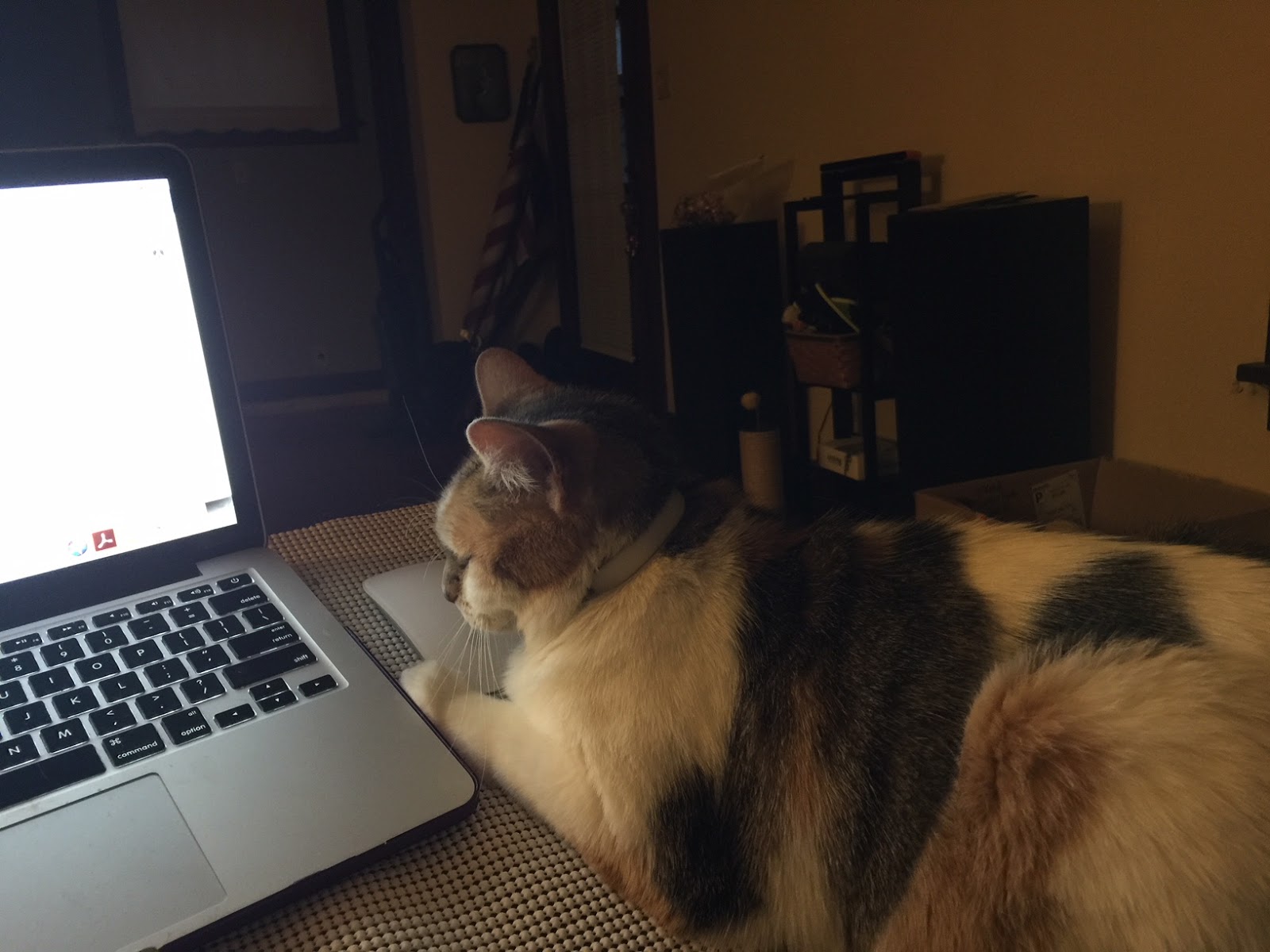
Girly-Girl is sitting on the arm of the couch next to me, purring. She’s my editor.

My editor is falling asleep on the job.

It’s definitely dark (and rainy) out here at 7:30 AM. I’ve had a Messenger chat with my favorite nature interpreter about aquascape and pond design. The rain hits the window like buckshot. I discuss the sorry state of American politics with Richard.

I check the seedlings downstairs in my grow room — the only evidence that there will someday be spring. The tomatoes and peppers and eggplant stretch and grow in their bigger fiber pots; the perilla seedlings perk up, the first of the miner’s lettuce seems to be sprouting.

Someday there will be spring. Someday I will find an agent, someday I will feel healthy enough to work out, someday I will accept aging gracefully.

But for now, I sit in a warm room lit by the glow of candles, next to my cat. I can live with that.