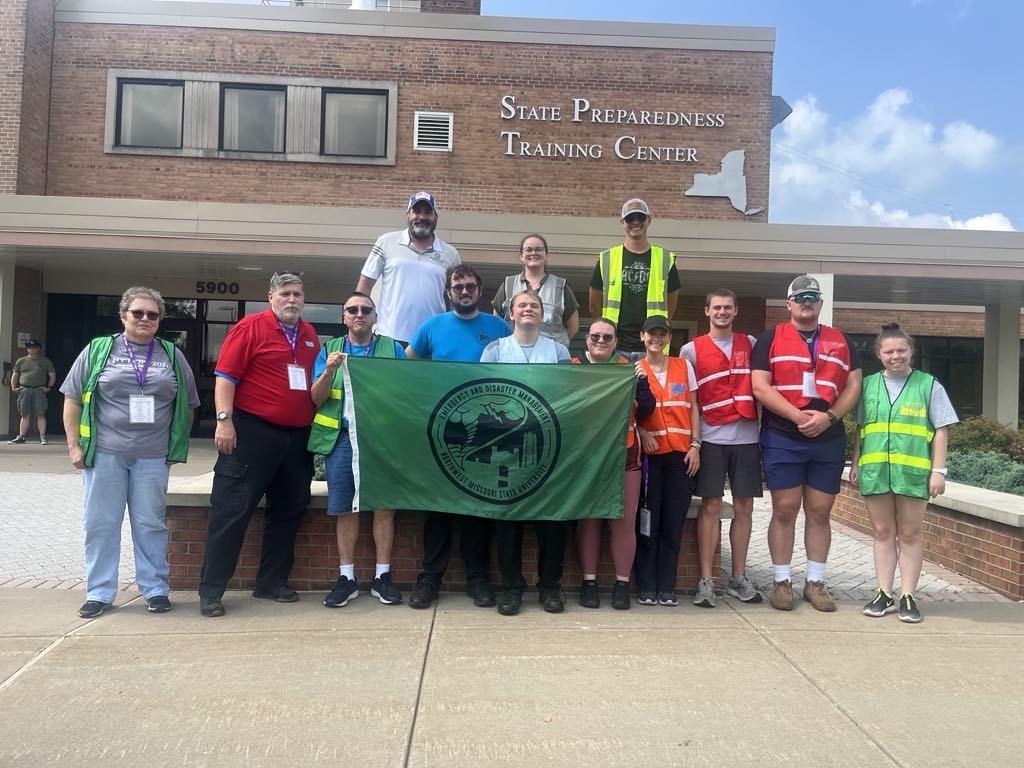
This is what I’ve been up to these past few days.

I’m the one to your far left.

I go here every year to do moulage (casualty simulation) for a disaster training exercise called New York Hope. The people with me are. Fellow students and faculty from the Emergency and Disaster Management at Northwest Missouri State University. And my husband.

We went to Niagara Falls on our way home. Here we are again.

When I get home, I promise I’ll write.

Writing as a Habit

Describe one habit that brings you joy.

I try to write, or at least do something that pertains to writing, every day. Writing, like any flow activity, gives me joy.

I love playing with words, finding the right words, using my skills to eliminate extraneous words. I love using special words, exact words. Creating worlds, making characters realistic, building conversations โ€” all of these are parts of writing.

Sometimes itโ€™s challenging to build in writing time. In the summer, where I have responsibilities but freedom in scheduling them, I have written daily after my daily โ€œday jobโ€ tasks. So after I have worked on my new class for the day, and after grading for my internship class, I have time to write. This fall (which starts in a couple of weeks for me), I will not have that early afternoon time. So most days, I can write after work; other times it will have to be early evening. But itโ€™s important that I write, because I need a little joy every day.

Curiosity Embarassed the Cat

What are you curious about?

I was born with an exceptional amount of curiosity. An inconvenient amount, in fact. When I was a child, I had to be shamed into not asking personal questions or snooping in drawers. Luckily, I have grown up to constrain myself from my urge to know.

And I do have an urge to know everything. Curiosity is just one of the tools we have to learn about the world, and itโ€™s a great thing for scientific inquiry. But my curiosity about the minutiae of daily life could get annoying quickly, particularly when it comes to medical stuff.

Medical stuff.

For example, I read the obituaries trying to find out how people died. Memorials provide this information, unless the family of the deceased want memorials to be given to the Humane Society or the decedentโ€™s Alma mater, in which case my inquisitiveness is frustrated.

I am a frequent victim of clickbait. A headline like โ€œHollywood Star Falls Victim to Rare Diseaseโ€? I donโ€™t know who the Hollywood star is, nor care, but I want to know all about the disease. I admit that ordinary gossip does little for me, but that rare disease? Iโ€™m there. (Note: itโ€™s usually something like diabetes, not a rare disease.)

I resist the more rude parts of my curiosity, like asking someone why they went to the hospital. But I am forever, embarrassingly curious.


Sometimes my curiosity has its benefits. I am on my first day of moulage for New York Hope, making people up to look like human casualties of an inland hurricane. It helps to know what an open fracture, a bruised spleen, or a case of cholera look like from the outside. Iโ€™d show you a picture, but weโ€™d have some people getting ill.

Two days in a van did not yield any inspiration. However, a couple new developments in my writing life occurred, one good, one bad.

The bad first: A submission of mine on Submittable was rejected. Iโ€™m not surprised; I havenโ€™t been able to find this particular story a home. Maybe itโ€™s not a good story. I like it, but I consider myself a proud mom of what might just be an unlikeable kid. I get lots of rejections as a writer; I keep trying.

The good development: my niece is working on the sketches for the cover of my latest novel, Reclaiming the Balance, and it is coming along nicely. Looks like I have no excuses for not publishing it this January.

I donโ€™t know a single writer who doesnโ€™t have imposter syndrome (Ok, I know one who appears not to; heโ€™s insufferable). We all take rejections hard, and when facing success, we feel like we donโ€™t deserve it. Iโ€™m not sure why the insecurities but they seem like a universal.

I will keep on plugging, keep on editing the novels I have in reserve, and keep on waiting for inspiration for some short stories.

How would I describe myself?

How would you describe yourself to someone who can’t see you?

How would I describe myself to someone who can’t see me? I assume they never had eyesight. I would have to rely on other senses, wouldn’t I?

I am round. Plenty round. Here’s a hug. My nose slopes slightly, but it’s pretty average. I wear glasses; I almost never take them off. My hair is fine and somewhat unruly.

I am not considered beautiful. It’s not a big concern of mine. I’m sixty; I have aged out of beauty.

My voice is a pretty good indicator of how I look; sweet, like a sticky bun. You have all you need about me.

On the Road

I’m trying to think about writing as I sit in a van barreling down the rural road. I’ll be here for seven hours or more today and tomorrow, so I might as well be productive.

I want to write some stories not relating to my world (the Hidden in Plain Sight stories). They aren’t coming to me. I seem to be on a hiatus writing-wise these past few days.

If life plays as it usually does, I should get an inspired idea just as I’m in a place where I can’t write, like the middle of applying fake blood on people. I’d rather inspiration show up during idle time.

Wish me a brilliant idea!

Hiatus

Just a heads-up. Starting on Tuesday, I will be reporting in sporadically at best for a week. I will be at my annual remote disaster exercise, New York Hope. Here, I will be doing casualty simulation (moulage) for a few days. This means that I will be applying theater makeup to volunteers to make them look like victims.

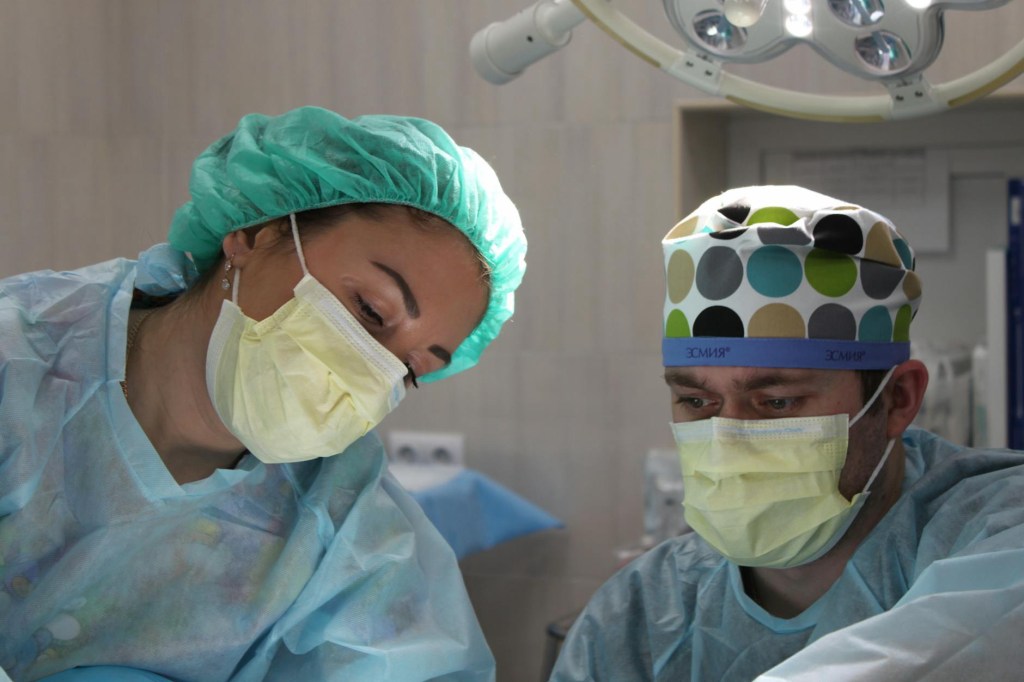
Photo by Slyzyy on Pexels.com

The basic injuries are lacerations, burns, impalements, bruises, and breaks. Moulage artists model lacerations and breaks with skin wax, burns and bruises with paints, and impalements with prosthetic plant-ons. There will be a lot of fake blood, which is made with liquid starch and food coloring. Illnesses are faked with cyanotic blue theater makeup, diaper rash cream, and glycerin water for sweat. Moulage is not for the faint of heart.

I will report when I can, but I will likely not be thinking about writing for the next few days. When I am in moulage mode, I am definitely in another world.

An Excerpt from Kringle Through the Snow:

Photo by Kristin Vogt on Pexels.com

Wade Nelson stretched his 6โ€˜4โ€œ frame over the back of the chair, feeling the tension of a workday subside. He straightened up, realizing heโ€™d made a spectacle of himself. He shrugged and peered at the laptop in front of him.

Wade wanted to type the notes down so he could keep this scenario with the others he had written over the years. To write a dungeon, he had to juggle the abilities of the playersโ€™ characters with the statistics of monsters, magic users, and weapon-wielders. The idea was to create a challenge, not annihilation. Sometimes the party got annihilated anyhow. Foremost, in his opinion, he had to come up with a story.

He looked up, remembered he was in the cafรฉ. He had lost track of time and place. Looking up at the big clock, he realized he had little time before he had to go home to feed his dog. He still had plenty of time before Saturday, when he would try out this new campaign on his players.

He walked up to the counter, where Geena with her red braids stood at the counter. โ€œIโ€™d like another cafรฉ au lait,โ€ he said.

โ€œHave you ever considered a London Fog?โ€ Geena suggested, wielding a large coffee mug.

โ€œWhatโ€™s a London Fog?โ€

โ€œEarl Gray tea, steamed milk, and vanilla syrup.โ€ Geena smiled. โ€œItโ€™s your new favorite drink.โ€

โ€œIโ€™ll have that.โ€ He rummaged for his billfold.

โ€œYou have a smudge on your nose. Looks like a big pencil smudge -โ€

โ€œIt is kinda like a big pencil smudge.โ€ When his work at the battery factory brought him to the bays, sometimes he was in contact with tons of the graphite mixture that went into the cores of the batteries. He excused himself and went into the menโ€™s room to wash the smudge, which turned out to be considerable, off his nose.

He saw medium light hair, very short, and a beard, closely trimmed. He looked, to his eyes, like an engineer. Which he was, a well-polished geek.

When he returned to the counter, his London Fog was ready, and he liked the smell. Maybe the London Fog would be his favorite drink.

He sat back at his computer and flipped through the pages of the book. โ€œIs it time for the Aspect of Tiamat? I think itโ€™s time for that, right in the next room with lots of tempting treasure. And some minionsโ€ฆโ€ He saw the Chromatic Dragon in all its multi-headed glory and grinned. Hopefully, the party would survive.

He figured his players played Dungeons and Dragons for the strategy or for leveling up. To him, though, the game would always be about the role-playing. About the story-telling.

Satisfied with his progress, he packed away his laptop and books and stood up to leave when a woman in a kelly green suit halted him. โ€œYouโ€™re Wade Nelson, right? I remember you from the Grinch auditions.โ€

โ€œYes. How did you know I was going to be here?โ€

โ€œKris Kringle โ€” I mean Kriegel โ€” at the toy shop. He told me you were a regular here on Thursdays. Can I talk to you?โ€

โ€œUh, sure.โ€ They sat back down. Wade wondered how Kris Kringle โ€” Kriegel โ€” knew him.

โ€œIโ€™m Sally Perkins from Rolling Hills Improvement Committee. I wanted to tell you that youโ€™re our Grinch.โ€

โ€œGreat, I think. Iโ€™m not sure what a Grinch is supposed to do. I was at the interviews because my boss picked me to represent the factory, so maybe you can help me. How do I grinch?โ€

โ€œWell,โ€ Sally paused. โ€œWell, you are going to attend several community functions. Like the December Chamber banquet and Thanksgiving at BesMart, the parade, and the Charity Holiday Gala. In a Grinch costume.โ€

โ€œI think youโ€™re going to have to make me a new Grinch costume, then.โ€

โ€œWhy is that?โ€ Wade hadnโ€™t even noticed the clipboard on which Sally took notes, but there it was.

โ€œIโ€™m 6โ€˜4โ€ณ, a size 2xl, and Iโ€™m betting your Grinch costume wonโ€™t fit me.โ€

โ€œOh,โ€ Sally said, writing. โ€œI hadnโ€™t thought of that. Let me get on that. Iโ€™ll see you later,โ€ and with that, Sally had left as abruptly as she had arrived, and Wade had become the Grinch.

Now all he needed to know was what Rolling Hills expected of their latest Grinch.

Knowledge Base and Writing

There is a phrase among writers: ‘Write what you know’. The cop focuses on the precinct, the Parisian on Paris, and the college professor (like me) on college campuses because we have the details in mind.

The above examples all focus on settings. I want to focus more on the knowledge base — where plot points and themes are informed by knowledge of a specific area. For example, I have some basic background in disaster management. I teach disaster psychology and case management. I know how people do triage in a mass casualty event because I have had CERT training. Because of my training in disaster mental health, I can spot the psychological symptoms of acute and post-traumatic stress. (I want to emphasize that I am not a therapist or counselor, and that I can’t treat people with these disorders.)

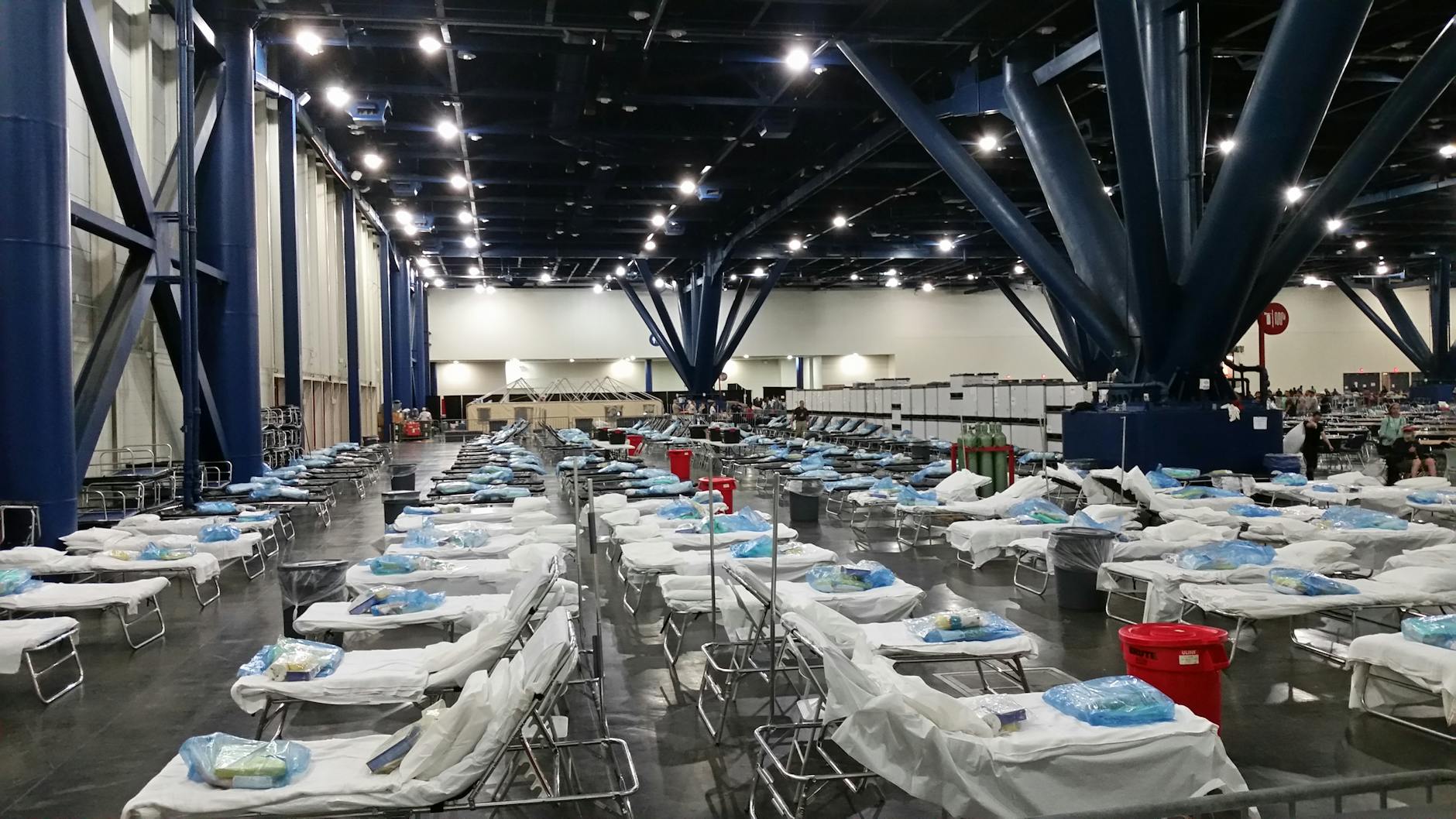
Photo by CDC on Pexels.com

I have written two books where mass casualty events come into play. One is Apocalypse, where an impending battle threatens to cause the loss of all the women of the world. Characters looking at that possibility project how they will react, with both despair and resiliency. In my most recent book, Carrying Light, two mass casualty events happen. Characters have to deal with emergency response, which includes the sobering truth that responders will have to leave some people to die. Acute stress reactions figure in both books.

When I use my knowledge, it provides more than just background knowledge and convincing details. It helps set the plot and the theme of the books. Plot points include recovering from working a mass casualty event; and themes include the toll that extreme circumstances take on those experiencing it. Writing what we know should, in my opinion, shape our stories to add to the realism of what’s presented.

Now, the issue of fantasy needing some basis in reality, or at least a consistent rule book, is an essay for another day.

My Editorial Staff

Despite my middle-class status and that I’m not a full-time writer, I have an editorial staff.

My senior editor, Me-Me.

Chuckie is sitting to my right on the window bench. Chuckie just woke up, and fell immediately asleep again. His job is usually to keep me on my toes. I am not on my toes right now.

Chloe is falling asleep on the job. This is probably because she is a cat, and cats are notorious for their ability to take naps anywhere. She’s on the back of the couch, right behind me. Her editing duties fall by the wayside.

I wonder if the cats are on strike, because the senior editor, Me-Me (at age 17) is sleeping on the couch.

Pumpkin has walked off the job.

I suppose paying my editorial staff in cat food isn’t the best arrangement, but they’re better than not having editors at all. And they have the advantage of purring when I pay attention to them.