Yesterday I got my COVID vaccine. Apparently in Nodaway County, MO, there are more vaccines than people who want to be vaccinated in Tier 1a and 1b right now. So Nodaway County Health opened the queue up to faculty, of which we have many. There’s a loophole, because Phase 1b includes K-12 teachers but not college professors. The loophole is that now, faculty are counted under “government”. (Which is true, as we’re at a state university. That way the vaccines don’t get wasted and the faculty are protected.
So, the shot. It didn’t hurt a bit — until I left the vaccination station, and then I felt a burning streak across my right arm. Yow! It went away quickly.
I didn’t feel any symptoms at all until I went home, and then all it was was a mild fever and a mild achiness. This morning, I have residual aches in both upper arms and upper back. Nothing bad, not nearly enough to keep me off work. (Ahh for Tiger Balm!)
So it looks like it’s going to be okay. My next vaccination is April 7th.
I have a somewhat tenuous relationship with time, and nowhere does it show up more than when I’m writing. Even though I write fast-paced plots that run over a few weeks or a month, I lose track of the time and suddenly two different plot points are happening at the same time.
I used to sit with a calendar and make notes on the Scrivener file, chapter by chapter, but then I didn’t get the full picture; I had no one document where I could look at the whole timetable. And flipping back and forth between chapters makes it hard to remember the sequence.
Then I discovered Aeon Timeline, a program that helps you organize a timeline by chapters or individual events, characters involved, and other potentially important characteristics. It organizes itself around two concepts: events and entities.
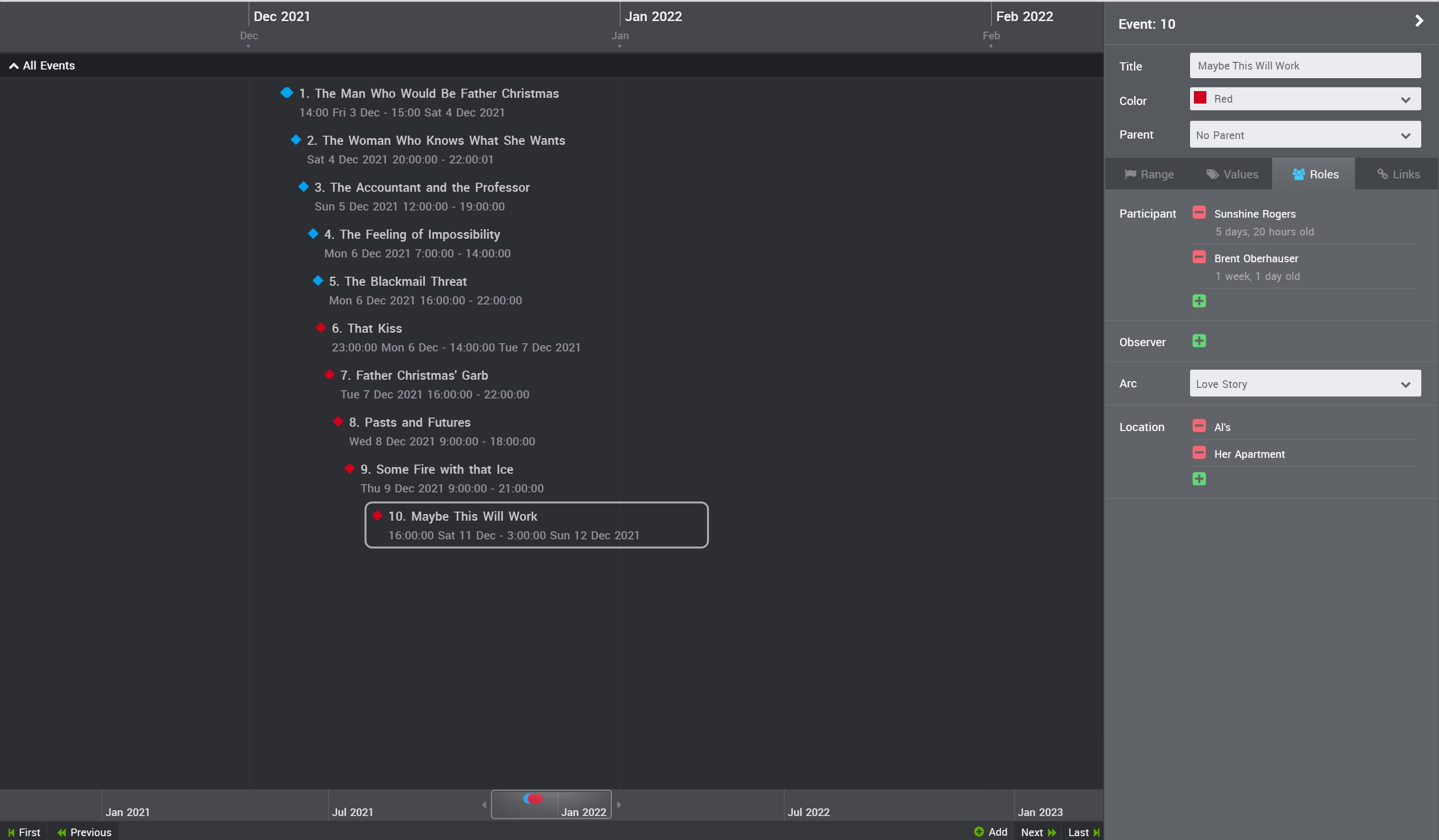
Here is a screenshot of my current project:
On the left, you can see the timeline. In my case, it’s color-coded to match a template I have for romance writing. On the right, you can see an event (the one highlighted on the left). On the event side, you can see at the top the event data — title, color, and parent. I do not use ‘parent’ because it ties everything to a preceding event and my mind doesn’t function that way. Below that to the right there’s data such as participants and observers, story arc, and location. Those are used as sorting prompts, and I haven’t found myself gravitating toward that function yet.
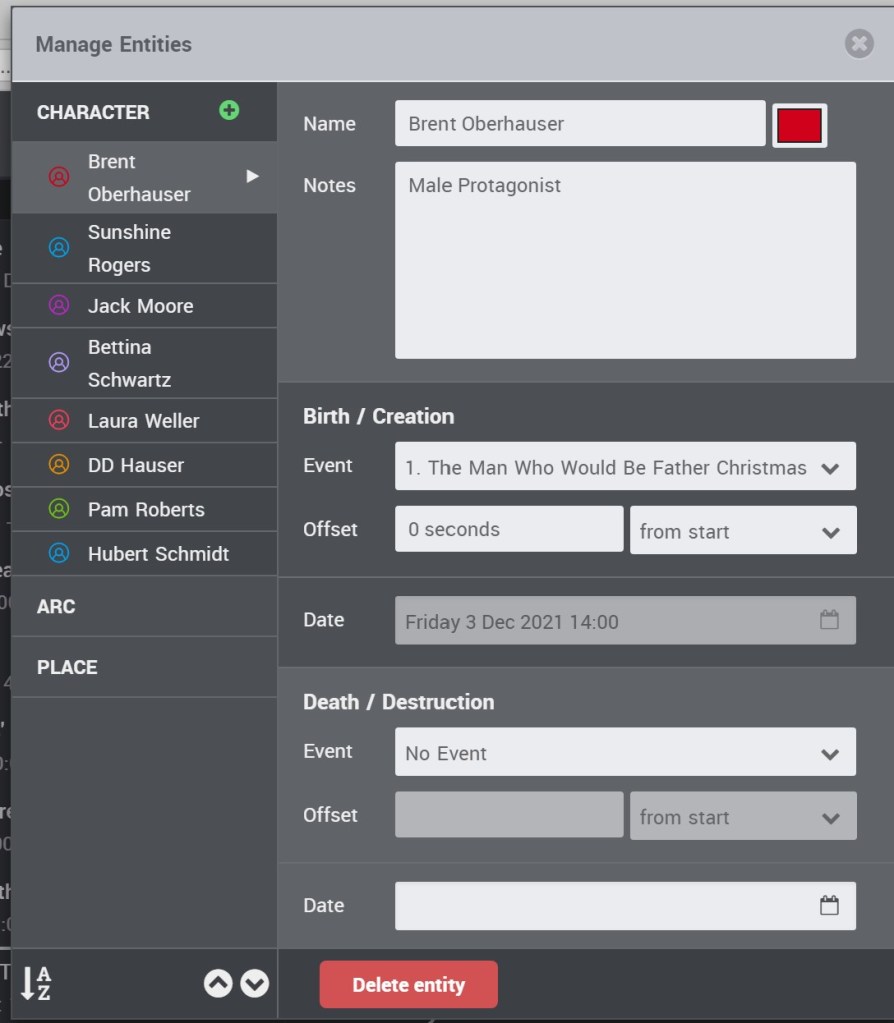
Below is what the ‘entity’ window looks like:
This is the ‘manage entity’ window. You can add entities here (to add anywhere, click a ‘plus’ button) and edit them. I recommend using this box rather than the ‘add entity’ box because you can manage things better here. Note on the left the window will also let you define story arcs and enter different places.
Notice I don’t use the birth/death blanks because I’m not writing epic fantasy. If I ever make the unified timeline for all my novels, I could use that. (But it would be an unwieldy timeline spanning 6000 years.)
The good thing about Aeon Timeline (to me) is that I can see that timeline, and in making it, I can ‘feel’ that timeline. I often make it after writing the book in my proofreading stage. This is probably the wrong way to use it. If I set it up before, I could actually import it into Scrivener (my writing software) and the timeline would show up. Somewhere. I have to try that.
The bad thing about this is all the data entry. I feel possessed to put in all the entity data and use all the categories when developing the event, and this can be a lot of work. Being a plantser (planner/pantser) writer, I don’t know that I would know all the events before using this tool such that I could use it at the beginning. I would advise to enter what is needed and leave the other bells and whistles alone.
I’m halfway through entering my Christmas romance for the year, Kringle in the Night, as I edit it one more time to make it ready for the Christmas season. It’s helping greatly. I’ll let you know about the Scrivener integration later.
I almost stayed in bed all day. I just about asked my husband to bring me breakfast (pancakes and turkey sausage) in bed. But if I had, I would have missed Bowie Symphonic Blackstar through the speakers and the sight of the trees bending in the wind under sodden grey skies.
I have plans for today. I will work on the pre-beta reader edit on Kringle in the Night. I might binge watch Monsters Inside Me because of its medical drama and wonderful illness simulation. I can watch some Babylon 5 with my husband and gaze at the porch swing rocking wildly.
This is how I can tell I’m not depressed, because there’s something to come downstairs for. I seek out productivity. I try to make things happen in my life because that’s who I am.
It feels like Spring. It doesn’t, however, feel like Spring.
In my life, COVID banished Spring. Teaching classes from home, not going out to restaurants and the café, and missing the warm days on campus where people gathered by the pond on campus and lounged in the hammocks — none of that remained under COVID.
I didn’t go out when COVID first hit. My husband made all the trips to the grocery store because that’s his job in the particular division of labor we have. So I didn’t get to see the toilet paper shortages, the people defiantly not wearing masks, or much of the sunshine. My most vivid memory was looking out the window to see a sliver of blue above the houses. COVID, then, was a darkened corner where I sat waiting for the all-clear signal, which never came.
The restrictions have lightened up, but I still don’t trust Spring. The virus still threatens and we still stand apart from each other. The blue sky seems distant, outside the house, beyond the mask. Clusters of students once again drink and party outside their houses, but their feeling of safety is not shared by those of us who are older.
I may trust Spring again if a torrent of rain, what we called a gullywasher in my childhood, overtook my neighborhood. Sheets of rain cleansing, if not the virus, my tainted memories of Spring.
I’ve been having a fruitful period of revising old works in the Archetype universe. I’m almost done with the Problem Child #2 (I can finish today and give it a good second pass) and have edited the short stories that go with the world.
Almost every novel I’ve written so far has been in that universe, one indirectly. (A total of five novels.) It’s a fascinating universe, with a group of immortals known as Archetypes, tethered to the human world by their responsibility of holding humans’ racial memories so humans are less consumed by their pasts. A few of the immortals get involved with humans as their protectors; others rage against the humans and plot genocide. Most Archetypes live outside of relationships; a few stumble their way through relationships. The Archetypes are super-fertile, and must abstain from sex, but rarely they make the decision to bring other Archetypes and the half-human Nephilim into the world, for good or evil purposes.
Within this universe, I have fit a number of genres and storylines: fantasy, romantic fantasy, and fantasy romance; Dude with a Problem, Golden Fleece; Buddy Love, Rites of Passage, Superhero.
I like writing within the universe because its characters and settings are so interesting to me. But I need a change, and I need it by Camp NaNo.
Today is the one-year anniversary of the World Health Organization declaring COVID-19 a pandemic. And from here, our lives changed.
The day that happened, I sat at home during my Spring Break for the meaning of this proclamation to develop. It developed quickly, starting with shelter in place notices, businesses shutting down, and toilet paper shortages at the store. The leadership at my university deliberated on whether they would open back up for the students coming back for Spring Break or move all classes online. When they declared that everything would go online, I was already in the middle of making that adjustment.
Masks became a normal part of our lives, along with avoiding public places and standing six feet away from each other. Group meetings were strongly discouraged, even with masks. All our precautions, however, seemed to be not enough as we watched the cases with COVID, and the deaths, tick upward in reports from the County Department of Health. Too many people got sick; too many people died, particularly (but not always) the elderly. Because of my husband’s preexisting condition, I worried quite a bit. However, I should have worried about myself, as a little-known study found that people with severe mental illness (such as my bipolar) have increased chances of both contracting and dying of COVID.
Now, a year later, businesses have been open for a while with precautions, but many are still (as in the case of restaurants) not necessarily safe. The first tier of vaccination (over 65, those with severe obesity or diabetes, some other disorders, medical personnel) is close to done, with teachers and essential workers next. Even so, vaccinated persons are being instructed to continue to wear their masks in indoor spaces. So COVID is not gone from our lives yet.
I still look forward to getting vaccinated so I can go to restaurants without (much) fear and have a vacation like I haven’t had for a whole year. I dream of a writing retreat somewhere, my favorite place being The Elms. Most of all, I dream of life as normal, which it will be, but not normal as it was last year. It will be a new normal.
This would be Spring Break week if we were allowed Spring Break this year. But yesterday was my Spring Break and I had to do two internship observations.
I need a rest. As faculty, I can’t take a vacation, and even sick days consist of doing all our actual work at home (but we don’t have to count it as a sick day unless we’re too sick to work). COVID and Zoom has changed the life of a college professor.
But there’s nothing that can replace a complete break from work Being able to focus on something that is not homework. I’m not going to say “going places” because we’re all still on COVID restrictions, but the moment I get my second shot and do my two-week immunity wait, I’m going on a writing retreat.
I wish I could sleep all day today. I need to keep an eye on this given that it could be a sign of a depressive episode. I think it’s just lack of break. But I’ll keep an eye on it.
My horoscope says my brain is worth of chatter. It is, if what you mean by chatter is “I really should doing this/that/the other thing” instead of coming up with any sort of new story ideas. And to some extent it’s right, given that I have an important assignment to grade, two interns to visit and two classes to prep for tomorrow. I will be busy today.
But I will manage some time for — what? I have to come up with an idea for Camp NaNo in April. Camp NaNo is like the training wheels version of NaNoWriMo — you can set a minimum of 10k words for a goal, there’s a lot more acceptance of doing something other than a novel during this time — it’s overall just a good warmup to a major project.
I have some back projects I could work on, if I can get engaged in them again. The main one is Gods’ Seeds, which deals not with gods per se, but the immortal Archetypes who have held societies’ cultural memories. The death of these memories will kill the people they represent. And now, as their leaders want to give cultural memory back to humans, a civil war between Archetype factions threatens widespread extinction across the Earth. One woman, one who touches mortality and the deity of the Archetypes, must realize her role and stop the immortals from fighting.
The other one would be fascinating, if I could spend six months in Krakow. This is not going to happen.
Part of my lack of ideas is this frustration with the idea of traditional publishing. I am beginning to consider self-publishing the rest of my catalog — fantasy and romantic fantasy, even as I struggle with the whole “your stuff will be considered better if you go through the gatekeepers.” It’s a big issue in the publishing industry, because self-publishing is confused with vanity publishing. But many famous authors started with self-publishing. I don’t think I will be famous, but I don’t want these books languishing in my computer files.
Or I could resubmit one of my works to another set of agents (or the same set of agents). That will take some work.
I don’t know what to do right now. Everything, anything, or nothing?
emotional lability — I feel weepy right now, and I’m sure I will be giggly later
sleepiness — I’m staring at my screen with my eyes half-closed
inability to type (or tipe or twpe as I’ve had to try three times to type that word)
babbling. Lots of babbling. So much babbling I wonder if I’m making sense.
decreased social filter — goes with the babbling. I try so hard to seem other than scatterbrained because I’m A Professional, but when taking pain meds I’m all “golly gosh shit shit shit” and I love it
shakiness
So definitely not ready for primetime. Good thing I’m working at home today. Hope you enjoyed this vicarious glimpse into my life while I’m still babbling.
We’re coming up on the anniversary of when COVID changed our lives. Everyone’s anniversary looks a little different because of where they live, how soon they started taking precautions, and the like.
For me, it was the first day of Spring Break, March 9th, when my colleagues and I started hearing about states shutting down through shelter-in-place. The university decided it needed to do something, because we were about to receive 7000 college students freshly back from Spring Break.
By Thursday of Spring Break, we had bought a little time for decision-making with this instruction — “Do not come back for the week after Spring Break; we will let you know what happens from here.” Faculty were assigned to put their classes all online just in case. By Tuesday of that week, the university had decided that all classes would go online. The faculty had a little over a week to go fully online. And then the whole state sheltered in place.
My husband’s job at the library shut down at that time, and we found ourselves living in a changed world defined by the four walls of our home. I became frantic at that time, and my psychiatrist’s nurse assured me that I was far from the only one calling the office in a panic.
The world quickly adapted around us. Public spaces were disinfected and required masks to enter. Stores distanced their customers to six feet apart and established flow patterns. Many restaurants established carryout. The harder things to adapt to: the loss of family gatherings except over zoom, relinquishing my occasional spa writer’s retreat, not eating at restaurants weekly (although we utilized the patio at A&G, a local steaks and chops place, before the weather got too cold).
Although we quickly adapted, we didn’t adapt happily, and we didn’t adapt without fear. Twenty-three people have died in Nodaway County, Missouri; this is one out of every thousand residents; 2.3% of those who got COVID. That’s a large number for deaths. These are large numbers for a small and relatively isolated county with no big towns.
A year later, the landscape has changed a little. The vaccines have rolled out for the most at-risk people; I still wait for mine. We’re all wearing masks still and some of us have a mask collection. The university is back on line, but with reduced classrooms and Zoom for the students and faculty sick or in quarantine. If I ever get my shots (I’m neither old enough nor fat enough to be among the first wave) I might be able to have that writer’s retreat, although still with a mask.
Life might never get back to normal, or maybe we will balk at having to don protection forever. Maybe the vaccine will reach enough people for us to have herd immunity. I hope one thing that changes is that we are more savvy about the microorganisms around us and their potential to become deadly.




 Words Like Me