Fear of Tik Tok (or: Facing a Budding Addiction)

What marks an addiction?

A long time ago in my general psychology class, I learned that three characteristics of addiction, whether physical or emotional, were dependence, habituation, and withdrawal. Dependence means going back to the drug or behavior repeatedly, needing that “reward” (a physical sensation in the case of drugs, a psychological boost of brain chemicals for non-drug items). Habituation means getting used to the dose (psychologically or physically) and wanting more, and withdrawal means feeling tension or even physical symptoms when away from the stimulus (again psychologically or physically) From there, continuing the drug or behavior despite bad effects to one’s life, cements the addiction.

There are various psychological addictions that follow this path: gambling, television, and, as it turns out, Tik Tok.

Tik Tok?

I am dealing with the beginnings of the addiction response in my relationship with Tik Tok. Although I’ve only been there a month, and watching content for about a week, I have found myself scrolling through my For You page a few times a day.

My behavior shows:

  • Habituation, as it takes more and more content to satisfy me;
  • Withdrawal, as I feel figuratively itchy when I put the phone down.

I’m missing the dependence, the actual part where I continue despite bad effects. This is mostly because I recognize when the process is happening and break the habituation.

The almighty algorithm

Tik Tok’s “algorithm” makes the app more addictive. Although nobody but Tik Tok knows the exact algorithm, users believe that the app provides you with more content in areas where the user lingers in. In other words, if a reader watches certain content all the way through, they will get more of that content, thus boosting dependence. And since the viewer is watching more and more of the same thing, habituation develops.

What saved me

I tend to get frustrated with passive pursuits like television and Tik Tok. No amount of habituation gets past the fact that I’m not doing anything. I like making things happen, and Tik Tok isn’t going to make that happen. I get bored lately, and the content algorithm of Tik Tok doesn’t deliver new content (like educational content) to keep me occupied.

So I think I’ll put Tik Tok up on the shelf for a while and let it tick without me.
No, not ‘happily ever after’!

A question I asked the other day in my Positive Psychology class: If there was a machine you could hook up to that would give you a medication that would keep you happy all the time, would you?

Almost all my students answered no. When I asked why, they said things like “Would you know you were happy if you were never sad?” “Would you be able to detect a threat?” “Wouldn’t you get bored?” One student said, “I think what you’re describing is called ‘heroin’.”

All good points.  The type of happiness we can seek on demand, the type of happiness the machine dispenses, is called “hedonic happiness”. It makes us happy in bursts, much like heroin sends the taker into short-term bliss. Hedonic happiness is short-term and can become addictive. Things like compulsive shopping and other addictions (including the aforementioned heroin) result from a perfect storm of complications in life, including the compulsion to self-medicate with happiness. Who wouldn’t be tempted if their life started to spiral out of control?

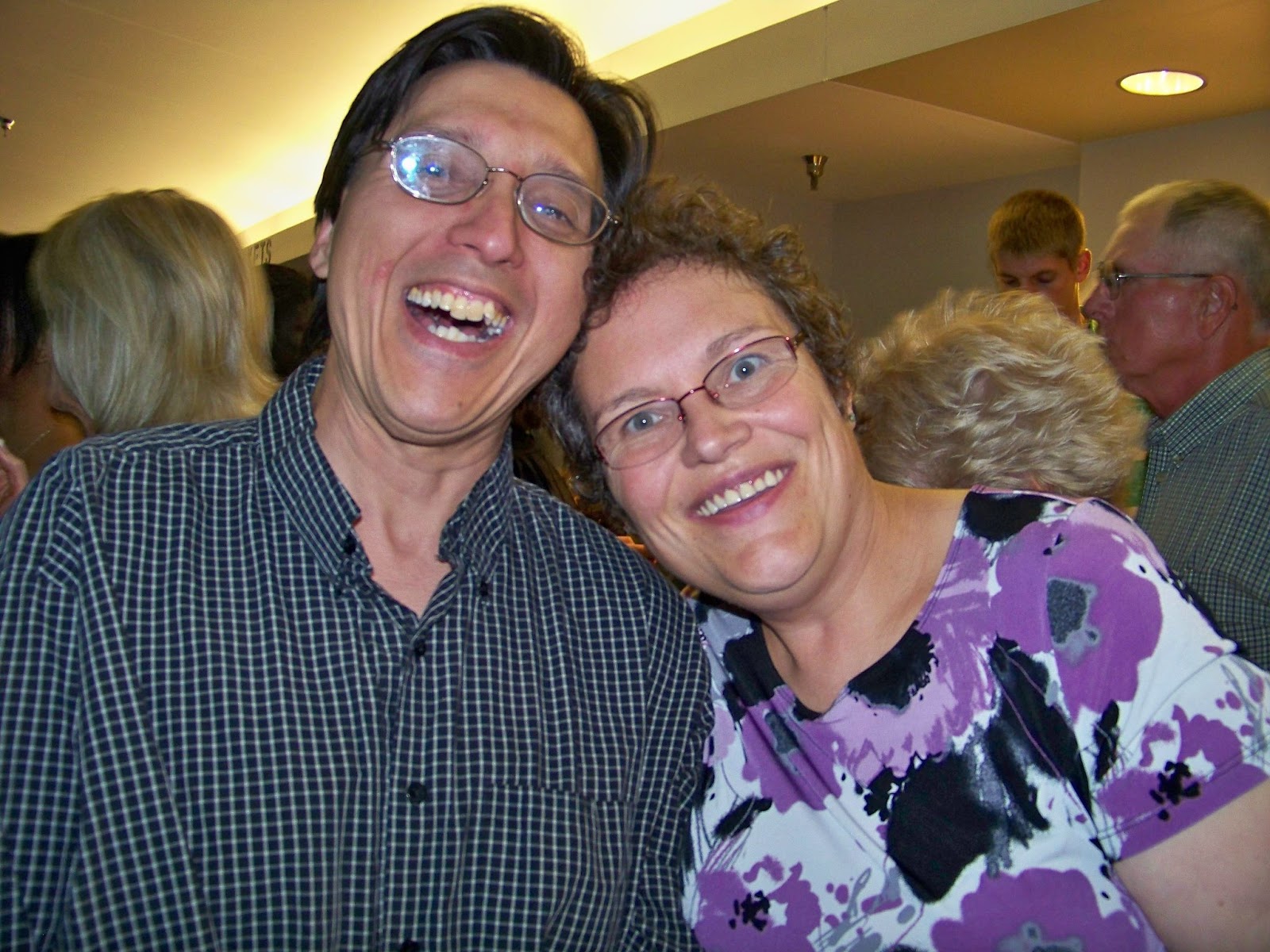
I have two characters in two different books, Allan Chang and Ichirou Shimizu, who both fight the lure of perpetual hedonic happiness. Is it a coincidence that both are Asian? That might be just because I think Asian men are underrepresented in literature and demoted as sidekicks or comic relief. It could also be because I think Asian men are cute, as evidenced bythis photo:

This is my husband, Richard Leach-Steffens, and I. He’s your typical Asian-German mix, brought to you by living in the USA.

It’s interesting, however, that Asian cultures emphasize balance and harmony, because the hedonic treadmill (represented by heroin for Allan and by a fantasy world for Ichirou) is counter to the values of an Asian society. Yet that harmony is broken for both — Ichirou by a hidden talent and the pressures of being young in contemporary Japan (see hikikomori), Allan by an abusive family situation.  I set up the balance/imbalance dichotomy accidentally, but I love the results.

This is the kind of stuff I mean when I say I put the things I know into my books. I don’t want someone well-balanced with no difficulties to be the addict, because research shows that happy rats don’t do smack, but the stressed-out ones do. And people don’t escape if where they’re at is just fine. (I’m not talking about the later stages of addiction, when the behavior becomes the life — just why some people can take drugs and quit, and others can’t.)

By the way, I wouldn’t hook up to the happy machine either. Being at the same level of happiness all the time doesn’t make for good writing.