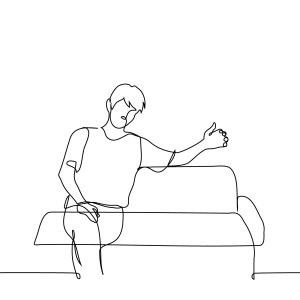
man sits as if hugging the person sitting next to him, but no one is visible – one line art vector. concept imaginary friend
In the Hidden in Plain Sight series, I have been writing enough books and short stories that the characters have become my imaginary friends. My husband and I play with questions like “What would Luke say about this?” or “Would Josh do this?” I occasionally ask my characters questions (what I call ‘interrogating’) to see what they tell me about themselves. I have backstories (often written in the short stories) that make the characters more complex.
I have two novels published (Gaia’s Hands and Apocalypse), one about to be published (Reclaiming the Balance), and three to be published in the future (Avatar of the Maker, Carrying Light, and Whose Hearts are Mountains.) There’s also a set of short stories out there and another in the works. There’s one more secret to be revealed, and I’m working out how to make it into a full novel. And then I don’t know if I have any more stories about that world.
I don’t know what I will write about if I feel like I’ve written too much in the Hidden in Plain Sight world. I could invent another world and write a while in it. I do have one novel with a different world (or a different angle on this current world like Hidden in Plain Sight is) and I suppose there may be more stories there. But I don’t want to leave my imaginary friends!
I’m three chapters away from finishing the first draft of Carrying Light, after which I am going to put it in a dark drawer (figuratively) for three months or more before I look at it again. To be sure, I don’t need a final copy for at least two years. I have two books that would get published ahead of it, Reclaiming the Balance (hopefully Jan. 1, 2025) and The Avatar of the Maker (hopefully Jan. 1, 2026). I also have one book that would be published after it, Whose Hearts are Mountains (January 1, 2028 if all works well). What will influence the publication dates is my cover artist, because I trust her vision on the books better than anyone else’s (she’s my niece).
The next project is going to be a final edit of Reclaiming the Balance. I’m still on the fence about publishing that one. It’s a different novel about the collective known as Barn Swallows’ Dance. It centers on a relationship between a human with a vengeful Archetype ex-boyfriend and a potential, unique partner. The conflict is in her relationship and in the collective trying to prevent her kidnapping. And in the dichotomy between the collective’s progressive attitudes and their very real prejudice. There’s action, kidnapping, a battle, and an attack. I just hope it’s not too “brainy”.
Publishing the Hidden in Plain Sight pieces (all the above-named) is nerve-wracking; I have a lot more invested in those than I do the Christmas romances. The Kringle Chronicles series is fluffy and fun. The Hidden in Plain Sight series is more serious (with glimmers of humor; I can’t go without that) and sometimes even dark. It’s where I ask about the possibilities ahead.
I will publish them eventually, because what’s the good of asking about the possibilities ahead if nobody reads them?
Ok, that was random. I’m done writing Avatar of the Maker, at least the first draft.
It needs a lot of work, enough that I don’t know where to start. At the beginning, I suppose. I think I need to make lots of notes on it and I don’t know whether to make these on paper or on electronic sticky notes. Or both; some of these notes are on the overall body of the book and others are specific. Writing a novel is hard; editing is harder.
I think I can describe the novel in one sentence: One death in this battle could kill millions.
In a paragraph: Leah Inhofer sees visions of a battle held in a dim place. Her best friend, Baird, draws her from her sheltered upbringing by his very existence as a Nephilim. They meet with Luke, a near-immortal Archetype who reels from the loss of the human patterns he carried. The battle Leah sees will happen, a battle of Archetypes. One death in this battle could kill millions of humans. Leah knows that she must act to stop the battle, at the risk of her life. She carries the responsibility as the Avatar of the Maker, who has the power to change the flow of reality.
My mind is already working on the book cover. That’s a long way from now.
I need to go back to writing on Avatar of the Maker, as I have only written about 2000 words in the past week. I could get it written in a month if I could get 1000 words a day. The problem is that I’m not eager anymore because of the remaining part being before the big ending and after Leah’s pregnancy revelation.
What would it take to get more eager? I need to talk to Baird. Baird is one of the male protagonists (this is not a love triangle!) He’s half-human, half immortal Archetype, and he’s in love with Leah. He’s a deliberate person, and could be accused of being slow by someone who didn’t know better. He’s a marshmallow in romance parlance.
I need to find his orneriness. I need to find his edge. I need to see him be worthy opposition to headstrong Leah. This part is murky and I don’t know where to go. How frustrating.
I’ve been stymied on my work in progress, Avatar of the Maker. I’m in the section where things are ramping up to a battle, and uncertain as to how to make the action actually ramp up (or should it be the calm before the storm as I am currently writing it?)
I feel like I have lost my bearings, that I have lost my flow. This is why I’ve gone back to the beginnings (even though I’m not done with the book) to edit and get a feeling for what comes before. I’m hoping this will give me a jumpstart for the flow of the second half of the book.
After going through the first 4 chapters, I have a good feel for the beginning. Now to go through and see where the flow bogs down.
Here’s Chapter 4: The Great Loss
In a place where humans had never set foot, a group of beings sat in a room. Its black crystal walls twinkled with light from the molten white floor, from the white table, and from the participants themselves. The shortage of light did not lessen the sterility of the surroundings. “The Apocalypse proved that we, the Archetypes, no longer take our protection of the human patterns seriously,” Luke said, his hands tented in thought. His ruggedness, in contrast to the unlined faces of the others, announced that he had, unlike most Archetypes, committed evil — in his case, for the sake of good. Also, unlike most Archetypes, he had repented, which gave him a perspective that could be called almost human. “But they still embrace evil.” The Baraka Archetype, short and spare like his people, leaned forward. “They fight wars. They envy each other and they commit crimes out of greed.” “Or out of want, or madness, or a dozen other things.” Luke grimaced, reflecting a view of reality that had wavered from the neutrality of an Archetype. Su, his consort and the Oldest of the Oldest, watched impassively. She knew how to play the game, Luke noted, something he had lost in his long association with humankind. “If we give them the full impact of their cultural histories — not just the facts, but the fear, the hatred, the xenophobia.” The Bering Strait Archetype looked at his hands. “How do you know it will make them worse? They already hold the oral tradition of their peoples’ pasts, and those seem to inspire xenophobia, it’s true. But what if they remember the full impact of the losses of war and weigh it against their hatred — would they decide to fight more? Or would they lay their weapons down?” Luke took a breath, to calm himself down, to wear the gravitas of the Archetype instead of the passion of humans. “What if gaining their cultural histories changes nothing at all, given that they are vast hybrids of cultures? The point is, if the humans kill each other, millions of them will not die with each death. If we keep holding the patterns of the humans — “ “One of our deaths will kill millions of humans through the loss of their patterns,” Su said. “Which is why the Maker created us nearly immortal. Yet the Triumvirate, Archetypes themselves, almost killed Lilith, who held the patterns of all women. Can we guarantee this won’t happen again?” Suddenly, the residents of the room stopped speaking. Luke felt as if a wind had cut through his immortal bones and chilled them. Then he felt the weight, a weight of the history of countless descendants of the people of the seax, the knife that gave its name to the Saxons. And then his burdens vanished, and he felt a hollowness inside. The gasps from the others at the table echoed him. “What — what was that?” The Ibero-Maurusian broke the silence. “I think — Su, did you notice anything?” Luke asked, noting the puzzled look on his consort’s face. “Nothing.” Su looked at the others at the table. “Except that all of you around me froze for a moment and slumped forward. As if something took something weighty from you.” “As it has.” The Bering Strait Archetype pressed his lips together. “I think — I think we lost our patterns, and if so, the Maker has taken them from us.” He sounded bewildered, as if he lost something more than the weight of patterns. “I must…” the Ibero-Maurusian said, then paused. “No.” She spoke slowly, as if weighing each word. “We may be the only ones whose have lost our patterns.” “But what does this mean?” The Baraka pounded a fist on the table. The Yolnju Archetype spoke. “I think this means that the Maker decided for us — He will take our patterns from us whether we are ready to relinquish them. And we’re the harbingers of this big change.” The discussion broke down into discordant declarations of confusion.
Later, Luke felt a hollowness in his entire being as he shimmered into the chilly dawn at Barn Swallows’ Dance. His feet materialized on the beaten green surrounding their Commons building. In the early morning, none of the residents — the human residents, that is — wandered the grounds. Luke sought his daughter Lilith and her consort Adam, both Archetypes, to share the latest news from the Council of the Oldest. He set toward their little blue cottage, his boots treading on the fallen gold and red leaves of a maple tree. Adam and Lilith lived as humans in the community of humans, to the consternation of the Council. They, and Luke and his consort as well, served as patrons of the collective. Giving — what? The residents showed more courage than the enemy and noncombatants in their fight to protect humanity. Humans proved more clever in the strategies they employed, subterfuge and illusion rather than brute force. Humans saved themselves, with the final sacrificial act of the Archetype Boss Aingeal merely a reflection of the compassion he saw by the humans. Or so Luke believed. Humans, Luke thought, do not need us anymore. They do not need us to protect their cultural memories anymore. They can fully face their ancestors’ raw emotions of fear and hatred and pride and belongingness. Humans are the future. Archetypes will fade into the past as the Maker decrees. Other than as repositories for human ancestral memory — the souls of cultures — Archetypes served no purpose. Luke thought about the differences between Archetypes and humans. Humans lived Earthside in buildings they created with sweat and toil, which they adorned with mementos that reminded them of important things. The building — the house — protected humans from the elements, and the humans’ ingenuity and intelligence protected them from many more hazards. Humans grew efficient enough in protecting themselves to possess leisure time to dream, create, and cherish each other. Archetypes dwelt in InterSpace, a nothingness of black crystalline walls and floors like milk glass. The Maker created Archetypes to need very little, not even each other’s company, but immortality and idle time weighed heavily on the soul. To fill their time, Archetypes fabricated what they furtively glimpsed Earthside from the stuff of InterSpace, and those artifacts would dissolve into their component molecules before too long, which kept the Archetypes from tiring of their material acquisitions. Luke knocked on the door of the little blue cottage. Luke, Adam said into Luke’s mind. You could have mindspoke us first. I didn’t want to interrupt you from doing human things. Adam opened the door, one eyebrow quirked. He wore the unrelieved black he preferred, which set off his pale gold skin and cinnamon brown eyes. Archetypes resembled superlative examples of the cultures they represented, and Adam’s Han and Proto-Celt heritage created a rare masculine beauty. Adam looked Luke up and down. “What’s up?” Luke hesitated. “Has anything — happened — to you? Strange feelings, or…?” Adam shrugged. “No. Should it have?” He opened the door of their cottage to Luke. “The Council just met, and I need to talk to someone. In person — this is not a matter of mindspeech.” Adam’s eyebrows raised, and he opened the door to Luke and stepped aside. Luke looked around at the house, at the decor in soothing blue, the comfortable couch and chair. On the wall hung a frame with two braids of hair — one black, one the golden blonde of his daughter’s hair — in the shape of a heart. A very human artifact, shaped by hands and not by thought in InterSpace. “Luke?” Lilith asked her father, as he followed Adam into the living room. “What’s wrong?” A smile formed and faded on Luke’s face as he studied his daughter, noting as he so often did how his features reflected in his daughter’s face shone so radiantly. “Nothing — I don’t think. At least I hope my vague worries are for naught.” Luke settled himself in a chair, feeling the whole of his six thousand years. “Well, the Council has been meeting for these three years since the Apocalypse. As you know, immortals take their sweet time deliberating on anything, especially immortals with as little imagination as Archetypes.” Luke steepled his hands. “Deliberating on what?” Lilith asked, leaning forward. “Whether humans should possess their own patterns, their cultural DNA. With us Archetypes carrying the collective cultural memory, the bone-deep emotions of culture, we subject large swaths of humanity to extinction if one of us gets killed.” “Such as what almost happened in the Apocalypse because I held all the women’s cultural DNA.” Lilith stood. “It seems a simple decision that we should divest the DNA patterns to the humans. Each one gets a piece of that memory and there’s no mass die-offs.” “I agree,” Luke mused, “but…” “But?” Adam interjected. “But just now, I sat in Council debating why humans earned the right to experience their full cultural memory — the Baraka and I debated whether cultural memory would exacerbate human nationalism — when I felt a great weight fall from me. From the collective gasp I heard from the others, I guessed they had experienced the same thing. The event stunned us into silence, rare for the Council. “Su spoke out of the silence that fell upon us, asking what happened to the rest of us. She didn’t experience any of the disorientation, the lightening of our being, because her charges, the Denisovans, died millennia ago. That was how we reasoned we lost our charges’ cultural memory. Those patterns we held.” “How?” Lilith inquired. “You said the Council hadn’t decided.” Luke waited a beat, then two. He didn’t know how to say the suspicion in his mind — “Yes?” Adam asked. “I would guess the Maker reclaimed them.” Luke felt that vague, floaty feeling that had plagued him since the incident. Adam and Lilith broke out in consternation. “The Maker? Does our Maker even exist?” “Su remembers the Maker, who created the first of us. Su never saw Her after that, and the legend is that the Maker created us to do His work, and She left to create the clockwork of another world. Until, apparently, now.” “Why now?” Adam inquired, brow furrowed. “I would guess it’s because we’ve fallen down on our job.” Luke looked down at his hands. “Which we have, given that at best we’ve been indifferent to our human charges, and at worst —” “Some of us plot to kill them.” Lilith grimaced. “It doesn’t matter that we — the people in this room — fought against those who planned to annihilate the humans. We, as a race, failed humans.” Lilith dropped her hands in her lap. The three sat in silence. A luxurious black cat, another sign of his daughter’s growing humanity, stropped Luke’s ankles. He reached down and idly petted the cat. “How do you know you’ve lost your patterns, Luke?” Adam pressed, leaning forward. “You just know — it’s as if I’ve lost some weight, some substance suddenly. I feel strangely bereft without the weight of the humans’ patterns on me. Like I’ve lost my purpose.” “But you have a purpose,” Lilith argued. “You’re on the Council. You help support Barn Swallows’ Dance.” “I can’t explain it.” Luke rubbed his forehead. “It’s a feeling, a very human feeling. At least, being close enough to humans to understand feelings, I can name what’s happening. But I don’t know what to do with myself.” The Bering Strait Archetype spoke in Luke’s head. We need you back up here. “Excuse me,” Luke nodded to his daughter and her consort. “It’s time to face the music.” And Luke shimmered away.
“Luke.” The Bering Strait Archetype shot a pointed look at Luke as Luke re-materialized in the dark chamber. “Glad to see you again so soon. We’re not impetuous beings. Does this come from your exposure to humans?” Su spoke. “What do we need to do to warn the other Archetypes of what will happen?” The Baraka hesitated. “I don’t know that we should warn them,” he mused, his hands clasped in front of him, fingers interlaced. “If we warn them, they may speak to each other and magnify the issue far beyond reason. I think it’s in our best interest to keep this quiet, and let each Archetype believe he is the only one.” “Are you sure this is a good idea?” Su asked. “You assume our Archetypes make no contact with each other? Although we are an introverted people, it doesn’t follow that there’s no communication between us. All it would take is a daisy chain of acquaintances trading observations before several Archetypes would know it wasn’t just them, and our lack of warning would be suspect.” “You mistake us Archetypes for humans,” the Baraka Archetype argued. “We are less volatile, more rational. I believe we will take this much more calmly than humans might.” “You felt what happened,” Luke pressed. “You felt the hollowing out of your being. How did it make you feel? Rational? I think not.” The Ibero-Maurusian jumped in. “I think the Baraka is correct. Besides, we hold no power over the divestment of human patterns, as it’s being driven by the Maker. Therefore, we possess no responsibility.” In the end, the Council voted to keep secret the divestment of human patterns from the rest of the Archetypes. Luke took a deep breath against the very real turmoil churning in his stomach.
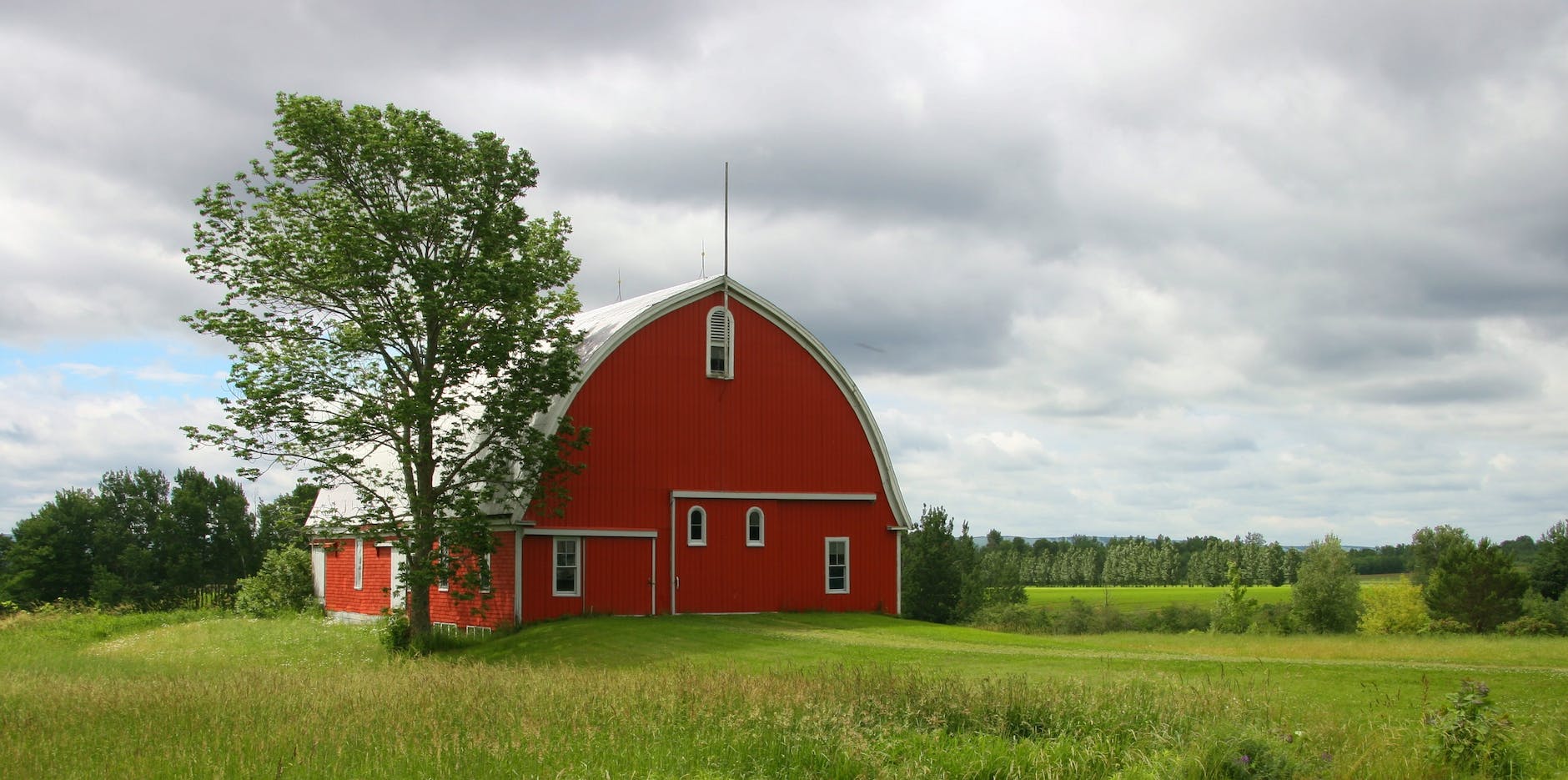
A week later, Brock and Leah sat in the livestock barn, hiding from the rain, which had broken out as they finished trimming the hooves of the Welsh Mountain sheep. The two sat on old folding chairs swiped from the Commons building.
“Leah, are you okay?” Baird asked as the rain hammered the metal roof.
“You keep asking me that!” Leah stood up and peered out the door at the rain. “I’m okay.” She didn’t want to talk about it — the feeling of foreboding that settled in her bones like a chill she couldn’t shake.
“No, you’re not,” Baird observed. “If you were okay, then you’d be able to laugh at me being so clueless.”
“I’m okay!” Leah turned away from Baird.
“Leah!”
“What’s the matter with you, Baird?” Leah turned to him, hands on her hips. “Why are you getting into my business?”
“I’m not getting into your business,” Baird shouted, standing up. He sat just as quickly, burying his head in his hands.
“Baird, what’s wrong with you?” Leah asked, standing and striding over to Baird.
Baird raised his head. “I’m not used to snapping at you. I’m not used to snapping at anyone. But it’s part of my nature, this anger. And I’ve learned to ride herd on it, to become a person instead of the soldier they tried to make me. I’m not the calm, meditative person you think I am.” He paused. “Or I am, but it takes work. Like right now. I know there’s something wrong — you look pale and wiped out. But you won’t talk.”
Leah sat back down, pulled her chair closer to Baird. “I’ve been feeling like something bad is going to happen for days. I’ve not talked about it with you because I’ve not talked about it with anyone. I don’t want anyone to think I’m crazy.”
“You think anyone here would think you’re crazy? We have Trees that give talents, and if I heard correctly, Josh foresaw the Apocalypse, didn’t he?”
“But that’s just it.” Leah fidgeted with her hair, taking it out of its hair scrunchie and pulling it back again. “Josh’s vision quickly made sense because the Triumvirate announced they’d attack us and kill Lilith. But we have nothing to tie my vision or my foreboding to. The vision looks nothing to do with Barn Swallows’ Dance if it means anything at all.”
“You need to tell someone. What if it means something?” Baird reached for her shoulder, then pulled his hand back.
“You don’t understand.” Leah raised her hands in resignation. “My parents grow increasingly uncomfortable about this place. They’re not comfortable with their talents, or with the presence of the Nephilim —“
“You’re telling me.” Baird snorted. “Oh, sorry — go on.”
“I’m afraid —“ Leah paused, staring down at her hands.
“Afraid of what?” Baird prompted.
“I’m afraid they’re going to disown me. For being what they’re afraid of.” The words came out in a rush; their weight lingered.
“They wouldn’t disown you, would they?” Baird asked to break the long pause.
“If they thought I willfully walked away from God, they might,” Leah fretted. “I don’t even know if I believe in their God anymore.” Leah fell silent, waiting for their God to strike her down. Nothing happened.
“Who is your parents’ God?” Baird asked, clasping his hands.
“Well, God.” Leah snorted. “Ok, the Christian God.”
“Do humans believe in other gods?” Baird leaned back in his chair, ready to learn more about humans, a thing he pursued with enthusiasm.
“Well, Aasha Kaur’s Sikh, and she calls her deity Ek-Ongkar. The Hindu have a pantheon of Gods and Goddesses, and Jeanne and Josh believe in nature spirits. But I can’t —” “You can’t believe in another God?” Baird guessed.
“Because our God is — “ Leah sighed. “It was comforting to grow up and feel we had the lock on salvation because we’d been born to the right God. It’s not so easy now, living at Barn Swallows’ Dance with so many beliefs.” Leah turned to Baird. “What do you believe?”
“Many of the Nephilim believe as the Archetypes do — in a creator we call the Maker.”
“Well, that’s original. But then again, we call our God ‘God’”.
“Anyhow,” Baird raised his eyebrows at her, “We don’t worship so much as acknowledge the Maker, who we believe constructed your world with its geography, its climate and weather and seasons, its ecosystems, and the Archetypes, held apart from humans by their immortality and their task to hold humans’ cultural underpinnings safe. And then They left to create another world.”
“So no sitting in judgment?” Leah asked. “That must be nice.”
“No. They’re pretty hands-off.” Baird cocked his head and listened — for the rain? Or for Leah’s father?
“They? I thought there was only one Maker,” Leah groused.
“The Maker has no gender. Or both genders. Nobody really knows.” Baird shrugged. “We haven’t heard from Them in thousands of years. Many thousands of years. We observe no rituals, we don’t pray. We are not the people of a deity.”
“That must be a relief.” Leah put her hands on her hips. “Beats being disowned by your parents for something you have no control over.”
“You need to tell someone. Besides me, that is — “
“I can’t tell Luke. Luke is — well, he looks at me like he knows something he’s not telling. I feel judged by him. It would be as bad as telling my parents.”
“Is there anyone else you can tell?”
“No. It would get back to my parents.” Leah grimaced. It would be so easy to let go her burden were it not for that.
“Okay,” Baird said. “Back to trying to make sense of the vision. Have you seen any visions since the one?”
“No, just the one. I feel like everything’s about to go wrong, however.”
“Back to the vision. What exactly did you see again?”
Leah shifted in her chair and closed her eyes, recalling to herself the vision. “I saw two lines of people facing each other, some in light armor, some with weapons. No guns, and as far as I could tell, no bombs. Just swords, and maces, like this was going to be a big man-to-man fight. They stood there, glaring at each other.”
“Did you recognize anyone in these lines?”
“No, but now I remember a man who commanded one line, pacing along the line, galvanizing them. He stood tall, and he taunted the men and women in line. Let me see — he said, ‘Do you want to be worthless? Do you want to be diminished as — he said some four-digit number — was? Do you want to be walking dead, trying to slit your own throats? We can stop this!’”
“That’s further than we’ve gotten before. What were they wearing?”
“To be honest, they looked like they dressed for a street fight. Or a gladiator ring. Both, kinda. Like I said.” Leah felt the dread like a miasma again. “Can we not talk about it?”
“I don’t know if we have that luxury, Leah.”
Leah tried to read Baird’s face, came up with concern and something she thought was puzzlement. “I just need to quit talking about it now.”
“Ok,” Baird said. “I’ll let it drop for now.” He looked out the door; Leah’s eyes followed his, and she noted the rain had stopped. “Let’s see if we’re needed in the food forest to pick fruit.” They left the barn and walked silently toward the food forest, through browning grass sloppy with rain.
When I write a story, I begin with the characters, because without them there would be no story. The story is theirs; it’s my responsibility to get the characters and story on paper.
In the current story, Avatar of the Maker, there are three main characters: the sheltered but headstrong eighteen-year-old Leah Inhofer; her devoted half-Archetype boyfriend Baird Wilkens; and Luke Dunstan, a six-thousand-year-old Archetype.
From there, I want to know what their motivations are. Leah’s is to be independent, which seems contradictory to having a child on the way. Baird’s is to support Leah, however possible; another goal is to find his way into a human adulthood. Luke’s goal is to keep a calamity in the Archetypes from happening, weighing potential harm to Leah and her unborn child with harm to humanity if she doesn’t act.
It’s necessary to get their speech cadence, their mannerisms, their word choice, all the things that make the characters distinctive and alive. Luke keeps pulling his blond hair back in a ponytail and letting it loose. Baird ducks his head sometimes because he’s shy. Leah talks emphatically; Baird talks in a slow drawl. Leah braids her hair tight. Luke’s accent is Yankee.
When I feel comfortable with these, I feel much more comfortable putting in the plot.




 Words Like Me