The Big Five Personality Test

One of the things I teach is Personal Adjustment, which is a poor name for what the class really is: a class in positive psychology. Yesterday, I covered traits and happiness. The whole thing about that is that we have personal genetic traits which might influence our happiness.

One way to measuring enduring traits is the Big Five Personality Test, which has been tested for correlation not only to the traits measured but to happiness. The Big Five mentioned in the title measures five dimensions (see picture below):
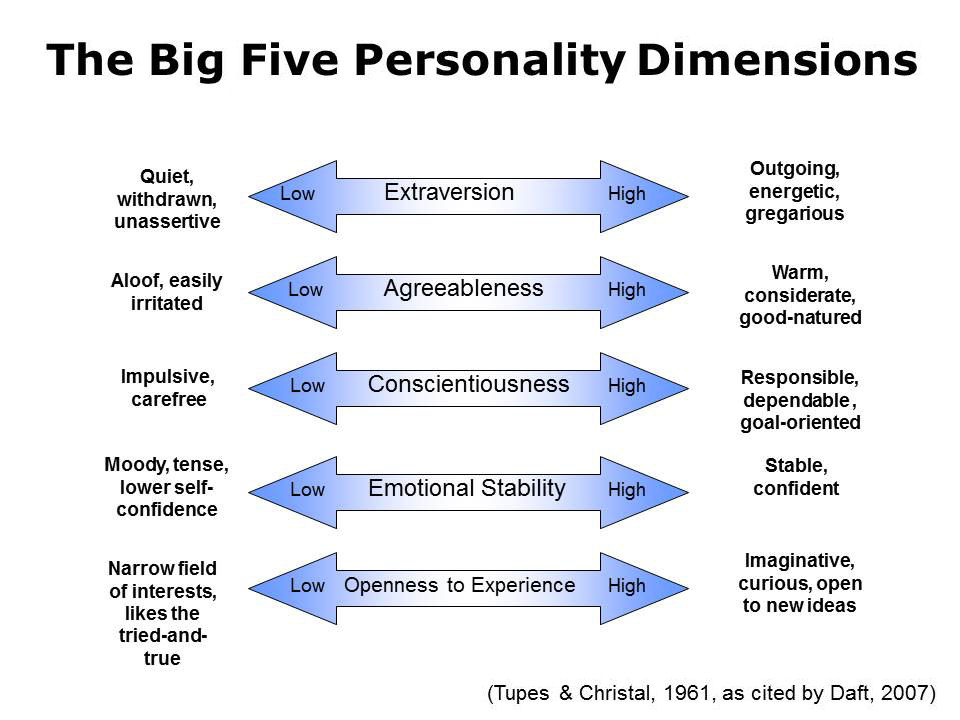
Some of these dimensions are linked to happiness as follows (Judge et al., 2007):

  • Higher openness to experience correlates to higher happiness
  • Higher extraversion correlates to higher happiness
  • Higher emotional stability correlates to higher happiness
  • Agreeableness and conscientiousness do not correlate to higher happiness

In other words, if you score low extraversion (i.e. score as an introvert), you will experience less happiness than someone who scores high in extraversion — and half that gap is unchangeable; it is a trait you have that won’t go away.

The good news, though, is the other half (on average) of that gap can be changeable. By pushing your comfort zones, you can recoup some of your happiness in openness and extraversion. By learning to manage emotions, one can increase emotional security.

So some people are happier than others, but it’s possible to approach a higher level of happiness through self-work, and that’s a good thing.

Fantasies, Aspirations, and Goals

The average self-publisher sells about 250 copies of their work.

Hearing this statistic floored me. I have no doubt that it’s accurate. It’s just that — that’s not a lot of copies. I thought I was being conservative when I set a goal of 400 copies if I self-published.

I thought I was being realistic when I ruled out thousands upon thousands of copies and the New York Times bestselling list. It turns out that my scaled back fantasies — even the 400 copies if I self-published — are too unrealistic. Without realistic grounding, our aspirations are set by our fantasies, and our aspirations in turn set our goals.  

It’s time for me to figure out how to pare back my goals, fueled by fantasy. My fantasy was that I would have an agent and would find a publisher of size (say, one of the Big 5) and go on a book tour where someone else made the arrangements for me and I didn’t have to buy my own copies to sign and sell. 

In a way, this is freeing. This makes me realize that having 20 readers of my blog is perhaps normal, and that the agents who reject me need to so they don’t starve, given the odds of someone picking up a book and reading it.

It also means that I will never get external validation of my work if I gauge success by my fantasies. How many readers is “enough” if the average self-published book gets 250 reads?  What does a rejection mean if the object is not quality but saleability?

My goals will stay the same:

  • Get picked up by an agent or publisher, avoiding vanity presses and publishing mills
  • If the above doesn’t work, research and develop an effective self-publishing strategy, avoiding self-publishing scams

What changes are the standards for success. I’m still working on scaling down my expectations. This will be difficult.