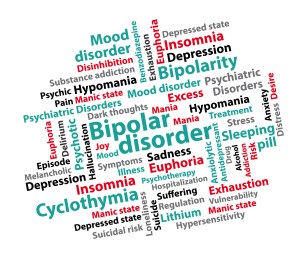
My biggest challenge is my bipolar disorder. Right now, I’m on an even keel and have been for a long while. No rages, no glitches in judgment, no loss of conscientiousness, no desire to sleep all day, no weepiness. None of this despite a change in medication. But I feel like I’m overdue. Maybe it’s just superstition.
Hypomania scares me more than depression; I have gone to work despite deep depressions in the past. I can work through hypomania, but I’m more likely to do something I find embarrassing. One time I CC’ed an email when I should have BCC’ed, which sounds minor, but I broadcasted the mailing list for an anonymous survey. And I did it again to apologize; the apology itself bordered on emotional meltdown. The reverberations went all the way up to the Board of Regents and I had to go through a disciplinary action (some training and a “Don’t Do This Again”.)
My bipolar could be so much worse. As a Type 2, I don’t have the level of mania that truly disrupts life, but I have all the depression. That’s bad enough. The hypomania is bad enough. It’s the biggest challenge in my life.
In my romances, I sometimes write about ordinary people who perceive that something about them will get in the way of a happily ever after (or at least a happily for now). Secrets, personal failings, longings, parental disapproval. The couple overcome these and find room for love.
This latest book I wrote (it’s in the editing stage), Kringle through the Snow, has one character whose flaw is that she has bipolar 2, which is something I manage in my own life. She is scared that another hypomanic or depressive state is just around the corner and nobody else should be exposed to it.
This is one of the hazards of being bipolar — the stigma. Someone with complications like bipolar is certainly more daunting than people without, and some potential partners want uncomplicated situations. Some are just scared. It is possible to have bipolar disorder and go years before another attack because of diligent management; how is this different than having diabetes or another chronic disease?
I write to ask these questions. In my writing, I want people to confront their preconceived notions, because I think we are our own worst enemies. I think love, when it’s truly there, finds a way.
I have Bipolar 2. Some people call it Bipolar Light, but to be truthful, the lows are just as devastating as they are in Bipolar 1. The highs are less extreme but can still be damaging as high moods lead to irritibility, impulsivity, and dysfunction.
The idea behind treatment is to even out the moods — cut the highs and the lows. Some of the medication I take targets lows, some highs, some both. Most people with bipolar take a fine-tuned cocktail of meds to optimally target their mood swings.
About two weeks ago, the doctor had to take me off the mainstay (lithium, the gold standard) because of damage to my kidneys. They’re weaning me off it, and I honestly don’t know how stable I will remain. They’ve upped another of my meds to see if it takes care of the problem. I know that if I start having trouble with my moods, I’ll be able to call my doctor and see if my meds need more tinkering.
This is scary to me, because active bipolar makes it harder to function. Depression is horrible; hypomania is fun until I’m not getting any sleep and overwhelmed with projects.
I am just coming out of a depression. I don’t remember going into it, instead easing into it as if it were just a change of season.
I reminded myself that I was not feeling depressed. There was no self-flagellation, no remorse, no desolation. That was the big lie — that my reclusive behavior, my flat affect, and my resignation to being (in my eyes) a failure wasn’t depression.
Telling my colleagues that I was fine if they asked me if anything was wrong (and they asked me at least three times) was another lie. I am known in my workplace as being bipolar, and thus I feel I have to be on my best behavior lest they think I was going to the hospital again. I told my colleagues again and again that I was doing great, and maybe I even believed it because the temporary bubble of positive attention (that I felt I didn’t deserve) buoyed me. But then I fell back into the grey of my life this last winter.
It’s only now that my mood has risen with the Spring that I discovered how low I had fallen. I have depressive tendencies in Winter, but I didn’t expect to have fallen to the place I was this winter. The scale said I’d gained weight; I didn’t pay attention to my looks. I did very little. Too many times, I accepted negative self-talk as the truth about myself.
What could I have done differently? First, I could have caught the mood change sooner. I need to find some signs of the doldrums before they become depression. Second, I could have been more honest with myself and others, and maybe I would have accepted a medication change. Third, I could have been better to myself, but only after the first two were in place.
Bipolar Disorder is a weird disease, seeking balance in a body that wants to go to extremes. In fact, I am watching now to make sure I don’t tip in the other direction toward hypomania with its endless elation and debilitating restlessness. This is my life, and it’s not that bad. Maybe the biggest lie is the stigma I surround myself with that isolates me.
Venturing into the attic as my father worked to restore it. The entire neighborhood late for school because my cat is having kittens. A gully washer sending rain cascading down the steps across the street. The hospital with its old wood panels and cordovan leather. The evening when I played in the street with my neighbor and my sister. Fishing in the park with my father, the first time I threaded a worm on a hook. When I finally got a boyfriend.
Going off to college unprepared and coming home again. Going back and staying there even through summers and Thanksgiving breaks. Growing microbes in Petri dishes and cooking pound cake in the food lab. Classes I skipped to sit on the Quad and watch people.
Walking to my graduate classes barefoot and scandalizing my professor. Skinny dipping at the St. Joseph’s Sportsman’s Club on a skinny September night. Watching Star Trek with my friends. Losing Thanksgiving Break to a class project. Walking across the stage to get my PhD.
Exploring my new home across the country, walking everywhere. Being betrayed by a husband and breaking up. Spending a week in an inpatient facility that saved my life. Falling in hopeless, chaste love with a rock band. Moments I felt like the sky was falling down, but I persevered. Driving to the Adirondacks to camp by myself and feeling freedom.
Moving back to the Midwest to be with someone I thought was the one — he wasn’t. Buying a house as an act of solidarity with single professional women. Learning how important laughter was to a relationship. Driving for miles and miles before getting to the next town. Watching coffee shops pop in and out of existence. Finding the right man and marrying on St. Patrick’s Day. Watching my mother die nine months after our wedding.
Appearing in a dunk tank for charity. Traveling to visit interns across Missouri and across state lines. Getting diagnosed with bipolar disorder and spending a few days at the hospital. Recuperating. Being moved into a bigger house. Spending a pleasant day with my father while he was in hospice.
And now I sit in the greying afternoon, having reviewed almost sixty years of life. All these memories are mine. I cling onto them as the things that define me.
I missed one of my medications for two weeks. I don’t know I did it, except it fell off of repeat refill, and I didn’t notice it was gone. It was my anti-depressant; I take a cocktail of meds to manage my bipolar disorder. Which means that without them, I progressively got depressed and anxious, curling up in a tiny ball, saying the grownup equivalent of “Nobody loves me” because the whirlwind in my abdomen felt that way. I still functioned at work, because I have a solid sense of duty that keeps me from calling off.
I just figured out on Saturday what happened, and by Sunday I got the prescription refilled. I am recovering.
It sobers me that one half of a teaspoon of chemicals daily keeps me from non-functionality, or at least less functionality. I admit the meds are miraculous, even with their side effects, which include benign tremor, dehydration, and maybe a bit of incoordination1. These meds keep me from despondency, from helplessness, from inertia, from self-flagellation, from a variety of self-deprecating and ultimately self-destructing exercises in my life. On the flip side, they also keep me from frightening elation, a feeling of invincibility, magical thinking2, and a touch of grandiosity.
I function well because of chemicals. Not even perfect chemicals — none of these efficiently target the difficulties in the brain, but work together to keep something (usually excitatory actions of the brain) from happening and make other things (retention of neurotransmitters and inhibitory processes) more likely to happen. My brain chemicals are tripping my body to be hyper, to be miserable, to be depressed, to be despondent when there are no stimuli backing up the feelings. The medicine keeps that from happening.
Very few people tell me to “go natural” and quit treating my bipolar. I think it’s because bipolar scares them and they don’t want to see me without my meds. I suspect they think I will become psychotic if I go off the meds. Probably not. But I appreciate their faith in my meds.
Again, it’s sobering that I function because of medications. but I’d rather function than not.
It’s hard to tell which is my natural incoordination and which is the medication, to be truthful.
Magical thinking is believing in irrational connections between A and B, where A is “step on the cracks” and B is “break your mother’s back.” I contrast this to most practitioners of magic, who believe that stepping on the cracks may affect your relationship with your mother but not break her back, and besides that, they don’t do actions with evil undertones.
Being vulnerable is that scary, that human. It’s scary to risk rejection because we have been a sloppy mess in front of someone. It’s scary for society to witness the breakdown.
The alternative, however, is that we stuff our feelings until we explode. Or we manipulate others so we don’t have to feel. Or we try to control everything until we cannot function anymore. None of these are good ways to deal with feeling like a mess, but ironically, those methods can seem more functional in the short run. They give an illusion of power — power over oneself, power over other people, power over situations.
I have very raw moments in my life. Although it’s kept well under control, I have a mental disorder. I have breakthrough times in February and October. During those times, I have sleep disturbances that keep me exhausted, severe anxiety, and a general feeling of being overwhelmed. I have to talk about it because it’s an overwhelming bad feeling and, at the time I have it, I feel like it’s always been there and will always be.
I’ve come up with some rules for myself on how to talk about not being okay:
Choose wisely who you will talk to and how much to disclose.
Mere acquaintances might rate an “I’m under the weather right now.”
Coworkers might rate very simple situational statements, like “My father died.”
Good friends, if they can handle things, might rate a description of what’s going on with some frankness, like “I have seasonal affective disorder right now and I’m doing pretty poorly.” This list is to protect you from the people who might reject you or the message.
The best thing, though, is to approach people who are supportive toward you.
Don’t use your friends as therapists.
Don’t rehearse negative scenarios on them and expect them to argue endlessly against you.
Also, don’t unleash your worst behavior on them. Treat them like friends and honor their feelings.
Apologize if you have behaved badly, just as you would when you’re not overwhelmed.
Do not expect your friends to keep dangerous secrets, like suicidal or homicidal ideations, for you.
If you are dealing with depression, anxiety, bipolar, schizophrenia, or other mental health issues, your best support system is not a substitute for therapy, whether that be psychotropic prescriptions, talk therapy, cognitive-behavioral therapy, or others. Reach out to your health care providers or get yourself some providers on your side.
I hope this has been helpful. I feel like I’ve clarified some things for me, and I hope that I’ve helped others think about this, because all of us have heavy times.
We’re officially past Christmas and New Year’s, and I’m officially done with the first draft of my next October release, and the skies are relentlessly gray. For someone with bipolar (II) disorder who uses the holiday season to hide from the darkening days, I am officially in the dreary months, or those months where I’m at risk for depression.
I’m tired all the time right now, and I’m weepy. I feel bogged down by a pretty normal workload. The answer to the question “What am I looking forward to?” is “A nap”, but there seems to be no time for that. I might nap on Wednesday. I have meetings all afternoon this week. On Friday I have an appointment in large letters: “NATHAN”. I do not remember who Nathan is or why I’m meeting with him. Since it’s in all caps, it must be important.
Remember that I am relatively stable right now and have been for a few years. No giddy, voluble mania; no draining depression. I almost wonder sometimes if I never really had bipolar at all, I’ve been comfortable for so long. Life gives us an amnesia when it comes to strong emotions; otherwise no woman would have a second child. So I know that my bipolar isn’t a figment of my imagination, even if I forget how traumatic it’s been.
My bipolar sits below the surface, waiting for its chance. It likes to boil up when I haven’t had enough sleep; I guard against that with a regular sleep schedule and supplemental medication for bad nights. It bursts out of quiescence when I face a lot of stress, and it roars into my life during crisis. Not always; that’s the tricky part. It’s not even predictable in crisis.
So I find myself saying “Well, I got through that” a lot lately. As in, “Well, I got through my dad’s death” and “Well, I got through all that grading” and “Well, I got through finals week” and even “Well, I got through carrying that heavy Nespresso machine down a flight of stairs without dying”. I feel relief that I haven’t gone on a three-day rant or begun tripping over my words in racing thoughts.
Sometimes I’m so relieved I feel like crying, and then I worry that a depression threatens to emerge. I shrug and promise myself that I will get on top of any threatening moods. I know the drill: Get enough sleep, talk to my psychiatrist, journal. Well, I got through that rocky patch.
Sometimes I write because I see it as a method of getting an idea out there into the universe, as if the universe will supply me with something I need to deal with it creatively. Part of my belief system holds that, if one listens closely enough, the answers or comfort or solution is out there. I like whoever’s providing the aid to know what I’m asking. It comes from Quakerism and it also comes from the Christian belief of praying for what you need. I don’t know if I believe in what would be called “intercessory prayer” in some circles wholeheartedly, because my spirituality has become a muddle from the time a psychiatrist diagnosed me as bipolar. But I put words out into the universe occasionally, with some witnesses to hear. That’s you.
My life with the muse
Right now, I struggle with creativity. The spark is gone. I am writing without that burning desire to see what comes up next in my work. Everything I write feels pedestrian. I lay my problem on the muse I have had throughout my career. Muses exist to give motivation. For example, my writing life goes like this:
Inspiration>Obsession>Writing
I assume the muse enters at the inspiration part of the equation. I used to get inspiration from my dreams. My dreams haven’t come from a muse lately. They’ve come from the Karen of my subconscious. In my dreams, I forget little things like showing up for class (I’m the professor) and wearing clothing. I’m doing everything wrong, and I am about to be discovered as a fraud. My bad dreams don’t even have the courtesy of being a dystopic plot line, preferring instead pedestrian impostor syndrome.
As muses are notorious for whipping up their subjects into a creative fury, I lay the problems of my obsession stage on the muse I’ve had as well. The obsession is the need to get into the story to interrogate the dream. I want not just to know the story but to be in it. To be it. It’s an exhilarating feeling, like flight. The obsession part is alright, unless it’s not. I know writers go a little crazy when they write, but my obsessions come with hypomania. I get into mood swings that swing between elation and Subconscious Karen, telling me I’m out of control, as if she fears I will skip class and run around naked. (Thank God I have done neither.) So I don’t get wild, but I fear giving creativity any quarter will cause the calamity I dream of.
Go away, muse
So I fired my muse. Those obsession parts were too wild, and I feared sliding down a slippery slope to a bacchanalia in the middle of the University Ballroom and all those other explosions Subconscious Karen feared. I never have experienced the wild elation since I fired my muse. I miss it sometimes, but it’s nice not having Subconscious Karen around all the time (she’s only around sometimes now, usually when I’m under a lot of stress).
Now I wonder if I can hire a new muse. I don’t want an erratic, frenetic, startling muse anymore. But I want a muse to inspire me without the feeling that I’m about to choose to swing naked on that chandelier. There has to be a middle between swinging on a chandelier and Subconscious Karen.
It’s not about a muse, is it?
Writing this article has been alchemy. I discovered, in writing this, that it was about writing with bipolar disorder. Although I am convinced that I am not less creative with the bipolar meds, I don’t know how to grasp my creativity as readily as I would like to. In a hypomanic state, ideas jump at me and I grab onto them and run. I feel touched by the muse and my self-doubts melt. I feel gifted, and this makes writing easy. Subconscious Karen keeps me from veering off the deep end but makes my life uncomfortable and my mood swings worse. I have given up those things which encourage artificial highs (irregular sleep, extended stress, obsessive crushes) and thus have robbed myself of the muse.
My thought going out into the universe: Help me live with Subconscious Karen in a way that doesn’t rob me of joy. Help me find inspiration without obsession, intensity without disruption, creativity without condemnation.








 Words Like Me