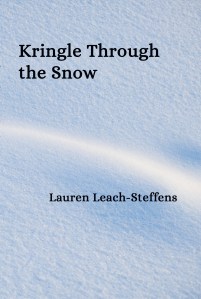
Both my books for publication are ready to be published. They’re sitting on KDP waiting only for their publication dates. I will release Kringle Through the Snow on October 1, just in time for falling into your Christmas romance TBR pile. Kringle Through the Snow involves an event planner with a secret dealbreaker, a self-professed nerd with a big dog, and a high-class gala with the Grinch. And, of course, snow.
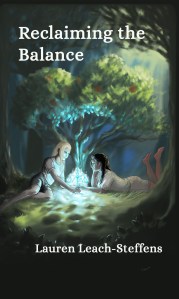
Reclaiming the Balance, a Hidden in Plain Sight novel, will be published on January 1st. I use the New Year as publication dates for this series (even though I could release it today) because of some sort of superstition on my part. This novel concerns Janice, a sculptor who flees her immortal ex-boyfriend with the help of Amarel, an androgynous Nephilim. The two face prejudice from the open-minded people of Barn Swallows’ Dance as they attempt to liberate Janice’s Nephilim son from her ex.
The e-books are available for pre-order; not so much the paperbacks.
I have discussed writing as a flow activity often enough that I’ve made the case that writing for the sake of writing is a worthy pursuit. Even so, I like to get recognition for my writing. I want to know that I am an interesting writer and have some skill.
Right now, in society, wanting external validation is a weakness. We call it “attention-seeking”* and that’s considered bad. However, external validation shapes our self-esteem, according to sociometer theory. When we don’t get it, we shape our behavior in order to get it.
In some ways, I get the validation I need. My friends know to ask me how the writing is going. That’s appropriate and my sociometer registers positive.
What I wish I had, though, is the readers. This is something most indie authors struggle with. There are so many writers out there, and so many books, and some people use traditional publishing as their judge how worthy a book is to read. What traditional publishing signals, in reality, is how well the idea sells. There are good writers in independent publishing. But they’re hard to find, and there’s a catch-22 that dogs indie writers: People read books that are read by others.
How to get readers? I wish I knew. I advertise mine on Facebook and Threads and Instagram. But the ads are not tempting readers to read, and I don’t know what to do about that. It’s hard sometimes, but I persist in hopeful thinking that I will get a following someday.
* Not all attention-seeking is good, and I can explain this in terms of sociometer theory. The bad form of attention-seeking is that which violates one of the social norms of a group, and that is attention-hogging. We don’t approve of one person getting all the attention, but are often too polite to signal that directly. Wanting positive attention in and of itself is not bad, however; it’s something we’re programmed to do.
There is a phrase among writers: ‘Write what you know’. The cop focuses on the precinct, the Parisian on Paris, and the college professor (like me) on college campuses because we have the details in mind.
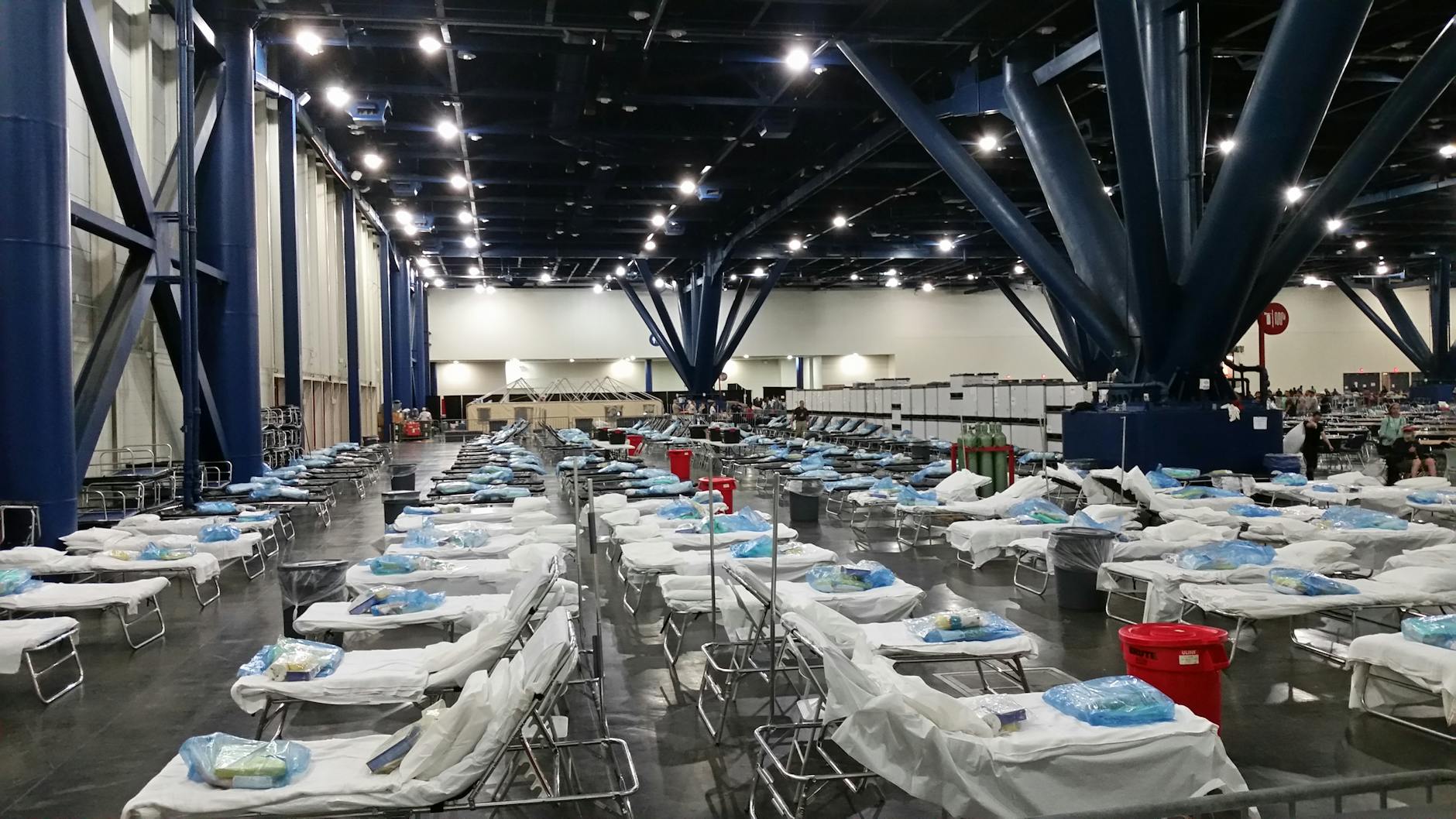
The above examples all focus on settings. I want to focus more on the knowledge base — where plot points and themes are informed by knowledge of a specific area. For example, I have some basic background in disaster management. I teach disaster psychology and case management. I know how people do triage in a mass casualty event because I have had CERT training. Because of my training in disaster mental health, I can spot the psychological symptoms of acute and post-traumatic stress. (I want to emphasize that I am not a therapist or counselor, and that I can’t treat people with these disorders.)
I have written two books where mass casualty events come into play. One is Apocalypse, where an impending battle threatens to cause the loss of all the women of the world. Characters looking at that possibility project how they will react, with both despair and resiliency. In my most recent book, Carrying Light, two mass casualty events happen. Characters have to deal with emergency response, which includes the sobering truth that responders will have to leave some people to die. Acute stress reactions figure in both books.
When I use my knowledge, it provides more than just background knowledge and convincing details. It helps set the plot and the theme of the books. Plot points include recovering from working a mass casualty event; and themes include the toll that extreme circumstances take on those experiencing it. Writing what we know should, in my opinion, shape our stories to add to the realism of what’s presented.
Now, the issue of fantasy needing some basis in reality, or at least a consistent rule book, is an essay for another day.
In WordPress, I click on the purple bell at the right corner of my home page to find the announcement:
You’re on a 24-day streak on Words Like Me!
I never intended to blog for 24 days straight. Normally, I don’t have enough ideas for 24 days in a row of content. But after the first four days of steady content, I found I didn’t want to break my writing streak, and so I kept writing. Now I’m looking at my 25th day, and I feel chained to my laptop for the next update.
I am naturally a competitive person, and the person I vie with is myself. Write a novel? (There was a time when I had never written one, and that was only 12 years ago at age 48.) Walk 60 miles in three days? (I’ve done that too, at age 40.) So that writing streak counter in WordPress makes me want to write another day.
The horrible part is that if I decide to not write one day, my streak goes down to zero. That didn’t bother me when I only wrote every other day. A 1-day writing streak broken doesn’t feel like a tragedy. A 100-day streak? Or even a 20-day streak? Much more impactful.
Oh, no! What if I run out of words?
My husband assures me I will never run out of words, as I have never managed to during long car trips. (He’s correct.) But what more do I have to say about writing?
I haven’t let you read any of my writings lately. That’s certainly one thing I could blog about. I haven’t written down a character interrogation lately, either. Or talked about any one of a dozen other things. I want to stay interesting, though, which is a pressure that almost equals the pressure to write another day. Almost.
I’ll write daily as long as I can stay interesting, and I’ll try to write about writing as much as possible, because I think it’s more interesting than hearing about my very uneventful life.
My task for the last couple of days has been to re-edit two books I hope to publish by the beginning of the new year. I just got done re-editing Reclaiming the Balance, which is the book I am wrestling with publishing on January 1st. I’m wrestling with it because it’s one of my Hidden in Plain Sight books, and those aren’t selling like I’d like. I have distributed many free copies of the first book, Gaia’s Hands, as part of BookFunnel promotions, and I don’t know that they’ve yielded too many sales. It’s the burden of being an indie author, not knowing how to market my books. Reclaiming is also an unusual book, where the primary romance is between an artist and a truly androgynous half-human.
Today I’m re-re-editing Kringle Through the Snow, which will go out on October 1 (just in time for WalMart to put out their Christmas decorations.) I have little to change in this; three chapters so far, and I have changed two words. I can’t tell if it’s boredom or anxiety making me go through these stories again.
I might just be killing time. All I have between now and my trip out to New York on the 30th is making some prosthetic impalements for moulage. (Think ripped and charred wood glued to discs for adhesion onto skin). I’m all set up for classes this fall, and I have time to feel like I really have a summer vacation. Or I might be coming to terms with the realization that all I can do is be the best writer I can and hope I get the hang of promotion.
I haven’t used Submittable for quite a long time — three years, according to my list of submissions. Submittable, as I’ve explained it before, links creatives with contests and calls for publication. It’s another of those amazing computer assists that I don’t know how writers did without.
I can’t remember why I quit writing short pieces for publication. I think I tired of rejections, even though I got ten publications from it over a couple years. But, given that I’m all noveled out right now, I think it might be time to risk submitting again.
Toward this end, I got an email from CRAFT, whose first chapter contest I entered a couple of years ago. That’s how I got on their mailing list. I didn’t win, which is how my life didn’t change a couple of years ago. I decided I could get back into publishing short pieces with this contest.
I’m publishing the first 5000 words of Whose Hearts are Mountains, a future novel in the Hidden in Plain Sight series. That story has an interesting background, having been the result of a bout with pyelonephritis (kidney infection) in 1984. It took me almost 30 years to write down, after I had worked on at least a couple other novels. It might be my best novel, yet there are other novels to get through before I publish it. Unless a miracle happens.
I have to allow for the possibility of miracles happening.
I wrote a little on my short story today, not as much as I would have liked. Combining my 30-year-old fragmented knowledge of Chicago with Google Maps and my near-future dystopic imagination is challenging. The result will hopefully be a background story developing a one sentence aside of the book I just wrote. Many of my short stories begin as character sketches, and this one is no exception.
I would like to write more short stories that don’t tie into characters in my novels. If I do that, I might submit more writing to Submittable contests and publishers. If you don’t know what Submittable is, it is a website that publicizes writing contests and journals and magazines that are looking to publish poetry and short stories. It’s a great way for a writer to get some exposure in those venues. There’s often a small payment for readers or subscription fees, but it’s rewarding to be published even in small venues. The last story I got published was “The Inner Child”, which was published by Flying Ketchup Press last fall.
I feel like I would have trouble publishing my tie-in stories because they are so character driven, but I guess I could always try to see. I have had little luck publishing them in the past, but had one story receive an honorable mention, so there’s that. Although I write as a flow activity, I still have a desire to be read.
I’m just about to where I will put Carrying Light into a drawer to mellow for a while. I’m repairing immediately obvious problems, including cutting a subplot out that wasn’t adding anything and modifying some wordy expository stuff (telling, not showing) at the beginning. Today will be looking at continuity of the main relationship. I got so immersed in the book I don’t want to let it go. For a few weeks, it was my reality.
It’s time to pick up a new project. But what? I feel singularly uninspired. I have a book waiting for me, but no desire to write it. Richard (my husband) gave me an idea for a book but I definitely see no reason to write a book that feels like a contractual obligation in my series. I don’t write the next Kringle book until November; it’s my annual NaNoWriMo ritual.
Oh, but there’s another book I need to write … it’s in the Hidden in Plain Sight series, and it tells of why there are only about 300 Archetypes and thousands of different ethnicity groups in the world. (There should be Archetypes to represent most, if not all, of the groups.) This was revealed in a previous book with a lingering question. I’m not sure what to do with that book idea, because as momentous as the implications are, I don’t know how to get to the momentous part. The action goes fast and then there’s the revelation, and then there’s a lot of heaviness afterward. There’s a lot of feeling, but not a lot of there there. It could be a short story, but can a short story carry that much of the secret of the Archetypes? I think not.
I suppose I could take a break. But it’s the middle of the summer, and I am ahead on my classes. I work on them in the morning, and then work on writing. The ritual helps me with my moods and with my productivity.
I’m losing steam with this book I’m writing, doubtless because I feel like I haven’t enough stuff to write in the remaining chapters. I tried an old motivation trick and went forward to more interesting chapters, having written one chapter where shit hits the fan and the last two chapters. That means I have about 5 chapters where not enough is going to happen unless I figure out how to write them without introducing filler. To advance the story past the “boom”.
This happens when one is pantsing a book. I feel like free-writing without an outline (i.e. pantsing) promotes a chapter-to-chapter view rather than a big picture view. “What am I going to do with this chapter?” is more how I write when pantsing. Although I get continuity by extending themes and plotlines (and I feel there’s a surplus of those), I still feel like the plot is going willy-nilly. Until it’s not going.
The book will probably turn out better than I think. I’ve written books this way before and they haven’t turned out bad once edited. But I prefer my outlines, so I can approach the next chapter and say, “This is what’s supposed to happen in this chapter.”
Pantsing refers to a style of writing whereas one makes the story up as they go along. It’s part of the trinity of methods, the other two of which are planning and plantsing. Planning the story is just what it sounds like — from using an outline of each chapter to setting up scenes and documented world-building. Plantsing is somewhere between the chaos of making it up spontaneously and organizing everything.
Normally I am a plantser — I have “note cards” (a feature on Scrivener, the program I recommend for writing novels) for each chapter denoting what should happen in the chapter, and I see where those directions and the characters take me. But this time around, I have diverged from the note cards enough that I am most definitely pantsing.
For example, I was writing about how my characters in their collective (think commune, sort of) were going to cope with the potential for communications and shipping breakdown in the oncoming breakdown of American society, and I thought about replacement parts and fuel for the farm. While I was in the middle of writing that, I thought, “Oh my god, what are they going to do about the staple goods they don’t grow themselves?” The collective eats a certain amount of bread, for example, but they don’t raise the wheat themselves because only the wrong type of wheat grows in the Midwest. In addition, they’re vegetarian and bought rather than grew their legumes. They use their farm land for more suitable items for the collective, like fresh fruits and vegetables, as they could always buy the staples through the local food co-op. So they suddenly figured out they could have a food crisis. In striving to be self-sufficient, they blinded themselves to the fact that they were not self-sufficient, any more than other humans. They discovered this at the same point where I thought about it, of course.
I may edit this later, putting the food crisis before the capital goods crisis chronologically. But I may not, because if it occurred to me in that order, maybe it would have occurred to them in that order. Maybe the capital goods crisis they envisioned was the one the collective saw most clearly* and therefore first. Part of the process of pantsing is the harder job of editing down the line.
Photo by u0410u043du043du0430 u0420u044bu0436u043au043eu0432u0430 on Pexels.com
It’s been a wild ride writing this novel so far. I feel like I’m climbing a rock wall without a belayer. If I felt a lot better about my rock climbing skills, I would not feel like I needed belaying.** Ah, well. See you at the edit.
* This is known in cognitive psychology as the availability heuristic, whereas we believe the most readily imagined scenario is the most likely or important one. This heuristic is why young people buy life insurance and not disability insurance despite being 7 times more likely to die than to become disabled.
** I just about used the word ‘balayage’ here, which is a hair-dyeing technique. Oops.









 Words Like Me