Me and My Romance

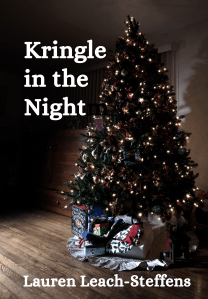
I am almost done with Kringle Through the Snow, which is the Kringle (Christmas romance) book I almost didn’t write. I thought I was done with the Kringle series (this makes six of them) until one of my Facebook friends told me I needed to write more. It took little arm-twisting, but I always wonder if the current book is the last.
I never thought I’d write romance. And, in fact, my romance is clean (only implied sex) and funny. It’s much more relationship based, although it promotes the Instalove trope, which means people getting attached quickly; I think because that’s always been my personal experience. There’s also several friends-to-lovers, enemies-to-lovers, and one age gap. (Two if you count the 100,000-year-old Su and the 6000-year-old Luke.)

Is romance realistic? It’s not supposed to be. It’s grounded in its society (whether that society be modern American, fantasy, science-fiction, etc) and fantastical in its romance elements. Some of the things that happen in romance would not or should not happen in real life (borderline stalkerish behavior, grooming, teacher-student romances) and some only happen in very defined and conscientious contexts in real life (S&M). Some things that happen in romance are just unrealistic. But romance is a type of fantasy — define the rules of the world and you can dream freely on the other parts.

To find my books, click here.
Using Templates to Shape a Book

I use templates to remind me of the shape of a book as I’m writing it.

Templates are scripts of a sort that one can use to structure writing to fit readers’ expectations. Readers expect a story structured such that the action rises to climax and then subsides. Other techniques can be added to this, such as interactions between a character and other characters to highlight tensions.

Well-written book guides offer plotting systems. Save the Cat Writes a Novel is an example of one, and one I highly recommend as a method to organize one’s plot. But I go one step further with templates that writers can load into Scrivener, the writing software I use.

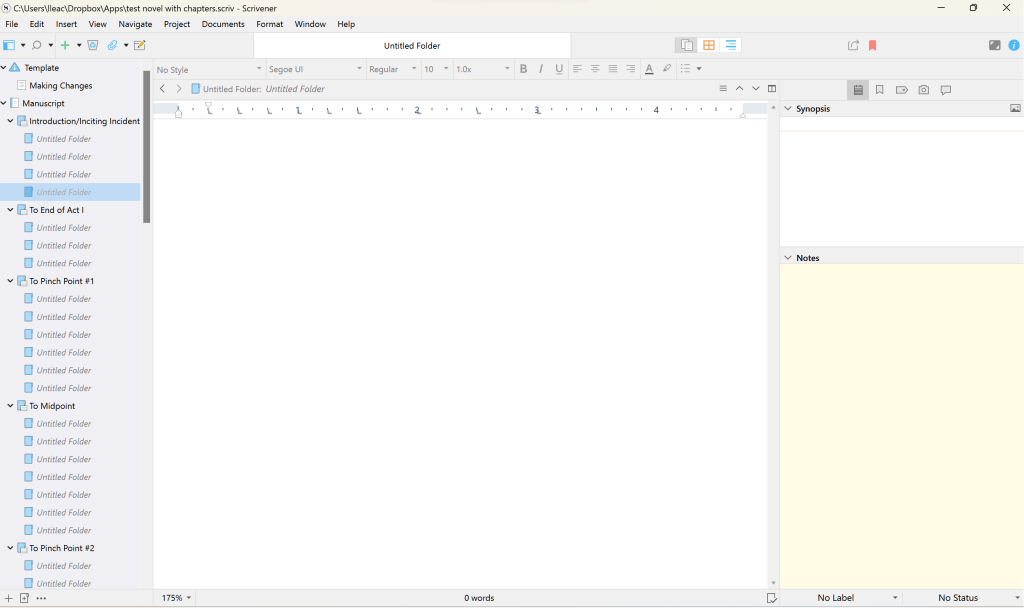
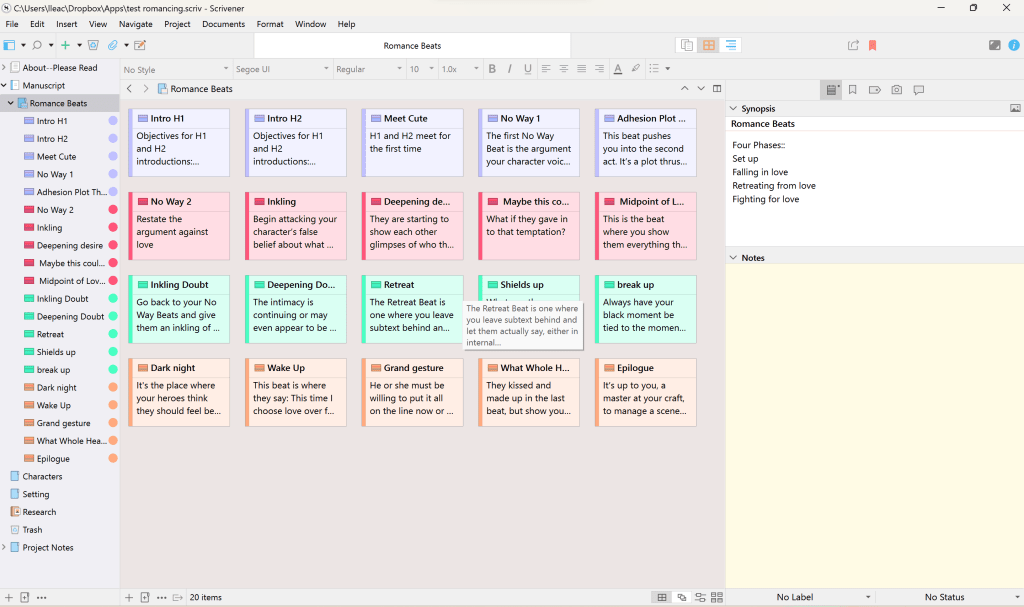
One of these is Romancing the Beat by Gwen Hayes. In twenty chapters, she lays out a romance novel’s structure with uncomplicated prompts for the reader. For example:

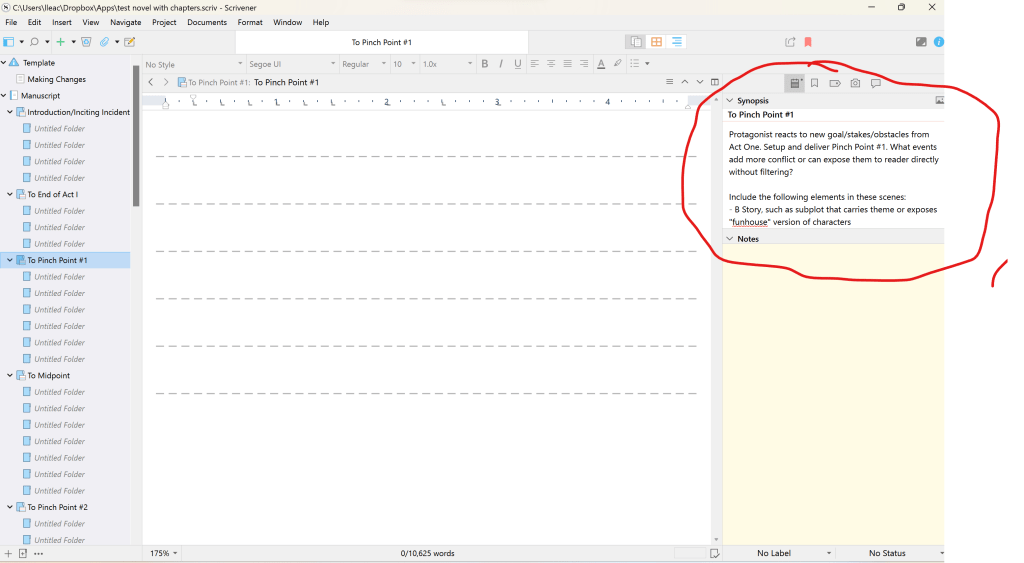
The column at the left shows the chapter outline with evocative titles. In the notecard view here, you can see each chapter’s prompt. When you are in chapter view (writing the chapter), you will see the full prompt in the upper right corner area called synopsis (seen below).

This is my go-to for writing romance novels. My go-to for writing fantasy novels is a template that no longer can be found on the internet (or if you can find it please let me know so I can give the writer credit). It’s based on the timing of Save the Cat templates, but it does the math for you. It looks like this:

In the left-hand column are the basic parts of the book, and the number of chapters is their relative weight in the book. Given roughly equal chapters, these distributions of chapters should give you the recommended pacing.

The template also gives guidance:

At the far right, there is a description in each section for what should happen in a section.

These are the templates I currently use for writing. I like using templates because I’m a plantser — someone who likes some structure but likes to flow within the structure. These templates allow for that. I write my chapter synopses within the guidance of the template and I’m ready to write.

Realism in Fantasy

I write fantasy romances and romantic fantasies. Obviously, fantasy is part of what I write. But does fantasy mean unrealistic?

Not really. Fantasies have their own internal rules so that they don’t stretch realism past incredulity. For example, any magic user will not be invincible — that will make the story unrealistic. The character has to have magic for a reason, which the writer can reveal as simply as “he’s a magic-user” to a long, descriptive back story.

There has to be internal consistency to the magic system. Readers will balk at inconsistencies, especially convenient inconsistencies that favor the hero or villain. If you defy gravity, do so consistently.

I write contemporary fantasy, which means a lot of realism as modern culture, geography, physics and the like. So there’s a lot of reality around the fantasy, but I still have to make sure there’s some internal consistency in the structure. Nephilim fly, Archetypes teleport. Humans don’t get more than one gift from the trees. Archetypes can’t teleport split-second and everyone’s gifts have practical limits. Gaia’s presence does not pass beyond the borders of the Garden.

World-building accomplishes a lot of these rules and boundaries. I do a lot of world-building in conversations with my husband in conversations like: “Do you think Forrest can knit wool if he can knit bones together?” (We decided yes.)

Fantasy is more fantastic when there’s a point of reference, when there are winners and losers (even with the possibility to change in the story), and no power goes completely unchecked.

Photo by Pixabay on Pexels.com

List three books that have had an impact on you. Why?

Three books that have had an impact on me. Hmm… I’m glad the prompt is not “THE three books that have had an impact on you” because there have been many more than three.

The three I’m thinking about right now are all in the fantasy genre because that’s what I’ve been reading most of my life, and because I write in those genres. Keep in mind that I’m almost sixty years old, and so are some of these books. I consider them foundational in my life.

The first book is not just a book, but a series: The Dark Is Rising sequence by Susan Cooper. Before we had categories like young adult and middle school, these books appeared in my small town junior high library. Our librarian recommended them to me, and my life changed. People my age facing mythological beings, trying to stop the forces of evil — I know, it sounds like a thousand stories. But dressed in British folk custom, with evocative descriptions, I could read it again as an adult.

The second book was one I was turned on to in college, and it has stayed with me as if I’d read it yesterday. The book is Godbody by Theodore Sturgeon, in which an itinerant man leaves interpersonal miracles in his wake. Is he the second coming of Jesus? The parallels of the narrative suggest so. The book advocates a less hierarchical, more personal relationship with God, and a view of love that transcends the restrictive culture of man. This book has informed my view of religion and spirituality and continues to do so.

The third book is, again, a series, and a lengthy one. The series is Darkover, by Marion Zimmer Bradley, and I cannot post this without mentioning the serious and credible allegations against Bradley made by her daughter Moira Greyland. It’s with some uneasiness that I put Bradley’s books on my list.

Darkover isn’t just a series, it’s a world. Not a perfectly realized world, but one where characters recur from book to book, where the reader can trace a family tree over a few hundred years. There’s lore and reputation and conflict — this has been as attractive to its fans as its sword and sorcery, with psychic powers substituted for the magic. Darkover fans have done genealogy with the characters, developed persona in the world, and made a role-playing society of it. I have taken my love of character development, convoluted relationships, and my dream of creating an all-absorbing world from Darkover.

So there are my three books. As I’ve said, there are many others. But these are perhaps the most influential of the fiction items.

Where Do I Go From Here?

Marketing myself

One of the things that has been happening to me this summer is that I’ve mostly been marketing, but that’s part of the whole writing process. Today I will be revising my cover letters after getting some expert help from a published author (thank you, Sofia Aves!) and checking for more subscribers to my newsletter list. And then maybe outlining the rest of the Kel and Brother Coyote series. And — what am I being called to do?

I haven’t written for a while

I haven’t written on my creative works for a while because I’m discovering the marketing side of things, but I’m itching to get back to the writing part. The selling part still seems to be so far away, but I am contemplating putting “Gaia’s Hands”, a fantasy romance, on Amazon to try to get more people reading my works.

Photo by cottonbro on Pexels.com

But I do need to write. I need to get totally fascinated to write, and I haven’t had a break to do that. I need to fix this.

Taking Myself Seriously

I think that through this process where I’m taking an active role in promoting my works, I am finally taking myself seriously. I don’t need external sales (how many are enough?) to start marketing. I don’t need external validation to start making something of my sales. Deep breath — this is growth for me, and evidence that I am a serious writer no matter how much I dislike flogging myself.

For the curious

My social media are at the following: