Reprint: Missouri Hope

Note: This is a reprint of a post I made two years ago for Missouri Hope:

When I’m not a professor or a writer, I’m a moulage artist.

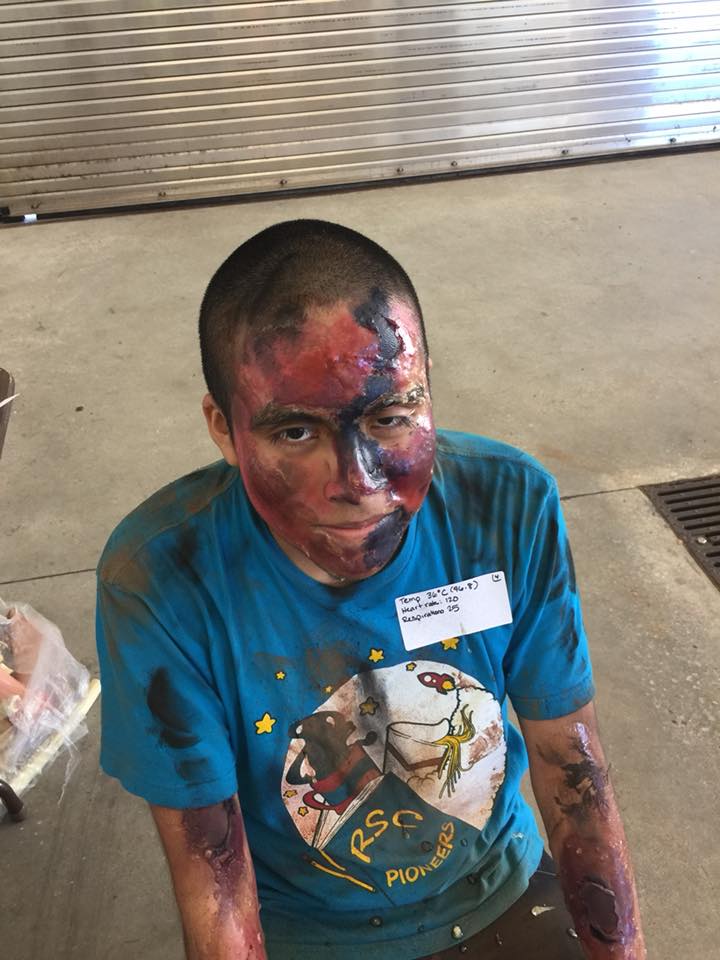
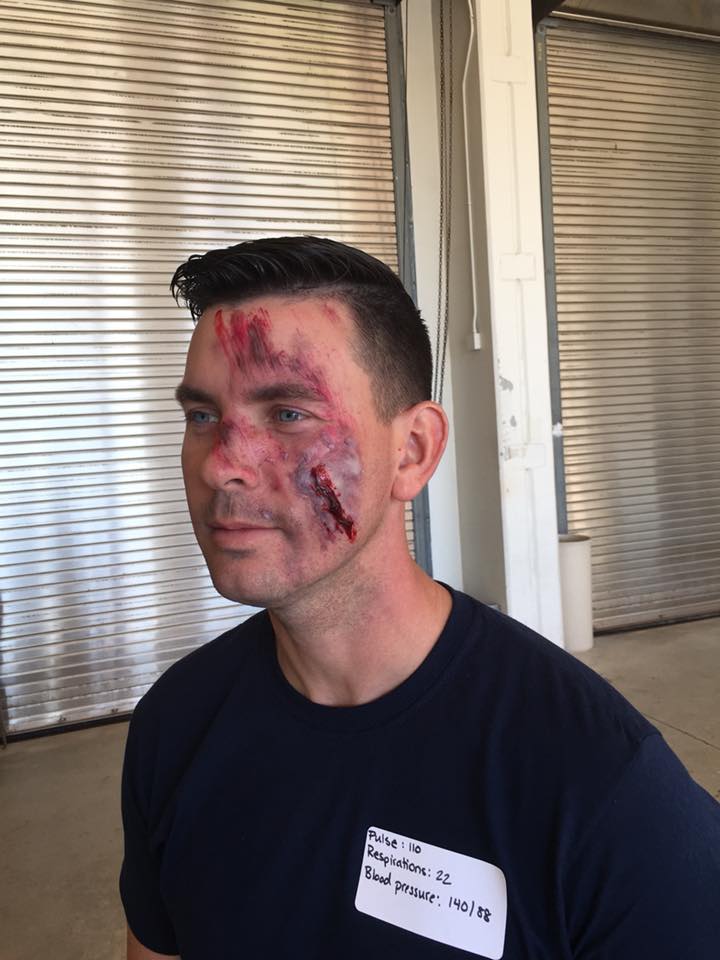
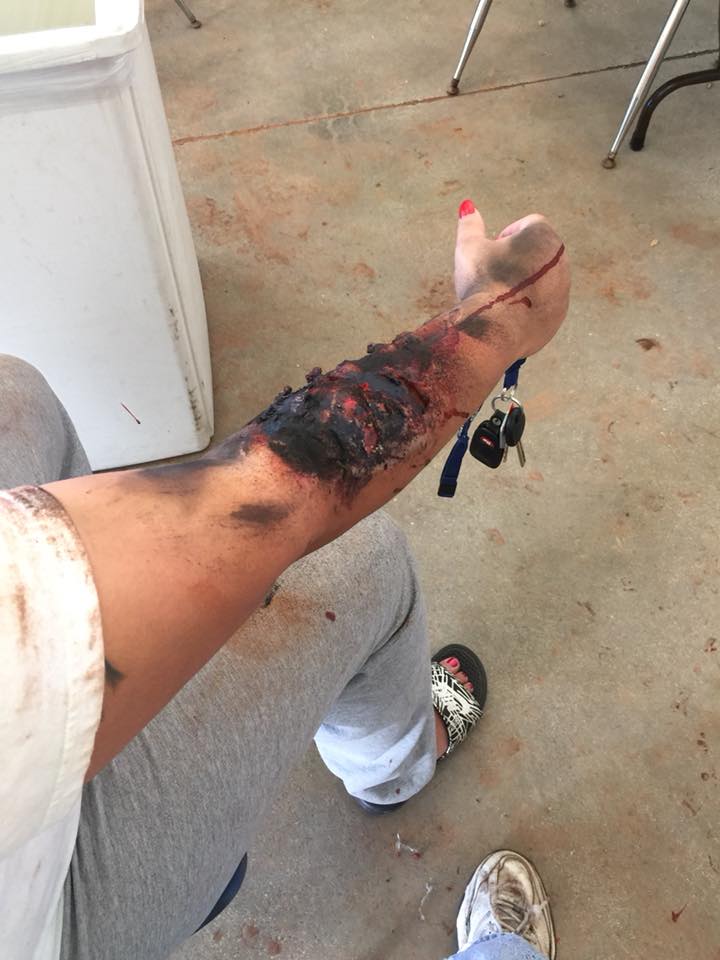
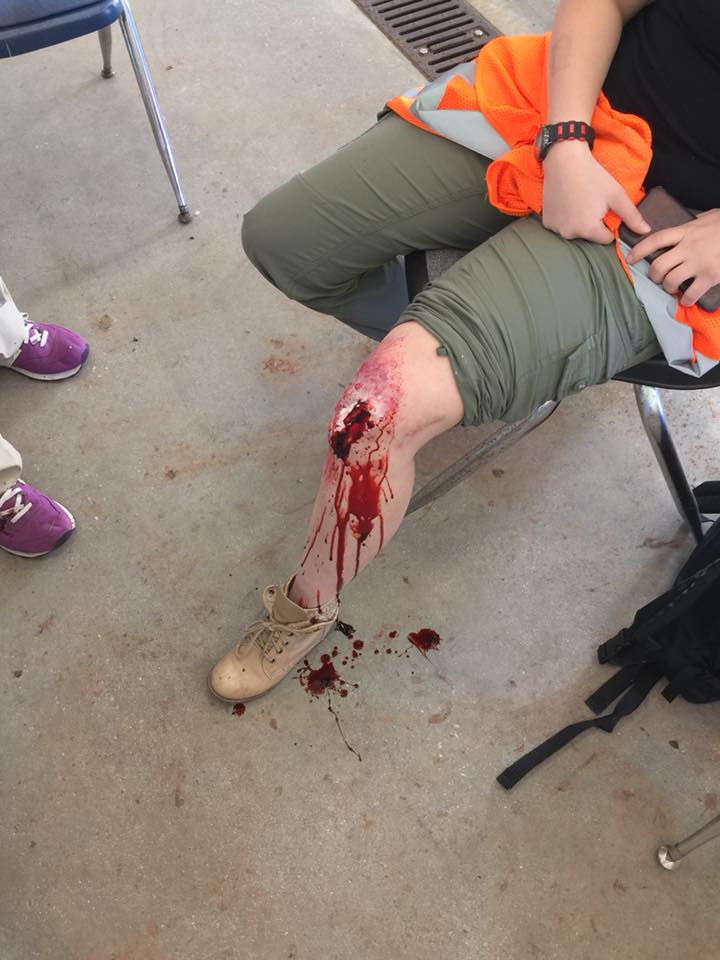
I do this work 2-3 times a year, making up volunteers to look like accident victims sporting injuries from broken legs to burns to drowning to long lacerations. It’s illusion, done with wax and grease paint and fake blood (there are good fake blood recipes at the link).

The big event of the year is Missouri Hope, three days of training in the rough for undergraduates, nurses, and emergency personnel. As the moulage coordinator, this takes a lot of preparation — inventory, ordering, prepping materials, and taking a deep breath and hoping I’ll have enough volunteers to help (recruiting is not part of my duties).

It starts this evening. I will have dinner with my fellow staff, from team and lane controller/evaluators to logistics and operations staff to our catering crew. I know many of these people from the university and from previous exercises. One of them is a current student of mine; another a former student. One is my husband. I feel at home in this crowd, which is part of the reason I’ve been doing moulage for 12 years.
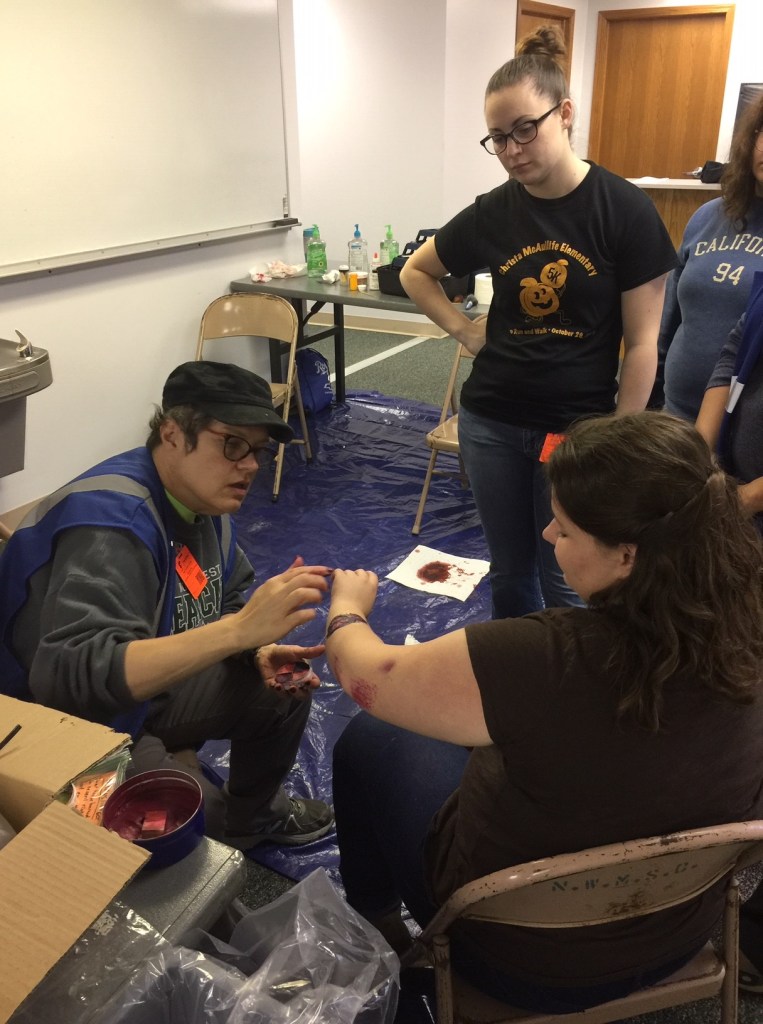
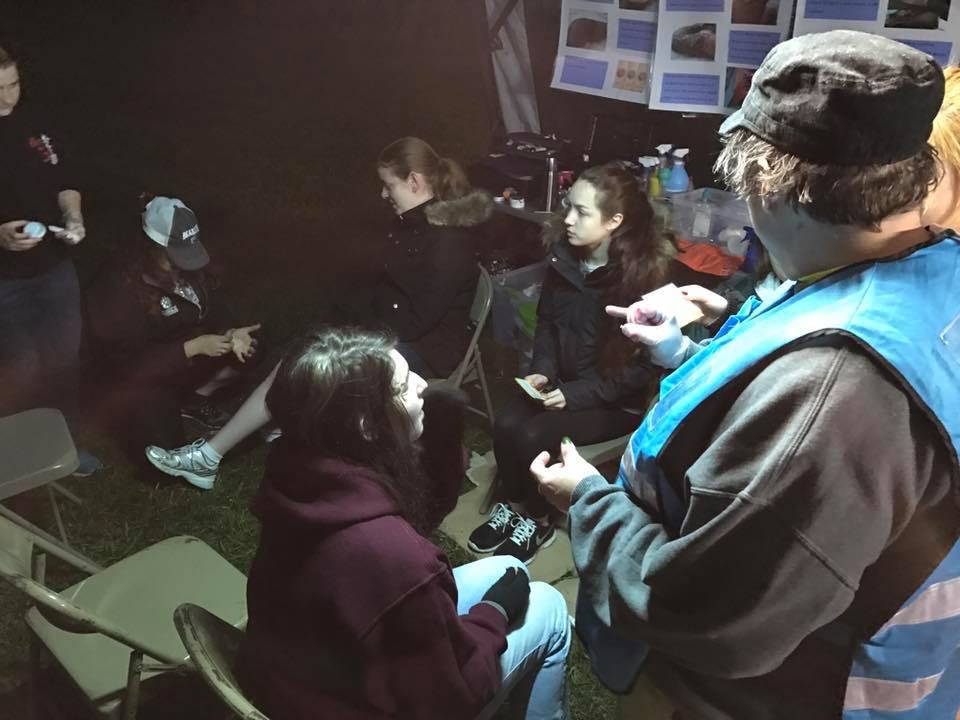
This is me doing moulage. It’s my least gory picture.

I’ve gotten to where doing moulage is second nature, and I can do it pretty quickly. I can’t do it too quickly; injuries like lacerations and breaks require a layer of wax followed by a layer of latex followed by a layer of castor oil followed by a layer of makeup.

I have all my supplies (except the castor oil I’m hunting for) ready to go. The fun starts tomorrow.
Missouri Hope Arrives

When I’m not a professor or a writer, I’m a moulage artist.

I do this work 2-3 times a year, making up volunteers to look like accident victims sporting injuries from broken legs to burns to drowning to long lacerations. It’s illusion, done with wax and grease paint and fake blood (there are good fake blood recipes at the link).

The big event of the year is Missouri Hope, three days of training in the rough for undergraduates, nurses, and emergency personnel. As the moulage coordinator, this takes a lot of preparation — inventory, ordering, prepping materials, and taking a deep breath and hoping I’ll have enough volunteers to help (recruiting is not part of my duties).

It starts this evening. I will have dinner with my fellow staff, from team and lane controller/evaluators to logistics and operations staff to our catering crew. I know many of these people from the university and from previous exercises. One of them is a current student of mine; another a former student. One is my husband. I feel at home in this crowd, which is part of the reason I’ve been doing moulage for 12 years.

This is me doing moulage. It’s my least gory picture.

I’ve gotten to where doing moulage is second nature, and I can do it pretty quickly. I can’t do it too quickly; injuries like lacerations and breaks require a layer of wax followed by a layer of latex followed by a layer of castor oil followed by a layer of makeup.

I have all my supplies (except the castor oil I’m hunting for) ready to go. The fun starts tomorrow.
Moulage (warning: graphic pictures)

My other hobby

I forgot to talk about one of my other hobbies yesterday, or rather, I neglected to talk about my other hobby/volunteer work. I do moulage, otherwise known as casualty simulation. In short, I make people look injured for emergency disaster training.

This isn’t a hobby I can share casually, because, actually, I did a pretty good job. The pictures creep people out.

My favorite story on the realism of my work is going into work after our big disaster training weekend (I’m a professor) and getting the rumor that one of my “victims” was sent to the hospital for a simulation, and they started hooking up an IV on him. He had to stop them from doing so. I mentioned this to another class, and his girlfriend corroborated it.

None of this is real

Moulage requires a certain amount of art and science. The science comes in studying injuries — knowing how they’re inflicted, what they look like on the body, how they change over time. The art comes from recreating them in grease paint, fake blood, wax, and latex.

Examples (warning: do not go below this point if you are upset by these pictures)

*

*

*

*

*

*

*

*

*

*

A bloody good time

I don’t have a lot of time to put in a big post, because I will be moulaging a bunch of high schoolers for the high school docudrama. This means that I look at a card detailing injuries and recreate it on a volunteer using makeup.

The docudrama exists as a way to scare teens out of drunk driving, distracted driving, and various other jerky things teens do while driving that will get them and others killed. The woman who runs it encourages us to get severe and bloody with our casualty simulation because they will be seeing it from a distance (unlike Missouri Hope, where people will see it close up). 

It’s a fun time. 

DIscombobulated

I really want to write today.

But so far, my calendar seems to thwart me from all directions. I have (another!) dental appointment* this morning, followed by a meeting with the outfit that is sponsoring the National Guard training which my husband and I will be doing moulage** for.  And, depending on how long that will take (too long, I suspect; I have no patience with dawdling) maybe then I’ll have time to write.

I had great ideas last night for my rewrite/character development of Gaia’s Hands, and of course I forgot some of it and I’m trying to piece the rest of it together with Richard***. I need a good stretch of time to write with more coffee to fuel me****. 

I’ve written today’s blog and I have promised myself at least an hour on Gaia’s Hands. Hopefully, I will feel inspired.

* I was born with an enamel deficiency and rather soft teeth; I have all my teeth crowned, but one or two of my teeth have broken off and require further work.

** Casualty simulation; making up volunteers to look like victims for training purposes. This run-through is an earthquake simulation to train the local National Guardsmen. For the first time ever, we’re getting paid for it. Woo hoo!

*** Richard is the husband previously mentioned.

**** We’re currently drinking our way through a coffee blend that is supposed to taste like chocolate; no matter how we roast it, we aren’t getting any chocolate notes, just something that tastes like really good commercial coffee. Sigh.
 

Another year of Missouri Hope in the books.

Role players: 185

Amateur moulage artists: 6

Scenarios: Earthquake, car bomb, refugee camp, water rescue, beatings by marauding gangs.
Injuries: impalements, burns, disembowelments, cuts, scrapes, plucked out eye, bruises, lacerations, broken bones, drowning, cholera, old injuries badly treated.

Real world emergencies at the moulage headquarters: 0

I’d say we had a successful Missouri Hope at the moulage building.

Moulage mode

I can’t talk about writing today, because my brain is completely into Moulage Mode.

I walk around the house looking for random objects that look like they’d make good impalements.

I have a gallon and a half of fresh fake blood by the basement door and I wonder if it’s enough.

I have gone through two and a half pounds of powdered plain gelatin and I wish I had more.

I was told to prepare for lots of impalements. I have prepared 28 impalement prosthetics thus far.

Unflavored gelatin smells like burnt hair. My house smells like burnt hair.

I am dreaming third-degree burns.

I love this.

I’ll write when I get time. It’s going to be an intense couple of days moulaging for the biggest exercise that Consortium for Humanitarian Service in Education holds.

The Art of Gorifying

Last night, I made shrapnel. Lots of shrapnel.

Missouri Hope is this weekend, and all my creative brain cells are occupied in making prosthetic plant-ons for casualty simulation. These are used to simulate impalements, and can be glued on someone’s skin with spirit gum. I learned this from Will Lanfear, who is a professional moulage artist in New York state.

I made a quart of special effects gelatin — 2 cups each of water and unflavored gelatin, 1/4 cup each of sorbitol and glycerin. It’s actually fun and soothing to make, and it can be frozen.

The loops of intestines are ready, and all they need are fake blood  (1 jug liquid starch, 1/4 cup red food coloring, 1 teaspoon blue food coloring).

Yes, moulage (casualty simulation) is gory. It’s a lot of sitting around the dinner table talking about the color of day-old bruises and how laminating plastic makes good glass debris. It’s googling pictures of hand deglovings (this is exactly what it sounds like) and third-degree burns, and then figuring out how to recreate those injuries. It’s buying a large wheeled toolkit to bring supplies in to the site.

It’s being nicknamed “The Queen of Gore” by a retired Army brigadier general.

Yes, it’s creativity.

Welcome to Atlantica

I’m typing this from the borders of Atlantica, the imaginary country
People from the Consortium for Humanitarian Service and Education will be creating for the training of some 50 individuals.

Atlantica is a troubled country. Freshly out of a war with a neighboring nation, Atlantica is riddled with corrupt officials, suspicious factions, and cholera. Then Atlantica gets hit by an earthquake, and our humanitarian aid teams navigate the red tape, vague threats from officials, and diseases rampant in the area to negotiate aid for the fragile country.

The idea behind CHSE’s exercises is to create a realistic exercise so that the participants can learn under pressure, make mistakes, and get advice from controller-evaluators so they can retry the encounter.

My job is to create realism. I’m the coordinator of the Moulage crew, and my crew supplies realism through simulated injuries and illnesses. We go for as much medical realism as we can produce with stage makeup and fake blood. None of our trainees have vomited yet, but we once sent someone to a hospital for a drill and he was seconds away from getting an IV.

Moulage is one of my favorite creative outlets. My husband and I have a little competition as to who’s grossing out people the most realistically. His specialty is degloving injuries, mine is deep burns. We learn from the nurses, medics, and zombie aficionados we encounter on our crews. And it’s worth sleeping on the floor and eating the Atlantican national dish, rice and beans, for four days.

I wish you could be here in sunny Atlantica.

***********
Just a reminder that my Kindle Scout campaign is live. If you want to nominate the book, go through the whole nomination process:

https://kindlescout.amazon.com/p/250Q7OJ0R0F8W