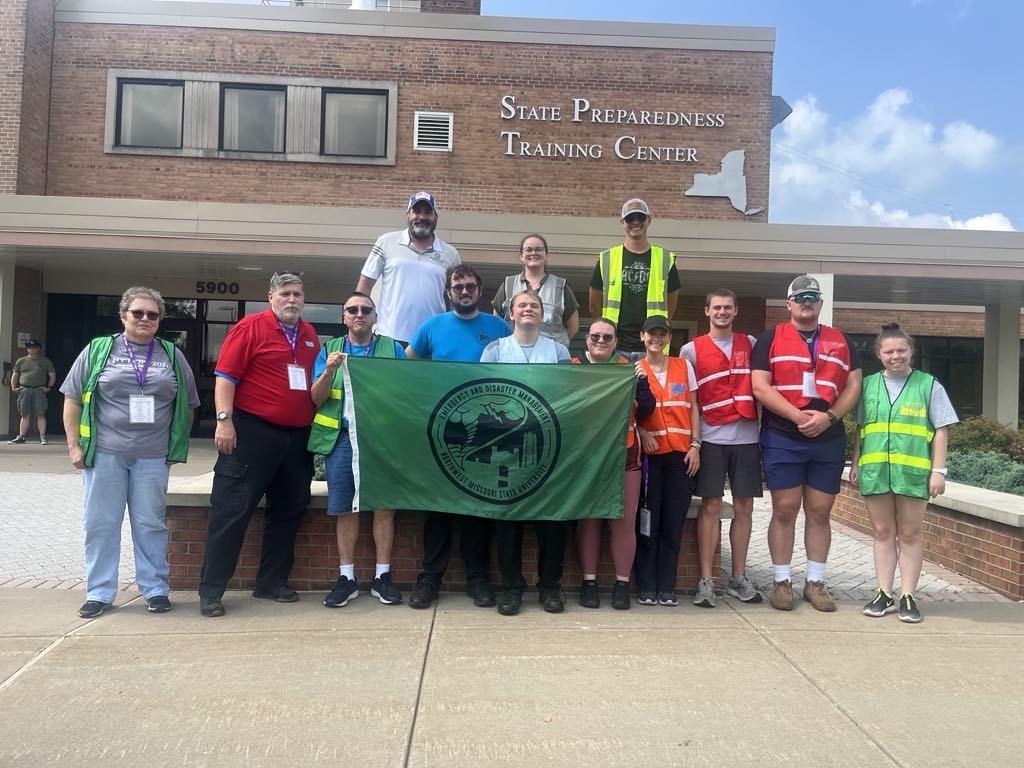
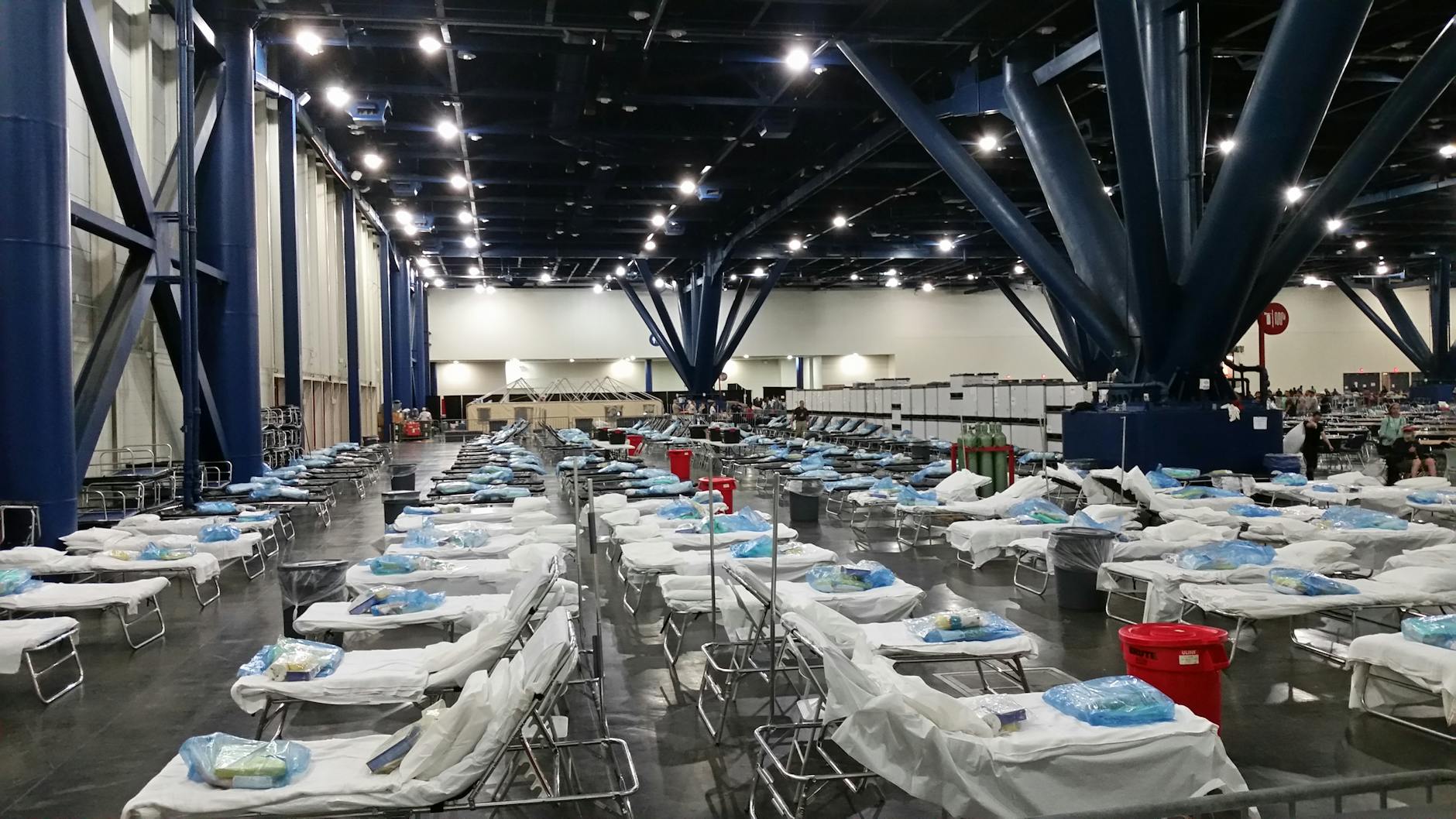
I go here every year to do moulage (casualty simulation) for a disaster training exercise called New York Hope. The people with me are. Fellow students and faculty from the Emergency and Disaster Management at Northwest Missouri State University. And my husband.
We went to Niagara Falls on our way home. Here we are again.
There is a phrase among writers: ‘Write what you know’. The cop focuses on the precinct, the Parisian on Paris, and the college professor (like me) on college campuses because we have the details in mind.
The above examples all focus on settings. I want to focus more on the knowledge base — where plot points and themes are informed by knowledge of a specific area. For example, I have some basic background in disaster management. I teach disaster psychology and case management. I know how people do triage in a mass casualty event because I have had CERT training. Because of my training in disaster mental health, I can spot the psychological symptoms of acute and post-traumatic stress. (I want to emphasize that I am not a therapist or counselor, and that I can’t treat people with these disorders.)
I have written two books where mass casualty events come into play. One is Apocalypse, where an impending battle threatens to cause the loss of all the women of the world. Characters looking at that possibility project how they will react, with both despair and resiliency. In my most recent book, Carrying Light, two mass casualty events happen. Characters have to deal with emergency response, which includes the sobering truth that responders will have to leave some people to die. Acute stress reactions figure in both books.
When I use my knowledge, it provides more than just background knowledge and convincing details. It helps set the plot and the theme of the books. Plot points include recovering from working a mass casualty event; and themes include the toll that extreme circumstances take on those experiencing it. Writing what we know should, in my opinion, shape our stories to add to the realism of what’s presented.
Now, the issue of fantasy needing some basis in reality, or at least a consistent rule book, is an essay for another day.
Today I found out that I will be teaching not one, but two of my favorite classes this fall.
The first is Family Resource Management, and this has a bit of history. I used to teach this when I taught in a Family and Consumer Sciences department (that is my background). It’s one of my favorite classes because all management is resource management. It’s part of everything we do and decide.
I lost this class when the FCS Department got disbanded some 12 years ago and I was placed in the Behavioral Sciences Department. I taught Psych classes there, teaching myself as I went along. The classes I taught in Psych included Research Methods, Personal Adjustment and General Psychology. I also taught (and still teach) Case Management, which is a lot closer to what I’m used to.
But now we’re bringing back Resource Management, and I’m teaching it!
The other class is Disaster Psych. This is a class for Emergency and Disaster Management majors. I am, besides being Behavioral Sciences faculty, EDM faculty by virtue of teaching Case Management, an option for the major that few students take. (Most EDM students are high adrenaline students who like humanitarian hot zones and lots of sirens).
I feel at home with the EDM people, and I work with them twice a year doing moulage (casualty simulation) for their disaster/humanitarian simulations. So I love working with them.
It’s funny how, when what we do is a good fit, our self-image becomes more solid. I have felt like an impostor for years, with most of the classes I taught not sitting with my self-image. But now I feel like I’m doing what I trained for.


 Words Like Me