Big Audacious Goals for 2026

I have two Big Audacious Goals for 2026, although neither of them are very big at this stage.

Photo by Markus Winkler on Pexels.com

I plan to publish two books this year, Avatar of the Maker and Kringle Once More. The books are already written and edited. The added material (About the Author, Dedication, etc.) are already added. They are formatted. All I have to do is have a cover made for Avatar and upload, then click and we’re published. The publication dates are October 1, 2026 for the Kringle book, and January 1, 2027 for the other.

The reason it’s a Big Audacious Goal is because of the insecurities I feel as a writer. I am one of the many indie writers that doesn’t get many sales. I assume I am not a good writer because of this. In actuality, I am one of the many indie writers hampered by obscurity, the large number of writers in the indie industry, and preconceived notions of indie publications. (And possibly because I’m not a good writer.)

Other Big Audacious Goals — I plan to finish a book this year. I have two in limbo — the romance Walk Through Green Fire, and the Hidden in Plain Sight novel Hiding in Plain Sight. The latter, although close to finished, is a mess, with too much sitting around and talking and not enough action. So that’s an ambitious rewriting project. The former is something I put aside to write Carrying Light, another Hidden in Plain Sight novel that I wrote last year but somehow didn’t put on my Big Audacious Goal list.

Why didn’t I put Carrying Light on my Big Audacious Goal list last year? Probably because I thought writing another novel wasn’t that audacious given that I had already written several. But any new creation is audacious. How could creation not be a shot against the bow of Things As They Are?

So I have Big Audacious Goals. I have other goals, not yet fleshed out. I have ideas, which are not yet goals. I have enough to keep me busy this year.

Over and Over

Daily writing prompt
What book could you read over and over again?

I wish I could say the book I would read (and have read) over and over was a high-brow book, like The Return of the King. I wish it was a staple of fantasy, something that would give me geek cred. But the book is as mass-market as any book selling at the grocery store, and it still captures me every time.

Photo by Engin Akyurt on Pexels.com

The novel is Origin in Death, by JD Robb. JD Robb (alternative pen name for Nora Roberts) writes futuristic crime novels. She’s written a lot of these, perhaps 40. Reading them is like eating popcorn — tasty, addictive, and a little more nutritious than you might think. Her protagonist is a police lieutenant, Eve Dallas, who runs the murder squad at Cop Central. She’s excellent at what she does, and she’s a bit curmudgeonly. She’s married to one of the richest men on earth, a former jewel thief who goes by the name of Roarke. Roarke, with his larcenous ways, makes a perfect partner in fighting crime.

The specific story, Origin in Death, involves a father-son pair of doctors who are killed within a day of each other. The murder trail leads to a network of underground hospital wards and a conspiracy to supply men with the perfect lover/wife. How the doctors manage this is part of the light science fiction that JD Robb trades in. There are twists to surprise, and a big chase scene at the end that made me wish for a version for the screen.

I read this novel now and again. It’s quick to get through, and I know all the plot twists. But it remains entertaining, and perhaps the best of JD Robb’s In Death series.

Writing Is Not Happening

This is the longest I have gone without writing. I am concerned about this, because I’m afraid I’m losing the habit. I can think of some reasons I have had so much trouble writing.

First reason is that I am facing the fact that my books may never get enough readers. It takes a miracle to get attention. Or notoriety, but I’m reluctant to go that far to get readers. I usually combat this by reminding myself that my focus should be on writing for the sake of writing. That doesn’t always work.

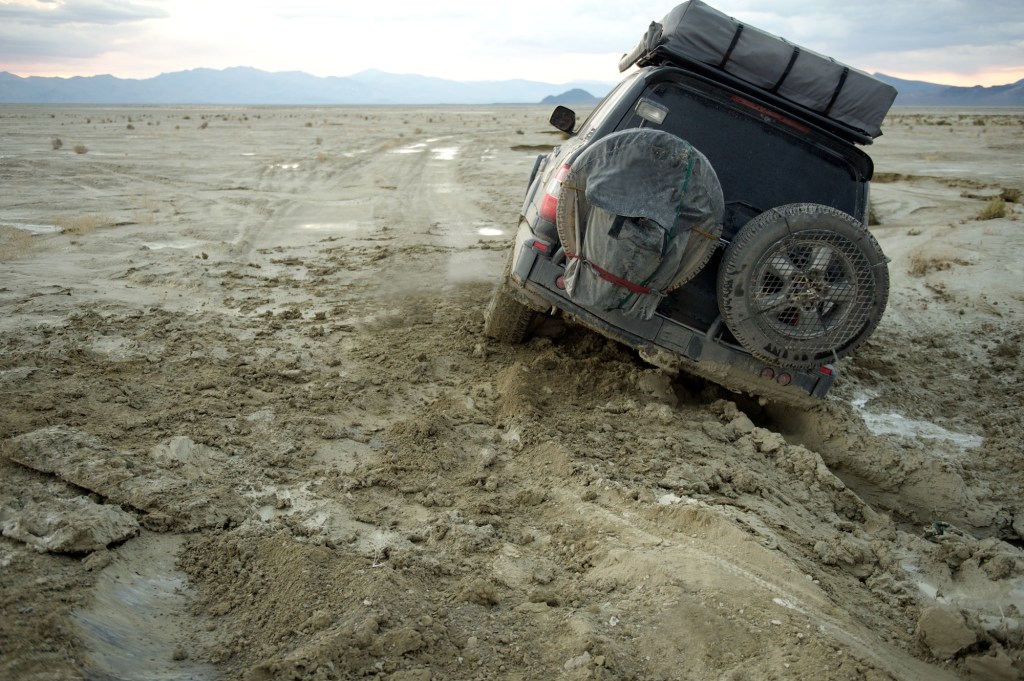
4×4 or truck stuck in the mud at sunset on the Applegate Trail, Black Rock Desert, NW Nevada, US

Which brings me to crippling self-doubt. I compare myself to people who get published and selling books, and I feel that there’s something wrong with my writing that readers avoid it. This is contradictory with the first reason — if people aren’t buying my books, how do they know that they’re bad? My mind is not listening to reason, however.

Third, but just as important, is that I am not finding flow in my writing lately. I’m working on a novella based in the Hidden in Plain Sight universe, and it is bogging down before it’s even started because of my nagging feeling that I have not structured it right. The other, the latest Kringle book, is likewise bogging down because of structural issues. I’m using an outline but still struggling with this.

Part of this is that none of my ideas have captured my imagination. They all feel like contractual obligations, like that album the band had to make because the record company wanted them to.

Thus, I have fallen out of the habit of writing except for this blog. I write it every day, at this point for 170 days running. Maybe this is a good thing because I have a challenging spring semester with one of my classes. Maybe this helps me in the seed-starting season (we’re going to have a garden this year if it kills us, and that’s my responsibility).

I could give up writing — I have enough books to edit and release that I’ll be releasing books yearly for the next three years. I have written sufficient books to call myself an author. I would never have to release another book other than the ones I have already written. But I miss the flow of writing, something that helped my well-being and which defined me.

I need some reassurance, some encouragement, some breakthroughs in plotting or an idea that excites me. I need one of those factors to budge so I get motivated to write.

Torturing a Metaphor

Blank notepad on a wooden surface. Top view

I wanted to write about the blank page I face every morning, but I was afraid it would devolve into some inspiration glurge about how every day is a blank page that we write on, and we have the choice of what to write on it every day. A little cliche for me to start the morning with.

Every day is not a blank page. It’s another page in a never-ending story, complete with themes, plots, and foreshadowing. The theme for this week has been “People at work do nice things”, which has been almost magical. One of the plots has been “Lauren is starting to write again, but slowly.” We often do not see the shape of the story except in retrospect, which makes the metaphor very limited.

I don’t like the page as a metaphor for life, unless it’s one of those “Choose Your Own Adventure” books, where your life branches when you commit to a certain activity. With unlimited choices, there are infinite branches. Sometimes the plot doesn’t make sense, even in retrospect.

I’ve tortured this metaphor enough. Time to write the story of my day.

A New Book on the Horizon

A sure sign that I don’t like where a book is going — I lay out the bones of another book.

I just made a sketchy outline of the next Kringle book, which I traditionally don’t start working on until November. Oh, wait, it’s only three weeks until November! This is about the time I start laying out the next book!

Traditionally, I write my books during NaNoWriMo, the international writing movement which takes place during November. I will write in November, but I will not be using NaNo’s infrastructure, due to the controversy around its support of AI for writing. I will have to find other motivational tools. Maybe Written? Kitten! or Pacemaker. Or maybe I’ve outgrown the need for the graphs and awards of NaNo.

I’m also working on the playlist. I make a new playlist for each novel I write, not necessarily to listen to while writing, but to get the feel for the novel in my head. This year’s, for some reason, is tending toward bossa nova, even though it’s set in one of my favorite places on Earth — the alternate version of Starved Rock. There’s a lot of bossa nova Christmas music out there, by the way.

But it’s time to work on prepping the Christmas novel, at any rate.

A Little Bit of Writing: Short Stories

I wrote a little on my short story today, not as much as I would have liked. Combining my 30-year-old fragmented knowledge of Chicago with Google Maps and my near-future dystopic imagination is challenging. The result will hopefully be a background story developing a one sentence aside of the book I just wrote. Many of my short stories begin as character sketches, and this one is no exception.

I would like to write more short stories that don’t tie into characters in my novels. If I do that, I might submit more writing to Submittable contests and publishers. If you don’t know what Submittable is, it is a website that publicizes writing contests and journals and magazines that are looking to publish poetry and short stories. It’s a great way for a writer to get some exposure in those venues. There’s often a small payment for readers or subscription fees, but it’s rewarding to be published even in small venues. The last story I got published was “The Inner Child”, which was published by Flying Ketchup Press last fall.

I feel like I would have trouble publishing my tie-in stories because they are so character driven, but I guess I could always try to see. I have had little luck publishing them in the past, but had one story receive an honorable mention, so there’s that. Although I write as a flow activity, I still have a desire to be read.

Wish me luck!

Finding Inspiration for a New Book

I’m just about to where I will put Carrying Light into a drawer to mellow for a while. I’m repairing immediately obvious problems, including cutting a subplot out that wasn’t adding anything and modifying some wordy expository stuff (telling, not showing) at the beginning. Today will be looking at continuity of the main relationship. I got so immersed in the book I don’t want to let it go. For a few weeks, it was my reality.

It’s time to pick up a new project. But what? I feel singularly uninspired. I have a book waiting for me, but no desire to write it. Richard (my husband) gave me an idea for a book but I definitely see no reason to write a book that feels like a contractual obligation in my series. I don’t write the next Kringle book until November; it’s my annual NaNoWriMo ritual.

Oh, but there’s another book I need to write … it’s in the Hidden in Plain Sight series, and it tells of why there are only about 300 Archetypes and thousands of different ethnicity groups in the world. (There should be Archetypes to represent most, if not all, of the groups.) This was revealed in a previous book with a lingering question. I’m not sure what to do with that book idea, because as momentous as the implications are, I don’t know how to get to the momentous part. The action goes fast and then there’s the revelation, and then there’s a lot of heaviness afterward. There’s a lot of feeling, but not a lot of there there. It could be a short story, but can a short story carry that much of the secret of the Archetypes? I think not.

I suppose I could take a break. But it’s the middle of the summer, and I am ahead on my classes. I work on them in the morning, and then work on writing. The ritual helps me with my moods and with my productivity.

So what am I going to write? Toss me some ideas!

Losing Steam

I’m losing steam with this book I’m writing, doubtless because I feel like I haven’t enough stuff to write in the remaining chapters. I tried an old motivation trick and went forward to more interesting chapters, having written one chapter where shit hits the fan and the last two chapters. That means I have about 5 chapters where not enough is going to happen unless I figure out how to write them without introducing filler. To advance the story past the “boom”.

This happens when one is pantsing a book. I feel like free-writing without an outline (i.e. pantsing) promotes a chapter-to-chapter view rather than a big picture view. “What am I going to do with this chapter?” is more how I write when pantsing. Although I get continuity by extending themes and plotlines (and I feel there’s a surplus of those), I still feel like the plot is going willy-nilly. Until it’s not going.

The book will probably turn out better than I think. I’ve written books this way before and they haven’t turned out bad once edited. But I prefer my outlines, so I can approach the next chapter and say, “This is what’s supposed to happen in this chapter.”

Wish me luck; I’m about to go back to writing.

Twelve Years of Writing

I’ve been writing for twelve years. I started, strangely, three months after being diagnosed with bipolar 2, which I hadn’t realized till today. I know I didn’t start writing as a coping mechanism or as character insertion (my first characters were not me) and I didn’t write about being bipolar. I think I started writing because being treated for bipolar helped me focus on continuous tasks instead of pouring all my energy on the whim of the moment.

I was not a good writer at first — I wrote each chapter as if they were separate episodes, like short stories strung together. I didn’t feel like I wrote an overarching plot. The novels (I use the term loosely) I wrote then I have had to revise several times such that only the characters are the same. I learned a lot from revising them.

Things I have learned over the past few years:

Photo by Pixabay on Pexels.com
  • My first draft is not my novel. Over the years, the novels have needed less and less rewriting, but there are always things to fix in second and third (and fourth, and …) drafts.
  • Developmental editors are an important part of your writing toolbox. It is worth paying for them.
  • There are three ways to write a novel: Plotting, pantsing, and plantsing.
    • Plotting: an organized outline at the beginning, and following the outline.
    • Pantsing: writing it as one goes along, without the outline.
    • Plantsing: writing with a rough outline but pantsing through the chapters.
    • I am a plantser.
  • Scrivener is a great program for composing my work, especially plantsing.
    • Scrivener arranges itself around a chapter format and a synopsis form that I use to guide my chapters. I use it like pantsing with training wheels.
    • One can get templates for Scrivener novel-writing that incorporate plotting frameworks, such as Save the Cat and Romancing the Plot.
  • ProWritingAid was another investment I don’t regret — my grammar has improved in ways I hadn’t considered before. I have lessened my passive verb structure massively.
  • Writing is the easy and fun part. I still don’t think I have the hang of promotion (and this blog is part of my proof of that.)
  • My favorite novel is always the one I just finished.

The most important thing I learned? That I can write. The second? That there’s a whole lot of luck in being discovered, and luck hasn’t come to me quite yet.

I feel like I could have learned more in 12 years, and maybe I have, but these are the biggest things I can think of. I hope they’re helpful to someone!

The Lost is Not So Lost


I have never learned to speak
the language of these slate-edged hills;
silence speaking eloquently
things I almost understand

I think I have heard you walking
softly, barefoot and daydreaming;
wonder if you've heard me calling
out my name, an owl's whisper.
In the Catskills,
do the sleepy towns tell tales?
In the Catskills,
do the sleepy towns tell tales?

**********
Photo by Creative Vix on Pexels.com

This is all I remember of the song. I wrote it 30 years or so ago, and I really haven’t visited it since I wrote it. I couldn’t even remember this much earlier this morning. I wrote the words down somewhere, but I don’t remember where I put them.

I looked on my computer and I found it! I found it!

I have never learned to speak
The language of these slate-edged hills –
Silence speaking eloquently
Things I almost understand

CHORUS:
I think I have seen you walking
Softly, barefoot and daydreaming
Wonder if you hear me calling
Out your name, an owl’s whisper
In the Catskills,
Do the sleepy towns tell tales?
In the Catskills,
Do the sleepy towns tell tales?

Looking in the deep blue patience
Of your eyes, I falter, losing
All my words of consequence
Everything I meant to say

CHORUS

In the wind that blows around
The hills, I thought I felt your smile
Gather up my words again
And try to ask what you were thinking

CHORUS

I used to be a singer-songwriter until I divorced my guitarist. I had an okay voice; my guitarist played a semi-finger-picking style and wasn’t very disciplined. We were never going to be anything but those folksingers who attended open mic occasionally. But I loved the words.

Most of what I wrote was about crushes I got while spending my daily life in a small town in the foothills of the Catskills. I had lots of crushes; I have lots of songs to reclaim.

I can’t sing now; I’ve lost my voice in all but my talking range. I suppose I could get it back with practice, but it’s hard having the heart to practice when reminded of how much I’ve lost.

I started to sing this, and I could sing without obstruction to my voice, although it was not as strong as before. The lost is not so lost anymore.