Animals in Writing

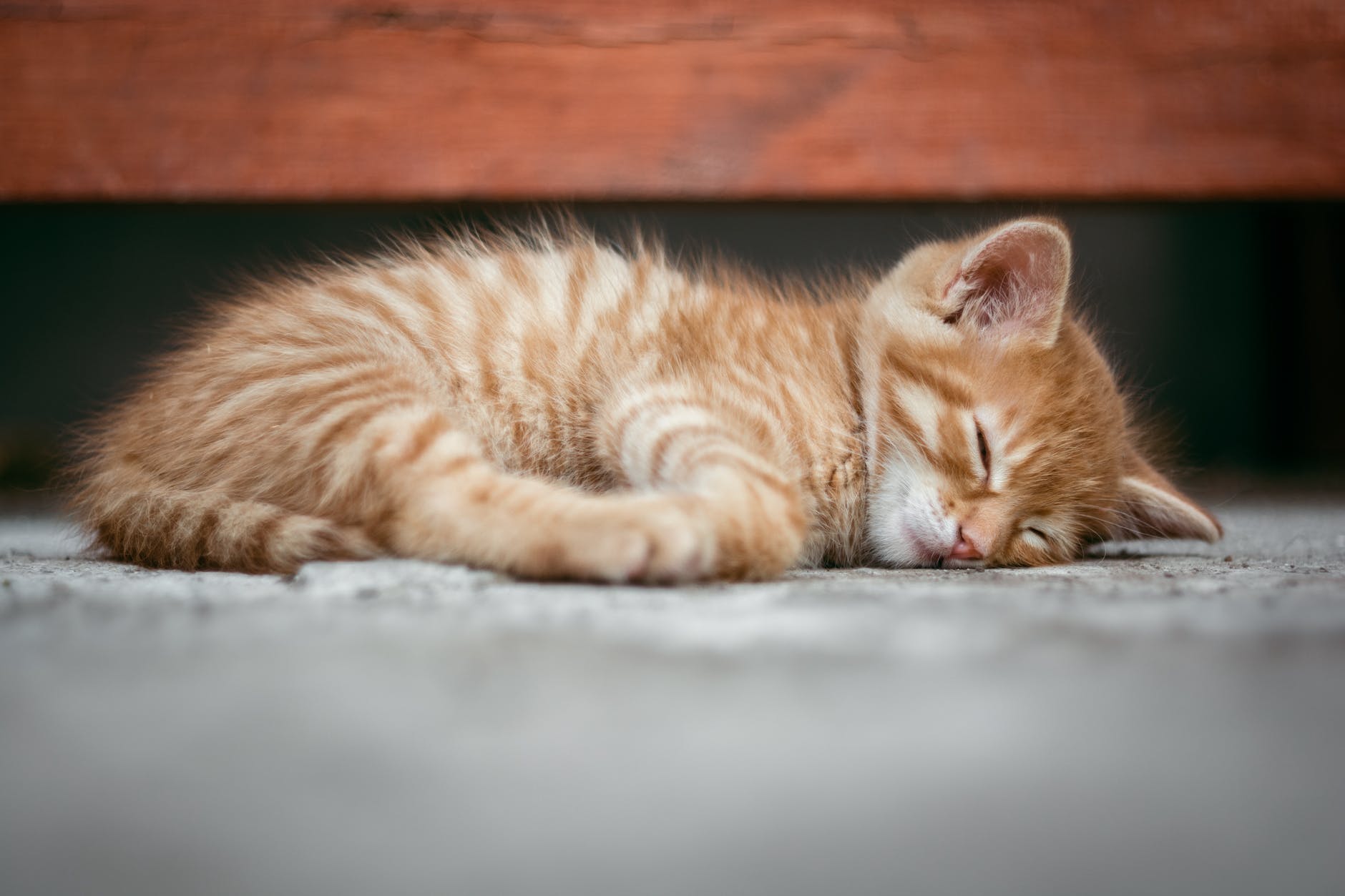
Every now and then, animals find their way into my writing. The current book I’m writing, Kringle Through the Snow, has a highly intelligent Newfoundland named Shadow Lord. The other book I’m writing, Carrying Light, has the preternatural cat Bergeron. The last book I wrote, Kringle on Fire, has a not-so-bright orange cat named Doofus.

At this point I’m supposed to talk about why I put animals in my stories. I think humor is a big part of it. Shadow Lord is so big and so well-behaved, yet he still detains Sierra long enough for Wade to talk to her. Doofus loves everyone like a drunken bro, even the child in the middle of his terrible twos. Bergeron flies — sometimes causing a traffic jam, in front of people who are not to know of her existence.

If I had to find a similarity among these pets, it’s their ability to communicate with humans. In pet-like ways, of course. Except for Bergeron, who speaks with telepathy to other telepaths. How many of you would like a telepathic cat? I’m not really sure myself. How many interruptions a day would I tolerate, especially if the transmission is “I’m starving! I can see the bottom of my food dish!”?

Photo by Pixabay on Pexels.com

I should mention that another reason to include animals is because it makes protagonists look more soft-hearted. Unless the pet is a wolf, and then it accomplishes exactly the opposite.

Animals as characters can make for fun in writing and in reading. I’m going to have to write them in more often. Kittens, anyone?

Using Templates to Shape a Book

I use templates to remind me of the shape of a book as I’m writing it.

Templates are scripts of a sort that one can use to structure writing to fit readers’ expectations. Readers expect a story structured such that the action rises to climax and then subsides. Other techniques can be added to this, such as interactions between a character and other characters to highlight tensions.

Well-written book guides offer plotting systems. Save the Cat Writes a Novel is an example of one, and one I highly recommend as a method to organize one’s plot. But I go one step further with templates that writers can load into Scrivener, the writing software I use.

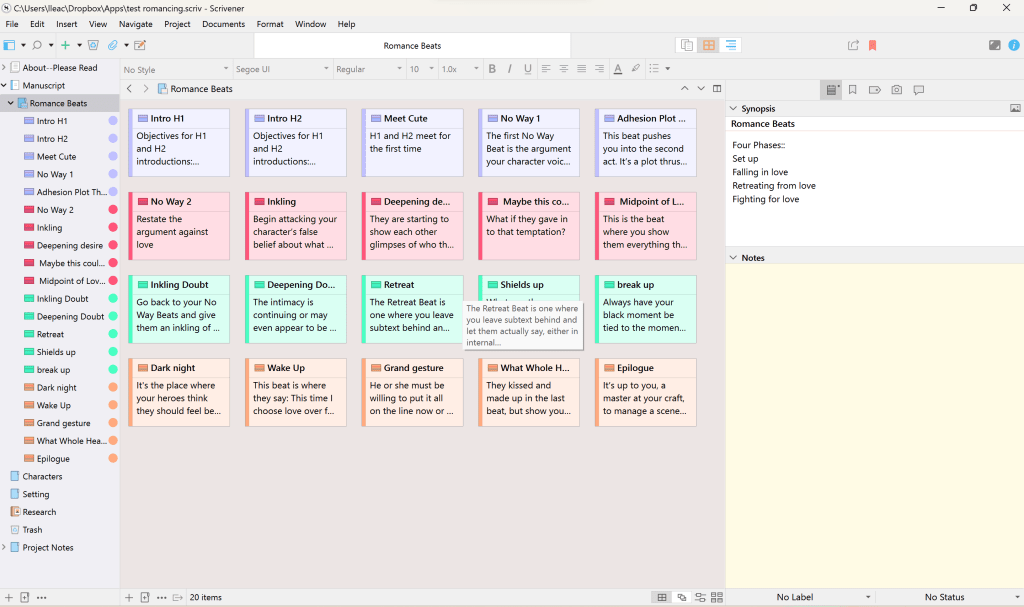
One of these is Romancing the Beat by Gwen Hayes. In twenty chapters, she lays out a romance novel’s structure with uncomplicated prompts for the reader. For example:

The column at the left shows the chapter outline with evocative titles. In the notecard view here, you can see each chapter’s prompt. When you are in chapter view (writing the chapter), you will see the full prompt in the upper right corner area called synopsis (seen below).

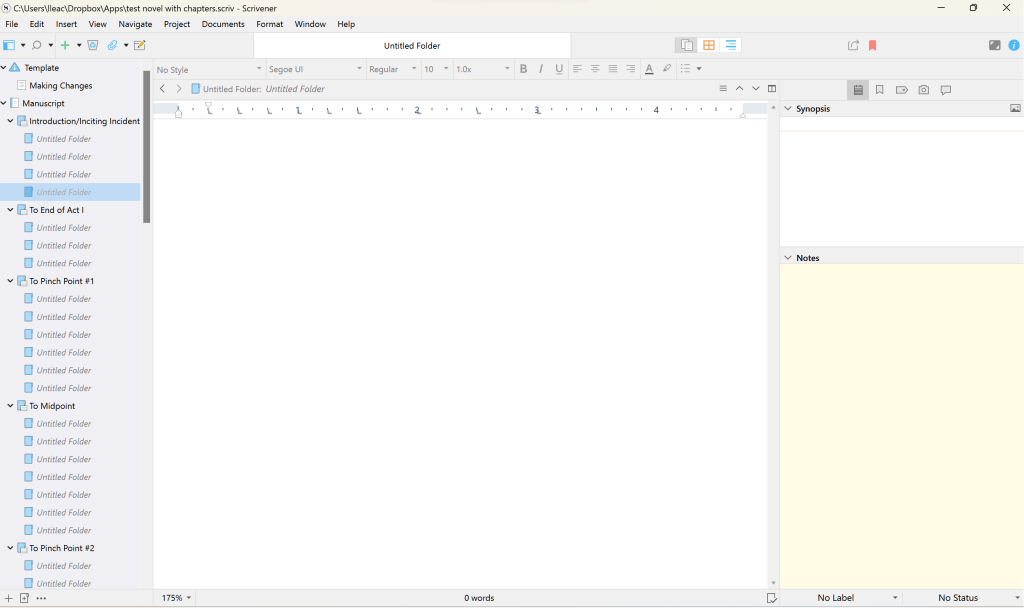
This is my go-to for writing romance novels. My go-to for writing fantasy novels is a template that no longer can be found on the internet (or if you can find it please let me know so I can give the writer credit). It’s based on the timing of Save the Cat templates, but it does the math for you. It looks like this:

In the left-hand column are the basic parts of the book, and the number of chapters is their relative weight in the book. Given roughly equal chapters, these distributions of chapters should give you the recommended pacing.

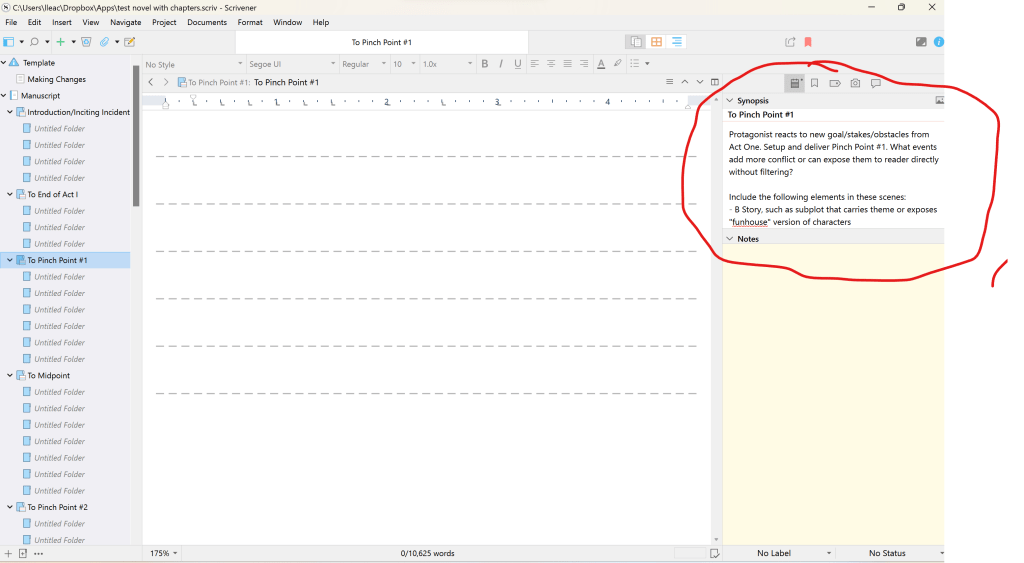
The template also gives guidance:

At the far right, there is a description in each section for what should happen in a section.

These are the templates I currently use for writing. I like using templates because I’m a plantser — someone who likes some structure but likes to flow within the structure. These templates allow for that. I write my chapter synopses within the guidance of the template and I’m ready to write.

Realism in Fantasy

I write fantasy romances and romantic fantasies. Obviously, fantasy is part of what I write. But does fantasy mean unrealistic?

Not really. Fantasies have their own internal rules so that they don’t stretch realism past incredulity. For example, any magic user will not be invincible — that will make the story unrealistic. The character has to have magic for a reason, which the writer can reveal as simply as “he’s a magic-user” to a long, descriptive back story.

There has to be internal consistency to the magic system. Readers will balk at inconsistencies, especially convenient inconsistencies that favor the hero or villain. If you defy gravity, do so consistently.

I write contemporary fantasy, which means a lot of realism as modern culture, geography, physics and the like. So there’s a lot of reality around the fantasy, but I still have to make sure there’s some internal consistency in the structure. Nephilim fly, Archetypes teleport. Humans don’t get more than one gift from the trees. Archetypes can’t teleport split-second and everyone’s gifts have practical limits. Gaia’s presence does not pass beyond the borders of the Garden.

World-building accomplishes a lot of these rules and boundaries. I do a lot of world-building in conversations with my husband in conversations like: “Do you think Forrest can knit wool if he can knit bones together?” (We decided yes.)

Fantasy is more fantastic when there’s a point of reference, when there are winners and losers (even with the possibility to change in the story), and no power goes completely unchecked.

Photo by Pixabay on Pexels.com

Writing non-fiction: It’s totally different. But is it?

I’m alternating a chapter of a non-fiction book we jokingly call “the care and feeding of roleplayers” — it’s a book to help people preparing disaster exercises how to handle the various aspects of roleplayer involvement, including moulage. (Just as a reminder, moulage — or casualty simulation — is the art of making roleplayers look injured, often severely so. It’s one of my hobbies.)

What I’m finding is that writing non-fiction takes a different approach and skill set. It’s not that I haven’t written non-fiction before — I have several research articles under my name, not to mention a 67-page dissertation. It’s just that I’ve never concentrated on both in the same day, and I didn’t write anything longer than short stories at the time. Now — I have a goal to write on both the novel and the article daily, and I’m quickly switching up between the two items.

When I write non-fiction, such as the chapter I’m writing, I have to outline the article so that my writing flows from idea to idea. I have to do research in order to support the points I’m making in the paper, so that I am grounded in realism. My observations have to be grounded in facts, because my observations might be biased and not substantive. As I tick through the outline, I note that I make progress toward the whole, and that motivates me further.

Writing the novel, as I’ve found out from previous novels, takes not only imagination but discipline, because imagination doesn’t necessarily believe in deadlines. If I set a goal of, say, 1000 pages, my imagination is more likely to deliver. Likewise, if I have an outline of where the action’s going to go, my imagination has something to embellish it. I can’t escape research when writing fiction because the laws of physics, the names of places, and the technology doesn’t change with a slightly alternative Earth.

Strangely, it looks like writing non-fiction and writing fiction have a lot in common when it comes to the importance of structure, of research, and of goals. Where they’re different is imagination — and even then, non-fiction requires a certain amount of describing examples to illustrate concepts — and that’s imagination.

Oh, well, so much for today’s essay.

Fictionalizing my Morning.

First person:

I faced the bathroom mirror. My eyes still squinted from a swollen face; my cheeks had faded from magenta to the pink of a first-degree sunburn. My nose had developed a smattering of tiny scabs near the tip. The rash that lined my cheeks and chin could not be seen, but felt. I placed my hands on my face to cool the burning and soothe the itching; scratching the itch would only make it hurt worse.

The sullen pink cheeks and nose formed a roughly butterfly-shaped rash that could, if I squinted, be the butterfly rash of lupus. It’s always lupus, isn’t it? Instead of indulging the hypochondria I inherited from my mother, I grabbed for Occam’s razor — the answer that requires the least mental contortions and complications is the correct one. That was easy: On Saturday or Sunday, I put an acne treatment product on my spotty forehead, nose, and chin. Monday, I woke up with the rash, which worsened on Tuesday, and lingered through this morning. I was not suffering from a chronic autoimmune disease.

I ran into Richard in the hallway. “Your face looks better,” he announced. Easy for him to say —  he wasn’t wearing my face.

Third person:

Lauren peered into the bathroom mirror. Her eyes still squinted from a swollen face; her cheeks had faded from magenta to the pink of a first-degree sunburn. She spied a smattering of tiny scabs near the tip of her nose. She raised her hands to her face and felt the pebbly rash across her cheeks and chin. Her cool hands felt like ice against her burning cheeks.

The sullen pink cheeks and nose formed a roughly butterfly-shaped rash. Lauren searched her mind for a reference to a butterfly-shaped rash. Lupus — it’s always lupus, isn’t it? She turned away from hypochondria and grabbed for Occam’s razor — the answer that requires the least mental contortions and complications is the correct one. She racked her memory: On Saturday or Sunday, she had put an acne treatment product on her spotty forehead, nose, and chin, having heard about it from the pimple-popping videos she’d binge-watched the night before. On Monday, she had woken with the rash, which worsened on Tuesday, and lingered through that morning. By Occam’s razor, then, the acne cream was the likely cause of the rash.

She ran into her husband in the hallway. “Your face looks better,” he announced. Easy for him to say, she mused.

Future tense

In the morning, I will face the bathroom mirror. I will observe my eyes squinting from a swollen face; my cheeks having faded from magenta to the pink of a first-degree sunburn. My nose will sport a  smattering of tiny scabs near the tip. I will place my hands on my face to cool the burning and soothe the itching; I will feel the pinprick rash that I cannot see in the mirror.

I will touch my cheeks, wondering if my face bears the butterfly rash of lupus. It’s always lupus, isn’t it? Instead of indulging the hypochondria I inherited from my mother, I will grab for Occam’s razor — the answer that requires the least mental contortions and complications is the correct one. I will review the sequence of events: On Saturday or Sunday, I put an acne treatment product on my spotty forehead, nose, and chin. Monday, I woke up with the rash, which worsened on Tuesday, and lingered through this morning. I will reassure myself that it’s not lupus.

I will run into Richard in the hallway. “Your face looks better,” he will say. I will grumble at him — “Easy for you — it’s not your face.”