Missouri Hope Arrives

When I’m not a professor or a writer, I’m a moulage artist.

I do this work 2-3 times a year, making up volunteers to look like accident victims sporting injuries from broken legs to burns to drowning to long lacerations. It’s illusion, done with wax and grease paint and fake blood (there are good fake blood recipes at the link).

The big event of the year is Missouri Hope, three days of training in the rough for undergraduates, nurses, and emergency personnel. As the moulage coordinator, this takes a lot of preparation — inventory, ordering, prepping materials, and taking a deep breath and hoping I’ll have enough volunteers to help (recruiting is not part of my duties).

It starts this evening. I will have dinner with my fellow staff, from team and lane controller/evaluators to logistics and operations staff to our catering crew. I know many of these people from the university and from previous exercises. One of them is a current student of mine; another a former student. One is my husband. I feel at home in this crowd, which is part of the reason I’ve been doing moulage for 12 years.
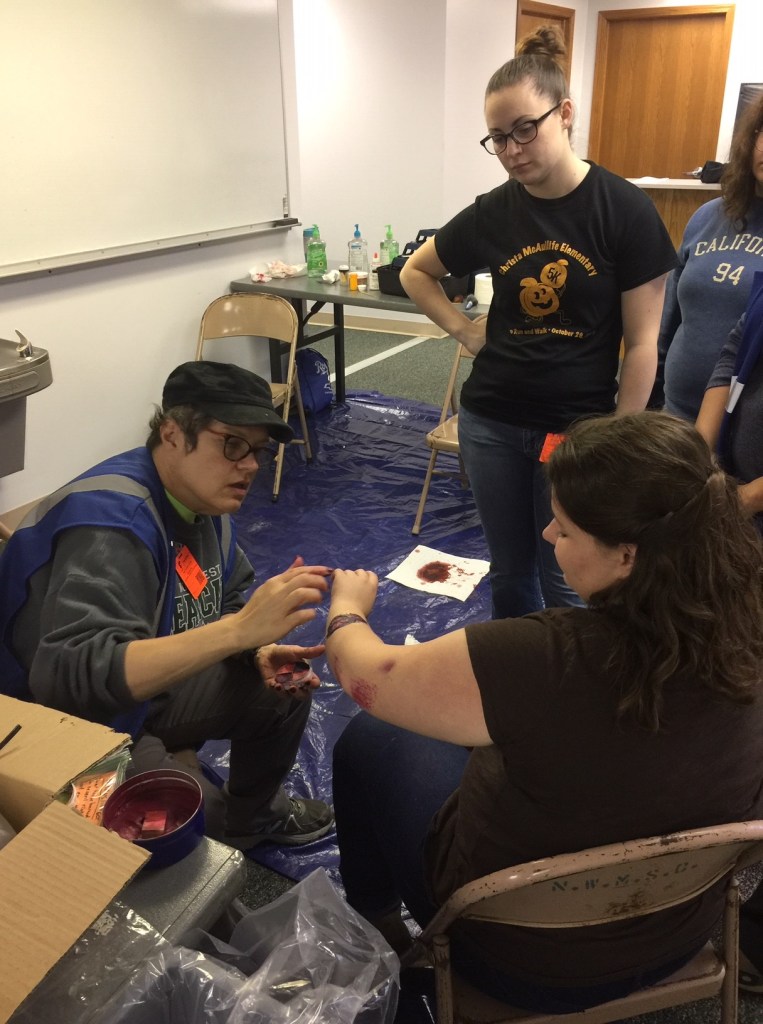
This is me doing moulage. It’s my least gory picture.

I’ve gotten to where doing moulage is second nature, and I can do it pretty quickly. I can’t do it too quickly; injuries like lacerations and breaks require a layer of wax followed by a layer of latex followed by a layer of castor oil followed by a layer of makeup.

I have all my supplies (except the castor oil I’m hunting for) ready to go. The fun starts tomorrow.

Day 2 moulage

Day 2 of moulage: I’m already tired, and I’ll be here till at least 9 PM.

This is such a great opportunity, though, because we’re under the supervision of Will Lanfear, who does moulage for a living (ok, among other things). We talk shop, and I learn all sorts of new things to try out at home. 

The Hope exercises, of which there are currently three (Missouri, Florida, and New York), were created to train college students in emergency and disaster management majors to use their skills in as realistic learning environment as possible. The exercises aim for the optimal amount of stress for learning — too little, and it comes off as frivolous; too much and the learner shuts down. Now others take an opportunity to train, especially at Missouri Hope, where we have nurses, emergency personnel, and the National Guard both creating the learning opportunities and learning themselves.

This is where moulage comes in — we exist to make the disaster scenarios as realistic as possible. You saw a couple of our pieces yesterday. Moulage is 3/4 knowing your materials — skin and bone wax (theatrical products), gel blood and paste blood (not really blood, but theatrical products again), gelatin, latex, and greasepaint; and 1/4 looking at gory pictures and saying “I want to learn to do that!”

So that’s what I do, and that’s how I’m spending my last week of freedom before the fall semester starts.

The Art of Gorifying

Last night, I made shrapnel. Lots of shrapnel.

Missouri Hope is this weekend, and all my creative brain cells are occupied in making prosthetic plant-ons for casualty simulation. These are used to simulate impalements, and can be glued on someone’s skin with spirit gum. I learned this from Will Lanfear, who is a professional moulage artist in New York state.

I made a quart of special effects gelatin — 2 cups each of water and unflavored gelatin, 1/4 cup each of sorbitol and glycerin. It’s actually fun and soothing to make, and it can be frozen.

The loops of intestines are ready, and all they need are fake blood  (1 jug liquid starch, 1/4 cup red food coloring, 1 teaspoon blue food coloring).

Yes, moulage (casualty simulation) is gory. It’s a lot of sitting around the dinner table talking about the color of day-old bruises and how laminating plastic makes good glass debris. It’s googling pictures of hand deglovings (this is exactly what it sounds like) and third-degree burns, and then figuring out how to recreate those injuries. It’s buying a large wheeled toolkit to bring supplies in to the site.

It’s being nicknamed “The Queen of Gore” by a retired Army brigadier general.

Yes, it’s creativity.

Short post — Moulage and External Validation

I may not be writing as much this week, because this is my big week for performing moulage. If I haven’t mentioned it, moulage is casualty simulation for emergency workers. This week I do two events — a small one this morning where I help out with the high school’s annual docudrama where they hammer home the consequences of drinking/texting while driving. Richard and I will moulage seven high schoolers.

This Friday-Sunday is the big event, Missouri Hope. The biggest of the Hope exercises held by Consortium for Humanitarian Service and Education, we will moulage about 200 people by the time we’re done. I will have a bigger crew, perhaps 8 per day, and I will provide hands-on training while we create victims — all simulated injuries of course — of a major tornado so that emergency personnel and students can use their skills in a realistic scenario.

I have developed a reputation for this among the CHSE exercises, which makes me happy. I know I can do better, and I always try to do better. In that way, it’s like writing, but I feel more secure about it because I have external validation. And external validation is one of the biggest motivators there is.

My colleagues call me the Queen of Gore. What better external validation is that?