Daily writing prompt
Describe a phase in life that was difficult to say goodbye to.

Living in my home town was a particular sort of hell. I had only one friend, and we didn’t have much in common. I was no longer being bullied (much) in high school, but it was still a lonely, aggravating time.

Photo by Bruno Thethe on Pexels.com

I attended the University of Illinois for 11 years — four years of undergraduate and seven of graduate school. It took me a couple more years to get out of graduate school because of a pesky car accident in the middle of the process, but I didn’t mind. My college years were some of the best of my life.

My undergraduate years were the years of discovering myself, of finding out there were others like me out there. I was a quirky person with lots of enthusiasm and nerd credentials. I did not do well in a small town high school where I was the only one like me, but in my undergrad I discovered a D&D group I fit in with. I found other friends on the PLATO computer system. I started having actual escapades with my newfound friends.

Graduate school was when I came into my own. I discovered a peer group of people, an eclectic bunch, who spent every Saturday night together watching Star Trek: The Next Generation and hanging out. We celebrated holidays like May Day in medieval costume with probably the only portable May pole in the world. We were quirky as heck and I loved it. We were close enough that sometimes we got into arguments with each other, but that was good. It felt good to have a bunch of people I felt close to.

When I left to go to my first faculty job in upstate New York, I knew I would miss these people terribly. We had a packing and pizza party to commemorate our leaving (I was married at the time) and a couple of us drove toward New York the next day.

In New York, I was 900 miles away from my people. I survived, though, with the help of some new friends I made. I spent five years out there, making a new world for myself. Without those years in Champaign-Urbana, however, I would never have known how to.

Lost Rituals

It’s Saturday, and most of the snow has melted. The apple blossoms, however, are not coming back, so there will be no apples this year. It’s symbolic, I think, for all the rituals of American life which will be put on hold this year because of the coronavirus — graduation ceremonies, weddings, birthday parties. Burials go on, but funerals do not. 


I worry about not having these rituals, especially the rituals of transition like college and high school graduations. Without these types of rituals, we feel rudderless, out of sorts. We need a recognition of what we’ve accomplished and where we’re going.

At the college, our students won’t go through graduation until fall, if we are even out of shelter-in-place by then. Our retiring faculty and staff will get no parties. 

I suspect that our changed situation will be temporary, but that temporary could be as long as a year and a half. A cohort of people will not have their rituals to cling to, will feel rudderless, bereft. And although it is a small pain compared to the real possibilities of losing a family member, I will still mourn it with you.

Graduation as a Ritual of Closure

A little story about myself: In the darkest moments of my graduate career, when I wasn’t sure I had the energy to finish, one shining beacon would keep me going — the thought of being able to wear the professorial hood at other people’s graduation. When I received my PhD, after the ceremony where I rented my cap and gown and hood, my academic advisor gifted me with a hood in University of Illinois regalia colors, and I wear it to this very day to students’ graduations.

According to “A Field Guide to College Professors”, this hood belongs to
someone with a Ph.D. from University of Illinois. You can tell from the
navy blue with orange stripes.

I teach three classes and handle the internships in my department, Behavioral Sciences, at Northwest Missouri State University. Between students in my classes, advisees, and interns, I work with about 150 students a year. I can tell the graduating seniors in the class after midterms — this is when they start counting the number of days until they graduate, and they’re extremely accurate. In fact, one class posted the number on the board every class period. A student in another class could calculate the days to commencement to the hour.

When one of my students asks if they should go to Commencement, I say “YES!” Why? There are some downsides to commencement (graduation) ceremonies — for example, they run long, gowns are hot and sweaty, commencement speakers are boring more often than not, and there are big crowds at the cookies and punch.

However, without going to commencement, students may never feel like they’ve graduated. Commencement ceremonies provide a sense of completion and closure through their ritual — the graduation gowns, the processional, the professors in academic regalia, the discomfort of the flat cardboard caps that students often decorate, the selfies with friends and professors.

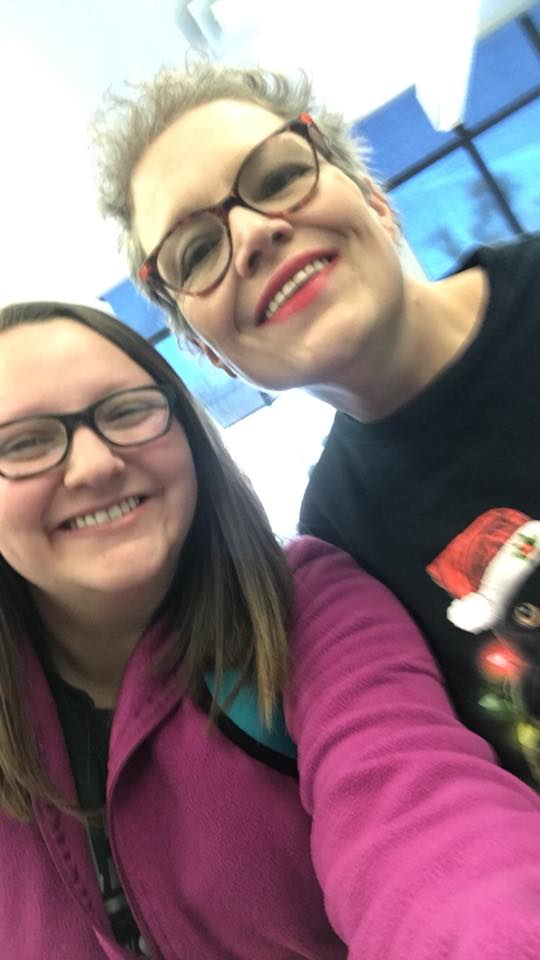
This selfie with a student was taken right after the final for the class.
Hi, Maggie!

Graduation and its ceremonies create a sense of completion and closure, as I said earlier. More important, they provide a rite of passage, something that is spiritually important. In the US, we have a crisis of rituals for passage into adulthood — high school graduation used to be the rite of passage into adulthood, but we no longer consider it so because of college. However, not all high schoolers go to college, so those teens no longer have a rite of passage. On the other hand, we don’t consider college students as adults, nor do they consider themselves as adults. This might help explain things like street gangs, which provide a sense of family and an initiation ritual that could serve as a ritual of passage.

I try to include rituals in my writing, as they’re so important in keeping a society together. We have religious ritual, academic ritual, holidays. Some of us have individual rituals, like mine of having my annual alcoholic beverage (Irish coffee) on Christmas Eve. Social/community rituals tie us in with our “people”, our community, our society. They give us a definition and a sense of community.

Something to think on.