Playing with the Pen

According to National Pen, handwriting has benefits over typing. From higher cognitive engagement to memory recall, the slower process of handwriting engages the mind more. Admittedly, National Pen may have a bias, given that they’re in the business of selling pens. However, a recent report in Frontiers in Psychology spells out similar findings.

As a writer of novels, I find writing 70,000 plus words by hand painful (literally — arthritis) and the thought of typing all that handwriting into its necessary digital form is daunting. I foresee handwriting the first draft of a novel doubling my process time, and I don’t feel like my writing is suffering that much by typing the story.

I think there has to be a way I can harness the power of handwriting. I used to do free writing when I was stuck with a scene or a character, and I haven’t done that as much recently because I haven’t felt I needed to. But what if I free-wrote before sitting down at the computer as a general practice, to gather my thoughts and project them forward? A writing ritual?
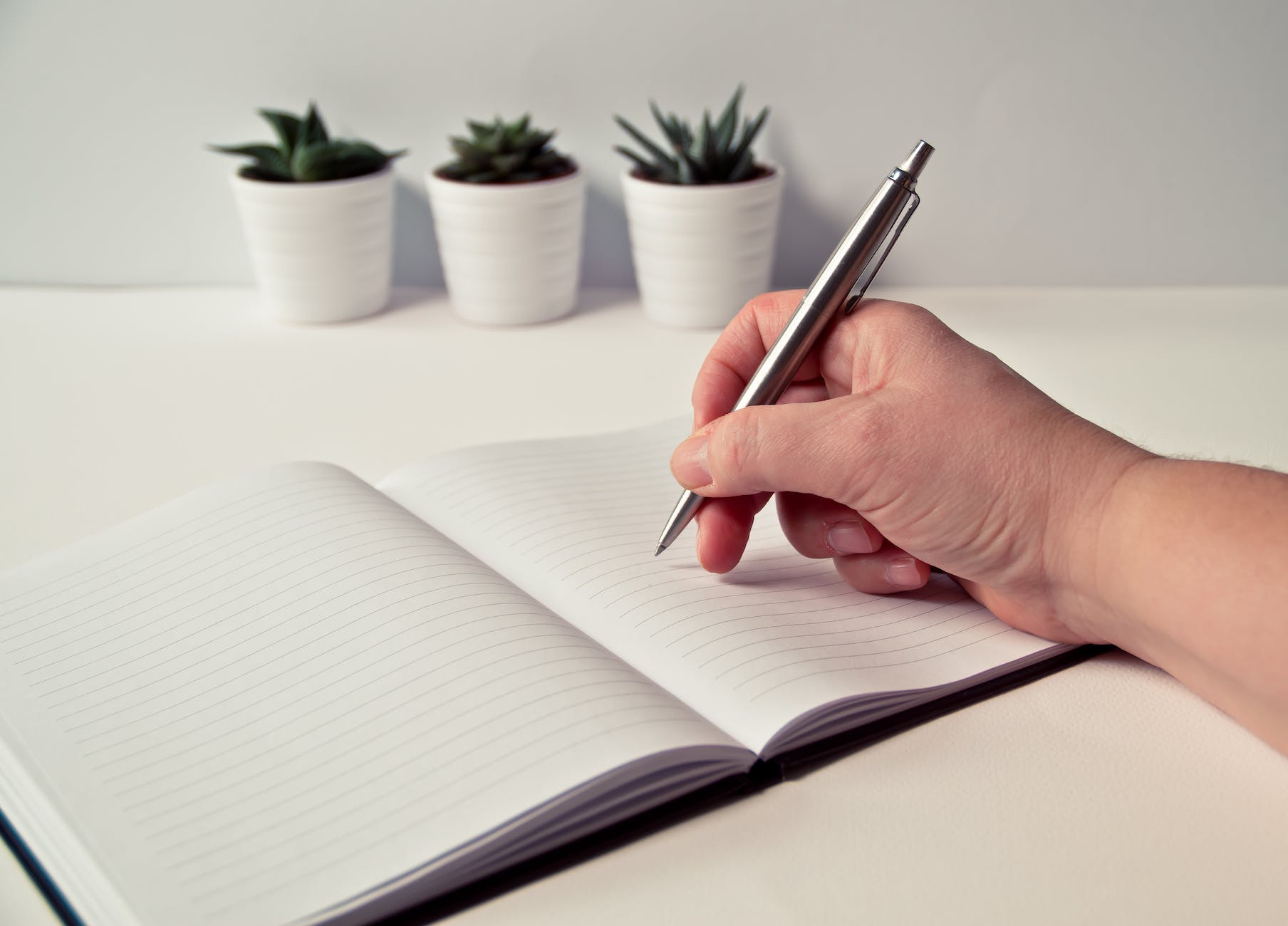
Photo by Ylanite Koppens on Pexels.com

My husband bought me two composition books to start the ritual. I have fountain pens to write with, which gives this more of a ritual air. The idea is to consider and write about the upcoming scene and free-write, then see if it makes getting those words more smooth.

I’ll let you know how it goes.

Review: Rocketbook with Frixion (not Flexion) pen

I got my Rocketbook with Frixion pen yesterday and decided to give it a whirl. It’s a thin notebook with slippery-feeling pages with a bar code in the corner.

Writing on it with the Flexion pen was the smoothest experience I’ve ever had writing. My fears of scratchy writing were based on Frixion markers, which are scratchy and pale on paper. The pen, a rollerball, has none of these problems. There’s no grid or even visible dots to guide one’s writing, yet my lines were almost perfect because of, apparently, the smoothest of the writing surface.

Scanning took a little more effort. Instead of clicking a few buttons and sending the scan to Dropbox, I had to scan the pages one at a time, click a few buttons, and mail it to myself to get a digitized copy, as scanning to Dropbox yields only a scanned and not digitized copy. That’s no big deal.

I found the optical character recognition (OCR) is slightly less sensitive than the Moleskine+ setup. I believe this comes from using a scan rather than a camera to digitize. It would work better, I’m sure, if I printed rather than used my idiosyncratic writing. I have to think about whether I can print fast enough to get my thoughts out, or if the slowdown is to my advantage.

The book erases cleanly with a microfiber towel and a touch of water. This is an advantage and a disadvantage, as most of us don’t carry microfiber towels with us. But those pages are perfectly clean to use again.

So here’s the breakdown for the Rocketbook/Frixion pen:

Advantages:

  • Smooth writing
  • Renewable
  • Destination setups 
  • Much less expensive
Disadvantages:
  • Slightly less clear OCR
  • A little (only a little) more convoluted to use
  • Need to send to mail to digitize
I’m going to play with both for a while, but I’m biased toward the Rocketbook right now because of its cost and the fact that I can erase pages after I’m done with them. The deal breaker will be if it can’t catch up with my handwriting or if I can’t improve my handwriting to make it clearer.