A Model of Well-Being (or Happiness is Not Enough)

I’m teaching the positive psychology class again this semester. I love this class, because it’s all about what promotes happiness and well-being and how to find more well-being in one’s life. What more can you ask from a class?

Martin Seligman, the father of positive psychology, breaks well-being into five factors (2011):

  • Positive emotion (Of which happiness and life satisfaction are all aspects)
  • Engagement
  • Relationships
  • Meaning and purpose
  • Accomplishment

This, not surprisingly, is known as the PERMA model.

To go through each letter:

  • Positive emotion: Basic happiness, including hedonic happiness based on consumption of goods and experiences.
  • Engagement, or connecting: With hobbies and activities, volunteerism, and work. The idea is to do, not just experience.
  • Relationships: Good relationships. Not just romantic, but friendship; familial; connection with co-workers and the people around.
  • Meaning: Feeling a purpose beyond oneself. This does not have to be religious in nature.
  • Accomplishment: Completion of goals, development of expertise, recognition of work.

Photo by PNW Production on Pexels.com

An instance can fulfill more than one of the PERMA aspects. For example, I do moulage — casualty simulation — making people look like disaster victims as a volunteer for the Emergency and Disaster Management program. Through both my absorption in applying the makeup and my involvement in a volunteer activity, I achieve engagement. Through my improvement in skills over the past several years, I achieve accomplishment. You could stretch this even further regarding my connection to the other staff members as relationships.

To achieve well-being (which is more than happiness or life satisfaction) one should be fulfilling all five.

This is one of the first things I will be teaching in class. I’m glad I got to teach you first.

Seligman, M. (2011). Excerpt from Flourish: Authentic Happiness. Available: https://www.authentichappiness.sas.upenn.edu/learn/wellbeing [January 7, 2023]
The Big Five Personality Test

One of the things I teach is Personal Adjustment, which is a poor name for what the class really is: a class in positive psychology. Yesterday, I covered traits and happiness. The whole thing about that is that we have personal genetic traits which might influence our happiness.

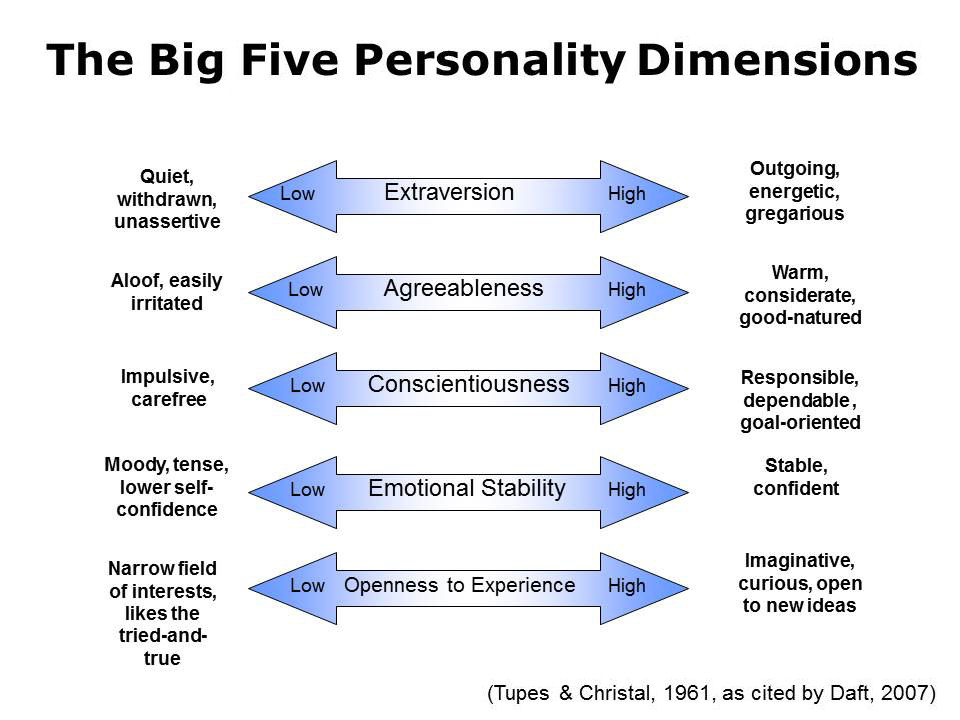
One way to measuring enduring traits is the Big Five Personality Test, which has been tested for correlation not only to the traits measured but to happiness. The Big Five mentioned in the title measures five dimensions (see picture below):

Some of these dimensions are linked to happiness as follows (Judge et al., 2007):

  • Higher openness to experience correlates to higher happiness
  • Higher extraversion correlates to higher happiness
  • Higher emotional stability correlates to higher happiness
  • Agreeableness and conscientiousness do not correlate to higher happiness

In other words, if you score low extraversion (i.e. score as an introvert), you will experience less happiness than someone who scores high in extraversion — and half that gap is unchangeable; it is a trait you have that won’t go away.

The good news, though, is the other half (on average) of that gap can be changeable. By pushing your comfort zones, you can recoup some of your happiness in openness and extraversion. By learning to manage emotions, one can increase emotional security.

So some people are happier than others, but it’s possible to approach a higher level of happiness through self-work, and that’s a good thing.

Learning optimism

Speaking of anticipating good things happening , I’ve noticed that pessimists often call themselves “realists”, yet I haven’t heard optimists say the same thing. It’s almost as if, again, we expect bad things to happen and not good.

I’m trying to focus on good things happening — the good deeds of humans, the unexpected good thing, achievements and accomplishments, and so on. The things that spark gratitude and, thus, happiness

Being an optimist is not the same as descending into toxic positivity. I don’t chirp “Look on the bright side!” to people who are going through tough times; I listen to them. I don’t ignore my own feelings of hurt. I don’t choose to ignore the bad things in the world. 

I hope. That is the core of optimism — hoping for good things in the future. 

It’s hard sometimes. I worry that I am enjoying my white privilege. I deal with a pessimistic inner voice that tells me I’m just going to get hurt. I wonder if I’m fooling myself. 

However, I think I’m doing the right thing. Pessimism makes us ill and makes us unhappy with life. I hope to stick with optimism because it seems healthier.

In Search of Small Happinesses

How do I kick myself out of these blahs?

These aren’t bipolar blahs, they’re just plain blahs. Lots of rejections, one dead cat (RIP Snowy), nothing exciting to look forward to. Except my birthday, and I have my psychiatrist’s appointment that day. So lots of reasons to stay blah.

If I want to stay blah, I can rehearse my hurts and aches and pains, hoping that I can win some sort of concession from God (“Look at all this crap that’s happened to me. I deserve some compensation!”). Note: It doesn’t work, and it keeps me from seeing good things that could be happening. 

It’s my responsibility to do what I can to get into a better mood. I wouldn’t say happiness is a choice, because that’s unfair to people like myself who face depression. But I can help myself until I feel better or. in the case of depression, till the meds kick in or I can talk to someone else. When I’m depressed, it’s so much harder to think of these, much less do them. Work helps me connect with people, and that helps a little, as does forcing myself to write. These things don’t get rid of the depression, but they take the edge off it.

What can I do? I think I’ve talked about this before, but I need a refresher, so here I go again:

  • Gratitude journaling — three things I’m grateful for every night. I admit I fall behind on this, because at night I generally want to sleep.
  • Walking — I could walk to coffee this morning. That might be a good thing.
  • Pet therapy — with five cats, this isn’t hard to do. 
  • Getting out — I’m contemplating the Board Game Cafe, as usual.
  • Accomplishing something using my character strengths — I have a story I’m writing which I’m not currently in love with; I can send Whose Hearts are Mountains off to dev edit; I could come up with a new story. Or submit more queries/submissions.
  • Connecting with people — Board Game Cafe works.
So I’m off to take care of my mood.


A happy note about bad things

Sometimes the things I need are not the things I thought I needed.

I needed the bad yearly evaluation, because without it, I would not have been able to talk honestly with my boss about what I had been going through for the last two years illness-wise. I would not have gotten the kick in the butt to do better, nor would I have realized that my boss cared about how I was doing.

I needed to have my writing rejected, because I would never have been pushed to get beta-readers on the job. Not only do they help me improve, but they are reading my stuff and that feels good.

I needed to feel like I was the most uninteresting person on earth (isn’t depression grand?) so I would see the places where I am geekily interesting — edible plants and herb garden, persistence in fishing even though I catch nothing, wanting to learn everything, moulage, the ability to talk to anyone about anything, addiction to coffee, dedication to writing …

I needed to have that terrible school year — two terrible school years filled with depression and illness. Even though I have a lot of work (writing, disaster mental health class, redesigning a class) this summer I feel relaxed because I can take a day to go off to St. Joseph and drink at a quirky old coffeehouse.

I needed to break my heart on that crush, because it showed me how understanding my husband is about my periodic idiosyncracies in looking for the muse, a person who subtly infuses my creative soul with energy. (Crushes would lose their power if one did anything about them, so they’re supposed to go nowhere. Dear muse, if you are reading this, thank you.)

I needed to feel alone, because if I hadn’t, I wouldn’t have realized how much it means to me that I have readers. I love you all!

Marcie shows up to class

Hi, it’s Marcie. Remember me? Aunt Laurie let me come to class on Tuesday because she said it’s about happiness. My aunt gets to teach a whole class about happiness! I want to take that class. It sounds a lot more fun than math.

I was the youngest person in the class; everyone else was almost as old as Aunt Laurie. I mean, not old-old, but grownup. Aunt Laurie talked about two different types of happiness — they had big word names, but the first type of happy was the happy you get when you eat ice cream or binge on Netflix — I think she called it “hee-DON-ick”. I think the “ick” part is when you eat too much ice cream. The other was called “ew-die-MON-ick”, and it has nothing to do with dying. It’s the happy you get when you’ve done something good, or you do something you really like and you’re good at it, and then Aunt Laurie said you feel those two types of happy differently —

I knew about this from talking in one of Aunt Laurie’s other classes! So I waved my hand real big and Aunt Laurie, who was of course wearing her teacher clothes and looking all official and stuff, called on me. I explained to the class that when you eat ice cream, you get a biiiiig happy that goes away quickly, and when you do something good, it’s not as big a happy but you feel it longer. I think I should be a teacher when I grow up.

Yesterday, one of Aunt Laurie’s students walked up to her before class and asked her if she could bring me in because his best friend was having a birthday and he wanted me to pop in. So I did and I told him that having a birthday felt like a big happy and then, the next morning, you wake up and say “I’m older now!” I know I felt like that when I turned seven.

I still feel happy when I think of that. I think I did a good thing for someone.