Classical-Adjacent?

I’m listening to what some columnist called “Classical-Adjacent music”.On now is Ludovico Einaudi, with all the melancholy yearnings that his music evokes. I appreciate this music, even as outside, mud and sunshine replace the snowy afternoon it calls forth.

Photo by ready made on Pexels.com

The playlist moves to Sakura by RIOPY. The mood is positive but introspective, hinting of inspirational. This is the feel of much of the music: introspective. I think I like this genre so much because it encourages thought and emotion without taking over my mood.

I listen to modern classical (another name, a little less sardonic) when I’m writing. It distracts me from my inner dialogue and from my surroundings and lets me pay attention to what I’m building in my head.

Who fits into modern classical? Start with its philosophical founders: Erik Satie and Brian Eno (my opinion), then include people like Johan Johannson, Ólafur Arnalds, Max Richter, Ludovico Einaudi, and others. On iTunes, you can find them in playlists like Classical Edge, Classical Concentration, and Contemporary Classical.

I end this blog note with Alexandra Streleski’s Elegia, which is as melancholy as one could get. I look out my window, which seems incongruously cheerful. That’s okay; melancholy is the mood I want to write.

Fighting Burnout

You haven’t heard from me in a while

I apologize. I’ve been neglecting my writing. Not just the blog, but the books, etc. I’ve been busy with work. I’ve been tired. I’ve had so many little things to arrange.

Or I’m just burned out. The ideas are not flowing. I’ve been devoid of good ideas. I’ve been discouraged by how little my books have been read compared to other people’s work. I’ve been frazzled by how much of my life has become promotion of books. I’m irked at how many writers look down on self-published authors like myself. Like there’s a pinnacle to reach and I will never read it.

Photo by Ron Lach on Pexels.com

I’ve lost the joy of writing

I’ve been actively avoiding writing lately. I avoid my current work in progress rather than staring at it. I avoid this blog.

I need to find the joy of writing again. I am thinking of changing gears and working on the next Kringle book, which needs to be plotted by November 1st. I need something to perk me up, to remind me that I’m a writer.

I have been here before; I will be here again. I just need to find the way out.

Writing about the moment.

Good morning, dear friends!

I feel like I’m fresh out of ideas today. I just got another rejection email, it’s freezing rain out there and I still have to go to work, and I’m wearing one of those technological reminders of mortality around my neck — a Holter monitor. (Don’t worry about that last point — we’ve already found the problem with the little pitty-pat-cha-cha of my heartbeat, and it’s easily fixable with a med tweak. They’re just making sure that’s all there is.)

It’s a good day to be down. Not depressed, just down. The desire to wrap myself in the coccoon of my blankets (rather than throw my clothes on over the monitor, put on makeup, and trudge down and up a flight of stairs with my computer backpack) is almost overwhelming. Almost. After all, life is out there, not under my blankets, and the adult thing to do is make the best of it.

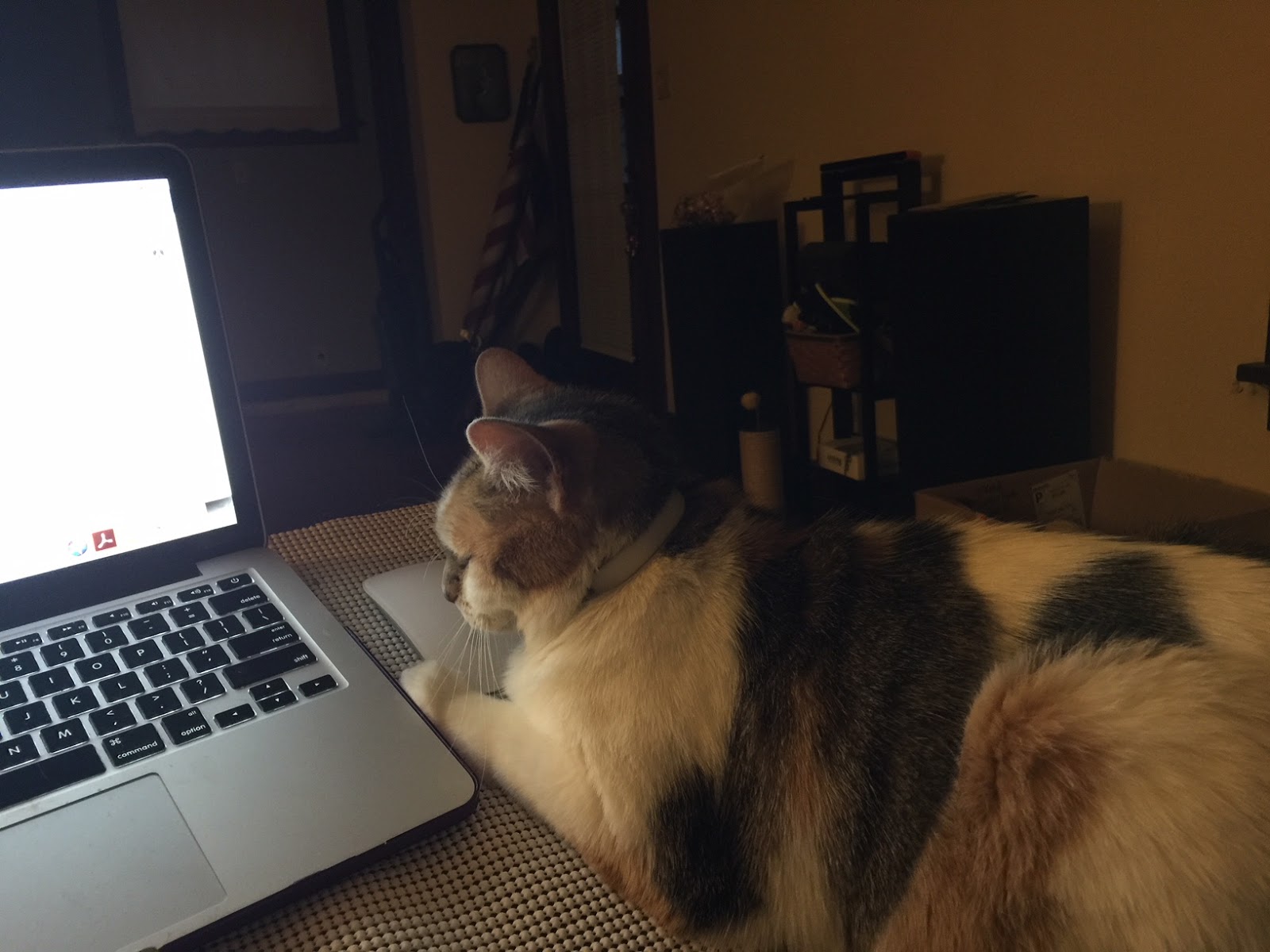
Girly-Girl is sitting on the arm of the couch next to me, purring. She’s my editor.

My editor is falling asleep on the job.

It’s definitely dark (and rainy) out here at 7:30 AM. I’ve had a Messenger chat with my favorite nature interpreter about aquascape and pond design. The rain hits the window like buckshot. I discuss the sorry state of American politics with Richard.

I check the seedlings downstairs in my grow room — the only evidence that there will someday be spring. The tomatoes and peppers and eggplant stretch and grow in their bigger fiber pots; the perilla seedlings perk up, the first of the miner’s lettuce seems to be sprouting.

Someday there will be spring. Someday I will find an agent, someday I will feel healthy enough to work out, someday I will accept aging gracefully.

But for now, I sit in a warm room lit by the glow of candles, next to my cat. I can live with that.

Old Hat

I’m not as excited about participating in NaNoWriMo, or that international month of writing 50,000 words toward a novel,  as I need to be.

I’m not sure why. It might be because this is my fourth NaNo, or because I didn’t succeed last year, or because I’ve succeeded two years before that. It could be because there aren’t others in my area to have writing sessions with, or because I’ve discovered that the officially sanctioned NaNo group events seem more about cliquishness than encouragement, or because I suspect I wouldn’t notice it was cliquishness if I were part of the clique (which embarrasses me).

Things are so much more motivating when they’re shiny and new, aren’t they?

I need to fall in love with my ideas:

Anna Schmidt/Annie Smith, an anthropologist, embarks on a quest to find the origin of a post-Fall fairy tale in the ruins of the United States.  She senses the ghosts of a traumatic incident following her as she pursues her quixotic journey through a world of black-market economies, scrapyard ingenuities, border skirmishes, and attempts at law and order.

In the high desert of Owayee, Anna meets Daniel in the nick of time, and he takes her to his home, an underground communal enclave. She suspects she has discovered the people of her fairy tale, who are in fact real but more unusual than she had guessed.  Then her secrets are revealed to the commune, some of which not even she knew. Revealed also is a plot that could cause widespread deaths — and Anna and members of the commune must stop Free White State from accessing a super-lethal virus Anna’s stepfather, a cryptographer, had once locked up.

I need to get a better feel for the characters, perhaps through more interrogation, or through writing a fun part of the story.

Melancholy Pt: 2 — a poem about Limerance

Limerance
There’s a push to ask you for your name,
And a pull ‘cause I have no right to know,
As I stand in the corner of the venue
With nothing in my mind except the color of your eyes.
There’s a push to sift through every word
And a pull to flee from disappointment
Still I remember and I polish all your words
And call myself the author of the author of their shine.
There’s a push from my husband and he’s laughing,
And a pull from my husband ‘cause he’s scared
And I’m standing on one foot while juggling cats
And I don’t want what I want,
And I don’t want what I want.
NOTE: No husbands were harmed in the writing of this poem. Said husband says he’s merely bemused, not scared. 
NOTE2: This may not be the finished work.

Melancholy makes for good poetry.

When someone paints a portrait of a poet in their mind, they picture the poet as brooding, head resting in hand or fingers steepled, drinking coffee absentmindedly in a cafe with walls the color of storms.* The word “Byronesque” comes to mind, appropriately.

There’s a very good reason — melancholy makes for good poetry.

Why? Because poets bear the feelings of their society. Not just the positive feelings — all the feels.  The feelings we don’t want to deal with, the feelings we’re afraid to deal with, the feelings we wished others understood. Poets even imbue poems about stealing plums from the refrigerator with interpretable, moody meaning.

Poets have a solid qualification to write about society’s moods — poets are moody.  They ponder in ways that bring feelings to the surface. They flirt with limerance and relive heartbreak. Their words bleed on the paper as they write with fountain pens in cafes with walls the color of storms.

But you need our melancholy, because you need to visit your own.

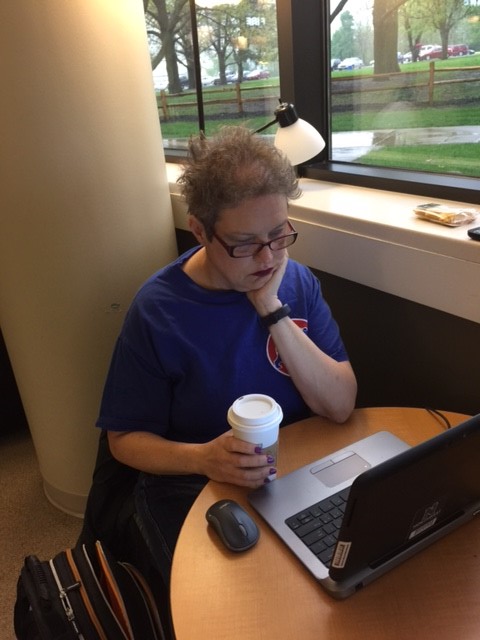
Portrait of the author on a blah day.

* Correction: only the male poets. The female poets always look perky, even though some of the moodiest work ever was by women like Maya Angelou and Gwendolyn Brooks.  And Emily Dickinson. And Sylvia Plath. And …