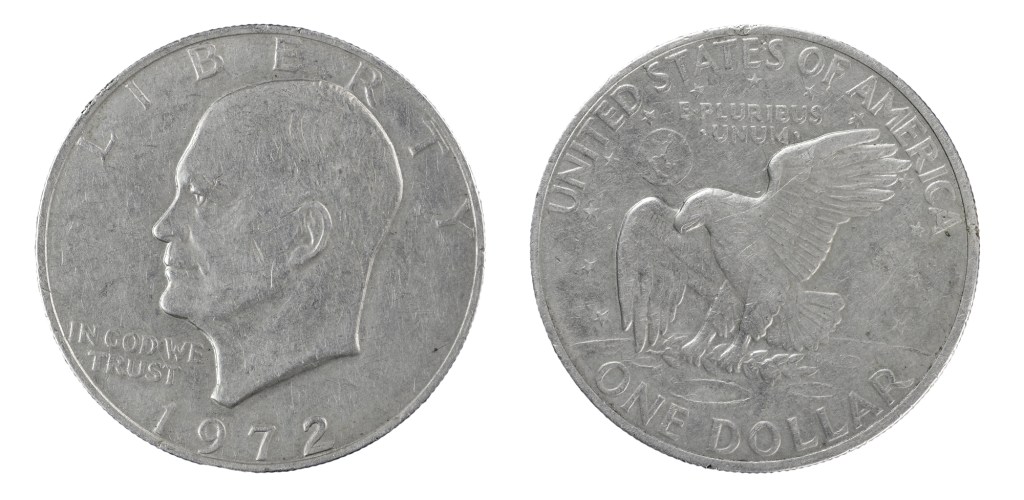
One Dollar Coin

Daily writing prompt
Write about a time when you didn’t take action but wish you had. What would you do differently?

When I was about 11, the music director at the church had put together a children’s choir for Easter. There weren’t many of us, to be sure; it was a small church. We rehearsed in the choir loft on Wednesdays.

On Easter, my friend Kay, who was in the choir, was set in charge of her cousin Denise. Denise was older than us, but she had developmental disabilities and the maturity of a six-year-old. Therefore, she ended up in the choir loft with us. The choir director, Mrs. Rose, said it was okay as long as Kay didn’t let Denise sing because Denise would “ruin the music”.

Denise was crushed. One of her favorite things to do was to sing. As I stood singing, I felt a creeping sense of remorse. This was God’s house, and we were denying Denise an opportunity to worship the one way she knew how. We had decided Denise wasn’t worthy to be heard. This didn’t sound like the God we learned about in Catechism. It didn’t matter to me that Denise would ruin our rehearsed music. I felt the music would be perfect if all our voices were heard.

At the end, Mrs. Rose gave each of us a dollar coin. In those days, a dollar coin was an impressive size and was considered special. I took mine, ashamed of myself for having been one that had rejected Denise. This was my fifty pieces of silver. Soon, I left the choir, and it didn’t last for long after that because there weren’t enough of us.

I tell this story, and most people don’t understand what the big deal was. After all, we had rehearsed for the opportunity, we had a specific sound that Mrs. Rose wanted to capture, and Denise would have ruined it. But I believed that God loved everyone, and that everyone was welcome at God’s table.

Later, much later, I became a Quaker because everyone is welcome at their table. And, if liturgy had been part of their services, they would have let Denise sing.

If I Got Great, Fantastic News …

Daily writing prompt
You get some great, amazingly fantastic news. What’s the first thing you do?

I haven’t had great, amazingly fantastic news in so long, I have to use my imagination to think about what I would do if I got it. Luckily I have a great imagination. Maybe this is a factor in getting older, but I’ve gotten more bad news (like people dying) than good news these last several years.

Wow paper background with colorful geometric confetti. Vector illustration.

What would be great, amazingly fantastic news? Winning the lottery or snagging an agent, winning an award at work or selling a lot of books. Maybe I expect more from great news than I did when I was younger; I’m not sure.

The first thing I would do if I got great, amazingly fantastic news is let my husband know. Probably by text, because I’m not a big one for phone calls. It’s not a terribly exciting answer, but there it is. His response would be “Yay!” because he’s not an excitable person.

We’d probably celebrate later at a local restaurant, and we would discuss what to do with this great, amazingly fantastic (I love that phrase) thing that befell us, because even great, amazingly fantastic things have consequences.

I’m going to sit here and think of great, amazingly fantastic news. I’ll let you know if anything comes my way. After I tell my husband.

What I Wanted to Be When I Grew Up

Daily writing prompt
What alternative career paths have you considered or are interested in?

When I was a child, I wanted to be a poet. I remember announcing this to my mother, who said, “Do you like to eat? You’ll starve as a poet.” She didn’t know about academia, where someone could get a Ph.D. and teach in composition and creative writing while getting paid for writing poetry. It’s just as well I didn’t take that path, though; I might have taken well to that unit in poetry as a third-grader, but I’m not enthused with my poetry now.

Photo by Pixabay on Pexels.com

Then, in Junior High, I wanted to be a doctor. Then I had some medical issues, and I realized I didn’t like doctors. They were abrupt and rude. They didn’t explain things to me and I was the patient. I wouldn’t have made a bad doctor, because in college I loved my physiology and microbiology classes. Chemistry, not so much. I still love medical stuff and try to diagnose people on reruns of Emergency! (American TV show, circa 1972) all the time.

The common wisdom is that the average college student changes majors seven times before they graduate. I think this is a gross exaggeration, but I did change my major three times from dietetics to food and nutrition to foods in business. Still, that wasn’t my final destination.

I didn’t want to become a college professor until college, because I hadn’t been exposed to the job. I had a friend in college whose father was a college professor, and I liked the way he had been brought up. It was only a matter of figuring out what I would be a professor of. My senior year, I discovered family economics and my career path was clear.

I joke sometimes that I still don’t know what I want to do once I grow up, but I have been a college professor for over 30 years, so I guess that’s what I am now.

An Excerpt from Kringle Through the Snow:

Photo by Kristin Vogt on Pexels.com

Wade Nelson stretched his 6‘4“ frame over the back of the chair, feeling the tension of a workday subside. He straightened up, realizing he’d made a spectacle of himself. He shrugged and peered at the laptop in front of him.

Wade wanted to type the notes down so he could keep this scenario with the others he had written over the years. To write a dungeon, he had to juggle the abilities of the players’ characters with the statistics of monsters, magic users, and weapon-wielders. The idea was to create a challenge, not annihilation. Sometimes the party got annihilated anyhow. Foremost, in his opinion, he had to come up with a story.

He looked up, remembered he was in the café. He had lost track of time and place. Looking up at the big clock, he realized he had little time before he had to go home to feed his dog. He still had plenty of time before Saturday, when he would try out this new campaign on his players.

He walked up to the counter, where Geena with her red braids stood at the counter. “I’d like another café au lait,” he said.

“Have you ever considered a London Fog?” Geena suggested, wielding a large coffee mug.

“What’s a London Fog?”

“Earl Gray tea, steamed milk, and vanilla syrup.” Geena smiled. “It’s your new favorite drink.”

“I’ll have that.” He rummaged for his billfold.

“You have a smudge on your nose. Looks like a big pencil smudge -”

“It is kinda like a big pencil smudge.” When his work at the battery factory brought him to the bays, sometimes he was in contact with tons of the graphite mixture that went into the cores of the batteries. He excused himself and went into the men’s room to wash the smudge, which turned out to be considerable, off his nose.

He saw medium light hair, very short, and a beard, closely trimmed. He looked, to his eyes, like an engineer. Which he was, a well-polished geek.

When he returned to the counter, his London Fog was ready, and he liked the smell. Maybe the London Fog would be his favorite drink.

He sat back at his computer and flipped through the pages of the book. “Is it time for the Aspect of Tiamat? I think it’s time for that, right in the next room with lots of tempting treasure. And some minions…” He saw the Chromatic Dragon in all its multi-headed glory and grinned. Hopefully, the party would survive.

He figured his players played Dungeons and Dragons for the strategy or for leveling up. To him, though, the game would always be about the role-playing. About the story-telling.

Satisfied with his progress, he packed away his laptop and books and stood up to leave when a woman in a kelly green suit halted him. “You’re Wade Nelson, right? I remember you from the Grinch auditions.”

“Yes. How did you know I was going to be here?”

“Kris Kringle — I mean Kriegel — at the toy shop. He told me you were a regular here on Thursdays. Can I talk to you?”

“Uh, sure.” They sat back down. Wade wondered how Kris Kringle — Kriegel — knew him.

“I’m Sally Perkins from Rolling Hills Improvement Committee. I wanted to tell you that you’re our Grinch.”

“Great, I think. I’m not sure what a Grinch is supposed to do. I was at the interviews because my boss picked me to represent the factory, so maybe you can help me. How do I grinch?”

“Well,” Sally paused. “Well, you are going to attend several community functions. Like the December Chamber banquet and Thanksgiving at BesMart, the parade, and the Charity Holiday Gala. In a Grinch costume.”

“I think you’re going to have to make me a new Grinch costume, then.”

“Why is that?” Wade hadn’t even noticed the clipboard on which Sally took notes, but there it was.

“I’m 6‘4″, a size 2xl, and I’m betting your Grinch costume won’t fit me.”

“Oh,” Sally said, writing. “I hadn’t thought of that. Let me get on that. I’ll see you later,” and with that, Sally had left as abruptly as she had arrived, and Wade had become the Grinch.

Now all he needed to know was what Rolling Hills expected of their latest Grinch.

Excerpt from Kringle Through the Snow

This is an excerpt from the latest Kringle romance, which will be published October 1, 2024:

Surprised by the visitor, Sierra DuBois stood up from her desk at the Venue Barn, where she worked as general manager and event planner. Sierra looked neat, from her shiny brown bob to her crisp white blouse and slacks, against the room strewn with fabric samples, receipts, and white tulle. The red-headed woman at her door wore an emerald-green suit and carried a clipboard.

“Sierra DuBois?” she asked. “I’m Sally Perkins, head of the Chamber of Commerce and vice-president of the Rolling Hills Improvement Committee.”

“Yes, please, come in.” Sierra noted Sally had already started walking into the office.

The two sat, and before Sierra could speak, Sally introduced her topic. “You know the city wants to start a fun little initiative with the community for the Christmas season. A Grinch initiative?”

“As in, green guy who doesn’t want the neighbors to celebrate?” Sierra had watched the animated TV special about the Grinch since she was Cindy Lou Who-sized.

“Yes. He’s a favorite among kids and adults alike. Quite the thing.” Sally looked down at her clipboard. “We would like to incorporate him into holiday events. He’ll already be riding the fire truck in the Christmas parade, and -”

“What happened to Santa Claus?”

“They’re on the truck together.”

Sierra couldn’t imagine they could both fit in the truck’s basket, given that Santa’s belly was quite jolly. “What can I help you with?”

Sally took a deep breath, and Sierra felt a bit of apprehension. “We would like it if you could incorporate The Grinch into your gala.”

“Oh.” Sierra said. “The charity gala. You know the gala is an elegant event that raises hundreds of dollars for community philanthropies.”

“Yes, I know. The Chamber donates to the setup every year. As I recall, Ray’s Liquors donates 75 bottles of bubbly every year.”

Seventy-five bottles of Cordon Negro wasn’t Dom Perignon, but it was still a hefty donation. And when someone receives that big a donation, one gives back. “Sally, let’s work together on this. How can we incorporate the Grinch into this gala without losing the panache?”

“That’s your job.” Sally stood. “I would hate to get in your way.” And with that, just as abruptly, she left.

Talking About the Weather

I know that talking about the weather is the smallest of small talk, the type of inoffensive speech that makes it safe to talk to total strangers. I hate small talk, preferring to talk about people’s passions, as I am passionate about mine. But look at the freaking heat index!

We’re under a heat advisory here in Northwest Missouri. The heat index (a measure of how heat and humidity get together to cause misery) is 108 degrees Fahrenheit. The temperature without the heat index will be 98 degrees F. People die of heat stroke at these temperatures. I won’t be going out today because I take medications that make me prone to the consequences of high temperatures. (Of course, human nature being what it is, I desperately want to go to Starbucks to write.)

I think about climate change a lot when the weather gets like this. It’s not just my imagination; scientists note an increase in weather incidents like this. On average, our world is getting hotter. I think about this from the viewpoint of someone sixty years old: I remember when we didn’t worry about this. I don’t want to worry, but I am worried. How will this affect the world’s people?

As a Midwesterner (United States), I’ll be far away from the flooding and some of the extremes as they come. But how will people in poverty fare? People without air conditioning? There are ways of living, but do we still know them? Do we remember how to do them? What will we have to give up of our 21st Century values to enact them?

Photo by Fabio Partenheimer on Pexels.com

I wonder how life will change. I wonder if I cannot change my life enough to make any difference in the slide into turbulent weather. Thinking this as I sit in my writing spot is a lonely moment, because it’s sobering to think about a future I can’t control. To think it all goes downhill from here.

I could be wrong. We are always on the brink of great innovation. Change is always possible. Maybe someday, riches will be measured in how we relate to others. I do not feel optimistic at this moment in 98 degrees F.

The Taco Truck’s in Town! (Severe Weather)

We in the far northwest corner of Missouri have spent two consecutive days down in our basements (about two hours total) because of tornadic activity. We didn’t fare too bad — the tornado at Maryville did not touch down but wasn’t that far from campus, although some neighboring areas saw some damage. Northwest of us — Omaha and Lincoln — got some bad damage, as did parts of Oklahoma on day 2.

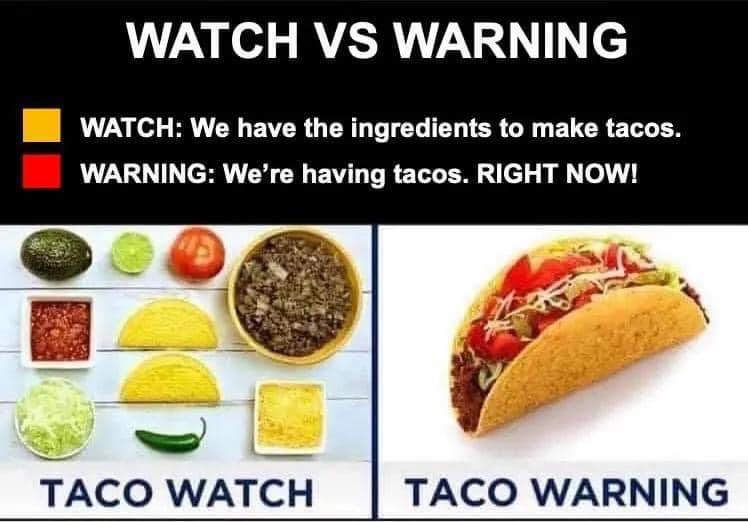
I wrote the other day about how today’s weather warnings are so much more sophisticated. The FEMA app (my favorite for severe weather) informed us throughout the afternoon and evening. This app distinguishes between “Your neighbors should be in the basement” and “YOU should be in the basement” when setting alarm noises; the latter noise is more alarming than the city’s ominous siren. What struck me was that, despite the neighborhood destruction in Omaha and Lincoln from an EF3 tornado, there were no fatalities and only non-life-threatening injuries. This speaks to me of a robust warning system and better awareness of the danger of a tornado.

The graphic at the top of this page is perhaps one of the most ingenious tools of the current emergency mitigation response. It’s a non-threatening way to describe the threat levels in a tornado. It’s funny enough to go viral. And on those severe weather days when we’re waiting for the sirens, we’re looking for taco trucks. Only we want to avoid them.

In Those Glorious Days of Civil Defense Tornado Warnings

For the next couple of days, my city (town?) is in a severe weather zone. The Weather Channel says, “There is a likely risk of severe weather today. Wind, tornadoes and hail are possible. Look out for large hail and powerful tornadoes. Have a plan and be prepared.”. This risk continues through tomorrow; the National Weather Service has given a Hazardous Weather Outlook (pre-Watches and Warnings) to our area.

Our house has weather radio and our phones have weather programs with warnings. Our basement has bottled water and emergency kits. We remember the tornadoes in Utica, IL and Joplin, MO (home town-adjacent areas for each of us) and take severe weather seriously.

Weather awareness has changed significantly since I was young, and I was in one of the few areas with any form of local weather response. When I was young, most people got their television through antennas, and so network TV carried tornado watches and warnings. I don’t believe stations posted severe thunderstorm watches or warnings back then. Our middle-of-nowhere town was in the Chicago market, yet 90 miles away, so we watched warnings in which we may have been obliquely mentioned. However, because there was no way we could receive TV waves in a river valley, we had cable TV in LaSalle County, IL, which was novel 55 years ago. This was important to the current discussion because we had our own emergency warnings.

At the time, FEMA didn’t exist; the national civil defense organization was named Civil Defense. Our Civil Defense person was Bill Bailey, who I believe was the Sheriff. And he delighted in Civil Defense. When a tornado watch or warning occurred, he cut into our regularly scheduled programming with emergency tones. He then droned on about the warning of the moment. Originally, the screen would go back, but I think later interruptions had this symbol:

We would all go to our basements like good little Midwesterners. Ok, I kid. I would go to the basement, as would my mother. My sister and dad went out to the front porch to watch for tornadoes. I was scared to death of tornadoes back then (and many other things as well, but not spiders or snakes or bees or wasps).

Nowadays, we have a much better warning system. We have warnings about weather days in advance from the National Weather Service. We have FEMA with not only warnings, but sophisticated operations in the aftermath of severe weather. But I remember when all we had in LaSalle County, IL, was Bill Bailey.

A Shooting Close to Home

Yesterday, the news hit close to home. A shooting at the Kansas City Chiefs (American football) Superbowl celebration at Union Station in Kansas City. 23 shot, including children. One killed.

I live 95 miles away, which means the shooting isn’t that close to home. But it is. Union Station is a landmark in Kansas City, a grand building which hosts exhibitions which have commemorated Van Gogh and the Holocaust. It’s a gathering place along with its nearby Memorial Hill and Liberty Memorial Tower. I have been there, eaten at Pierpont’s, and taken a train from the station to Hermann for my honeymoon. Never have I felt unsafe there.

The first I heard of the shooting was the messages on Facebook: Kansas City friends, please report in. Are you okay? And the reports came in, from friends and friends of friends: We went over the fence. I heard a series of pops and we ran. I was right in front of where it happened. I don’t know what to tell my kids.

23 shot, including children. One killed.

Photo by kat wilcox on Pexels.com

And then, the frustration. Thoughts and prayers become suspect, because the prayers we need are for people to do hard work to solve the mass shooting problem. The thoughts we need are for solutions. It’s going to take both pro- and anti-gun sides to do the work because that’s how we work in the US. Instead, we see finger-pointing and recriminations and the shrugging of shoulders because we can’t find any way to solve the problem of mass shootings.

I am a pacifist, so I sit on the side of fewer guns in the US. But I also believe that a way can open for us to find the solution, even with vehemently opposing sides. And my thoughts and prayers will go toward a way where this can happen.