The story I’m writing is going so badly. I don’t think I’m ever going to finish it, even though it is mostly done. There’s not enough action in it; too much emotional drama; too much talking. There’s not enough there there.
I should probably finish it and then relegate it to a figurative drawer somewhere to age. Or rot. I’m not sure which.
I’m not feeling a strong affinity to writing lately. It could be because of this book. It could be that I don’t like this book because I’m not feeling like much of a writer. I’m not sure which, but this book is making me grouchy.
I’m writing a book right now, where the female protagonist is (among other things) a folksinger, and her significant other is an immortal who wants to be human because he thinks it will cure his loneliness. One song she performs at open mic night is Child 39a, an old ballad called Tam Lin.
The ballad is about Tam Lin, a captive of the fairy realm who holds a plot of land, and any unaccompanied woman who passes there has to give up something of herself, including her virginity. One woman, who gets pregnant, returns to demand he support his child. He agrees to marry her if she takes him from captivity. He warns her he will turn into all sorts of vicious forms, and if she continues to hold on, he is hers. This goes according to plan and they live happily ever after.
I realized in the middle of writing this section that their story is basically Tam Lin, with a few changes. He is held captive by his loneliness. She rescues him and holds onto him as several layers of his existence are shed — immortal, being made in the image of humans, and then his final layer — inevitably other. No vicious forms, but the alienness of his being stands in. In the end, their story is bittersweet as I suspect Tam Lin’s is — how do you live in the ordinary world when you have been touched by the fey? How do you have a relationship with someone that alien to you?
I’m using the song as a framing device. I would tell you it all fell together accidentally, but I know the subconscious of a writer is a powerful thing.
Did I mention that I’m working on another book? I don’t remember whether I did.
Anyhow, it’s another book in the Hidden in Plain Sight series, which is already full of stories, but I thought I’d write another. This one, which does not have a title yet, happens in 2015, before any of the other books so far. It is the setup for the collective Hearts are Mountains featured in Whose Hearts are Mountains, which has not been released yet. It’s an origin story about how a bunch of Archetypes, beings who are usually solitary, form a commune in the Nevada desert.
It’s going slow, especially as there are necessary conversations that have to drive my main characters to where they actually contemplate such a crazy thing. I feel like I’m doing too much talking as I write, but I’m in the “getting the words down” stage. I’m thinking, though, I’m thinking of how to get more action in the first three chapters.
There’s also a love affair between an archetype and a human, which results in a Nephilim who is not brought up to understand her heritage, who also becomes important to the plot of Whose Hearts are Mountains. So the events of twenty years later have their roots in this story.
I love the process of watching a story take shape, even one that presents a struggle such as this one.
So I’m writing a new book, or at least I think I am. I’ve gotten past the layout (which I will revise, I’m sure) and into the actual writing. I have gotten one chapter written and already I find myself out of ideas at the moment. It’s the part of the book where the writer sets up the premise and I already feel like I have that sewn up. And there are three more chapters to develop the premise. I hate when that happens.
I use a template when writing because I feel somewhat impaired by linear storytelling. There is an expectation of when things are supposed to happen in a book, and a template helps with that. For example, in the next part of the book, there’s supposed to be a debate over the future action in the plot: “You should not do the thing.” “Why should I not do the thing?” “Bad things will happen if you do the thing.” (And the protagonist does the thing, and everything goes wrong, and the protagonist’s hubris gets them killed. This is known as a tragedy. I don’t write tragedies. Yet.)
By the end of this book, the intrepid protagonists will gather together, fight against the Council of the Oldest who are trying to keep them from congregating, and start a commune in the desert of Nevada. I hope that’s enough plot to keep the book going. The problem with this story is that it’s writing out a historical event I know happens to my protagonists, but I don’t know if there’s enough there to write. Wish me luck; I need to get some writing in.
It’s in the Hidden in Plain Sight universe, and it takes place before any of the other books. It concerns some characters of Whose Hearts are Mountains, the last book in the series. I don’t really have the plot, but here goes: MariJo Ettner is the main character, and she is an eminent anthropologist. She is also an Archetype, an immortal being who has lived for millennia. By the end of the book, she will help to start the collective Hearts are Mountains. She will play matchmaker with Alice Johnson and William Morris, another Archetype, who will have a Nephilim child. That Nephilim child will become the protagonist of Whose Hearts are Mountains.
It’s still in its fledgling stages. One thing the book needs is a plot; another is a theme. I am experimenting with this group of Archetypes and their isolation, fear of being discovered, and status as Archetypes not born in InterSpace. It’s going to take a bit of work.
To prepare, I am rereading/editing Whose Hearts are Mountains. It’s been a while since I’ve looked at it, and as I now have ProWritingAid, I am finding a plethora of grammar quirks. (It’s already been edited for awkward sentences and plot holes).
It’s nice to be writing again, although I’m not really writing yet.
I think I have the idea on how to re-re-revise this year’s Kringle novel. It’s going to be a little flexible with reality, but not in an unrealistic way. No, that didn’t sound so intelligent. Let me try again. I will have to introduce a slightly unrealistic scenario, but not one that requires a massive suspension of disbelief.
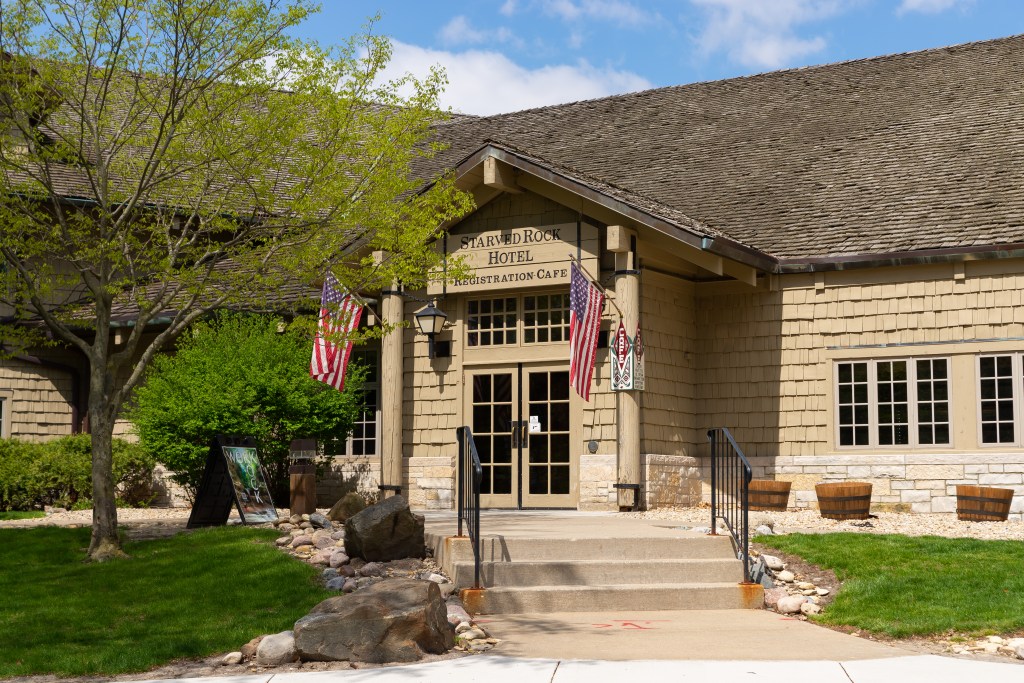
Oglesby Illinois – United States – April 26th, 2023: Exterior of the Starved Rock Lodge in Starved Rock State Park, built in 1933-1939, on a beautiful Spring morning.
The problem has been how to keep my aspiring writer in town and at the lodge for long enough that she actually has time for relationship development from meet-cute to growing interest to the peak, the misgivings, the breakup, and the reconciliation. The writing retreat has to be about two weeks long, and she’s not independently wealthy, so two weeks at the lodge isn’t something she can afford (even though it’s not exorbitantly expensive to stay there).
Enter an artist-in-residence program. This is not completely unrealistic; Amtrak had one a few years ago (that I desperately wished I was well-enough regarded as a writer to receive). There’s no reason the lodge couldn’t have this, and in the winter, which is not the prime tourist season. I know in reality that the lodge I am modelling this after never has a down time and thus would not sponsor an aspiring writer. But it’s theoretically possible.
In this scenario, my female protagonist, a writer, would be invited for a two-week artist-in-residence stay at the lodge, which would last through Christmas. During this time, she would give a book reading, talk to local aspiring writers, and write some features on the area. So she would interview the local Santa and visit the surrounding towns as well as the park. And she would fall in love with the executive chef.
How does she have two weeks for a writer’s retreat if she’s also college faculty? This is the end of her sabbatical, and she will go back to work after the break. Not unreasonable assumptions again.
I think this is doable. All I have to do now is write it.
So I gutted the Kringle book and started it again. My female protagonist is now a writer who can spend a bit more time at the lodge and start her stay early enough that they might actually progress to a “breakup” before Christmas.
The romance novel has a structure. I use a Scrivener template called “Romancing the Beat” based on Gwen Hayes’ book of the same name. This lays out the romance in terms of four parts: Set up, Falling in love, Retreating from love, Fighting for love. Each of those parts has five steps that progress the reader through the story. (If you think that romance novels are too formulaic, there are beat sheets for your favorite form of literature as well. We have expectations when reading a story).
The problem with my original story is that the happy ending has to happen by Christmas (it’s a Christmas romance, after all). As the romance started less than a week before Christmas, the plot had no time for them to pass through the stages between doubt and breakup. I suppose I could have collapsed them, but part of the fun for the reader is to pass through those stages. It’s not only part of the plot, but gives the reader a satisfying emotional roller coaster.
So I am rewriting the story with a protagonist who can stay a little longer. Not even that much longer — she’s got two more days to be there. The days are important, not only for the timing of the novel, but for what can happen during those days. Because their getting together time is not as close to Christmas, they have time to do things together before the male lead (an executive chef) has to buckle down for the Christmas Eve/Christmas Day buffets. This is in closer keeping with the original plot. It’s not romantic if they don’t get to enjoy some courtship.
I wrote the first thousand words yesterday. I think this will be a better book, although I won’t be done by the end of November. At least I won’t spend all my writing time grumbling about how it’s not working.
I’m having to abandon the current Kringle (Christmas romance) story because of encroaching improbability. The way I set it up, romantic developments are supposed to happen in hours rather than days, which is just too rapid. There is no way to stretch out the time the book covers, because the female protagonist is a schoolteacher and would not get to the Lodge sooner than she has. Nor could she afford to stay there for two weeks; a week is expensive enough. The relationship needs to be resolved by Christmas. There’s just no time for the two of them.
This has been happening to me lately; stopping in the middle of a book and not feeling it. Here, I’ve not been feeling like writing for a very good reason: The book is untenable. I can resolve this with some plot tweaks, including a protagonist who can arrive at the lodge a few days earlier. Maybe a writer on a writing retreat. That would be writing what I know. I already have someone from the last book in mind.
Today I have to keep writing, even if I’m not doing NaNo, even if I’m having to start from scratch. This is my flow activity; I need to keep it in my life for my health.
This new novel is got me looking forward to developing it, which I will do more of today in my spare time. I didn’t know what I was writing would make such a difference.
It’s another Christmas romance. Low spice, cozy with some humor.
Jacquie Ames goes back to the hotel she spent her honeymoon at 15 years ago, trying to find closure after her recent divorce. Only to find her ex-husband with his much younger fiancee there for the holiday. Barry Trout, the executive chef at the hotel, sees Jacquie’s distress and makes a deal: Let’s show your ex that you don’t need him. What could it hurt? The ex definitely has it coming to him. The two become a fake couple, but genuine feelings grow. If Jacquie could just find closure from her divorce and Barry could give up his solitary existence, maybe they could make it work for real.
This is another of the novels I write during the Christmas season so I get the full feeling of the season funneled into it. (To be truthful I will start it November 1, so a little early for the Christmas season, but WalMart will play Christmas carols anyhow).
I write to write. I publish just in case someone wants to read. I hope to be discovered, because I promote as much as I can, but it’s not enough. But the books will never be read sitting in a drawer somewhere.
A sure sign that I don’t like where a book is going — I lay out the bones of another book.
I just made a sketchy outline of the next Kringle book, which I traditionally don’t start working on until November. Oh, wait, it’s only three weeks until November! This is about the time I start laying out the next book!
Traditionally, I write my books during NaNoWriMo, the international writing movement which takes place during November. I will write in November, but I will not be using NaNo’s infrastructure, due to the controversy around its support of AI for writing. I will have to find other motivational tools. Maybe Written? Kitten! or Pacemaker. Or maybe I’ve outgrown the need for the graphs and awards of NaNo.
I’m also working on the playlist. I make a new playlist for each novel I write, not necessarily to listen to while writing, but to get the feel for the novel in my head. This year’s, for some reason, is tending toward bossa nova, even though it’s set in one of my favorite places on Earth — the alternate version of Starved Rock. There’s a lot of bossa nova Christmas music out there, by the way.
But it’s time to work on prepping the Christmas novel, at any rate.









 Words Like Me