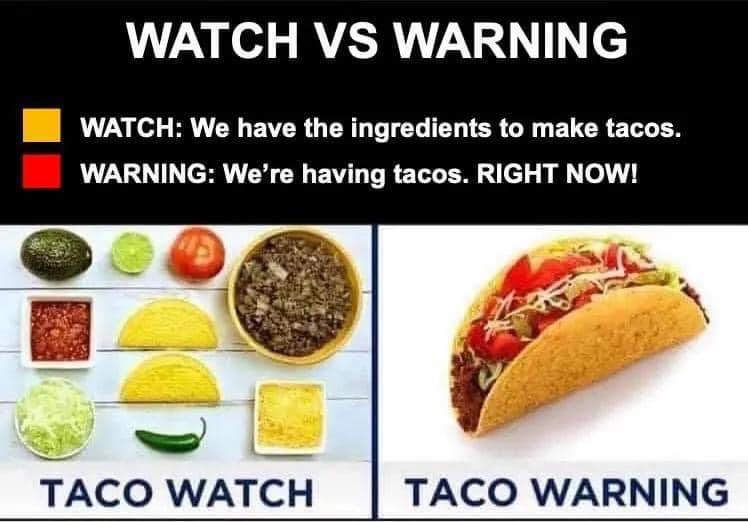
The Taco Truck’s in Town! (Severe Weather)

We in the far northwest corner of Missouri have spent two consecutive days down in our basements (about two hours total) because of tornadic activity. We didn’t fare too bad — the tornado at Maryville did not touch down but wasn’t that far from campus, although some neighboring areas saw some damage. Northwest of us — Omaha and Lincoln — got some bad damage, as did parts of Oklahoma on day 2.

I wrote the other day about how today’s weather warnings are so much more sophisticated. The FEMA app (my favorite for severe weather) informed us throughout the afternoon and evening. This app distinguishes between “Your neighbors should be in the basement” and “YOU should be in the basement” when setting alarm noises; the latter noise is more alarming than the city’s ominous siren. What struck me was that, despite the neighborhood destruction in Omaha and Lincoln from an EF3 tornado, there were no fatalities and only non-life-threatening injuries. This speaks to me of a robust warning system and better awareness of the danger of a tornado.

The graphic at the top of this page is perhaps one of the most ingenious tools of the current emergency mitigation response. It’s a non-threatening way to describe the threat levels in a tornado. It’s funny enough to go viral. And on those severe weather days when we’re waiting for the sirens, we’re looking for taco trucks. Only we want to avoid them.
Your life could change in an instant — preparedness

Your life could change in an instant.”

People always think of the worst when they say this — a dire diagnosis, a car wreck, murder.

It also means, however, that our lives could change for the better in an instant — a windfall of money, a job offer, a baby in the family. Is it a sign of pervasive pessimism that we can only think of the negative implications of the phrase? 

Yes, I think people are born pessimists. I think it’s a survival mechanism, because without the belief that bad things can happen unexpectedly, we won’t prepare for them. Disaster preparedness (knowing where the fire exits are, packing a “bugout bag” in case of evacuation, having a plan for tornadoes) is a good example of preparing for the unexpected. Insurance is another example. Without the belief that one’s life could change for the worst, would people invest the time and money to mitigate the unexpected calamity.

But people have to prepare for good things as well, although we don’t think about it. If one wins the big lottery, one must have in place plans like investment, legal issues, and dealing with family members. An unexpected baby requires a reallocation of money. One can’t place the plans unless the good thing actually happens, but one can set in the first steps — finding a good lawyer and accountant, allowing for savings to mitigate the financial effects of a baby, agreeing to rules about how to deal with the surprise discovery.

The key is to anticipate possible events, both good and bad, and set things in place. There’s always an event that will surprise people, but setting in place the acknowledgment that surprises need plans will help deal with the unexpected — even the good unexpected.