Rituals (again?)

The semester is approaching, and I’m sitting in the neighborhood Starbucks. Two days until my freedom (such as it was) ends, and my fall semester begins.

Rituals and the new school year

Fall semester, for faculty, begins with an all-faculty and staff picnic at the Pavilion on campus. It’s a ritual, one of many that start the school year. The Friday meetings (I’m booked from 8-4 and expect my eyes to glaze over by then), fireworks, even cleaning my office and buying office supplies I don’t need are my beginning of semester rituals. (I tried to convince my husband that a new iPhone fit the category of something I didn’t need but he didn’t jump on it.)

Rituals as a part of my life

Photo by Anna-Louise on Pexels.com

I am a great fan of rituals. Perhaps this comes from my childhood as a marginal Roman Catholic that helped me spot rituals in the least likely places (like a Quaker meeting) and caused me to make my own. Rituals help me focus, help me change my direction or rededicate myself to my intentions.

For example, let’s take the shopping for office equipment. Even though I do almost all my work on computers, I still associate pencils and pens with cognitive work and scissors and markers with creativity. Hence my ritual of buying those for the new school year. To be honest, I do use them (although with the markers, not as often as I should.)

Applying this to writing

I’ve been struggling with writing lately, focusing instead on marketing and this blog and TikTok. I wonder if rituals would help me in writing as much as they help me at the beginning of the semester. A new start, a refocus — I need this in my writing because I have drifted away from writing again.

What would be a good ritual to start me writing again? I asked my husband, whose response was “I don’t know”. Guess I’m on my own for this.

I don’t think I need new pens for motivation. I might need to do something in the office to make it feel more mine and less like some place my husband has sentenced me to. I used to work in the living room, and I felt more motivated because I wasn’t alone. The office is small and cluttered, and there is little to be done about it because much of it is items needing to be filed with no room to file them.

A ritual … I’m going to have to think about it.

A Short Ritual

Sometimes it’s hard to believe

It doesn’t seem to matter what religion or spirituality one belongs to — it’s difficult to believe. In oneself, in one’s deity, in one’s face, in one’s calling. Faith does not exist without the humanity involved — the struggle to believe.

We pray, we talk to ourselves, or we talk to respected elders, or do rituals. We connect to the avatars of our beliefs, even if they are a quiet place in the woods. And we ask for reassurance, for calm, for help, for confidence, and for support when we tune in. The answers do not fix our fate (for those who believe in a deterministic outcome) or the factors we can’t control (for those who feel they have more control of their fate). But they may give us hope that something better comes down the road for us. Or that our pain will lessen. Or that there’s comfort.

I am a rational (yet complex) person

Photo by Jonathan Petersson on Pexels.com

With a PhD and years of academic writing, I have developed a rational bent, as evidenced by the above paragraphs. (Ugh, that academic writing again!) I think people need comfort, need to know about the afterlife, need to feel there’s a sense of justice, and need to feel that there’s a force beyond themselves. I even teach that in a class.

Still, I have some irrational beliefs, embarrassingly irrational.

I believe in superstitions.

Moreover, I believe in curses.

Curses!

When a string of bad things happen to me, I decide I am being cursed. I do not know who’s cursing me — I have suspected everyone from God to the old Italian grandmother who thought I was defiling her great grandson (it was his idea to take me on a tour of the backyard on his dirt bike for what it’s worth). It doesn’t matter — it’s a curse.

People can think of curses as bad luck, a losing streak, “someone hates me up there”, terrible fates, unfair consequences, or “the devil’s trying to beat me”.

And nothing is going to get better until one breaks the curse.

How are curses broken? That depends on one’s belief system. Prayer, ritual, good luck tokens, a visit from a shaman — all are ways one breaks curses.

For me — a strange and convoluted story I’ll leave for another time — I use a ritual of burning all the bad things out of my life after writing them on a piece of paper.

To be truthful, I felt better. More importantly, from a strictly psychological view, I quit framing every minor annoyance as another terrible proof of the curse.

That may be the only result of the ritual, but hey, it works.

My Everyday Habit

My morning practice

Every morning I write this blog. There are many reasons I do this, not the least because I want that little message from WordPress that I have written the blog X days in a row (yay gamification!) I’ll explore some of the other reasons below.

A morning ritual

I consider writing this blog my morning ritual, along with coffee, music, and getting my hair to behave. The ritual starts with racking my brain with finding a topic to write on. Then I start typing and thinking and typing. And editing as I go.

Warming up for writing

I find the practice of journaling warms me up for writing. Not just the fingers, although by the number of typos I make while typing the blog I guess my fingers need warming up.

Photo by Taryn Elliott on Pexels.com

Writing the blog warms up my mind. It trains it to write as a flow exercise, a task where time flies past me and I’m in the moment. Admittedly, blogging itself is not a flow experience because it doesn’t go on for long enough. but blogging limbers up my mind so that flow is possible.

A challenge

One of my attractions to my daily ritual of blogging is that it’s a challenge. What am I going to write today? Have I written about that lately? Will anyone care about my blog? I don’t know about the latter, as I have between 11-20 readers on a regular basis and 57 followers, which suggests most of my followers aren’t reading the blog. That’s okay; I still face the challenge every morning.

To my fellow bloggers

How often do you blog? Daily? More than daily? Weekly? Let me know!

Coffee as a Family Ritual

The formative coffee experiences

Photo by Justus Menke on Pexels.com

I dated a guy (to the point that we later got divorced) whose family had a Sunday ritual of strong Gevalia coffee in white Scandinavian porcelain ware, classical music, and the New York Times.

Another boyfriend’s family ritual involved percolator coffee in the cluttered kitchen as the cats drank out of the sink, and his stepfather and I discussed socialism.

My own family would drink coffee out of mismatched mugs in the kitchen on Mom’s good days, and the cats would wander around the table and occasionally stretch up on Dad’s legs. We would plan dinner, which often consisted of tearing apart a recipe and reassembling it again.

Coffee has always been a ritual

Throughout time and place, coffee has been featured in ritual. The Ethiopian coffee ceremony, which involves roasting and grinding the beans at the table; the coffee breaks in an office offering time to talk with colleagues; weekly coffee dates. After-dinner coffee, sometimes spiked with liqueurs. Turkish coffeehouses and coffeehouses in Paris.

There’s something special about the coffee bean that lends itself to special moments. (I know the same could be said for tea in the British world, but I’ve only had a proper British tea once.) We in the US have very few rituals, but the ones we do have are ingrained and almost impossible to separate from everyday life.

Our Sunday ritual

Right now I sit in the living room typing this with a cup of coffee listening to classical music. The cats are somewhere — they don’t like classical as much as we do. The music du jour is one of Bach’s kids. We have a faux fireplace, which is on for ambience even though it’s summer (don’t ask; it’s a husband thing).

Soon I’ll be working on writing and Richard will be working on a project for the public library; but for now, we have our ritual.

For you, the reader

Do you have any Sunday rituals? Coffee rituals? Let me know in the comments below!

Courting Luck

The Day I Gave Away my Luck

I used to be a lucky person — you know, the person who wins random (small contests, not the lottery) and could be in the right place in the right time. Not that I never had setbacks or rejections, but that occasionally something delightfully unexpected would happen.

For the past few years, I feel like all my luck has gone, especially in the area of writing. Getting published is, to some extent, a matter of luck — having the right materials in the right place in the right time. This has so far, not happened to me. And I think it’s because I gave away my luck.

I did it for the purest of reasons, or the most obsessive of reasons. I was trying to be a good Christian and sacrifice myself for the good of others. There are ways of doing this that are helpful for the world, but I didn’t choose one of those. I instead decided I was unworthy of luck, given my privileged status, and so I gave up my luck. I said, “God, I don’t deserve my luck, please take it away from me.”

I brainwashed myself into believing that I didn’t deserve luck, and that other people deserved to have my luck. I believed that luck was a scarce commodity.

Photo by Miguel u00c1. Padriu00f1u00e1n on Pexels.com

A Fanciful and Superstitious — and Conflicted Person

Writing this down in pixels, it all sounds very stupid, I admit. I am, however, a fanciful and superstitious person. I don’t believe in The Secret (a book about the “law of attraction”) because it’s very materialistic and I don’t believe the universe could or should shower that type of abundance on individuals.

I do believe, however, that my negative attitude may keep me from seeing the good side of things and might blind me — ok, fine, I believe that giving up my luck is refusing to see what the divine could be calling me to find. As I said, I’m hopelessly superstitious. I honestly believe that I had luck, I rejected luck, and I am now less lucky than I used to be. Or at least, I believe myself less lucky than I used to be. I don’t know what I believe.

I am a fanciful and superstitious and rational and really conflicted person right now.

A Ritual Would Be Nice Right Now

I am not a witch or a Wiccan or any sort of pagan, but I still see the value of ritual. How do I divorce ritual from religion? The same way millions of people across the world do. People who wear lucky socks are performing a ritual. Traditions are ritual. Going out to a prime rib dinner the night the COVID vaccination takes hold is a ritual (one I did the other night). So what do I have to lose?

Luck, if one thinks about it, is a type of optimism. It’s an optimism that the unexpected good thing can happen, that one does not have to exert infinite effort for something good to happen. Not like effort isn’t necessary, but that there comes a point where effort doesn’t work any longer, and that’s a great place for luck to intervene.

A luck ritual, in my opinion, would:

  • Reattach me to my optimism that good things can happen without my control
  • Tell me it’s okay to have good things happen to me
  • Emphasize that optimism is self-care

What Does This Ritual Look Like?

Again, this is a psychological ritual (like lucky socks and Christmas china) rather than a pagan ritual, so I’m not calling up any spirits as much as I’m trying to make a break with old thought patterns. What I plan to do is:

  • Take a bath in milk and honey bubble bath
  • Write some journaling on luck using my favorite fountain pen
  • Eat some bread with butter and honey (the milk and honey symbolism is deliberate symbolism)
  • Find one of my four-leaf clovers in a book (or better, find one in the yard. We have some.)

What Do I Expect This to Do?

What I expect is that this will help me stop declaring myself unlucky, I will likely suffer less from griping about my bad luck this way. That itself would be an improvement. I hope that my better attitude will help me to see opportunities and make me resilient to adversity. I will believe that I am deserving of good things. And maybe, just maybe, I will be (or believe I am) luckier.

A Creativity Ritual

I need something to slap my imagination into working.


Life has been pretty staid lately. I’ve already complained about it — the lack of scenery, the lack of creative forces, etc. Time to not complain.

When my editing is over (at least on the current novel, which is three out of four), it’s time to spend some time in creative freefall.

This will involve some sort of ritual — A bubble bath, some rose-scented spray, a candle burning, some fresh paper and fountain pens. Free writing, possibly based on one of the novel ideas (pun intended) I have sitting in a drawer that I haven’t felt passionate about). Possibly based on short story ideas.

I need to do something besides edit, I think. Although I have another novel that needs a rewrite. Maybe I should go there. But I am so, so bored of editing that I think I need a recharge.

Another Homecoming and the Words that Come With It

The leaves have finally turned, orange and red and brown, dazzling the campus for Homecoming. I remain convinced that Homecoming is the remnant of a pagan ritual that captures parts of the harvest festivals and part of the sacrificial king (in the guise of a football game.) This would make pumpkin spice latte a sacrament, and I’m not sure I want to go that far.


It’s been a long time since I’ve thought this way, of the seasons of the year yielding a mythology we live by. I had no reason not to think this way, given that both Quakers and Episcopalians can skew romantic about the seasons, and rare individuals of each even call themselves pagan. In fact, the liturgical Christian traditions follow a liturgy of seasons, and mystical Christian traditions offer a glimpse of the movement of the year as well.
When I was younger, I was what I called a kitchen witch, making my own rituals in solitude, following the seasons of the year. This faded with my years as a professor, even though my religious life didn’t give me the hands-on relationship with life that I wanted. (Correction: Membership in the Religious Society of Friends did, but I’ve been 90 miles from Meeting for 21 years. The Episcopal Church put me too far from the feeling of sacredness.)

We need our rituals, whether dressed Wiccan or pagan or Christian (or one of the many other religions we profess). Those who have stripped ourselves of rituals because they’re “pagan” lose our moorings to the seasons and to the earth. Those without rituals that speak to them frantically try to rip rituals from others by brandishing the word “Satanic”, or create a mockery of ritual that worships hatred, bullying, and totalitarianism (MAGA rallies, I’m looking at you.)

I think about what Autumn says to me — golden and bittersweet, rejoicing at the leaves and wrapping up against the chill. Saying goodbye (Les’s death still resonates) and hugging the last of harvest to my arms. Snuggling with cats — always snuggling with cats. 

Hoping it makes for good poetry now that I vow not letting work become everything.

Graduation as a Ritual of Closure

A little story about myself: In the darkest moments of my graduate career, when I wasn’t sure I had the energy to finish, one shining beacon would keep me going — the thought of being able to wear the professorial hood at other people’s graduation. When I received my PhD, after the ceremony where I rented my cap and gown and hood, my academic advisor gifted me with a hood in University of Illinois regalia colors, and I wear it to this very day to students’ graduations.

According to “A Field Guide to College Professors”, this hood belongs to
someone with a Ph.D. from University of Illinois. You can tell from the
navy blue with orange stripes.

I teach three classes and handle the internships in my department, Behavioral Sciences, at Northwest Missouri State University. Between students in my classes, advisees, and interns, I work with about 150 students a year. I can tell the graduating seniors in the class after midterms — this is when they start counting the number of days until they graduate, and they’re extremely accurate. In fact, one class posted the number on the board every class period. A student in another class could calculate the days to commencement to the hour.

When one of my students asks if they should go to Commencement, I say “YES!” Why? There are some downsides to commencement (graduation) ceremonies — for example, they run long, gowns are hot and sweaty, commencement speakers are boring more often than not, and there are big crowds at the cookies and punch.

However, without going to commencement, students may never feel like they’ve graduated. Commencement ceremonies provide a sense of completion and closure through their ritual — the graduation gowns, the processional, the professors in academic regalia, the discomfort of the flat cardboard caps that students often decorate, the selfies with friends and professors.

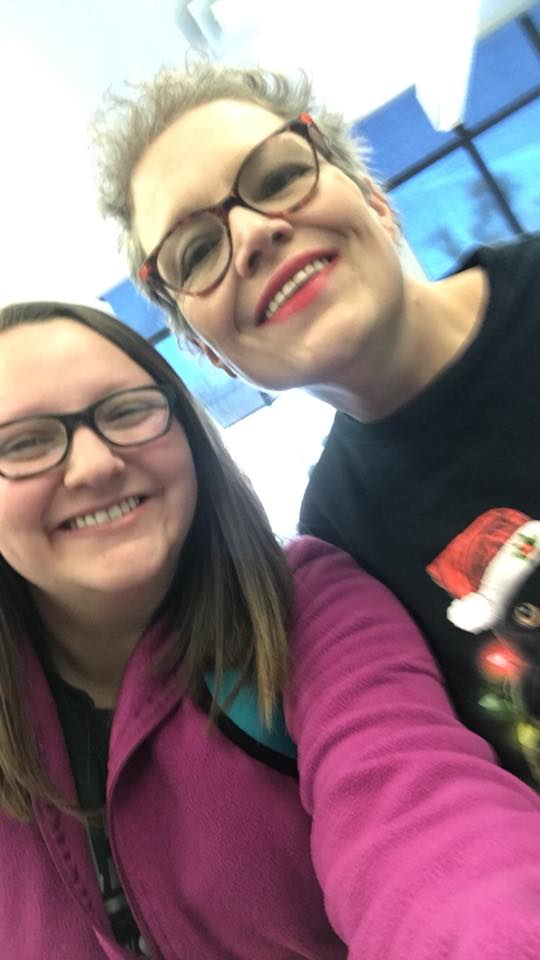
This selfie with a student was taken right after the final for the class.
Hi, Maggie!

Graduation and its ceremonies create a sense of completion and closure, as I said earlier. More important, they provide a rite of passage, something that is spiritually important. In the US, we have a crisis of rituals for passage into adulthood — high school graduation used to be the rite of passage into adulthood, but we no longer consider it so because of college. However, not all high schoolers go to college, so those teens no longer have a rite of passage. On the other hand, we don’t consider college students as adults, nor do they consider themselves as adults. This might help explain things like street gangs, which provide a sense of family and an initiation ritual that could serve as a ritual of passage.

I try to include rituals in my writing, as they’re so important in keeping a society together. We have religious ritual, academic ritual, holidays. Some of us have individual rituals, like mine of having my annual alcoholic beverage (Irish coffee) on Christmas Eve. Social/community rituals tie us in with our “people”, our community, our society. They give us a definition and a sense of community.

Something to think on.

For the Love of Coffee

On Facebook, coffee is a sacrament. Have you noticed this? Coffee jokes, coffee witticisms, coffee mugs. If you subscribe to writing-related pages on Facebook, you’ll quickly become convinced that coffee is the fount of all inspiration. For many of us, it is. (Those of you in the United Kingdom don’t understand this because your coffee usually is Nescafe instant and some boiling water. That is not coffee.)

Some of you reading this don’t fancy coffee and prefer your caffeine another way. For example, tea — sweet, unsweet, green, oolong, Earl Grey. Most of the people I’ve met who drink Earl Grey were English majors or Star Trek: Next Gen fans. Or Mountain Dew — all the people I’ve met who prefer Mountain Dew are computer programmers. Read on, because it may help you understand us coffee drinkers.

Why do so many writers prefer coffee? It could be because of the allure of coffeehouses* as places to write. Perhaps it’s knowing the mystique of the coffee’s journey from coffee cherry to processing method to grinding to brewing. Maybe it’s just that coffee is a socially sanctioned form of stimulants.

Coffee drinkers, like writers, appreciate the history of coffee. The apocryphal story of the discovery of coffee goes like this: An Arabic shepherd, feeling weary, sat under a bush to rest after making a fire to boil water. After he let the water cool, he notices one of his goats take a drink and then bound around the pasture with leaps and hops. The shepherd witnessed this, took a drink of the water, and no longer felt tired.**

Can you write without coffee? Yes — any ritual will help you get in the mindset, and writers have plenty of rituals — Using a fountain pen to write, writing in a dedicated Moleskine book, writing in a blog as a warmup, listening to music … Coffee is just another ritual. With caffeine added.***

*****

*  You will find the best ambience in indie coffeehouses. Consider yourself lucky if you have access to these. Chain “stores” that sell nationally recogized brands, not so much. Only one Starbucks in the US, in my opinion, has true coffeehouse ambiance, and it’s the Starbucks at Northwest Missouri State University, in the library. I work at that university and hold some of my office hours here.

**  I question this account for a couple reasons: 1) I’ve seen goats. They dance like they’re overcaffeinated ALL THE TIME. (Meet the crazy goats at Goats Gone Grazing Acres for an example.) 2) The herder boiled his water to be sanitary, only to drink it after a goat slurped it up? I prefer the story without the dancing goat.

*** Full disclosure: I am a coffee snob. In this household, we buy small lot green coffee beans and roast them at home in a small-batch drum roaster. We brew in a French press. We check for flavor notes. It’s really quite obnoxious. Really.

Writers and Rituals

From all the reading I’ve done on writers and writing (in the interest of procrastination), one thing I’ve learned: writers use rituals to help them write.

Some writers have to write in a specific notebook (Moleskine seems popular among writers), while others have to use a specific pen (with fountain pens the preferred utensil). Some have to write first thing in the morning, and almost all need their coffee. I suspect many have lucky shirts they wear every day (and unlucky roommates). I myself compose and revise on the computer (as my doctoral mentor taught me,) and do not believe in lucky shirts, but I always drink coffee.

The purpose of ritual in writing is not to court luck, but to court the Muse. The Muse, the whisperer of wildness in one’s blood, the source of inspiration, the bringer of strange harmonies. The writer courts the Muse, but never captures him*.

Tomorrow, I will be starting a new novel, without having any of my previous novels accepted by agents or publishers yet. I will begin this with my favorite ritual, which is spending a couple days out of my usual milieu (this time at a nearby park cabin). Because the middle of nowhere in this case has Internet, I may update occasionally. This is where I will seek the Muse** over the next couple days. 

* The Greeks’ Muses were female. I’m not Greek. Therefore …
** I am in search of a Muse. Duties include intriguing, enamoring, and occasionally bewildering the writer. Please send applications to lleachie@gmail.com.