I sit in my writing chair (the loveseat near the front window) feeling uninspired. This doesn’t sit well with me, because I am addicted to the flow.
I’ve talked about flow before, but it’s worth mentioning again. Flow is a state in which a person is completely involved in what they’re doing. Time slips by and the person experiences mastery of the task, an optimal level of challenge and competency. Flow contributes to well-being through accomplishment and a state of near-meditation.
I get my flow from writing, and that’s what brings me back to writing again and again. If I never published again, I think I would still write because of the feeling of flow. It took me years to accept that experiencing flow was enough of a reason to continue writing.
I’m looking for my state of flow today, and I don’t know if the current project is captivating enough for me to find it. I’ll be looking for a new project soon, maybe the right short story.
Today, I got reassurance about pantsing (aka “flying by the seat of my pants”). A reminder: I’ve been pantsing Carrying Light because I didn’t like the outline I set up for it. I found the outline rather weak and not supportive of any real depth, so I’ve been writing without the outline. As I’ve said before, I hate writing like that because I feel like I’m just making things up as I go along.
I encountered something that made me feel a lot better about this method, though. A book I wrote a few years ago in the Hidden in Plain Sight series (it’s got two books or maybe three ahead of it for publication) is one of my favorites. I had to go back to it because the end of Carrying Light refers to the flashback events in Whose Hearts are Mountains. I needed to know the names of six people killed in the siege on the University of Illinois campus. (Yes, I trashed my alma mater.)
Cat hidden in plain sight.
What I discovered is that I did not empty the trash in the Scrivener program, and that I clearly edited a great deal of the book, to where I found more pages in the trash than in the book. I hadn’t remembered that until looking at all the material in the garbage.
I remember now what happened — I got a developmental editor involved, and she did not make the suggestions that led me to the drastic remodel of the book. I finished her developmental edits (which were excellent) and then realized that the story needed better flow. Then I completely gutted the story and reorganized it.
I will doubtless do the same with Carrying Light once I set it in a drawer for a while. I don’t know if it will require as much attention, because I’ve learned something about plotting from tearing apart Whose Hearts are Mountains.
I’m losing steam with this book I’m writing, doubtless because I feel like I haven’t enough stuff to write in the remaining chapters. I tried an old motivation trick and went forward to more interesting chapters, having written one chapter where shit hits the fan and the last two chapters. That means I have about 5 chapters where not enough is going to happen unless I figure out how to write them without introducing filler. To advance the story past the “boom”.
This happens when one is pantsing a book. I feel like free-writing without an outline (i.e. pantsing) promotes a chapter-to-chapter view rather than a big picture view. “What am I going to do with this chapter?” is more how I write when pantsing. Although I get continuity by extending themes and plotlines (and I feel there’s a surplus of those), I still feel like the plot is going willy-nilly. Until it’s not going.
The book will probably turn out better than I think. I’ve written books this way before and they haven’t turned out bad once edited. But I prefer my outlines, so I can approach the next chapter and say, “This is what’s supposed to happen in this chapter.”
Pantsing refers to a style of writing whereas one makes the story up as they go along. It’s part of the trinity of methods, the other two of which are planning and plantsing. Planning the story is just what it sounds like — from using an outline of each chapter to setting up scenes and documented world-building. Plantsing is somewhere between the chaos of making it up spontaneously and organizing everything.
Normally I am a plantser — I have “note cards” (a feature on Scrivener, the program I recommend for writing novels) for each chapter denoting what should happen in the chapter, and I see where those directions and the characters take me. But this time around, I have diverged from the note cards enough that I am most definitely pantsing.
For example, I was writing about how my characters in their collective (think commune, sort of) were going to cope with the potential for communications and shipping breakdown in the oncoming breakdown of American society, and I thought about replacement parts and fuel for the farm. While I was in the middle of writing that, I thought, “Oh my god, what are they going to do about the staple goods they don’t grow themselves?” The collective eats a certain amount of bread, for example, but they don’t raise the wheat themselves because only the wrong type of wheat grows in the Midwest. In addition, they’re vegetarian and bought rather than grew their legumes. They use their farm land for more suitable items for the collective, like fresh fruits and vegetables, as they could always buy the staples through the local food co-op. So they suddenly figured out they could have a food crisis. In striving to be self-sufficient, they blinded themselves to the fact that they were not self-sufficient, any more than other humans. They discovered this at the same point where I thought about it, of course.
I may edit this later, putting the food crisis before the capital goods crisis chronologically. But I may not, because if it occurred to me in that order, maybe it would have occurred to them in that order. Maybe the capital goods crisis they envisioned was the one the collective saw most clearly* and therefore first. Part of the process of pantsing is the harder job of editing down the line.
Photo by u0410u043du043du0430 u0420u044bu0436u043au043eu0432u0430 on Pexels.com
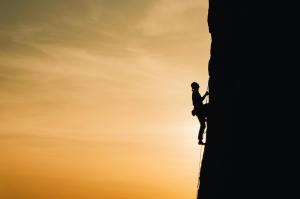
It’s been a wild ride writing this novel so far. I feel like I’m climbing a rock wall without a belayer. If I felt a lot better about my rock climbing skills, I would not feel like I needed belaying.** Ah, well. See you at the edit.
* This is known in cognitive psychology as the availability heuristic, whereas we believe the most readily imagined scenario is the most likely or important one. This heuristic is why young people buy life insurance and not disability insurance despite being 7 times more likely to die than to become disabled.
** I just about used the word ‘balayage’ here, which is a hair-dyeing technique. Oops.
I’ve been writing for twelve years. I started, strangely, three months after being diagnosed with bipolar 2, which I hadn’t realized till today. I know I didn’t start writing as a coping mechanism or as character insertion (my first characters were not me) and I didn’t write about being bipolar. I think I started writing because being treated for bipolar helped me focus on continuous tasks instead of pouring all my energy on the whim of the moment.
I was not a good writer at first — I wrote each chapter as if they were separate episodes, like short stories strung together. I didn’t feel like I wrote an overarching plot. The novels (I use the term loosely) I wrote then I have had to revise several times such that only the characters are the same. I learned a lot from revising them.
My first draft is not my novel. Over the years, the novels have needed less and less rewriting, but there are always things to fix in second and third (and fourth, and …) drafts.
Developmental editors are an important part of your writing toolbox. It is worth paying for them.
There are three ways to write a novel: Plotting, pantsing, and plantsing.
Plotting: an organized outline at the beginning, and following the outline.
Pantsing: writing it as one goes along, without the outline.
Plantsing: writing with a rough outline but pantsing through the chapters.
I am a plantser.
Scrivener is a great program for composing my work, especially plantsing.
Scrivener arranges itself around a chapter format and a synopsis form that I use to guide my chapters. I use it like pantsing with training wheels.
One can get templates for Scrivener novel-writing that incorporate plotting frameworks, such as Save the Cat and Romancing the Plot.
ProWritingAid was another investment I don’t regret — my grammar has improved in ways I hadn’t considered before. I have lessened my passive verb structure massively.
Writing is the easy and fun part. I still don’t think I have the hang of promotion (and this blog is part of my proof of that.)
My favorite novel is always the one I just finished.
The most important thing I learned? That I can write. The second? That there’s a whole lot of luck in being discovered, and luck hasn’t come to me quite yet.
I feel like I could have learned more in 12 years, and maybe I have, but these are the biggest things I can think of. I hope they’re helpful to someone!
I use templates to remind me of the shape of a book as I’m writing it.
Templates are scripts of a sort that one can use to structure writing to fit readers’ expectations. Readers expect a story structured such that the action rises to climax and then subsides. Other techniques can be added to this, such as interactions between a character and other characters to highlight tensions.
Well-written book guides offer plotting systems. Save the Cat Writes a Novel is an example of one, and one I highly recommend as a method to organize one’s plot. But I go one step further with templates that writers can load into Scrivener, the writing software I use.
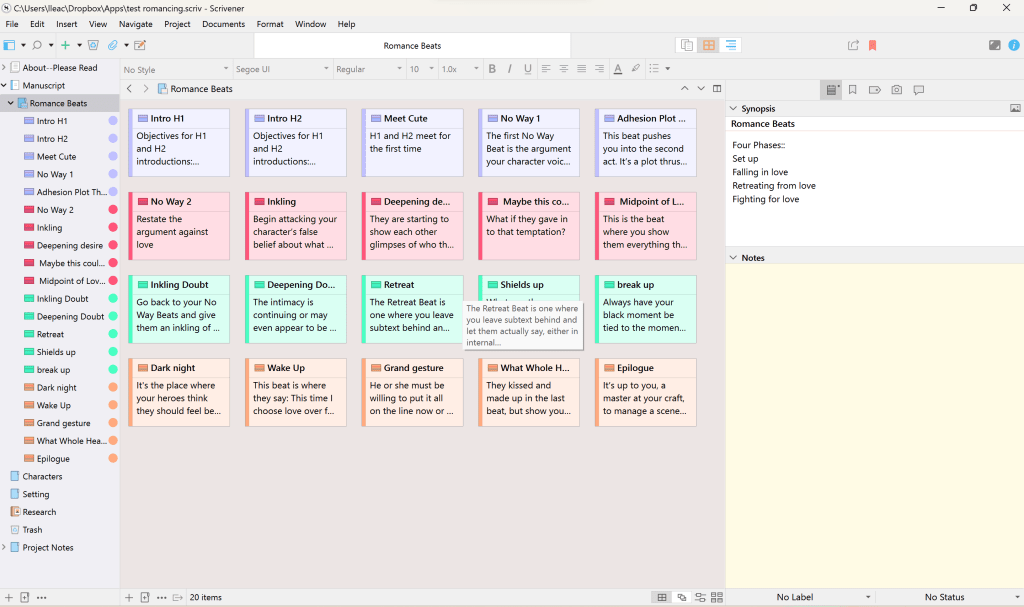
One of these is Romancing the Beat by Gwen Hayes. In twenty chapters, she lays out a romance novel’s structure with uncomplicated prompts for the reader. For example:
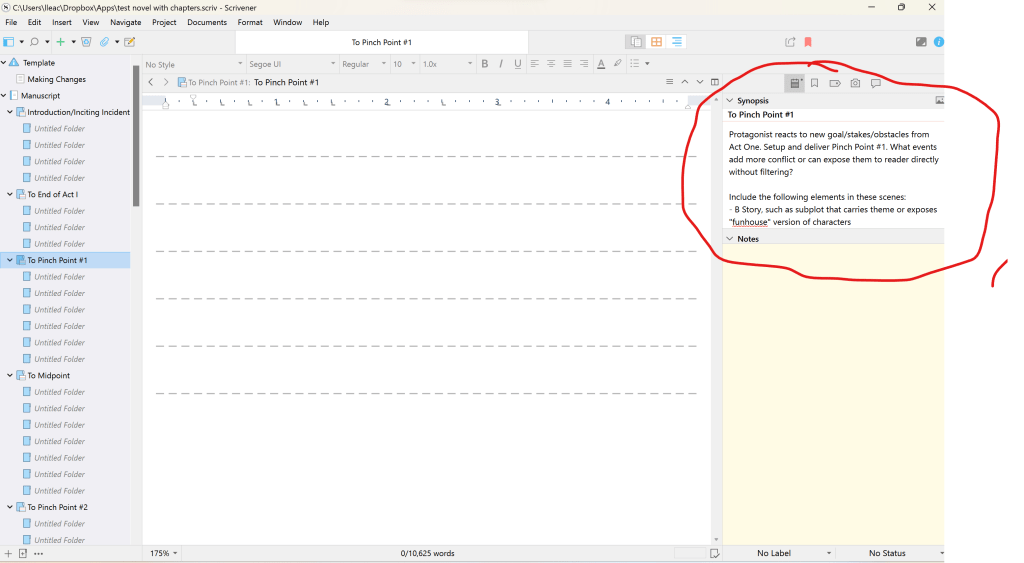
The column at the left shows the chapter outline with evocative titles. In the notecard view here, you can see each chapter’s prompt. When you are in chapter view (writing the chapter), you will see the full prompt in the upper right corner area called synopsis (seen below).
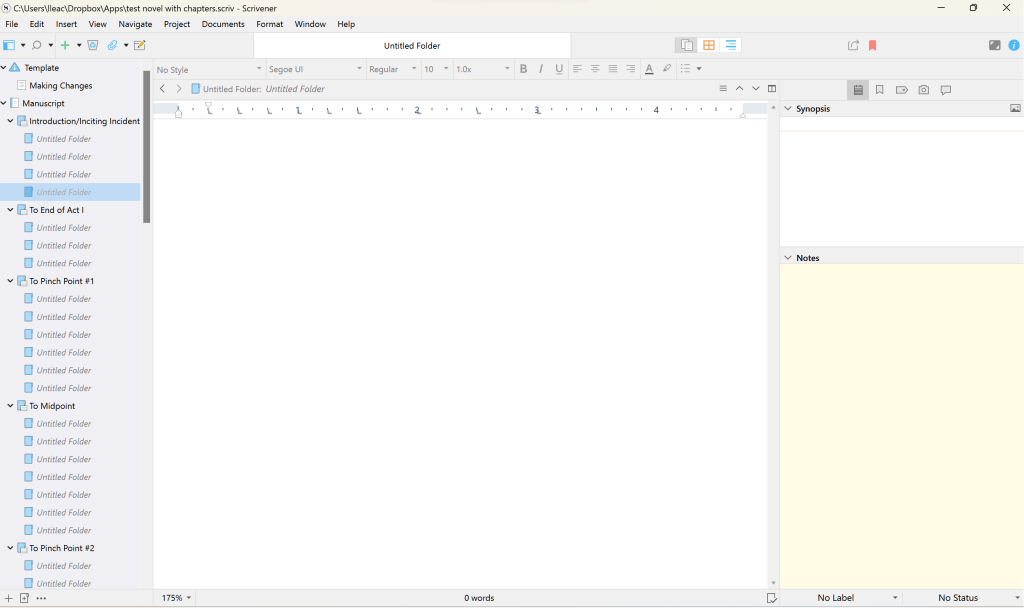
This is my go-to for writing romance novels. My go-to for writing fantasy novels is a template that no longer can be found on the internet (or if you can find it please let me know so I can give the writer credit). It’s based on the timing of Save the Cat templates, but it does the math for you. It looks like this:
In the left-hand column are the basic parts of the book, and the number of chapters is their relative weight in the book. Given roughly equal chapters, these distributions of chapters should give you the recommended pacing.
The template also gives guidance:
At the far right, there is a description in each section for what should happen in a section.
These are the templates I currently use for writing. I like using templates because I’m a plantser — someone who likes some structure but likes to flow within the structure. These templates allow for that. I write my chapter synopses within the guidance of the template and I’m ready to write.






 Words Like Me