P.S.: An excerpt from today’s work:

Of course I dreamed again after Ichirou left. Of course, I dreamed about being shot. And, of course, I dreamed about Greg:

I experienced the dream as if I was outside myself and inside my body at the same time.  I saw the sniper level his gun. I heard the shot, and I felt the tearing pain from the bullet. This time, I looked down at myself as the bullet tumbled out of me, and there was a tear in my shirt and a blossoming of blood. 

I collapsed, and everything happened in slow motion: I felt my heart stop; then I felt every cell of my body yanked backward by a second, maybe two seconds. I wanted to scream from the pain, but it was over almost before it had begun. I peered down to see the hole in my chest mended. Greg dropped to his knees, exhausted, and muttered, “O mój Jezu, przebacz nam nasze grzechy …” 
When I awoke again, the barest tinge of sun could be seen through the trees from my window. Greg stood over me, his long hair falling into his face. He pushed it back with one hand in a gesture that had long become habit, revealing his long, homely visage. I noticed his eyes looked hollow in the sparse light.

“Are you an angel?” I asked in a parody of awe. Joking was the only way I could encompass what he had done.

“Definitely not,” he muttered. “I’ve done a couple things in my life that might actually keep me out of heaven.” He bent down by my side and inquired, “How are you feeling today?” Unlike Ayana, Greg spoke English in a definite accent, with rolled r’s and subtle accent differences.

I sat up. “I can sit up without help. I’m hungry — are you sure I can’t eat anything but chicken broth and rice? Don’t I have red blood cells to build up or something?”

“We could make you some befstyk tararski. That should set you up good.” He raised his eyebrows.

“Which is — ?”

“Raw beef with a raw egg in it.”

I uttered a long sound that resembled wretching, then managed to choke out, “Gross!”

“You’re missing a treat, let me tell you.” Greg shook his head. “It looks like you’ll be eating some of Ayana’s rice porridge again. Yours will get a little spinach.” 

The porridge, it turned out, wasn’t bad at all. Certainly better than that raw beef Greg was talking about.
I whiled the time after breakfast trying to guess the implications of being resurrected. Nobody had come in to visit; I fretted about what they discussed in my absence. My viola was, as far as I knew, still packed in the truck, and I was pretty sure Greg was guarding the front door. I was ready, if not to run, to at least venture as far as the living room and eat lunch there. When I suggested the venue change to Greg, he scowled at me from the doorway.

“Why not?” I snapped at him. “I’ve got enough energy to —”

“Yell at me, it sounds like,” he smirked in his oddly accented English. “Maybe you are ready to come out and visit with us.”

“You mean — have tea, and talk about the weather?” I inquired.

“Not exactly. We’re having a debate about what we should do from here — running appears to be no longer an option.”

“What do you mean?”

“Ok, stand up so I can help you out to the living room.”

“I don’t need help!” I snapped. I stood up and promptly felt my knees give out from under me. Greg glared down his nose at me.

p.p1 {margin: 0.0px 0.0px 0.0px 0.0px; text-indent: 18.0px; font: 12.0px ‘Times New Roman’} p.p2 {margin: 0.0px 0.0px 10.7px 0.0px; text-indent: 42.2px; font: 12.0px ‘Times New Roman’; -webkit-text-stroke: #000000; min-height: 15.0px} p.p3 {margin: 0.0px 0.0px 10.7px 0.0px; text-indent: 42.2px; font: 12.0px ‘Times New Roman’; -webkit-text-stroke: #000000} p.p4 {margin: 0.0px 0.0px 0.0px 0.0px; text-indent: 36.0px; font: 12.0px ‘Times New Roman’; -webkit-text-stroke: #000000} span.s1 {font-kerning: none; color: #000000; -webkit-text-stroke: 0px #000000}

“Ok, so maybe I do need help,” I sighed. I was an emancipated minor, with all the responsibility that entailed — which was very little up to this point. Even now, I relied on Ayana and Greg to keep me safe. I stood again, this time supported by Greg, and we ambled into the living room.
Progress Report

Honestly, I haven’t been writing much since the depression hit. I’ve been revising the first chapters of Whose Hearts are Mountains to incorporate some ideas that Richard (my long-suffering husband) suggested, but revising  — “Oh, let’s change this verb to be more descriptive!” — doesn’t feel like writing.

Yesterday, I finally dug out Prodigies to write on it a bit when I had some downtime between classes and meetings.  That book is only half-done, and I had written it as far as the first of the BIG plot points. This next part is crucial and a bit of a challenge because I have to document how four prodigies make the change from being hunted to being — well, proactive.

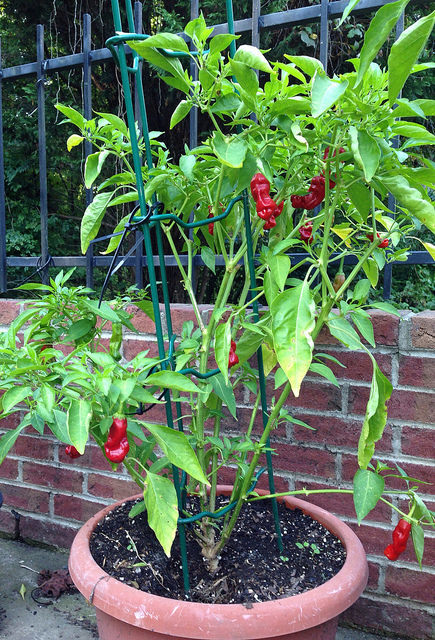
I haven’t been able to put much time in on either, because it’s also seedling season in my basement. I have a grow room, and if that makes you think of Cannabis sativa, you’ll be greatly disappointed. At the moment it contains a moringa tree sprouting from its roots, seedlings of two tomato varieties, two eggplant varieties, and two pepper varieties, one of which is “Peter pepper”. Look it up. Better yet:

Use a little imagination and you’ll see it.

I also have a couple experiments — cardoon (which I’ve never been able to grow before, but — bam! — I have an army of cardoon. Other experiments are perilla (a Japanese/Korean/Southeast Asian herb), and a Southeast Asian vegetable whose shoots are eaten in curry. I don’t have much hope for the latter; the seeds looked like they were firing blanks when I soaked them. There will be many more seeds — unusual herbs, edible flowers, and flamboyant beans — by the time the garden is put in.

I think the garden helps, rather than hinders, the writing. I don’t know why I hadn’t seen it before — taking breaks refreshes my mind, and I hear my characters’ voices again when I go back to write.

Tightrope walking

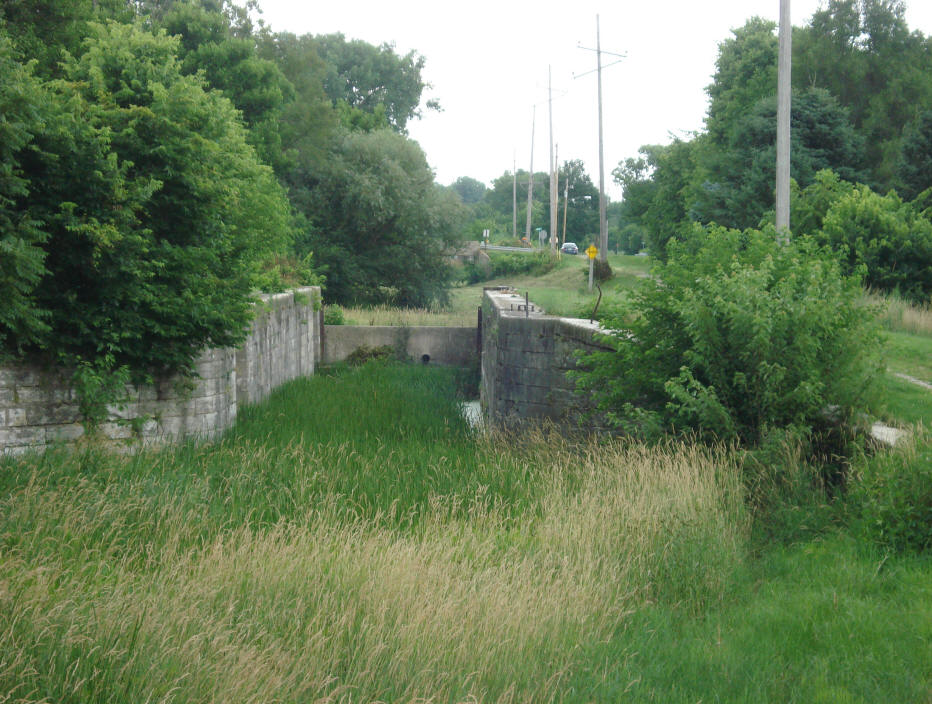
When I was in junior high school (middle school for you youngsters), I was walking home from school with my sister and a couple friends, and we came across a familiar piece of abandoned infrastructure from the old Illinois-Michigan canal: the remains of a lock that helped boats navigate the changing heights of the channel. It looked like this:

If you look closely between the massive retaining walls, you can see a concrete wall going from left to right. On the side closest to you, you see what is about a seven or maybe ten-foot drop into damp reeds. (This picture was taken too early for you to see the full-grown invasive Phragmites reeds dead and broken on the green side. Trust me, that’s the green you see.) On the side you can’t see is a shorter drop into what is brackish water most of the year. The wall itself is no more than a foot wide, and to access it you must sit on the retaining wall with your feet dangling and slip downward, landing on the retaining wall.

This is important, because my sister’s two friends decided we would take this route instead of the perfectly safe footbridge a half-block west. I expected Juli (not her real name) to navigate the treacherous path relatively well, because she was pretty slim and a tomboy, but then Bobbie (also not her real name) managed it despite her plump, awkward build.

Because these were my sister’s friends, they called out for my sister to try the path. I didn’t even exist to them, being younger and awkwardly embarrassing to be around. Lisa, who has a fear of heights, passed. I, seizing the chance to prove myself to them, shimmied down to the five foot jump onto the wall. Walking it was easy, if I didn’t think of the scummy green water on one side or the sharp canes on the other. And if I didn’t consider how immensely uncoordinated I was. I didn’t think about them, because I was working hard to walk fast across a balance beam when every other time I’d been on a balance beam I fell over. And trying not to pass out.

Somehow I made it, only to find the real challenge: trying to climb up that five-foot retaining wall with only a sharp, rusty bracket to hold onto. I withheld the desire to cry. Or barf. Luckily, Juli and Bobbie helped pull me up, after waiting a suitable time to make me suffer.

Why did I tell this story? To use it as an analogy for writing. Writing to be read is like walking a narrow beam where there’s a brackish pool of familiarity on one side, and a deep fall with sharp sticks on the other.

What do I mean?

Most people need some familiarity in what they need — whether topics, themes, plots, characters, or setting. For example, I’ve been told by a psychologist (of course!) that Jungian archetypes — Persona, Shadow, Great Mother, Wise Old Man — are necessary to sell a book. Genre fiction has its own tropes — where would science fiction be without the amusing alien (porgs in The Last Jedi), the ancient conspiracy (also in The Last Jedi), and the balance between Good and Evil (also in the Last Jedi)? Familiar topics help us place ourselves into the action, and familiar plots help us feel that an age-old myth unfolds before our eyes.

At the same time, people need their minds to be challenged, but not so challenged that they can’t identify. There’s a whole range of challenge from what we call “beach-blanket books” — light romance and slice-of-life books that are a vacation in a paperback — to Umberto Eco, whose books are so dense that one had to make a concerted effort to read.

In other words, people read things that affirm them, but at the same time they like some unfamiliarity. Danger, even — if not danger of being impaled on reeds, the danger of having their minds changed, their hearts broken, their lives expanded.

*********
Writing this blog also compares to that tightrope I walked as a child. My most read topics are the more personal ones: No Coffee, Marcie, Graduation, Bipolar disorder, Richard’s aunt dying. The creative pieces get a moderate number of visitors, thank goodness. The technical ones perhaps the least, but they’re not sparsely subscribed to, either.

I want to pick topics that appeal to everyone, but I don’t want to lose the writing/writer aspect of it. I want to share my creative writing, of course, and walk through the joys and sorrows of being a writer. I want to teach techniques in case I have writers out there. (Notice I don’t say “aspiring writers” — if you’re thinking about it, you’re a writer.)

So unless you object to the mix, horribly, I’m going to keep walking that tightrope.

What is my blog about?

I’ve noticed that the tone of this blog is not consistent. I originally set out writing about the craft of writing, writing the blog entries as I learned. I still write this way from time to time (yesterday’s post). I decided that I sounded a little didactic (i.e. like a professor teaching class), and I included personal writing examples in the analysis.

Then I realized that people reading — most of whom I suspect aren’t writers — enjoyed reading those excerpts and short stories and poems, so I sometimes posted creative writing without analysis.

And then my depression leaked in. You likely knew when it did, because my normally positive self despaired over every rejection and my writing took on a tone of desperation. In retrospect, I kept it in the blog because the experience of depression is real and maybe one of my two readers struggled with it or its mirror twin, mania. And now I’m writing on a semi-creative book about living with bipolar disorder.
So what is my blog about now? I believe it’s still about writing — writing on one’s journey through a forest of skeletons, writing about delighting in a beautiful creature, turning one’s visions into a character’s journey. It’s about the practice of writing — the choice of words, the way they’re used, and sometimes the way they’re misused. It’s about being a writer — publication joys and woes (in my case, it’s woes), lost material. It’s about writing as a way of understanding one’s personal baggage and acknowledging our common humanity.
Most of all, it’s about honesty — I choose my words, but I don’t censor my image. I claim the adjectives “raw”,  “honest”, and “TMI”. I speak to the people who haven’t found their voice, whose voices shake, and whose voices have been taken from them. I also speak to the people who have had smooth lives, that they understand the world of those of us who haven’t. This is my calling as a writer, more than just putting pretty words down. I want us all to find our true homes.
*********
The reason I’ve written this is because yesterday, I was interviewed by Jennifer Peltz of the Associated Press about the progress of women speaking out about sexual assault over the past twenty years, from Take Back the Night marches to today’s #MeToo movement. I spoke both as a professor and a role model, as a victim of rape and as a survivor. I don’t know how much of the interview, if any, will be included in the article, or whether anyone will read the article. If it gets published, I may stay in relative obscurity. I may get harassed, have my life threatened and my contact information published on the Internet. I see my honesty about my experiences as my calling at least as much as my writing is.
If the worst happens, I may need your support. Please keep that in mind.
And thank you.

More or Less an Analysis

One of the things I wrestle too much with in my writing — am I telling the reader too little? Too much?

The first thing I think of is Chekhov’s Gun, the rule that if something is important to the plot, it should be introduced before it becomes important. My first segment, then, is a veritable Clue game (“Look! There’s the candlestick that Mr. Mustard will use to kill the deceased in the parlor!”), but is it too much? Or too little?

What do we know from yesterday’s post of the first segment (yesterday’s post)?

  • Annie’s mother is a cultural anthropologist who supposedly told Annie odd bedtime stories when she was a child;
  • Annie doesn’t remember her childhood;
  • Annie has chosen to follow her steps, focusing on urban legends;
  • Annie’s stepfather was/is a renowned cryptographer for the government, and kept possession of codes when he left his position and changed his identity;
  • Annie dabbles in cryptology and inherits his cipher box and codes;
  • Her parents die three months after that passage in a home invasion;
  • An unknown time has passed, and Annie is remembering the incident.
I worry about whether I’m doing the right thing by not explaining these things more, but the too little/too much dichotomy runs through my head when I reread it:
  • Are the items above too much for the first thousand words of a book? Should I put in more description so it doesn’t feel like an information dump?
  • Have I given too little reference to time, so that I strand the readers in limbo and give them no clue as how the segment fits in the book?
  • Does Annie not worry enough about coming into possession of what might be government secrets?
  • Can I just leave Annie’s casual mention of not having childhood memories (a rare thing to not have any before a certain age) as something she just accepts, or do I have to explain more?
  • And, most importantly, does this beginning make my readers want to read more of it?
Just under a thousand words, and I have this many questions to answer. In some ways, writing fiction reminds me of writing my dissertation way back when — I’m relieved when the number of comments in red in the margins finally becomes less than the number of words I’ve written.

Baby Steps Back

Right now, I’m considering going back to Whose Hearts are Mountains — not to finish it up yet, but to sit down and look at the 70,000 words I’ve already written to see how I can balance the travelogue through a post-Collapse United States with the protagonist’s personal reactions — and field notes, because Annie IS an anthropologist.

I also have to make it plausible that the myriad of “incidents” (i.e. attacks) Annie experiences could be random malfeasances rather than the signs of a plot by Free White State’s government to capture her. I’m covering this for the next book in their series. I have to make the dreams and hints hint only toward her identity as a half-human, half-preternatural creature rather than the conspiracy that will be in the next book.

I also should work on the mental health book, which is going to require some primary sources. I’m too much an academic to use the Cliff Notes of bipolar disorder, Bipolar Disorder for Dummies. (I kid you not. Not even a tiny bit.) Biological psychology and psychiatry articles don’t intimidate me that much — ok, biopsych intimidates me a bit — it’s just that there’s so much “We don’t know what causes bipolar, but neurotransmitters are involved somewhere” that I can read without my brain going numb.

Yes, this is a lot of work I’m doing for something that may just be for the fun of it, given my total failure to find a agent. I may take a friend’s advice and try for literary fiction agents but not right now, not while I’m fighting off depression. Part of me wonders if writing, or at least putting 85,000 words into a novel (and I’ve done that with six so far) is a waste of time if I can’t get published. I like my creations to have an audience and speak to people, just as knitters want their family and friends to appreciate the gifts of socks and hats. 

This is my dilemma, the one I have to get a handle on before I write again.

Conversation with A Fictitious Author

I sat at an isolated seat in Starbucks sipping at a blonde espresso. My computer sat before me, unopened, as I wondered how to start writing again. I glanced up, and a man in his thirties, dressed like a professor in a red sweater and white Oxford shirt and jeans, strode toward me.  He didn’t look like any of my colleagues, although as time passed, it seemed I knew fewer and fewer of them. This man could have blended into a faculty reception without notice — of middling height and slight build, myopic brown eyes behind round steel-rimmed glasses —

I recognized him as he sat down, and understood why nobody else noticed him. The wide, vaguely almond-shaped eyes crinkled when he smiled at me —

“I figured I’d find you here.” Josh Young, chronicler of the sociomagical experiment known as Barn Swallows’ Dance — and writer of magical realism to the outside world — peered at me. “How’s progress on the book?”

“Books,” I corrected. “Two fiction and one not-so-fiction.” I studied my paper cup of espresso. “They’re not going well. I’m having trouble getting back to writing after my latest round of rejections, but you wouldn’t know that.”

The New York Times bestselling writer, who had won that distinction by the time he was thirty, suddenly seemed a little taller and more substantial. Of course — it was his connection to the earth-soul Gaia, to the sprinkling of trees that grew outside the library Starbucks. Nobody else, again, noticed. “Do you know why I’ve had the success in getting published?” I heard leaves whisper in his tenor voice.

“Because you’re really good at writing?” I met his gaze and his challenge.

“Because you wrote me that way. Because you wrote me as someone who studied writing fiction and wrote literary fiction and sent it to literary fiction agents.  You wrote me as someone who not only had great talent, but great luck.”

“I wrote you to be a better writer than me?” I stammered.

“I can’t be better than the person who’s writing me — you see?” Josh chuckled, a dry sound that reminded me of leaves again. “I will say, though, that you wrote some lofty aspirations for me. If this wasn’t fantasy, I’d get rejected just as much as you do. The idea is to tell your truth, and tell it over and over until someone listens.” Josh walked his fingers toward my espresso, and I tapped his hand with my spoon in warning.

“But what if no one listens?” I threw the rest of the quad espresso down my throat as if it were a shot of whiskey and slammed the paper cup on the table.

Josh raised his eyebrows and peered over his glasses at me. “Then that’s their problem, because if you don’t listen and discern, you don’t learn, you fail to adapt, and you die. The first law of nature.”

I remembered when Josh was a college student, a little more frail with spiked hair and bright t-shirts. This man, thirteen years later, was no less beautiful, but he had calmed from the black-clad, precocious poetry slam artist to an equally precocious, wry and weighty scholar. He glanced down at the table, breaking eye contact. “Yes?” I asked.

“There’s a question I need to ask.” He paused for a noticeable increment of time. “Will I outlive –“

I knew the end of that question, and why Josh wanted to know. The love of his life, Jeanne Beaumont-Young, was thirty years older than him, which I guessed made her about 63. Of course, I had written about the end of this committed couple’s life together.

“Jeanne will live an extremely long life,” I ventured slowly, “and she will outlive you, but by only six months.” I withheld his cause of death, an undetected aneurysm, because it would make no difference — the fatal defect would be inoperable.

Josh nodded. “You could have taken the easy way out and had us both die at the same time, or you could have made me wait twenty years.” He stood, shook my hand, and wandered off, looking like any other professor who frequented the campus Starbucks.

Soon, to my surprise, he returned, eyes twinkling, with another stout blond espresso. “Writers need their coffee,” he grinned, and faded into the crowded coffeehouse.

Callings and the Household’s Stories

First off, Marcie says hi. She’s just about done with her first novel, Chucky the Cat Saves the World. She’s tried to convince Chucky to illustrate it, but the negotiations haven’t been going well.

Meanwhile, I’m trying to convince Girly-Girl, who’s sitting next to me, to write a memoir. I’ve suggested the title I’ve Seen Everything and I Don’t Care Anymore. She didn’t care for that.

i’m trying to convince my husband to seek out an agent. He writes in science fiction and he understands the genre very well — its subject matter; its focus on machines, science, and battles; its masculinist roots. I believe he could find an agent pretty quickly, and I wonder if the reason I felt called to writing was to get him to write, and find him a career.

I’m still confused as to what I’ve been called to do, and whether I’ve been called to write. Callings are very important among Quakers — we believe that if we sit quietly enough, God will show us our callings. I haven’t felt anything as a calling for so long that I feel adrift.

When I start writing again, calling or no, I don’t know what I’ll start writing on again. I’m afraid of the creative memoir about bipolar disorder. Although it’s attractive being heard, I don’t want people to think of me as “THAT person,” the one you have to keep an eye on. Yes, as open as I am about my situation, I am afraid of people who judge. Sometimes I want to run away from this blog because I’ve talked about it here.

I feel stymied by Hearts are Mountains. It’s reading like a depressing travelogue, and I don’t know what it needs. It’s a bit flat. I might want to go back to Prodigies, but I wonder if that’s going very well either. I doubt everything since all the rejections.

I hope that I find my direction soon — in or out of writing, I don’t know. But I hope I find my calling.

My plate contains a smorgasbord

I have three books I’m working on at the same time. Three.

I don’t know how it came to this — well, I do. I was working on Prodigies, a dystopic contemporary fantasy about two teens born with unusual capabilities in influencing emotions and thus actions. Because of this, they are in danger from shadowy entities who find them potentially useful. Yes, it has shades of Heroes (a TV show that played from 2006-10), but it has multiple differences, too. This might become a YA novel if I finish it.

Then, my husband and partner in crime suggested I write the 20-something-year-old idea then named “Dirty Commie Gypsy Elves” by a friend of mine. That was my NaNo project, it’s since become two books and I’m working on expanding on the first so it’s a novel and not a novella.

Finally there’s my non-fiction/poetry/prose/story/research book explaining life with bipolar.  That project is currently called “Ups and Downs”.

OOPS. I’m also editing a book on roleplayer support in disaster simulation exercises and writing two chapters of it. That’s four books.

***********
The most compelling project right now is the non-fiction item because it’s creative, informative, and autobiographical. But both of the other books are begging for attention just now. Did I say I was going to quit writing because of too many rejections? (Oops, I forgot to quit.) Do I worry that my ideas don’t seem to quit? (Yes, I do, a little. Is it time for a med check?) Do I still wish someone would publish my stuff so people would read it and I would have money to put into a new computer that had more storage and could handle graphics? (Absolutely.)

I guess I can’t NOT be a writer.

Setting a Reminder

Right now, my writing routine is disordered. It’s the first week of Spring semester, and I expend a lot of energy setting the scene in my classes for the semester. The creative space in my mind is filled with strategies for getting students to interact more in my class. My cognitive skills grind in the background on new tricks for explaining concepts.

When I get home from work, I’m tired. I’m “I can’t think anymore” tired. “Let’s watch some cat videos — aren’t those cats darling? (*sniffle*) tired. I study potential garden plants for my edible landscaping project, and somehow noting that Nectaroscordum tripedale is in the Allium family and will grow in USDA zone 5 takes up fewer brain cells than writing.

The exhaustion gets better once I get back into my routine. Three weeks from now I won’t even flinch at the everyday chaos — trudging through blowing snow into the building; the rare bedbug scare; the projector that refuses to project. My class plans will need adjusting but, hey, I’m a professional here. But those first two weeks wring me out.

I force myself to write during those times. I write this blog, even though I stare at the screen at times like this, searching my brain for topics. I set a task on my reminder software to write an hour every day.

It turns out that I don’t want to lose my writing, even if I never get published. I want the discipline, I want the joy of finally doing something with my creative side. I’ll have to take breaks, I’m sure. But I’ll fight myself — my exhaustion and my discouragement — to keep writing.