So far, I have gotten no closer to the Big Audacious Goal. That goal was to sell books at a writers’ conference. I’m not totally sold on the goal, which is probably why I need to have the goal. Frankly, I’m afraid I’m going to fail selling any books. I think the goal is too audacious for me, as it plays with my insecurities.
I didn’t think I could find a BAG that would seem too big, either. I’m surprised to discover this. There are a dearth of writers’ conferences that are achievable. The ones in this area are too big and overwhelming. The one I would be most comfortable in no longer exists.
I have never learned to speak the language of these slate-edged hills; silence speaking eloquently things I almost understand
I think I have heard you walking softly, barefoot and daydreaming; wonder if you've heard me calling out my name, an owl's whisper. In the Catskills, do the sleepy towns tell tales? In the Catskills, do the sleepy towns tell tales?
This is all I remember of the song. I wrote it 30 years or so ago, and I really haven’t visited it since I wrote it. I couldn’t even remember this much earlier this morning. I wrote the words down somewhere, but I don’t remember where I put them.
I looked on my computer and I found it! I found it!
I have never learned to speak
The language of these slate-edged hills –
Silence speaking eloquently
Things I almost understand

CHORUS:
I think I have seen you walking
Softly, barefoot and daydreaming
Wonder if you hear me calling
Out your name, an owl’s whisper
In the Catskills,
Do the sleepy towns tell tales?
In the Catskills,
Do the sleepy towns tell tales?

Looking in the deep blue patience
Of your eyes, I falter, losing
All my words of consequence
Everything I meant to say

CHORUS

In the wind that blows around
The hills, I thought I felt your smile
Gather up my words again
And try to ask what you were thinking

CHORUS
I used to be a singer-songwriter until I divorced my guitarist. I had an okay voice; my guitarist played a semi-finger-picking style and wasn’t very disciplined. We were never going to be anything but those folksingers who attended open mic occasionally. But I loved the words.
Most of what I wrote was about crushes I got while spending my daily life in a small town in the foothills of the Catskills. I had lots of crushes; I have lots of songs to reclaim.
I can’t sing now; I’ve lost my voice in all but my talking range. I suppose I could get it back with practice, but it’s hard having the heart to practice when reminded of how much I’ve lost.
I started to sing this, and I could sing without obstruction to my voice, although it was not as strong as before. The lost is not so lost anymore.
Sometimes I get into those soul-searching sessions when I wonder if I’m doing the right thing with my time, whether there’s a better thing to do with my time, and what that better thing to do would be.
I think of this a lot when it comes to writing. I’m not tired of writing, but I feel like I’m slowing down a bit. It doesn’t help that I have two books I’m writing at once, one more than the other. I’m having a problem with only being able to write smoothly at Starbucks and not at home. I’m not sure what the focus problem is, but I think the low-level distraction of a coffeehouse helps me write.
I’m also dealing with the scourge of writing — the nagging little voice that tells me all I write is crap. It’s quite persistent. It’s killing my joy and distracting me.
On the other hand, writing is my favorite flow activity. It occupies my mind better than few other things. I can lose time while writing; it’s almost hypnotic. My other flow activity is moulage, but I really don’t get too many opportunities to do that. And I don’t know if there’s anything to pass my time that I enjoy as much.
I want to hang on to writing; I want to continue being a writer. I want to sell my work and have others read it. I’m going to have to find ways of overcoming the problems.
I shy away from writing about dark subjects in my blog. It’s strange because I’ve had several dark times in my life. I don’t want people to think I’m pandering for attention, even though the reason writers post their works in the first place is to get attention.
I won’t write dark for dark’s sake, nor will I use gratuitous trauma as a shortcut to character development. Yes, someone’s past will contribute to their character. But I won’t use trauma as the only character trait or even the main one, and only if it’s pertinent to the story. (See also the “fridging” phenomenon—killing a girlfriend character to motivate the main male character.)
Writing about dark topics in my stories is something I must work my way up to every time. For example, the body count in Apocalypse. I had trouble killing anyone, but a developmental editor told me that the last battle had to look hopeless, so I killed eight characters. I also, ironically, edited that book for gratuitous darkness because I had tried the cheap way to make it darker.
Sometimes an entire book is dark. Carrying Light, one of the two I’m currently writing, is a dark novel, being that it’s written at the cusp of the collapse of the United States. Apocalypse is dark, because the fate of humanity hangs in the balance. But it was hard to write these dark enough at first.
In the end, I think darkness needs to balance light. That’s just me; I know there are people who write dark all the time, with lots of death, depersonalization, and alienation. I can’t write there, because all my writing adopts a quote from ee cummings: “The single secret will still be man.”
Kringle Through the Snow is going pretty well. I keep writing on it, and it’s lively and fun. Sierra and Wade are about to have a nice evening analyzing The Grinch. And sitting next to each other on the couch because Shadow Lord, the immense Newfie, will take up the rest of the couch. Shadow Lord has an agenda.
Carrying Light is languishing in the bottom of my To Be Written pile. I just don’t know why that isn’t flowing, except it has nothing to do with characters. I don’t think it is plot. It is picky little details, like “Where is Janice going to work if the gift shop is no longer open and she’s getting no orders for pottery?” I feel sorry for Janice, but the collective can’t fix that problem for a while, for the good of the plot.
Okay, one book at a time, 750-1500 words at a time. I’ll finish the Kringle book first, then worry about Carrying Light. Oh, and fix the other book, the one I want to publish in December. Who, me busy?
My husband asked me today if there’s a distinction between “writer me” and “non-writer me”. Do I perceive them as different personas? Do I keep them separate in my mind?
The answer is “no”. Perhaps it is because I don’t use a pen name, or because I’ve been writing for so long. But I’m a writer and a college professor and a partner to one of the most interesting people I’ve ever met. And a few other things as well. I don’t see a contradiction in any of them, which is disappointing, because I so love contradictions.
I would hate to think that some other persona of mine was getting the recognition for my hard work. Or sitting at my breakfast table. That would be disconcerting.
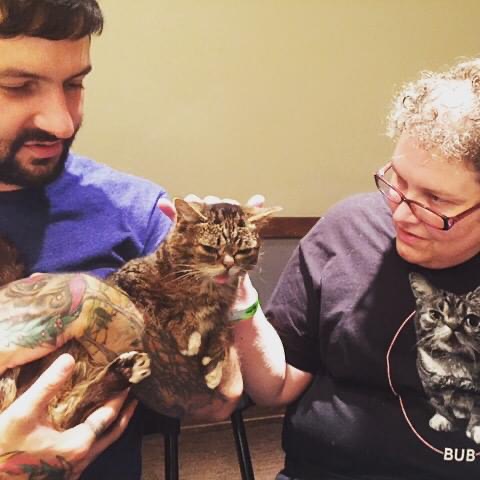
Yesterday, I watched Lil BUB’s Celebration of Life on streaming media. Lil BUB, a dwarf feline and once the Internet’s cutest cat, died four years ago of an aggressive bone infection. Before that, she was a furry bodhisattva whose very pictures caused millions of people to smile. She appeared in pictures and video, a documentary, her own short-lived TV show, and in live appearances for charity (where I once met her. She really was a furry bodhisattva.)
Me, Mike Bridavsky (Dude), and Bub.
She was also an ordinary cat with disabilities. Her owner, Mike Bridavsky (otherwise known as “Dude”), said this himself at the memorial service. This little ordinary cat raised over $1 million for cat-related charities through Lil BUB’s Big Fund.
In other words, BUB, despite her size, was a Big Audacious Cat.
I felt inspired by watching BUB’s Celebration of Life. She could accomplish that much in eight years? I’m not as cute as she was, but I can remember to be as audacious. Did she shrink from taking new opportunities? Did she hide from recognition? Did she get daunted by potential failure? (Yes, I know, she’s just a cat. But she’s also a persona, it can be argued. Or a purrsona.)
When it comes to my writing now, when I’m afraid of promoting my work, or thinking of quitting, or discouraged by lack of recognition, I’m going to ask myself the question: What would Lil BUB do?
According to National Pen, handwriting has benefits over typing. From higher cognitive engagement to memory recall, the slower process of handwriting engages the mind more. Admittedly, National Pen may have a bias, given that they’re in the business of selling pens. However, a recent report in Frontiers in Psychology spells out similar findings.
As a writer of novels, I find writing 70,000 plus words by hand painful (literally — arthritis) and the thought of typing all that handwriting into its necessary digital form is daunting. I foresee handwriting the first draft of a novel doubling my process time, and I don’t feel like my writing is suffering that much by typing the story.
I think there has to be a way I can harness the power of handwriting. I used to do free writing when I was stuck with a scene or a character, and I haven’t done that as much recently because I haven’t felt I needed to. But what if I free-wrote before sitting down at the computer as a general practice, to gather my thoughts and project them forward? A writing ritual?
My husband bought me two composition books to start the ritual. I have fountain pens to write with, which gives this more of a ritual air. The idea is to consider and write about the upcoming scene and free-write, then see if it makes getting those words more smooth.
Every now and then a WordPress prompt compels me so much that I have to answer it. This one I couldn’t resist, and now submerged in it, I don’t know if I can do it justice.
What’s the thing I’m most scared to do? Knowing me, it’s something that will get me rejected. I still have a lot of baggage over rejection. Despite that, however, I have managed to survive 30 years of course evaluations, hundreds of rejections of my novels, and too many unrequited crushes. In other words, when I look at an opportunity for rejection, I dive right into it. It could be that this time I will not be rejected.
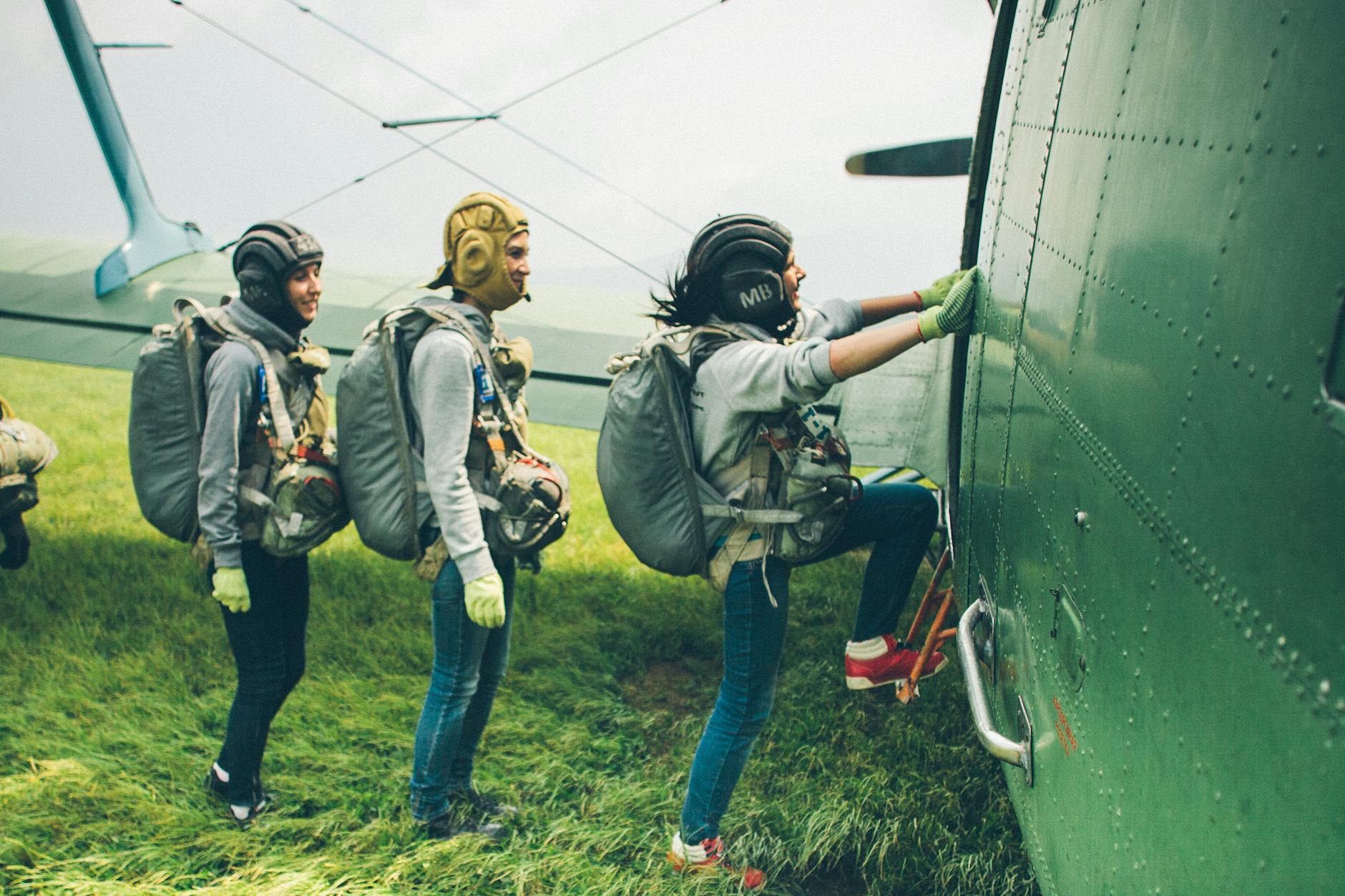
That brings me to daredevil stunts like skydiving, bungee jumping, and juggling chainsaws. First, I can’t juggle, so eliminate that. I have no desire to bungee jump, and I’ve experienced a controlled free-fall simulator. The only thing that will get me to do daredevil stunts is peer pressure, and I think I’ve aged out of peer pressure. I’m also a low-adrenaline person, so I seek naps more than thrills.
Back to rejection. There are things I’m scared of right now that fit under “rejection”. I’m afraid of reading my work aloud in front of strangers. I am afraid of selling my books at a real conference (but this is my Big Audacious Goal for the year). By facing the fears, fears become Big Audacious Goals. What’s the worst that could happen?
Every now and then, animals find their way into my writing. The current book I’m writing, Kringle Through the Snow, has a highly intelligent Newfoundland named Shadow Lord. The other book I’m writing, Carrying Light, has the preternatural cat Bergeron. The last book I wrote, Kringle on Fire, has a not-so-bright orange cat named Doofus.
At this point I’m supposed to talk about why I put animals in my stories. I think humor is a big part of it. Shadow Lord is so big and so well-behaved, yet he still detains Sierra long enough for Wade to talk to her. Doofus loves everyone like a drunken bro, even the child in the middle of his terrible twos. Bergeron flies — sometimes causing a traffic jam, in front of people who are not to know of her existence.
If I had to find a similarity among these pets, it’s their ability to communicate with humans. In pet-like ways, of course. Except for Bergeron, who speaks with telepathy to other telepaths. How many of you would like a telepathic cat? I’m not really sure myself. How many interruptions a day would I tolerate, especially if the transmission is “I’m starving! I can see the bottom of my food dish!”?
I should mention that another reason to include animals is because it makes protagonists look more soft-hearted. Unless the pet is a wolf, and then it accomplishes exactly the opposite.
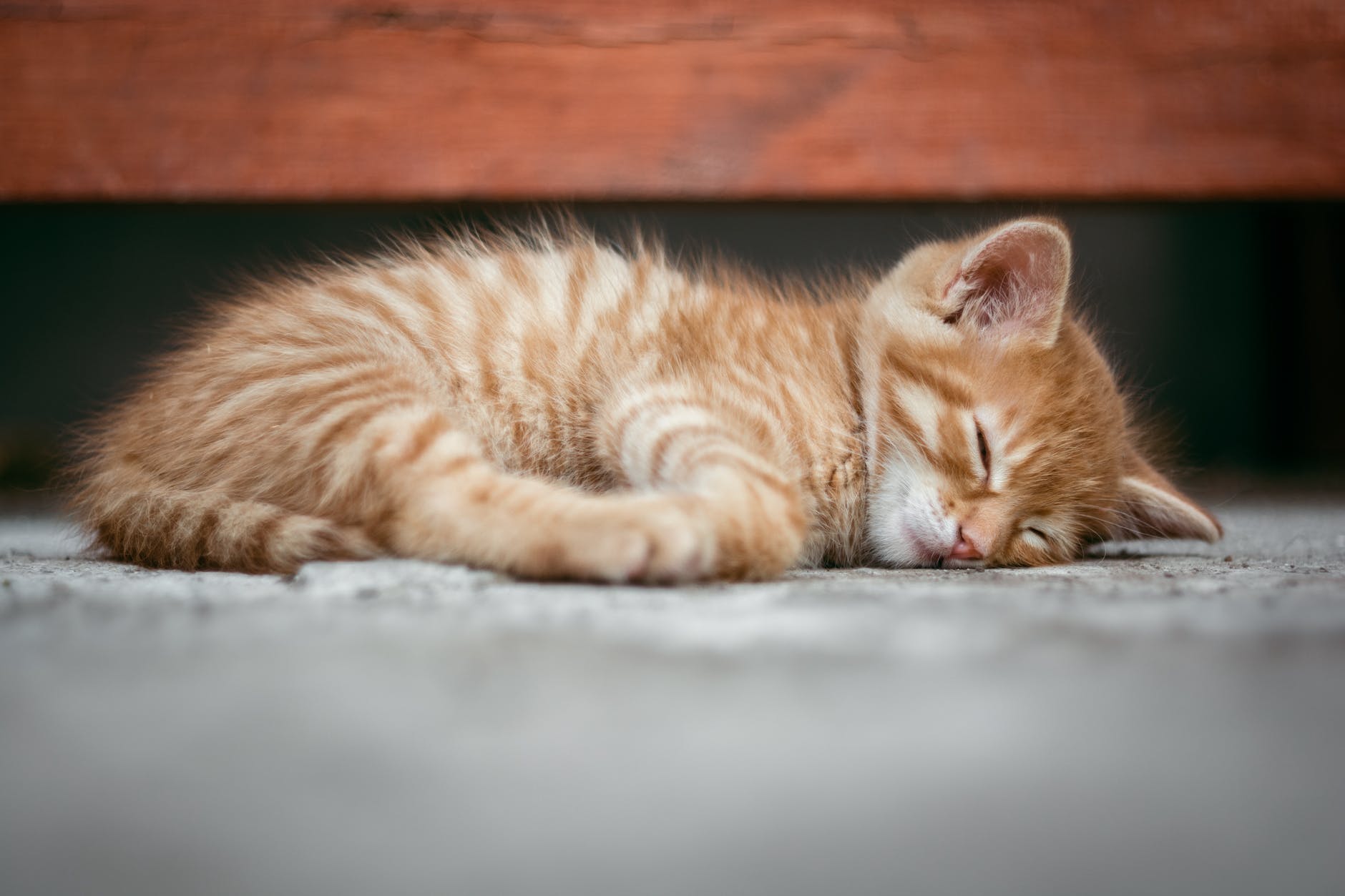
Animals as characters can make for fun in writing and in reading. I’m going to have to write them in more often. Kittens, anyone?









 Words Like Me