It’s practically end of semester at Northwest Missouri State. We’re in the middle of Prep Week (often called “dead week” by the number of faculty who are overwhelmed by the end of the semester) and I have nothing coming in until Friday to grade. I’m in t-shirt and sweats mode, only because I have a student appointment over Zoom today; otherwise it would probably be PJs. In other words, I have three more days of Nothing. To. Do. But. Write.
I have a massive amount of time to write. Am I writing? No. I’m looking for more work to do. I’m halfway to the end of the Internet. I’ve fallen in love with three Internet cats and could dissect the modus operandi of successful cat influencers (photos plus merchandise plus charity). The inspiration to write is nil.
On the other hand, when I’m grading midterms, I suddenly explode with inspiration. If I have deadlines to meet, I feel like writing a novel. NaNoWriMo, the international writing event in November, is perfectly nestled between surviving midterms and prepping for finals. I write the beginnings of novels during that time.
But now? I’m staring at the screen drooling on myself.
Making a plan for summer
My whole summer is wide-open. Although I have interns to supervise, I can work around them pretty readily, and will probably do most of my meetings on Zoom. But the thing that takes up most of my summertime, the online class, isn’t happening. I need to write this summer to keep me sane.
I can make some plans to increase my inspiration:
Write this blog daily as warm-up
Spend allocated times at the Cafe for discipline and change of scenery
Work on outlines for short stories
Sketch brainstorming notes on paper with fountain pen (this slows thoughts down)
Find a muse (hopefully he’s a-muse-ing too)
Only surf the Internet for 5 minutes an hour
Find a writing sprint timer
Some of these are writing rituals, meant to separate writing from the mundane world. I’m all about ritual and its ability to make space for important things.
A question for you
If anyone out there has some ideas for getting inspiration (especially some fantasy-based prompts) please tell me in the comments!
My husband and I went to the local game cafe (Board Game Cafe in Maryville MO) for the sole purpose of brainstorming some writing prompts for me for the summer. And, I guess, drinking coffee, whereas we drank too much. Three cups of coffee later (plus the two we had in the morning) and we had not only come up with some prompts but we were overcaffeinated enough that I could hear angels singing in my dental work.
Second, come up with some writing prompts.
We discovered that it’s hard writing prompts for someone else. My husband’s prompts are awesome, witty, catchy, and science fiction. I’ll play with them, but I’m a romantic, atmospheric, emotional fantasy writer. So I need to figure out how I will write “Writer who has to keep writing or reality stops”. I don’t know if I can write these. I can’t feel them. Does that make sense?
But I’m having trouble writing my own. I’m very character-based, and that’s hard to convey in a short story prompt. I have written some pretty good standalone stories (although I haven’t found the right place to send most of them because they’re fantasy) but most of my writing has been within my universe. So, reader magnets instead of submittable short stories.
I promised myself I would write some short stories for submitting for publication rather than novels (I have too many) or more reader magnets (I have enough to fill a chapbook). So I will work on these prompts and come up with some on my own.
Please help me!
Here’s where I need your help. If you can come up with any writing prompts (especially in the fantasy/science fiction vein) I’d love to hear them!
As we say in this house, I have 50% cattitude. Girlie-Girl , a senior citizen at 13 is sleeping next to me, and Me-Me, another senior at 13, sleeps on the back of the loveseat where I sit. Cats sleep a lot, it turns out, but they don’t sleep soundly. Either one of these little critters will wake up grudgingly.
The loveseat is not only the favorite of the cats, but it’s my favorite. I do all my writing here, because the stereo is here, there’s a window next to me, a Nespresso pot in case I have a coffee emergency. And my husband sits on the couch and I bounce ideas off him.
Is this the perfect place to write? It’s close. I don’t like writing in the office, because it’s really cluttered and small, and there’s a sort of sensory deprivation.
My perfect place to write? In the lobby of a boutique hotel. There’s just enough movement that I feel comfortable writing, yet not enough to disturb me. These are my writing retreats, and here are a few of my favorites:
Starved Rock Lodge’s Great Hall
Starved Rock Lodge, Starved Rock State Park, Utica, Illinois. The CCC-built, log construction lodge is the gem of the Midwest, sitting in the middle of the best state park in Illinois. The Great Room, rustic and towering, attracts visitors who have just come in from hiking or just come out from the lodge-inspired restaurant. The chairs are just comfortable enough that sitting in front of the fireplace makes a cozy writing place. The old section of the hotel part of the lodge has, tucked in a corner, old-fashioned writing desks. Book one of the fireplace cabins (if you can) for added ambiance, although they’re too small to comfortably write in. Massages are optional. Highly recommended, especially at Christmas, when it’s beautifully decorated and families come to exchange gifts
The Elms Spa and Hotel, Excelsior Springs, Missouri. This has to be my favorite writing retreat. A lobby which evokes the 1930’s, seats by the fireplace, and a spa with a relaxation room and a hot tub/sauna/steam room/hot shower room called the Grotto, this is the place where I not only write, but recuperate. Facials, massages of various types, and hydrotherapy (I might be wrong about the last part) are available. There’s a café on site and an excellent restaurant that plays Sinatra music, as it should. Again, rooms are a little small to write in, but they are light and elegant.
Lied Lodge, Nebraska City, Nebraska. Lied Lodge honors the founder of Arbor Day, and is located on Arbor Day Farm. As one might expect, the theme is trees, and the lobby has high ceilings, wooden beams, and world-affirming quotes on the walls. Although the massive fireplace makes the lobby a little crowded, the section behind the fireplace yields comfortable rocking chairs and just enough neighbors in seats to stimulate thought in those who prefer background noise. The restaurant is excellent and inspired. Lied has the most spacious rooms of the three, with more wood beams to provide ambience, but still too small to write in in my opinion.
I haven’t been on retreat for a year, having kept much to myself during COVID. Now that I’m vaccinated, I feel safe enough to schedule a writing retreat at The Elms for just before Memorial Day. Whew! All I need now is something to write.
I made 50k (50 editing hours) for Camp NaNo yesterday, and I’m almost done editing Reclaiming the Balance, which is in part a parable about how “woke” people can sometimes get caught being prejudicial of a new situation. It’s also a story about a love affair between a sculptor and a beautiful, truly androgynous being who was “born yesterday” as an adult. I guess it’s also a story about how our pasts cripple us in the present.
I feel a need for more ideas. Short stories this time, because I have enough novels, or so I’ve been told. My idea of stories, though, are mystical, mythical, and at times provocative.
I need some good, weird dreams as material to write. That’s how I’ve gotten my best novels. I need something new to write stories about — most of my short stories are about the world around Barn Swallows’ Dance (the fictitious ecocollective that keeps many secrets); one takes place in the Kringle world. I need to write some standalones to submit to journals and other outfits.
What I need is some time to think. I should have some of that this summer.
I am writing a series of short stories, space opera, which concern an unlikely duo — Brother Coyote, a monk from a restricted class planet who has a talent for opening wormholes, and Kel Beemer, the pilot of her family’s for-hire freighter. They go on a variety of adventures, with a certain amount of tension despite their opposite personalities. You know, space opera.
I have two and a half stories written, and finishing the third,”Kel and Brother Coyote Deal with a Psychic Allergy”, is something I could finish in a good weekend. And then, more. I would like these to be serialized episodes moving toward a bigger whole, as they’re in chronological order with not a huge amount of time between them.
I’m going to have a lot of time this summer, because I can’t take a summer class for the certificate in Disaster Mental Health, so I’ll have plenty of time to write. I’d like to write at least 5 more Kel/Brother Coyote, but that will only get me 10k-12k words. Enough for a chapbook.
Not enough for Kindle Vellum. Their business model will make the first few chapters free, and I won’t have many chapters after that. But I LIKE the business model, much more than WattPad (good luck getting noticed) or Chanillo (subscription only; no promotion). So I might try it this summer, while I’m writing more on the adventures of Kel and Brother Coyote.
An excerpt of “Kel and Brother Coyote Deal with a Psychic Allergy”:
In a strange room, on a strange planet, Kel lay on a strange bed on the floor, wrapped in tight bandages across her ribs. She glanced up at the glittering suncatcher that her partner, Brother Coyote, called a Sun Mandala. Kel, hopped up on painkillers after a spectacular rescue of the leader of Ridgeway III, dared not look at the wall where the reflection of the mandala shimmered. If she did, she might see something again, and she didn’t want to deal with that just then. The prisms sparkled and made her sleepy. She closed her eyes …
She heard the doorknob open and opened her eyes to Brother Coyote and a floating carry unit. He shut the door and sat down next to Kel, folding his lanky legs up beneath him. The gravitation unit sank gracefully to the ground. “Mom sent me up with dinner from the buffet line. She’ll be up in a few minutes.”
“The party’s still on? After an attempt on her life? That’s a pretty gutsy broad — Oops,” Kel giggled. “I suppose I shouldn’t call the Convener of the — the Moot — a gutsy broad.”
“Mom would have no trouble with that,” Coyote chuckled, pushing back his blond hair. “As for the party continuing, that’s a Ridgewayan cultural tenet. The celebration must go on. We remember too many times we’d quarantined ourselves from various fevers on the planet, so we celebrate any time we can.” Coyote lifted the lid of the carry unit; savory smells enveloped her.
“How do you get carry units on this planet if you’re a restricted trading planet?” Kel wondered aloud. “I can’t make that make sense.” Kel found herself wishing her tongue weren’t quite so loose.
“It doesn’t have an internal grav source, of course. I’m levitating it. Luckily it doesn’t take too much energy.” Kel sat up and Coyote transfered the tray to her lap.
“Ok,” she said. “What’s this?” Whatever it was, it smelled much better than meal bars.
“The stew there is made with native mushrooms and a legume that developed into a landrace here.” The stew, she noted, was an intense golden color, and from the smell, she suspected that Ridgeway III had a local equivalent of curry powder. “Then, with that, is a mess of greens that combines diaspora culture DNA tailored for this planet and some local weeds we’ve cultivated into crops. The two grow together symbiotically, which is a bonus.”
Kel took a small spoonful of the stew. “Take a bit of both individually. Then take a bite of them together. Then try a little of that paste on the edge of your plate with them. It’s important to be creative with your food,” Coyote instructed.
“Tell me, how does one get creative with meal bars?” Kel smirked, but she tried the food anyhow. “Wow,” she said after a few minutes absorbed in her food, which smelled warm and mellow, contrasting tartness and a deep mellowness. “This is amazing. What do you use for spices?”
“A lot of things, largely local. We have a tropical belt which accepted diaspora spices, and we have many herbs. This planet has immense agricultural potential, but only if it’s cultivated carefully. And by carefully, I mean as close to wild as possible.”
“So you’re hunter-gatherers instead of farmers.” Kel finished her meal and considered the pastry on the tray.
“Well, not hunters, unless you count mushrooms. We’re wildcrafters, we’re permaculturalists, we’re companion planters. We’re tree climbers, plant researchers — did you know there’s a plant here only pollinated by one particular miniature fruit bat? The guy’s not much bigger than a fly and climbs into the fruit’s flowers and gets drunk, then visits other flowers on a bender. He finally passes out in a flower and sleeps until the petals drop out from under him.”
“You must have a lot of farmers if you can’t factory farm.”
“Yeah, but we don’t have a lot of factories. We have them for the technologies we’ve chosen, but we also have artisans and craftsmen. You might notice this tray is wooden.” Indeed it was, Kel noted. “We have a stepped-down economy, and not a lot of us go off-planet, as you might guess.”
Kel found herself looking at the reflections of the sun mandala, which were mere shadows on the wall as twilight fell. Her sight blurred as she found herself sucked into a vision — Keyli, the Convener of the Moot for Ridgeway III and Coyote’s mother, strolling down the hall with a feline creature that came up to above her knee, trotting beside her on a leash.
“Coyote,” she said, instantly regretting the words when they fled her mouth, “Does Ridgeway have felinoids the size of Terran Shepherd Dogs?”
I didn’t have to deal with failure in my childhood (except for those crushes that were never requited). I wasn’t quite a child genius, but I was gifted. I managed to get to college almost entirely on scholarships including a National Merit Scholarship. I got on the honor roll despite the most perfunctory study habits.
I came to failure late and hard. Particularly in submitting my writing, particularly novels. I have received enough rejection to paper my room.
Don’t take it personally. If I have given my best, after reading guides on how to write, writing, editing, beta-reading, revising, and the like, it’s probably that my writing doesn’t fit the agent’s list or the journal’s theme I have learned, for example, that my poetry is not High Concept, as it doesn’t get published in high concept journals. This doesn’t surprise me because my Ph.D. is not in English/Creative Writing. My short stories are also not High Concept, being firmly lodged in the category of fantasy, romantic fantasy, and space opera. There are some places I’m more likely to get published in than others.
See what you can learn from it. I have had to grow as a writer by asking myself, “What is the takeaway from this?” I had to get rid of my perfunctory habits once I realized that one didn’t turn in one’s first draft (in my defense, it had very few grammatical or spelling errors). I read a lot of material on writing because of rejection.
Sorry I’ve been gone for almost a week, but I’ve been busy with Camp NaNo. I’ve been putting 3 hours a day in editing Reclaiming the Balance, which means almost no free time to journal. Today I will make my 30k goal for camp, but I will likely continue editing once I’m done with the goal, because I haven’t yet gotten Reclaiming the Balance where I think it can be.
I’ve done a lot of editing lately between Gaia’s Hands and Reclaiming the Balance, but these are a couple of my first books, so it’s expected.* I’ve learned much about writing novels from editing previous novels and don’t want these past novels to go to waste because their characters deserve to see the light of day.
So what have I learned about writing from editing? Let me think …
Structure really helps guide the reader and satisfies their expectations. I use two systems now:
And some things I’ve learned about editing from editing***:
Sometimes I have to cut one of my favorite scenes or chapter because it didn’t fit the flow of the book. This happens more if I didn’t use a structuring scheme
Sometimes a sentence that made perfect sense to me when I wrote it makes no sense when I read it later
I need help — developmental editors, sensitivity readers, beta readers.****
* I’ll admit that both novels are basically romances with somewhat “non-standard-reality” plots. I really don’t know how to classify the fantasy version. Contemporary fantasy? Magical realism? I certainly don’t write elves, sword and sorcery, or vampires. I like to think of my stuff as anthropological fantasy.
** The collective featured in Apocalypse, Gaia’s Hands, and Reclaiming the Balance has 60-70 members given the time period. Apocalypse was a third-person omniscient point of view. I had to pare point of view characters to about 9.
*** I’ve learned more than I’ve written here (action verbs, some description, because vs since, transitions) but those are more about words than writing
**** I proofread really well after the second or third pass, so copy editors and proofreaders are not on my list. They might be on yours.
PS: If anyone can help me with the footnote add-in (Easy Footnotes), I would greatly appreciate it!
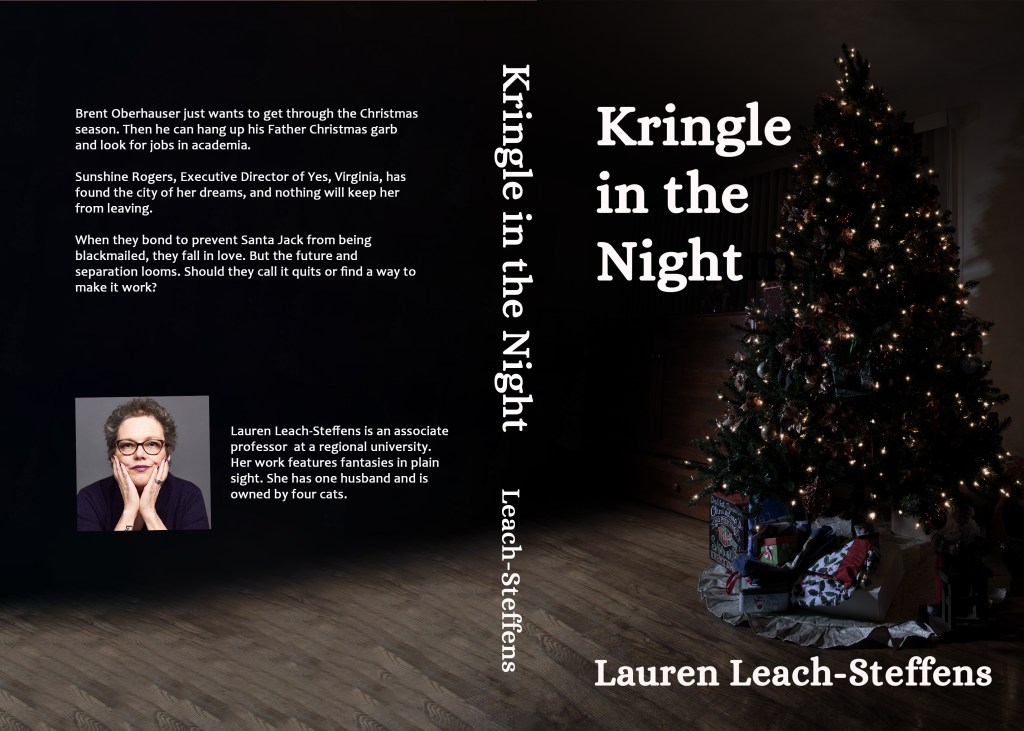
Yesterday I spent my morning making a book cover for this year’s Christmas romance, Kringle in the Dark. I can’t draw to save my life, but I can work pretty well with photos and Photoshop, which works fine with the Kringle novels. Get the rights to a picture, tweak the photo, set the photo just right. Make the back cover with cover blurb. Orient the spine title/author verbiage.
Here’s the mockup:
It was a stroke of luck getting the photo to expand to the back cover; I’m not sure I will ever be able to do that again.
This is the question every writer gets asked. Usually the response is vague dread, because many of us don’t know on the spot where we get our ideas. The answer comes only after a good session of introspection, and at the moment the question gets asked, we can’t reflect on the question rapidly.
Over the years I’ve done this introspection, and these are the answers I’ve come up with:
From other books I’ve read. But I need to be careful not to plagairize.
From dreams/daydreaming. This is my favorite source. I often take a dream and interpret it using Jungian methods, which I call interrogating the dream.
From conversations with my husband, which often start with “What if?”
From observation. I don’t know if I’ve ever written a story entirely from observation, but scenes and characters often come from this
From what I’ve written previously. Sequels!
Sometimes I don’t have any ideas. Right now I feel like I need to write a new novel (after revising a couple) and I don’t have any ideas. Ok, actually, I have three ideas based on series I have going, but I don’t know how excited I’m getting about them. Not all ideas are workable:
One of the books would require living in Poland for at least three months to get the flavor of the place. I have no money, no knowledge of the Polish language, and no tour guide.
Another which is part of my Archetype universe, and for some reason it’s not grabbing me.
Yet another in the Archetype universe that’s too nebulous to write about.
I think I need some dreams or daydreaming right now to inspire me. My dreams last night were stupid and not worth writing about. In my dreams, an actor friend of mine got a nose job and I got really angry because he had succumbed to dominant culture beauty standards. That’s it. Unless I’m writing a warped version of The Picture of Dorian Gray, I don’t see much use in this dream.
I have a somewhat tenuous relationship with time, and nowhere does it show up more than when I’m writing. Even though I write fast-paced plots that run over a few weeks or a month, I lose track of the time and suddenly two different plot points are happening at the same time.
I used to sit with a calendar and make notes on the Scrivener file, chapter by chapter, but then I didn’t get the full picture; I had no one document where I could look at the whole timetable. And flipping back and forth between chapters makes it hard to remember the sequence.
Then I discovered Aeon Timeline, a program that helps you organize a timeline by chapters or individual events, characters involved, and other potentially important characteristics. It organizes itself around two concepts: events and entities.
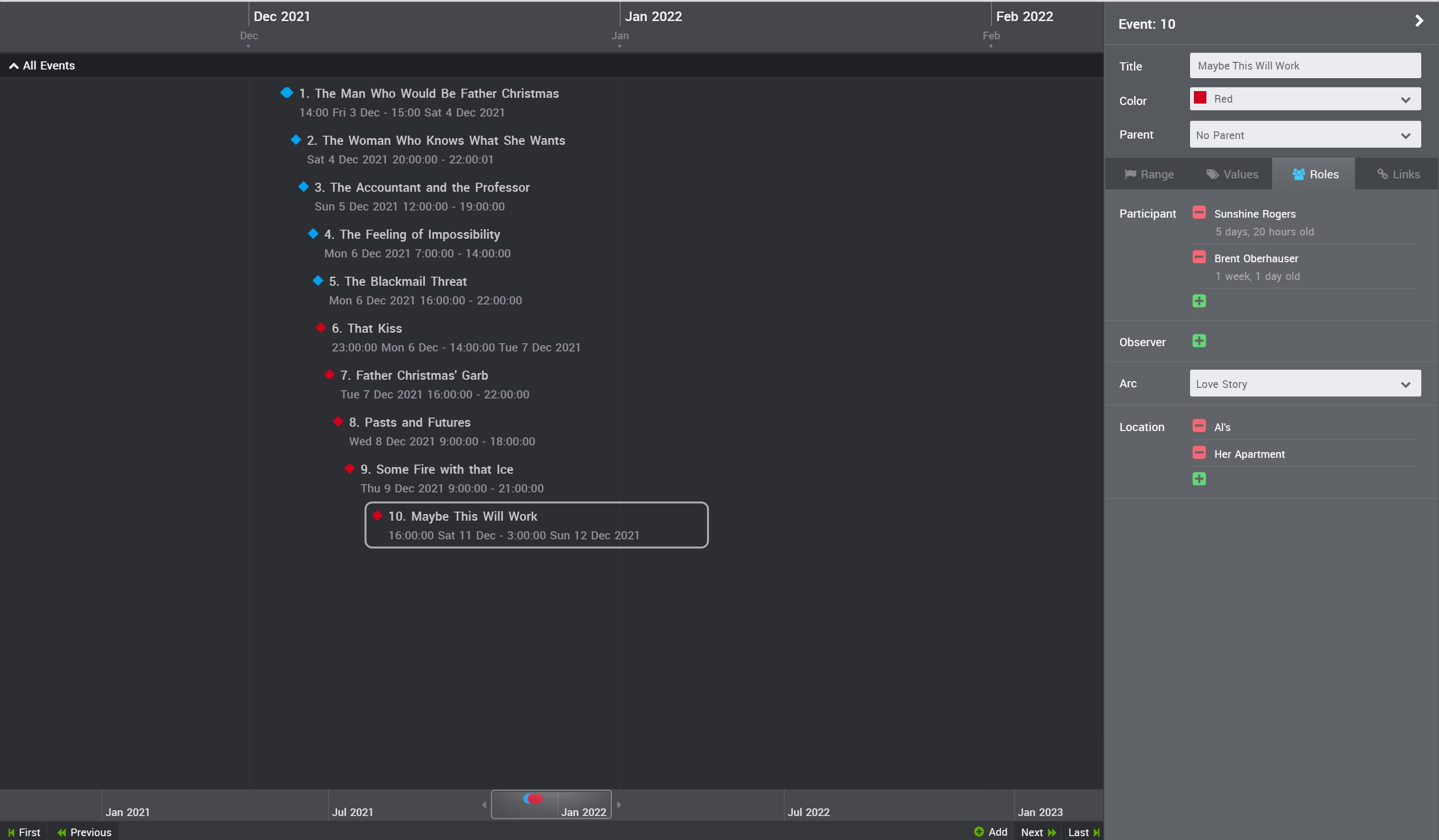
Here is a screenshot of my current project:
On the left, you can see the timeline. In my case, it’s color-coded to match a template I have for romance writing. On the right, you can see an event (the one highlighted on the left). On the event side, you can see at the top the event data — title, color, and parent. I do not use ‘parent’ because it ties everything to a preceding event and my mind doesn’t function that way. Below that to the right there’s data such as participants and observers, story arc, and location. Those are used as sorting prompts, and I haven’t found myself gravitating toward that function yet.
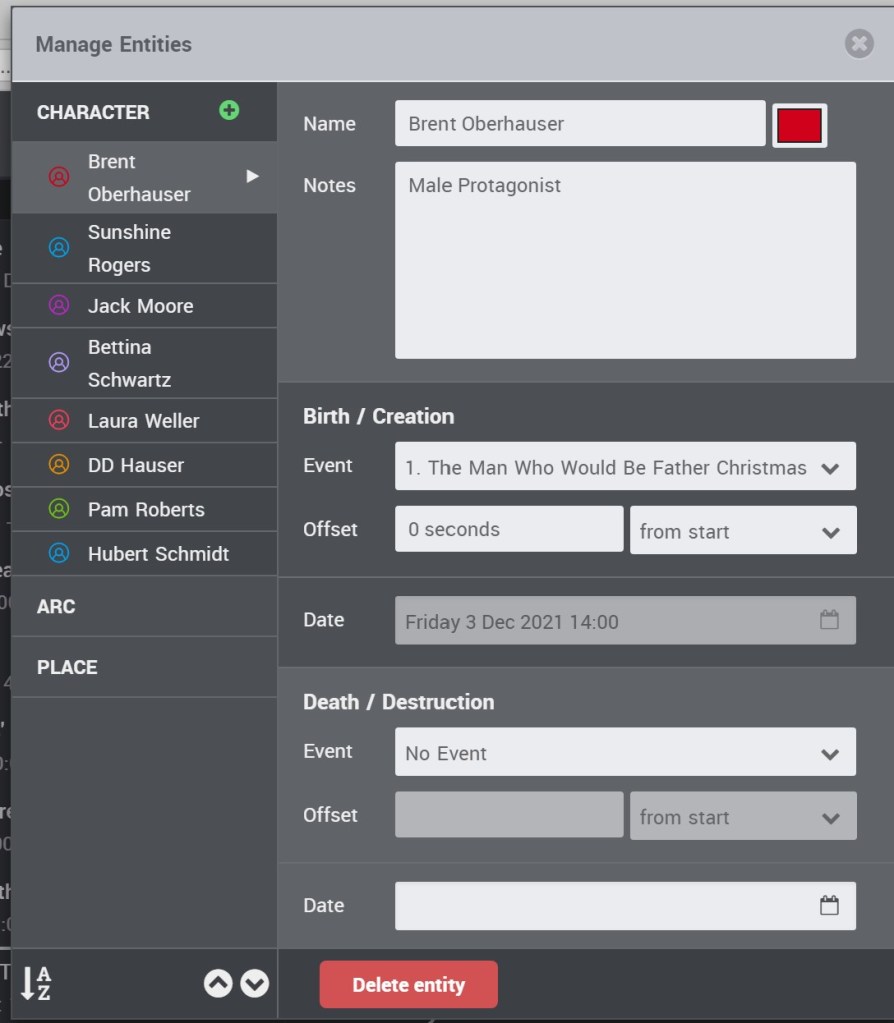
Below is what the ‘entity’ window looks like:
This is the ‘manage entity’ window. You can add entities here (to add anywhere, click a ‘plus’ button) and edit them. I recommend using this box rather than the ‘add entity’ box because you can manage things better here. Note on the left the window will also let you define story arcs and enter different places.
Notice I don’t use the birth/death blanks because I’m not writing epic fantasy. If I ever make the unified timeline for all my novels, I could use that. (But it would be an unwieldy timeline spanning 6000 years.)
The good thing about Aeon Timeline (to me) is that I can see that timeline, and in making it, I can ‘feel’ that timeline. I often make it after writing the book in my proofreading stage. This is probably the wrong way to use it. If I set it up before, I could actually import it into Scrivener (my writing software) and the timeline would show up. Somewhere. I have to try that.
The bad thing about this is all the data entry. I feel possessed to put in all the entity data and use all the categories when developing the event, and this can be a lot of work. Being a plantser (planner/pantser) writer, I don’t know that I would know all the events before using this tool such that I could use it at the beginning. I would advise to enter what is needed and leave the other bells and whistles alone.
I’m halfway through entering my Christmas romance for the year, Kringle in the Night, as I edit it one more time to make it ready for the Christmas season. It’s helping greatly. I’ll let you know about the Scrivener integration later.








 Words Like Me