Courting Luck

The Day I Gave Away my Luck

I used to be a lucky person — you know, the person who wins random (small contests, not the lottery) and could be in the right place in the right time. Not that I never had setbacks or rejections, but that occasionally something delightfully unexpected would happen.

For the past few years, I feel like all my luck has gone, especially in the area of writing. Getting published is, to some extent, a matter of luck — having the right materials in the right place in the right time. This has so far, not happened to me. And I think it’s because I gave away my luck.

I did it for the purest of reasons, or the most obsessive of reasons. I was trying to be a good Christian and sacrifice myself for the good of others. There are ways of doing this that are helpful for the world, but I didn’t choose one of those. I instead decided I was unworthy of luck, given my privileged status, and so I gave up my luck. I said, “God, I don’t deserve my luck, please take it away from me.”

I brainwashed myself into believing that I didn’t deserve luck, and that other people deserved to have my luck. I believed that luck was a scarce commodity.

Photo by Miguel u00c1. Padriu00f1u00e1n on Pexels.com

A Fanciful and Superstitious — and Conflicted Person

Writing this down in pixels, it all sounds very stupid, I admit. I am, however, a fanciful and superstitious person. I don’t believe in The Secret (a book about the “law of attraction”) because it’s very materialistic and I don’t believe the universe could or should shower that type of abundance on individuals.

I do believe, however, that my negative attitude may keep me from seeing the good side of things and might blind me — ok, fine, I believe that giving up my luck is refusing to see what the divine could be calling me to find. As I said, I’m hopelessly superstitious. I honestly believe that I had luck, I rejected luck, and I am now less lucky than I used to be. Or at least, I believe myself less lucky than I used to be. I don’t know what I believe.

I am a fanciful and superstitious and rational and really conflicted person right now.

A Ritual Would Be Nice Right Now

I am not a witch or a Wiccan or any sort of pagan, but I still see the value of ritual. How do I divorce ritual from religion? The same way millions of people across the world do. People who wear lucky socks are performing a ritual. Traditions are ritual. Going out to a prime rib dinner the night the COVID vaccination takes hold is a ritual (one I did the other night). So what do I have to lose?

Luck, if one thinks about it, is a type of optimism. It’s an optimism that the unexpected good thing can happen, that one does not have to exert infinite effort for something good to happen. Not like effort isn’t necessary, but that there comes a point where effort doesn’t work any longer, and that’s a great place for luck to intervene.

A luck ritual, in my opinion, would:

  • Reattach me to my optimism that good things can happen without my control
  • Tell me it’s okay to have good things happen to me
  • Emphasize that optimism is self-care

What Does This Ritual Look Like?

Again, this is a psychological ritual (like lucky socks and Christmas china) rather than a pagan ritual, so I’m not calling up any spirits as much as I’m trying to make a break with old thought patterns. What I plan to do is:

  • Take a bath in milk and honey bubble bath
  • Write some journaling on luck using my favorite fountain pen
  • Eat some bread with butter and honey (the milk and honey symbolism is deliberate symbolism)
  • Find one of my four-leaf clovers in a book (or better, find one in the yard. We have some.)

What Do I Expect This to Do?

What I expect is that this will help me stop declaring myself unlucky, I will likely suffer less from griping about my bad luck this way. That itself would be an improvement. I hope that my better attitude will help me to see opportunities and make me resilient to adversity. I will believe that I am deserving of good things. And maybe, just maybe, I will be (or believe I am) luckier.

Spring Came Back

Yesterday, I woke up to a winter wonderland. In April.

As I walked out my door to head toward work, I faced wet, sloppy snow, clumped on trees, melting off sidewalks, covering the grass. Not the sort of thing you want to see when the daffodils and apple blossoms are out.

Missourians tend to face spring snowstorms with a combination of outrage and pride — “Nobody has shitty weather quite like ours!” Nebraskans and Arkansans say the same thing, but they’re wrong — Missouri bas bragging rights to fickle weather.

I did not worry about the snow. Snows in April are temporary, and the spring flowers shake off the snow and shine just as brightly when it melts. A spring snowstorm is, like so many setbacks, temporary.

April snowstorm in downtown Maryville

My Favorite Writing Retreats

As we say in this house, I have 50% cattitude. Girlie-Girl , a senior citizen at 13 is sleeping next to me, and Me-Me, another senior at 13, sleeps on the back of the loveseat where I sit. Cats sleep a lot, it turns out, but they don’t sleep soundly. Either one of these little critters will wake up grudgingly.

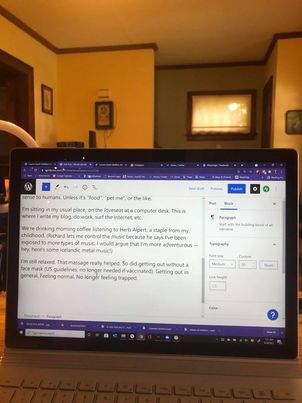
The loveseat is not only the favorite of the cats, but it’s my favorite. I do all my writing here, because the stereo is here, there’s a window next to me, a Nespresso pot in case I have a coffee emergency. And my husband sits on the couch and I bounce ideas off him.

Is this the perfect place to write? It’s close. I don’t like writing in the office, because it’s really cluttered and small, and there’s a sort of sensory deprivation.

My perfect place to write? In the lobby of a boutique hotel. There’s just enough movement that I feel comfortable writing, yet not enough to disturb me. These are my writing retreats, and here are a few of my favorites:

Starved Rock Lodge’s Great Hall
  • Starved Rock Lodge, Starved Rock State Park, Utica, Illinois. The CCC-built, log construction lodge is the gem of the Midwest, sitting in the middle of the best state park in Illinois. The Great Room, rustic and towering, attracts visitors who have just come in from hiking or just come out from the lodge-inspired restaurant. The chairs are just comfortable enough that sitting in front of the fireplace makes a cozy writing place. The old section of the hotel part of the lodge has, tucked in a corner, old-fashioned writing desks. Book one of the fireplace cabins (if you can) for added ambiance, although they’re too small to comfortably write in. Massages are optional. Highly recommended, especially at Christmas, when it’s beautifully decorated and families come to exchange gifts
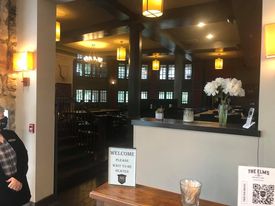
  • The Elms Spa and Hotel, Excelsior Springs, Missouri. This has to be my favorite writing retreat. A lobby which evokes the 1930’s, seats by the fireplace, and a spa with a relaxation room and a hot tub/sauna/steam room/hot shower room called the Grotto, this is the place where I not only write, but recuperate. Facials, massages of various types, and hydrotherapy (I might be wrong about the last part) are available. There’s a café on site and an excellent restaurant that plays Sinatra music, as it should. Again, rooms are a little small to write in, but they are light and elegant.
  • Lied Lodge, Nebraska City, Nebraska. Lied Lodge honors the founder of Arbor Day, and is located on Arbor Day Farm. As one might expect, the theme is trees, and the lobby has high ceilings, wooden beams, and world-affirming quotes on the walls. Although the massive fireplace makes the lobby a little crowded, the section behind the fireplace yields comfortable rocking chairs and just enough neighbors in seats to stimulate thought in those who prefer background noise. The restaurant is excellent and inspired. Lied has the most spacious rooms of the three, with more wood beams to provide ambience, but still too small to write in in my opinion.

I haven’t been on retreat for a year, having kept much to myself during COVID. Now that I’m vaccinated, I feel safe enough to schedule a writing retreat at The Elms for just before Memorial Day. Whew! All I need now is something to write.

I need ideas!

I made 50k (50 editing hours) for Camp NaNo yesterday, and I’m almost done editing Reclaiming the Balance, which is in part a parable about how “woke” people can sometimes get caught being prejudicial of a new situation. It’s also a story about a love affair between a sculptor and a beautiful, truly androgynous being who was “born yesterday” as an adult. I guess it’s also a story about how our pasts cripple us in the present.

Photo by Pixabay on Pexels.com

I feel a need for more ideas. Short stories this time, because I have enough novels, or so I’ve been told. My idea of stories, though, are mystical, mythical, and at times provocative.

I need some good, weird dreams as material to write. That’s how I’ve gotten my best novels. I need something new to write stories about — most of my short stories are about the world around Barn Swallows’ Dance (the fictitious ecocollective that keeps many secrets); one takes place in the Kringle world. I need to write some standalones to submit to journals and other outfits.

What I need is some time to think. I should have some of that this summer.

My Longest Hobby

I have spent my life developing “project obsessions” where I completely immerse in a hobby and then, inexplicably, give it up. I hit a moderate level of proficiency, and then I get stuck, and then I give up. I did this with embroidery, beadwork, gardening (I couldn’t keep up with the weeds and my gardens didn’t look beautiful. I hit the wall.

Photo by Pixabay on Pexels.com

Writing has been an exception. I have been writing for — six? seven? years, and I don’t seem to be ready to stop. I learn, and I improve, and I don’t seem to hit the wall. I’m not sure why; possibly because it doesn’t take hand-eye coordination (which I’m severely lacking) or lots of money (which I don’t have). Writing for me is at the optimal level of challenge with opportunity to improve.

With writing goals. it’s best to set internal goals. I’ve made the mistake of setting the goal of getting traditionally published which is an external goal I have little control over, especially in the overloaded publishing market. If I set internal goals, I’m much more motivated. Not that I’ve given up being traditionally published; I’ve just decided that I have to set it as a secondary goal.

I guess writing is with me as a part of my life.

What I’ve Learned from Failure

I didn’t have to deal with failure in my childhood (except for those crushes that were never requited). I wasn’t quite a child genius, but I was gifted. I managed to get to college almost entirely on scholarships including a National Merit Scholarship. I got on the honor roll despite the most perfunctory study habits.

I came to failure late and hard. Particularly in submitting my writing, particularly novels. I have received enough rejection to paper my room.

Photo by Anete Lusina on Pexels.com

What I have learned about rejection:

  • Don’t take it personally. If I have given my best, after reading guides on how to write, writing, editing, beta-reading, revising, and the like, it’s probably that my writing doesn’t fit the agent’s list or the journal’s theme I have learned, for example, that my poetry is not High Concept, as it doesn’t get published in high concept journals. This doesn’t surprise me because my Ph.D. is not in English/Creative Writing. My short stories are also not High Concept, being firmly lodged in the category of fantasy, romantic fantasy, and space opera. There are some places I’m more likely to get published in than others.
  • See what you can learn from it. I have had to grow as a writer by asking myself, “What is the takeaway from this?” I had to get rid of my perfunctory habits once I realized that one didn’t turn in one’s first draft (in my defense, it had very few grammatical or spelling errors). I read a lot of material on writing because of rejection.
  • Try again. Always try again.

Daily Warmup

Every morning (well, almost every morning) I sit in front of my computer staring at the WordPress site and its little white button that says “Write”. And I write.

In a way, this blog is the warmup exercise for everything else I do in a day, whether it be writing or work. This blog loosens my fingers up and loosens my mind up. There is a full day ahead of me to make of it what I will.

Photo by Olga Mironova on Pexels.com

Sometimes that is merely existing, moving myself toward the door with my computer case for a day of work. Sometimes it’s gleefully playing with my cats. Sometimes it’s a productive day at home writing or at work teaching.

But the blogging in the morning is essential, framing my inspirations for the day.

Today’s tasks are monitoring and answering email from students and prepping for Camp NaNo. I have already answered five at 6:20 AM. (This is rare because my students generally abhor mornings.)

It feels like a good day, although one that would benefit from coffee. (Lots of coffee).

Remaking Myself

I want to remake myself. This is the reason I think I try so hard to get published, because I want to think of myself as an author. It would give me an identity beyond the one I have currently (professor) that I will lose when I retire.

It’s not a good reason to write, but I think it’s a fine reason to try to get published. I think remaking oneself is a noble pursuit, unless one is trying to remake oneself as Harley Quinn (As opposed to Harley Quin, for all you Agatha Christie fans).

Photo by Sunsetoned on Pexels.com

I admire people who make themselves and remake themselves, flowing with the changes in the world. On the other hand, I believe that my writing is good and worthy of publishing, but I’m not apparently writing what agents want. Changes to flow with. Do I learn how to promote myself better and self-publish? Do I try to tailor my writing to the market — no. Then it would not by my writing. I will not remake myself by becoming someone else.

Have I already remade myself? I have written five or so books — Kringle in the Night, The Kringle Conspiracy, Apocalypse, Gaia’s Hands, Reclaiming the Balance, Whose Hearts are Mountains, and Prodigies. Ok, that’s seven, not five. I have put them through developmental editors and (most of them) through beta/alpha readers. One of them (The Kringle Conspiracy) has been self-published. Maybe I am already an author. Maybe I have remade myself.

I need a Spring Break

I have Spring Break next Friday. Yes, that’s it, one day of Spring Break. I understand the reason — the university doesn’t want the students to go out to Palm Beach and bring back COVID. But, ironically, the city has repealed its mask ordinance, and the students are having unmasked parties every weekend.

That week in the middle of the semester was an opportunity for faculty to recharge. Even with vacation spots still risky, we could sit at home and not do work-related items for hours at a time. Not answer student emails for a week. Not attend meetings. Time to write, sleep in, and occasionally do nothing.

There’s no use in complaining about something that was put in place for the right reasons. But the students are burning out, the faculty are burning out, and between COVID and working, I just want a break

Photo by Peng Louis on Pexels.com

My Family’s Curse

I believe that families have curses; however, what I mean by curse is a way of thinking, believing, or acting that hinders coping, relationships, and outlook. For example, a family that keeps trauma bottled up creates a dysfunctional habit that will pass from generation to generation.

My family’s curse is a killing of joy, a pervasive belief that joy is dangerous because good things never happen. For example, suppose there is a child who is looking forward to their birthday. Their grandmother says in a sepulchral voice, “Don’t look forward to anything; you’ll only get disappointed.” The child integrates this world view and passes it to their optimistic children so that children strangle their joy and grow up with the dreary world view.

Photo by Karolina Grabowska on Pexels.com

I have only partially internalized the curse; I feel elation every time I write queries for a book of mine. And then the family curse wakens in my mother’s voice and version: “My grandmother said you should never look forward to anything, because you’ll only be disappointed.” Her version of the curse invokes a matriarch whom I have never met, but stands as the forgotten fairy at the christening delivering the curse.

The faulty curse wobbles around in me — I feel hope and elation, followed by guilt I should feel this way, and caution in my mother’s voice: “Don’t look forward …” I do not hug the family curse as a reality I should adopt, but it has not died in me either.