I am selling my wares at a book sale at the end of the month. I have only done one book fair before, a couple of years ago. That book fair was in my small home town’s library, and this next one will be down the road in St. Joe, three times larger.
I think I know what I’m doing. I have books: Gaia’s Hands, The Kringle Conspiracy, Kringle in the Night, It Takes Two to Kringle, and Kringle on Fire. I have business cards (I think). I have handouts featuring all my books, including Apocalypse (coming soon!) I have giveaways (squishy apples) and a “vertical” (a visual element; mine is a driftwood tree branch with hanging apples).
I still feel way out of my league.
I feel like a newb, even though I have been writing and selling books for years. (Writing a lot more than selling, to be honest.) I don’t feel like a grownup when I promote myself. I don’t feel like a professional when I promote myself. I feel like an imposter!
I have to remind myself: I’ve earned money doing this. Therefore I’m a professional. Therefore what I do is professional.
My birthday weekend (when you turn 60 you get a whole weekend) has turned out to be — I’m having trouble finding the exact word. “Special” has an implication of something engineered to be perfect for one’s birthday. This was more like serendipity in action.
We arrived in Kansas City Friday night after eating dinner in St. Joseph up the road, and we arrived at the 21c Hotel, one of my favorite spots. It’s an artsy hotel, which appeals to my writer self, and part of the reason I do Kansas City trips is inspiration.
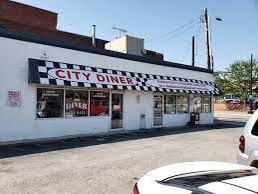
On Saturday, we started the day with breakfast at City Diner, which is truly a diner:
It has the settled-in look of a real diner, with hot sauce for your eggs and a menu of breakfast and burgers and fries.
From there, we spent some time at Broadway Cafe, so I could write and figure out a printing problem with a brochure I want to hand out for the book fair at the end of September. Broadway Cafe is a space for writing, and their coffee is perfect. I drank a depth charge (coffee with a shot of espresso) for the first time, and it was stout!
My husband and I were going to see Spirited Away at 3 at the Screenland Armour, so when we were done with coffee and writing, we noted that we would not have enough time to get lunch at Choga (way over in Overland Park when we were in mid-KC) so I suggested Blue Nile, an Ethiopian restaurant. Not only did that time out perfectly, it got us close to our destination of North KC for the movie. It was also tasty food.
Spirited Away is a classic Miyazaki film, artistic and fanciful. It’s a children’s movie, which hasn’t stopped any adults from watching it. I’m a Miyazaki fan, so it was a good choice for my birthday weekend.
After that, we went to pick up my birthday present, which was an orange Sailor 1911 fountain pen which we got at discount barely used. I collect fountain pens, so I was happy with the present and happier with the price.
We were too full from lunch to eat a full dinner at Waldo Thai, so we decided to have appetizer and dessert at the Savoy, a restaurant in the 21c. Oh, my goodness! Imaginative and tasty food! They treated me special for my birthday and put us in the private, round room. They also discounted us our desserts.
Today we’re winding down and sitting at Broadway Cafe again while I write this. A lesson learned — go with the flow, as the results are better that way.
I type this as I wait for 4:30 on the clock to release me from coffee hours at the on-campus Starbucks. We have the best Starbucks at the university — it’s in the university library. So our library is like a Barnes and Noble except it’s set up for studying.
I’m not winding down after this, even though it’s a weekend. I’m celebrating my birthday in Kansas City this weekend. (I’ll be 60 on Monday). It’s a me sort of weekend. We’re heading down tonight and staying at the 21c, which is an art hotel! (If anyone there has watched Middleman years ago, it’s like “Artcrawl!”). We’ll watch Miyazaki movies, eat Thai for dinner, write, and hopefully go to a cat cafe and consider adopting a little furry creature. We’ll see about the latter.
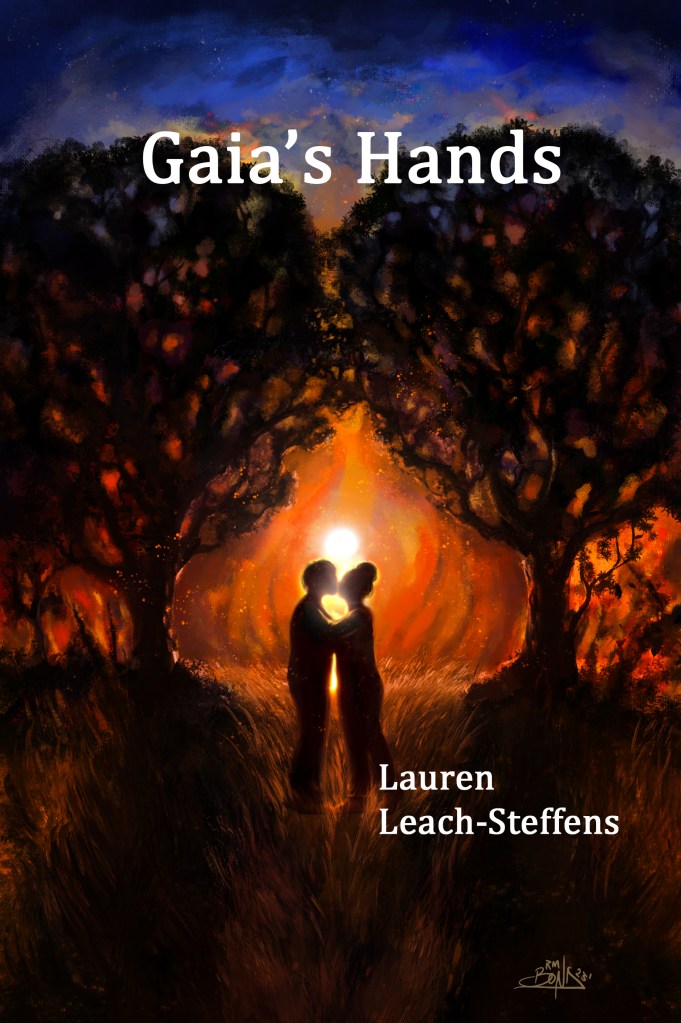
I’ve been getting a lot done these past few days — I have replaced the cover to Gaia’s Hands with its new look. My niece Rachel is very talented:
I also have put both the October 1 release (Kringle on Fire) and the January 1 release (Apocalypse) online. Putting together the covers is perhaps the hardest part, because I have to tweak the cover to fit the book. Whee!
I wouldn’t mention this before my birthday were it not because I’m turning 60. It’s a big milestone birthday, at least somewhat anticlimactic because I have been a member of AARP since age 55 and don’t retire till 67. I’m already eccentric. I’m now officially old enough to be my students’ grandmother.
But I don’t feel that old.
I feel slower. Despite my intense weekend of book production, I feel like my life has slowed down. I take breaks. I sometimes do nothing, not even read. Sometimes I binge on TikTok, about the laziest thing a person can do. But I’m not rushing about making things happen. Usually.
I think getting old would be different if I weren’t in a fortunate marriage. Or maybe it wouldn’t be different at all. Perhaps single me at 60 would be happily traveling on my own to writing retreats.
Sometimes I don’t know why I blog. I do not have very many readers, so few would miss it I stopped writing. But I still blog.
I could blog because I love writing, but I have 4 books published, two on the way, three waiting for publication and two in the process of writing. I have plenty of writing in my life.
I think I blog because of hope. I hope to have more readers, and I will never have them if I give up hope.
For those who are reading me now, you give me hope.
It’s Labor Day weekend, and I am already celebrating during my Friday coffee hours. My weekend is going to be full of book work. I realized I am going to have to do some heavy work to get Kringle on Fire put together. I need it published by a week from today so I have copies when I go to the Author Fair on September 30th.
I’ve already processed the text for publication using Atticus, which gives the work visual polish (Vellum does this as well, but is Mac-only.) The part I’m struggling with is the cover. It’s almost like I forgot how to make a cover. One royalty-free photo, a back cover, words (some sidewards) and — it doesn’t fit as an 5×8 cover according to the publishing site KDP (Kindle Direct Publishing). So that’s what I’m going to do tomorrow. If I get far enough ahead this weekend, I will try to do the same for Apocalypse. I have a cover for that, but I think it will fail as well.
I registered the copyrights for both books today. At least I got that done. I don’t know if that’s absolutely necessary, but I copyright my published works with the US Copyright office. I’ve been hearing of people on Kindle plagiarizing others’ works. Having the copyright is going to be a big cease and desist there.
There’s a lot of work with publishing a book that has nothing to do with writing. Traditional publishing entails less work, as one only needs to approve the book cover instead of creating it. One doesn’t have to do the bulk of the publicity, although there are promo tours. The self-publisher does more work on their own, but this is not a bad thing by any means.
I’m going to have a busy weekend, with some of it spent at Starbucks for a change of scenery. It’s part of publishing, and it’s part of what keeps me going. Wish me luck.
My Big Audacious Goal for the year was to send Apocalypse through querying, and I veered from that goal, deciding to self-publish January 1. I made the decision after learning that agents are receiving up to 600 queries to review annually. Or maybe in a shorter amount of time. In addition, my novels tend to 70-80k words, too short to be considered for traditional publishing.
My BAG, then, is to publish Apocalypse on January 1st, 2024. I already have a cover (from my favorite artist, Rachel Bond) and could put the whole thing together now in about an hour. I will do so soon.
But there’s the second BAG. I wrote a Kringle romance last November for NaNoWriMo and it took me a while to finish it. I let it sit for a while because I wasn’t sure I liked it. A couple weeks ago ,I looked at it and said, “Wait. I like this.” I will be self-publishing that October 1, 2023. So I will have to get that print-ready sooner. I have a cover, although I don’t like it as well as Rachel’s covers.
I also want to get a freebie set of stories for people who buy Apocalypse. I have those written; just wondering how to distribute. Does anyone have any ideas?
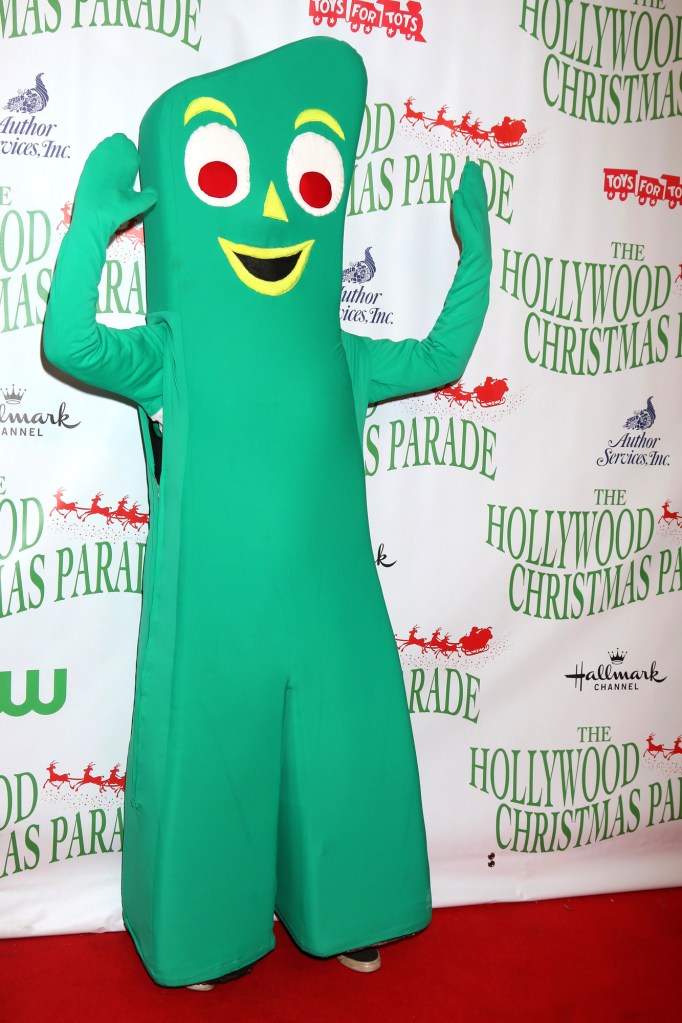
“Semper Gumby” is a saying in the emergency and disaster management community (and military) that means to always be flexible. This has been a fine week for the motto.
LOS ANGELES – NOV 27: Gumby at the 85th Annual Hollywood Christmas Parade at Hollywood Boulevard on November 27, 2016 in Los Angeles, CA
On Monday, I broke the projector screen to our big lecture hall, readying for my general psychology class. My boss says I didn’t really break it, but I know better. With quick thinking, I projected upon the not-so-ideal whiteboard.
On Wednesday (same class) the projector screen functioned. But the projector did not. So I had to use my PowerPoint slides as notes and give the lecture without visuals, and send the slides later to the 75-person class.
On Friday, the projection unit worked, but my lecture strangely vanished from my computer. So I gave a whole lecture (without notes) on research. Fortunately, I could deliver the lecture without referring to my notes. Next week’s lecture on parts of the brain would not be so easy for me because I’m not a visual person.
All this bad luck seems focused on my gen psych class, which I’m teaching for the first time this semester. If I were a more superstitious person, I’d incense the corners of the room to drive away evil spirits. But I’m a professor, so I rely on semper gumby to get through the daily disasters.