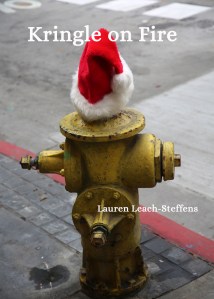
I have been writing on Kringle on Fire for the last couple of days. Slowly; only 500 words a day instead of my usual 2k, but I have been writing something.
I’m still wading in misgivings about the book, which does not feature firefighter heroics, hunks, or grateful victims rescued from conflagrations. I wonder if I should even bother to write romance novels, because I don’t write heroics, hunks, or grateful victims rescued from conflagrations. My books have good-looking but quirky protagonists, a lot of personality, and odd situations. And big misunderstandings.
I’m afraid my books are not fantastic enough to be romance novels, but I want to write romance novels for quirky people who don’t want their stories to manipulate them emotionally, but want to be woven into a story. It might mean they don’t sell, though, because there may not be a market. I have to write at least this book, because I’m almost halfway through it.
I haven’t been to Starved Rock for the holidays for two years. I’m there now, sitting by the fireplace in the Great Hall, writing. There are children running around, and there’s enough snow outside that we’re in a winter storm warning. A promising start to Christmas.
Starved Rock is a state park in LaSalle County, IL, near where I grew up. Full of sandstone bluffs and trees, it is one of the best places to see fall color in the US and is picturesque in the winter. It can get horrendously busy at Memorial Day and Fourth of July, so I would not recommend going at those times. Come in the fall or winter, although if you want to stay at the lodge, reserve early.
Nearby Utica is a cute, tiny tourist town worth visiting and Ottawa is a college town without a college. We’re close enough to Chicago to get their tourists, which builds the local economy, but far enough away that the area is still uncrowded.
Today I don’t think we’ll go out in the snow. I may write here; I will sit by the Great Hall fireplace and possibly build a fire at our cabin. There’s a hot tub I might go in later, and maybe I’ll take a nap. I may be in the best place in the world for a snow day.
My life is exactly what I pictured a year ago, mostly because I did not have wishes or aspirations of where my life would be. This is sad because I had nothing to push myself toward; I just had to make it day-to-day. This is also happy because I was pretty satisfied with life last year and pretty satisfied now.
Would I have liked it if my writing career blew up? I think so, but I don’t know if I’m up to two full-time jobs at this point in my life. I’m almost 60, after all. (NOTE: If the bluebird of happiness drops me a successful writing career, I will gladly suffer.)
Would I have liked a lottery win? I’ll be honest — probably not. My husband wants to win the big Powerball; I just feel like the changes inherent in winning lots of money would be destabilizing. Yes, I would like to retire early, but I don’t want to be obsessed with money, which is an idiosyncratic result of having a lot of money.
But those are extraordinary happenings, and so I didn’t dwell on them. My life is almost exactly as I figured it would be (except for my father dying, and even then it wasn’t unexpected at his age).
What do I see my life like next year?
I suppose this is a legitimate question at this time of year. I see my life being a lot like this year. Hopefully, another novel or two; a few more readers, but not much changed. No sweeping changes. I have my fingers crossed for no big changes, because at my age, many of those can be catastrophic.
A common piece of advice given to writers is “write what you know”, which is why there are so many books about writers. (This suggests to me that we need to get more variety in writers, because I’d like to read something with some detail about wait staff or electricians, but that’s off topic.)
To grow, however, a writer has to write about what they don’t know. This requires research, not just assuming that you do know. For example, Nora Roberts wrote a novel where, in the prologue, a character in Ireland is cultivating potatoes a long time before potatoes arrived in the Old World, being a New World vegetable. It’s natural to assume “Ireland = Potatoes”, but Ireland didn’t have potatoes till 1589. As much as I like Nora Roberts, here’s a historian’s take on what she gets wrong in one book.
Another example was a Jayne Ann Krentz novel (forget the name) whose male protagonist owned a winery. In this case, she got the details right, but the details were so sparse that the book didn’t have to have a winemaker protagonist at all. In this book, he strolled through the winery, and there was a little detail about a room with big barrels. I, as an amateur winemaker, expected at least a bit about him checking in with his chemist and taking a sample from a barrel to check out the taste. I expected my winery owner to be involved with the winery somewhat, for the sake of romance.
The takeaway is that your reader is going to know the details if you don’t. And the inaccuracy is going to take them out of the story.
Back when I was young, I wanted to write a story based on a long dream I had while sick with a kidney infection. My problem was that it took place “in the desert” and doing the level of research I would need just to show the characters’ interaction with the desert (wherever that was) would have been immense. I didn’t have time for immense research because I was trying to finish up a PhD. So I wrote a couple character sketches and segments of scenes and put it away.
Years later, the Internet made it possible for me to do the level of research I needed to finish the book. I chose the Owyhee desert (alternate future with demise of the US makes it no longer Bureau of Land Management land) and studied the flora and fauna as well as what food animals and crops would do well there for small landholders. I could not have researched that, nor could I have researched experimental underground habitats and water recollection. The book is named Whose Hearts are Mountains, and I’m going to publish it someday.
My advice for writing what you don’t know:
Look up basic facts, making sure that your sources are reliable. For the sake of writing, Wikipedia is usually concise enough, and its footnotes carry more information that will be helpful.
Provide enough detail that your readers are satisfied. This can vary, depending on who your readers are. But assume they want at least some accurate setting and background to feel engaged with your story. In romance, setting and background are one of the ways novels distinguish themselves with their time-honored plots and tropes. In fantasy, believable setting and background help you build a consistent world.
Ask yourself “what are my readers going to poke holes through?” Reinforce those areas with more real information.
Right now, I’m struggling to research the logistics of small town fire departments, fighting fires, and combustion in general. Luckily I live in a small town with a volunteer fire department, but I’m having trouble coordinating with the fire chief. I’ve been reading a lot online, especially things about fire trucks, firefighting gear, uniforms, and mutual aid. I have a couple small details I still need to find out. And this is just background to make sure the firefighting feels right. But I don’t want to write the book that people say “That’s not how it works” about. So it’s time to research.
Chronic stress is not a badge of honor. In fact, it’s a life-shortening problem. Stress is, however, inevitable, because there will always be conflict. Without stress, humans would not survive because they would not recognize danger. It’s just when stress gets chronic that it eats away at the mind and body. Therefore, we need to resolve stress and get past it.
I teach human services to students. They move on to case management careers, often transitioning to some sort of counseling after a while in the labor force. One question I ask them in case management class is what their self-care routines are. It’s important to take care of oneself when you work with other people in high-stress situations which sometimes hook into someone’s personal hurts. It’s important for everyone to decompress and let go of stresses.
As for my self-care, I’m off work until early January, the biggest perk of being a faculty member. I’d argue that I need the 3 weeks at Christmas to recuperate from dealing with students day in and day out. It’s a privilege, I know.
Because my fall semester is rough and my spring semester rougher, and because I manage bipolar II (when it doesn’t manage me), I try to cram in my self-care over the Christmas season.
On my self-care list:
Muscle soak baths
Plenty of water to drink
Christmas scent spritzed in the living room
All the Christmas lights on
Christmas music
Occasional naps
Hot Chocolate
So far, so good. I think I’m up to writing some on my novel today after a week of recovering (and maybe writing 500 words a day).
I hope you get at least a few moments for self-care this season.
I’m too old to believe in you, yet I persist because of Pascal’s wager (“But what if Santa really exists? I have nothing to lose”.)
I’ve been good — within reason. I admit overindulging in coffee and sweets, often at the same time, and sometimes I get cranky. But my cats think I’m a good person, and I think my husband does. I hope that counts for something.
I have a list. It will make sense to you if I first explain: I am a writer, and to say I’m unknown is perhaps an understatement of exponential proportions. My Christmas list will reflect this. So there will be no choo-choo trains or dollies on this list.
Enough. Here is my Christmas list:
The secret to getting followers on social media (for someone who wants to do it themselves)
A readership for my novels, particularly Gaia’s Hands (which is nearer to my heart than the Kringle books, to be honest.)
Inspiration to write on the three partially-written books I have on this computer
The courage to publish another book (the one that Gaia’s Hands is the prequel for)
Lots of good coffee
It might be a lot to ask, but I figure I have to be honest about my situation to someone.
Love, Lauren
Being bipolar means saying “Well, I got through that” a lot. An awful lot.
Remember that I am relatively stable right now and have been for a few years. No giddy, voluble mania; no draining depression. I almost wonder sometimes if I never really had bipolar at all, I’ve been comfortable for so long. Life gives us an amnesia when it comes to strong emotions; otherwise no woman would have a second child. So I know that my bipolar isn’t a figment of my imagination, even if I forget how traumatic it’s been.
My bipolar sits below the surface, waiting for its chance. It likes to boil up when I haven’t had enough sleep; I guard against that with a regular sleep schedule and supplemental medication for bad nights. It bursts out of quiescence when I face a lot of stress, and it roars into my life during crisis. Not always; that’s the tricky part. It’s not even predictable in crisis.
So I find myself saying “Well, I got through that” a lot lately. As in, “Well, I got through my dad’s death” and “Well, I got through all that grading” and “Well, I got through finals week” and even “Well, I got through carrying that heavy Nespresso machine down a flight of stairs without dying”. I feel relief that I haven’t gone on a three-day rant or begun tripping over my words in racing thoughts.
Sometimes I’m so relieved I feel like crying, and then I worry that a depression threatens to emerge. I shrug and promise myself that I will get on top of any threatening moods. I know the drill: Get enough sleep, talk to my psychiatrist, journal. Well, I got through that rocky patch.
Last week, I graded three major assignments and a handful of smaller ones. I fielded last minute requests, including two students who are just getting their spring semester internships put together. The Curriculum and Degree Requirements committee meeting went on forever.
I have written nothing this week — actually, the last couple of weeks — because I have been so tired. When I’m not working, I’m listening to Christmas music and surfing r/niceguys and reminiscing about my dating years. (I’m mostly joking.)
Next week, all I have to grade are the essay questions in the exams, and that shouldn’t take too long because they’re very short essays. Then I submit the grades. I should be done grading by Friday. Friday seems so. far. away.
All of this exposition about my time is for one purpose — to make the case that I am too tired for Christmas spirit. I’m sitting at Starbucks right now listening to Christmas music and wearing an ugly Christmas sweater. I just lost Whamageddon without realizing it. There is a Christmas romance I need to write and I’m not inspired. I’m not quite Bah Humbug here, but I’m about ready for a long winter nap.
And then, after a couple days of vegging out while listening to the Grinch soundtrack, I should be ready for the season.
Sometimes I write because I see it as a method of getting an idea out there into the universe, as if the universe will supply me with something I need to deal with it creatively. Part of my belief system holds that, if one listens closely enough, the answers or comfort or solution is out there. I like whoever’s providing the aid to know what I’m asking. It comes from Quakerism and it also comes from the Christian belief of praying for what you need. I don’t know if I believe in what would be called “intercessory prayer” in some circles wholeheartedly, because my spirituality has become a muddle from the time a psychiatrist diagnosed me as bipolar. But I put words out into the universe occasionally, with some witnesses to hear. That’s you.
My life with the muse
Right now, I struggle with creativity. The spark is gone. I am writing without that burning desire to see what comes up next in my work. Everything I write feels pedestrian. I lay my problem on the muse I have had throughout my career. Muses exist to give motivation. For example, my writing life goes like this:
Inspiration>Obsession>Writing
I assume the muse enters at the inspiration part of the equation. I used to get inspiration from my dreams. My dreams haven’t come from a muse lately. They’ve come from the Karen of my subconscious. In my dreams, I forget little things like showing up for class (I’m the professor) and wearing clothing. I’m doing everything wrong, and I am about to be discovered as a fraud. My bad dreams don’t even have the courtesy of being a dystopic plot line, preferring instead pedestrian impostor syndrome.
As muses are notorious for whipping up their subjects into a creative fury, I lay the problems of my obsession stage on the muse I’ve had as well. The obsession is the need to get into the story to interrogate the dream. I want not just to know the story but to be in it. To be it. It’s an exhilarating feeling, like flight. The obsession part is alright, unless it’s not. I know writers go a little crazy when they write, but my obsessions come with hypomania. I get into mood swings that swing between elation and Subconscious Karen, telling me I’m out of control, as if she fears I will skip class and run around naked. (Thank God I have done neither.) So I don’t get wild, but I fear giving creativity any quarter will cause the calamity I dream of.
Go away, muse
So I fired my muse. Those obsession parts were too wild, and I feared sliding down a slippery slope to a bacchanalia in the middle of the University Ballroom and all those other explosions Subconscious Karen feared. I never have experienced the wild elation since I fired my muse. I miss it sometimes, but it’s nice not having Subconscious Karen around all the time (she’s only around sometimes now, usually when I’m under a lot of stress).
Now I wonder if I can hire a new muse. I don’t want an erratic, frenetic, startling muse anymore. But I want a muse to inspire me without the feeling that I’m about to choose to swing naked on that chandelier. There has to be a middle between swinging on a chandelier and Subconscious Karen.
It’s not about a muse, is it?
Writing this article has been alchemy. I discovered, in writing this, that it was about writing with bipolar disorder. Although I am convinced that I am not less creative with the bipolar meds, I don’t know how to grasp my creativity as readily as I would like to. In a hypomanic state, ideas jump at me and I grab onto them and run. I feel touched by the muse and my self-doubts melt. I feel gifted, and this makes writing easy. Subconscious Karen keeps me from veering off the deep end but makes my life uncomfortable and my mood swings worse. I have given up those things which encourage artificial highs (irregular sleep, extended stress, obsessive crushes) and thus have robbed myself of the muse.
My thought going out into the universe: Help me live with Subconscious Karen in a way that doesn’t rob me of joy. Help me find inspiration without obsession, intensity without disruption, creativity without condemnation.
I haven’t written for a while. My father died a week ago on Thursday, and I feel so tired. I don’t understand it because my dad was 86, and I’m almost 60. It’s not a shocking death. I wake up every morning from nightmares that seem to have nothing to do with my dad, and then I realize there will be no fresh stories about my dad. There will be the old stories, and that’s it.
I haven’t cried for my father. I didn’t cry for my mother either. When my father figure, Les, died, I didn’t cry either. Or when my best friend Celia died. I seem pretty stoic in the face of death, unless I am asleep and my mind explores the afterlife.
Most of the time, I don’t believe in any afterlife. (This does not mean I don’t believe in a Divine Presence.) If there’s an afterlife, we are swirling energies in the universe that — um, contribute to the Akashic records? Sing the music of the spheres? I don’t think we lived this life as humans so that we could live as humans somewhere else.
When someone close to me dies, however, I want to believe in that paradise, and I clutch to myself the imagery of a big old house and a party where all the people I have ever been fond of show up. There are joyful reunions, even between those who have never met. We fill the house with hugs and laughter.
I go to the kitchen to help cook because I feel overwhelmed by the noise and the hugs; it’s something I often do. I turn to the woman cooking — she’s tall and bountiful — and ask if I can help cook. “No, go out there. It’s your party.” As I go out, I realize that it’s everyone’s party, because this is Heaven and this is God.
I fear death. Not the inevitable emptiness itself; I worry about the knowledge just before one dies, the certainty that there will be no next minute, no stories to tell. Yet it’s the only scenario that stands up after examination, after questions of “Who gets admitted in?” and “Aren’t they going to get bored?” That and the humanized energies scenario discussed above.
We die and are returned to ash. Our stories live beyond us, until those carriers, too, die. This is what makes me cry.






 Words Like Me