Constructive Arguing

Photo by Vera Arsic on Pexels.com

I’ve been married for fifteen years to a very stubborn man, and we’re still married. We get into arguments, and sometimes we get into big arguments. Although I’d like to tell you I’m always right, that’s not the case. But our arguments don’t last longer than an hour, and this list is what I credit to it. (The sources are Irving Gottman’s works and a few other things that have circulated around the internet enough that they are without attribution. If someone can find attribution, I will add.)

Here are the rules we argue by:

  • Soft startup. This is one of Gottman’s best contributions. It means “Don’t start arguments with jabbing your finger into the other person’s chest and demanding that they fix their problem.” I have been guilty of starting arguments by jabbing my finger in the other person’s chest for years.
  • I statements. This helps us own the problem. The formula is “I feel x when you do y.” “Feel” should be an emotion and not “like you are wrong”.
  • Finding the truth in the other person’s statements. It seems like manipulation, but it’s really a way of defusing the situation while letting the other person know they’re valid.

Anyone can use these tools. They don’t work instantly, but they can shorten the length and reduce the severity of an argument. It helps if both parties know the skills, but one person can use these with great effectiveness. I highly recommend this method of arguing, as it helps us to communicate to get their needs met, which causes an argument.

Thoughts about Death

When I was younger, I used to be so much more outspoken. If I was upset by something someone did, I let them know in the most forthright (and sometimes belligerent) terms. My friends christened me “Our Lady of the Two-by-Four” for the force with which I would address a problem.

I have lost some of that as I’ve grown older. I think this is for several reasons; first I have gained some consideration of others’ feelings and believe that the two-by-four is less effective than the — I have become trapped in my own extended metaphor and will get back to you later. Second, I understand the complexity of situations enough to know that I don’t see the complexity with ease, and especially when I’m in the emotional state where I want to express myself right away. Third, because society has conditioned me to keep quiet about what is bothering me, because that’s a sign of something not right.

I have let the latter rule me too long, having spoken obliquely in my post yesterday, not talking from my heart.

My dad is 86. He’s in hospice. I don’t think he is doing well. He’s … fading. Logically, I know that 86 is a good old age, and that people die. I would not stand in the way of a good, humane death and I know hospice does those well.

But I think about death and its starkness and my reluctant belief that there’s nothing on the other side. Not that I mind that too much; I will not be around for it, so to say. It’s just that looking at the finity of life from this end is jarring; the very notion that there will be an end to my cognitive and sensory partaking of the world chills me.

Maybe I’m wrong and we get another chance in the afterlife, but then, what would distinguish it from this one? I know I have many stupid things left in me; what is an afterlife for if I keep my stupid deeds? Alternately, if we became all-wise in our transition from the world, what would we live for? And doesn’t life, by definition, include pain that our dreams of the afterlife exclude?

Photo by Francesco Ungaro on Pexels.com

I’m almost 60. I maybe have 30 years left; probably less. This is the life I get, so if I’m unhappy about anything, I get to settle it here. If I want to experience moments of bliss, I have to find them here. It sounds like an Ebenezer Scrooge epiphany; it feels like a trudge through dusty clay. Outside there’s a perfect autumn day beckoning me, and that’s where I need to be, away from the corridors of my mind and into life.

Thoughts about What Comes After

I don’t believe in life after death, not in reality. But in my head, my mother told me she understood the things I was unhappy about and apologized for them, as the universe detached her spirit from the vortex of thought about the world of humans and worries. In my fantasies, I see Heaven as a dinner party where everyone I have loved mingles in my dining room, where all the wonderful conversations happen. I sometimes play with the concept of reincarnation, but I’m not too happy with that, because I would have to go through the pain of life again.

Photo by Thirdman on Pexels.com

The Heavenly Choir leaves me cold. In my theoretical explorations of Heaven, I recognize spirits go to heaven and bodies stay in the ground or scattered or whatever. I can’t, however, imagine my spirit being thrilled singing in a choir, no matter what key we’re in. To me, God is people — the guests at the dinner party.

Realistically, I believe all these musings are metaphors for that of God on earth, the wish to bask in the unalloyed goodness of people without the quibbles and sins that get in the way. Heaven is unity, what we only glimpse tantalizing moments of in our life among humanity. Will the vision resolve in the moments before I die? Probably not, but it’s comforting to think about.

Little Hiccups of Happy

This is how I’m feeling these past few days. The weather is finally trending cooler, and autumn has arrived. A gentle rain fell yesterday, and I traveled in its chill. I love Autumn — even the rain, especially the rain.

Missouri Hope last weekend was successful, and I’ve heard lots of good feedback, which makes me feel like I’m doing something right.

A couple of things have happened this week to make me chuckle. The Interim President of the university missed me at coffee the other day. I never thought I’d be able to say that. An acquaintance of mine ordered a paperback copy of my latest romance. He’s a retired Brigadier General. So, yes, a Brigadier General is reading one of my romance novels. I should offer to autograph it.

I’m (or rather, my husband and I are) making progress on the latest Christmas romance. He’s supposed to do some background research for me and I’m looking over our notes. Things are going well, and I feel a hiccup of happy in my chest.

Photo by Pixabay on Pexels.com

In the autumn

In the fall, I feel a twinge of sadness.

I feel it because I’m older, almost sixty. I don’t feel I grew older — I suddenly found myself this old, an unfathomable leap I seem to have made. Forty wasn’t old, nor was fifty. Sixty is old.

Photo by Life Of Pix on Pexels.com

They, the faceless mass of bearers of pithy statements, say that age is just a number. Yes, it is. But it’s also a path strewn with memories that go way back, and the tendency to pull them out and examine them: “I remember when there was still a soda fountain in my hometown.” Now I never see soda fountains, but energy drinks are everywhere.

The fall is associated with aging, because it’s the gateway to the winter of the year, in which the year dies. I don’t plan on dying soon, but I know that I’m closer to it than when I was twenty. And each falling leaf reminds me I have seen many, many autumns.

Perhaps I can learn to be old and young at the same time. There are leaf piles to jump into, puddles to stomp. Inevitably, I will grow old, but I don’t need to hold back on joy.

The Things I Love and the Things I Do Well

Sorry I haven’t written the past couple of days, but I was setting up for Missouri Hope, our big disaster training exercise. Then I was doing moulage for Missouri Hope, which means making up 185 volunteers in two-hour stretches (with two other moulage artists). Then I was recovering from Missouri Hope. It’s the most intense weekend of my year.

So, it’s Tuesday, and I have a spare few minutes to write my blog in-between grading and an online meeting that shouldn’t go too long. I have time to think. Today, I’m thinking of the things I love and the things I do well, which are not necessarily the same things.

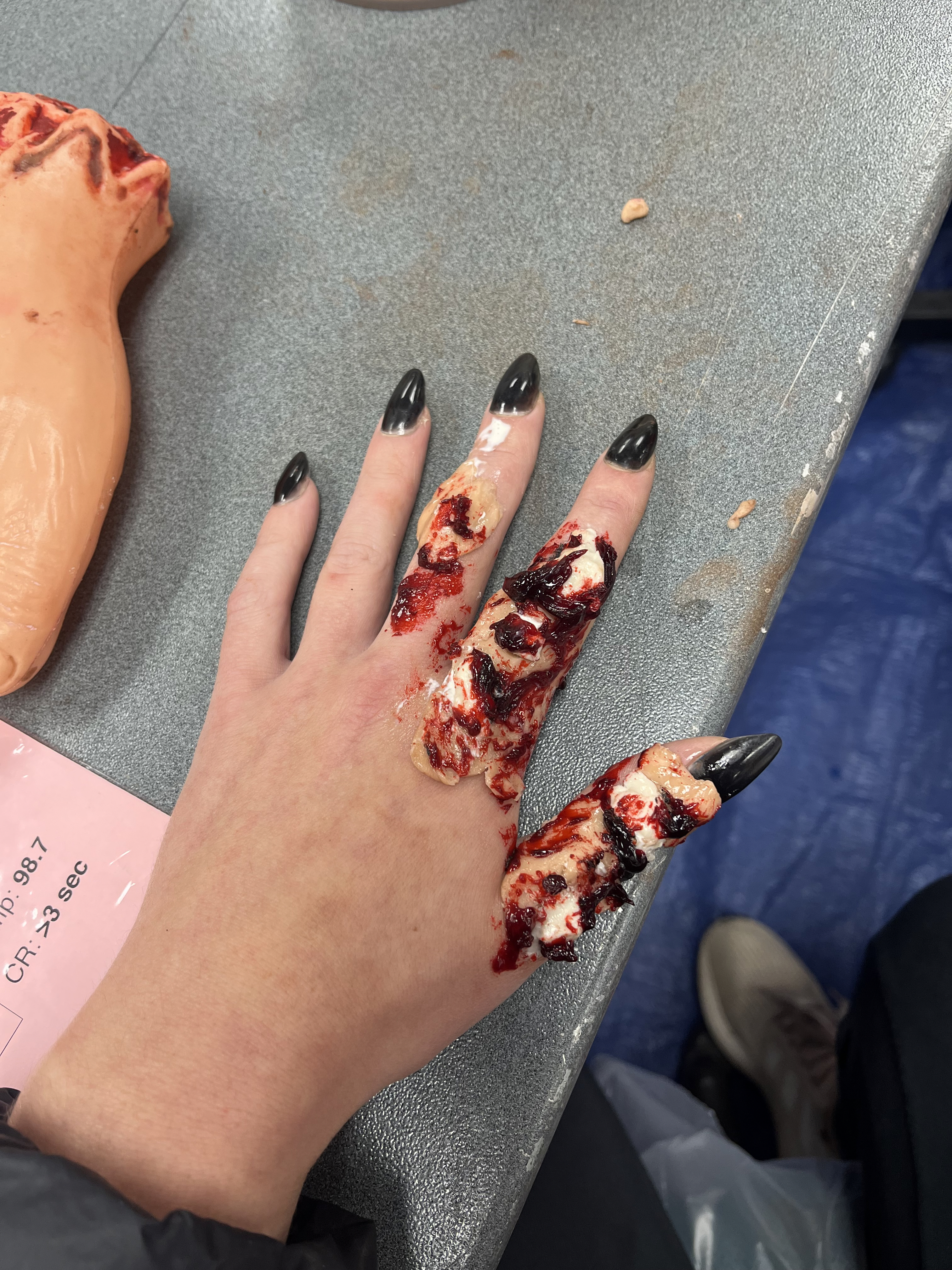
I enjoy doing moulage, and I do it well. I know I do it well because I get a lot of compliments and attention for it. Doing moulage gives me a boost. I get high from the attention.

Trigger warning: Below is a simulation of a crushed hand:

.

.

.

.

.

.

.

.

.

.

.

.

.

.

.

.

Back to writing:

I enjoy writing, too. I’d like to believe I do it well, but I get little feedback from publishing my writing. Few people have read my three Kringle novels, my fantasy romance novel, or my Vella serial. I’m not sure this has to do as much with my writing as the whole struggle to get the word out about my writing. I’m not good at putting myself out there because I feel insecure about my writing in a way I do not about my moulage. A vicious cycle, apparently — no praise means insecurity; insecurity means I don’t push myself forward; not pushing myself forward means no readers; no readers means no praise.

I need to find a way out of the vicious cycle, because I want to have the relationship I have with my moulage with my writing, something that I both enjoy and which feeds my need for recognition (which is a small thing, actually). I’m willing to entertain ideas …

Missouri Hope Arrives

When I’m not a professor or a writer, I’m a moulage artist.

I do this work 2-3 times a year, making up volunteers to look like accident victims sporting injuries from broken legs to burns to drowning to long lacerations. It’s illusion, done with wax and grease paint and fake blood (there are good fake blood recipes at the link).

The big event of the year is Missouri Hope, three days of training in the rough for undergraduates, nurses, and emergency personnel. As the moulage coordinator, this takes a lot of preparation — inventory, ordering, prepping materials, and taking a deep breath and hoping I’ll have enough volunteers to help (recruiting is not part of my duties).

It starts this evening. I will have dinner with my fellow staff, from team and lane controller/evaluators to logistics and operations staff to our catering crew. I know many of these people from the university and from previous exercises. One of them is a current student of mine; another a former student. One is my husband. I feel at home in this crowd, which is part of the reason I’ve been doing moulage for 12 years.

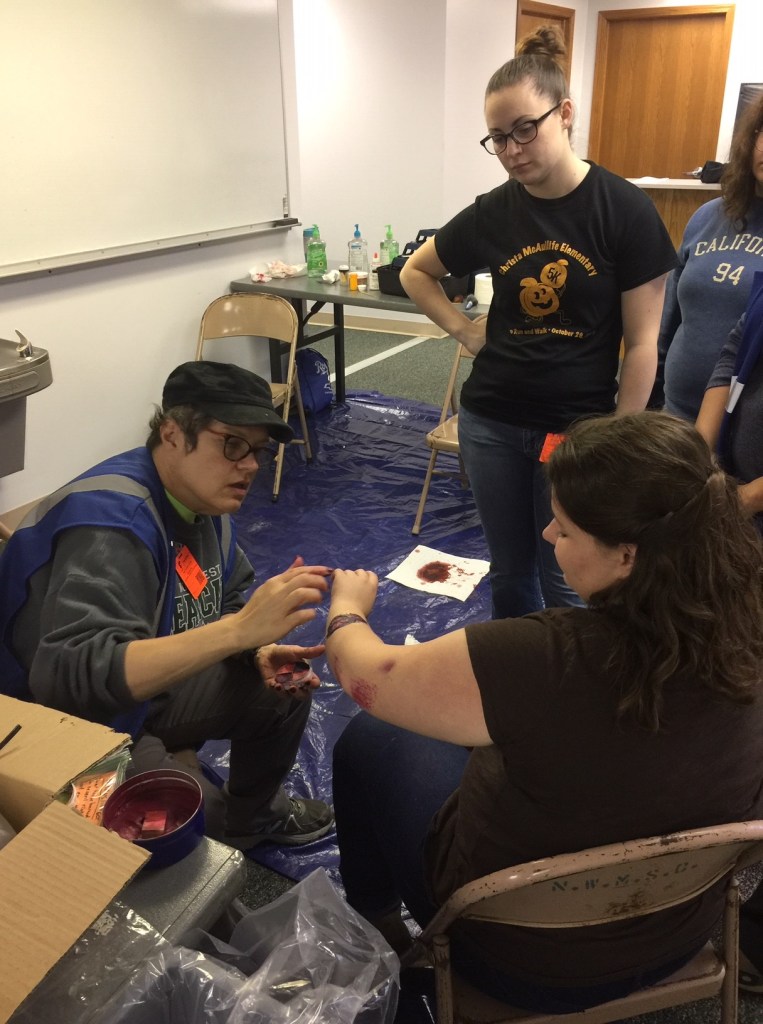
This is me doing moulage. It’s my least gory picture.

I’ve gotten to where doing moulage is second nature, and I can do it pretty quickly. I can’t do it too quickly; injuries like lacerations and breaks require a layer of wax followed by a layer of latex followed by a layer of castor oil followed by a layer of makeup.

I have all my supplies (except the castor oil I’m hunting for) ready to go. The fun starts tomorrow.

Progress on the Work in Progress

I have been working on preparing the Christmas romance novel Kringle on Fire with Richard, and we are way ahead of our goals. We are adopting a variation of the method I use to plot a book:

  1. Use a Scrivener template (Romancing the Beat or other variants on the Save the Cat method). I do this because I want to make sure the story develops as expected by the reader.
  2. Write character sheets for each character with appreciable dialogue (Scrivener has these).
  3. Use the writing template in 1) to lay out descriptions of action at each plot point.
  4. Write the book using these plot points as guideposts.

This is the writing method known as plantsing — neither as structured as planning, nor as free-form as pantsing (aka flying by the seat of your pants). We’re planning a bit more than usual because I want to make sure that Richard has enough input into the book to justify co-authorship. (In other words, I want to work his butt off.)

Photo by Alexander Zvir on Pexels.com

The goal: a decent plan by November 1st so that I have a foundation to write this book. And an enjoyable November listening to Christmas music and writing.

Writing with my Husband

My husband wasn’t kidding when he said he wanted to co-author my latest romance novel with me. Honestly, I thought he’d beg off on strategizing sessions, but he’s been meeting and working on a brief chapter outline with me. We’ve been through the outline for the first time and are going to add more detail. I rarely make my outlines in this much detail, but with the two of us working on this, I feel we need more guidance.

The way Richard and I work together is that I, with more knowledge of romance writing (and possession of the computer, scrivener, and template), lead and type our responses. Richard largely functions by suggesting ideas, which I reject or accept.

Photo by J carter on Pexels.com

The writing part is going to be mostly me, with Richard critiquing and suggesting as we go along. We’re going to argue because we’re both headstrong. But he has fresh ideas and I have the knowledge and the worldview, so we think we can get the novel done together.

The novel’s plot: two twenty-somethings, one with a toddler, wonder if they can manage adulthood. Their uncertainty is what’s keeping them from falling in love. The theme of the book: You are enough. We are enough. The background: Christmas in a small, quirky college town.

I’m looking forward to writing this.

My New Book Drops Saturday!

Time has flown by so quickly! It seems like just yesterday that I was writing It Takes Two to Kringle! Truthfully, it was last November, but I haven’t kept track of the time.

It’s time, however, for me to release the book into the wild. So, on Saturday, the third book in the Kringle Chronicles, a series of holiday romance novels, will be available for sale on Kindle. This book features enemies to lovers, faculty romance, a quirky small town, a challenge, and Santa Claus. And Krampus. (Let’s not forget Krampus!)

Check out this book and treat yourself to an early Christmas!