Is this depression?

I am fighting a down mood that may or may not be depression. The seasons can set people with bipolar up with either mania or depression, and this article suggests that there is definitely a link between manic or depressed state and weather.

I won’t know if it’s a true bipolar state until I’ve held it for two weeks or more. This came on rapidly on Friday, and it’s hard to tell whether it’s an actual mood swing or just me beating myself up over something. I can be negative on myself sometimes. Or it could be a bad few days, which I’ve had. Or it could be burnout, because a lot of us in education are going through it after COVID.

So I’m resting and being patient with myself. I’m accepting that maybe the inner nagging voice is right and I’m a bad teacher these days, but I still have worth as a person. Maybe that will get me through.

Irked With My Computer

My Surface Book 2 just bricked itself. The replacement I got six months ago is. not. working.

I know it has to do with the base. After all, the keyboard wasn’t working and the power in wasn’t working either. And because the keyboard wasn’t working I couldn’t take the computer off the base. And it ran out of power before I could save my current files to Dropbox, so my querying files are sitting on a dead computer.

I am not happy. I am writing on another laptop, not really mine. I don’t like borrowing laptops for my creative work. I really don’t like an out-of-warranty computer to fail miserably. I have to figure out what to do instead of querying some agents by email (I use Query Tracker to find agents) in my free time today. Luckily I don’t have a lot of free time to occupy.

What’s next: I’m hoping that we decide to: 1) get me the new computer I’m wanting, which I can get cheap; 2) Get this one fixed; 3) Give it to my husband, who doesn’t need all the bells and whistles I need, and it’s newer than his. We may just find a way to get this fixed and stay with our current computers. This may not be fixable (although I’m pretty sure all we need is to get this off its base and switch in a new base — fixing it would cost about $500 for the base and labor. (Is it worth putting $500 in a used computer when the new computer costs $900 on sale?)

So that’s how my day is going. Hoping it goes better.

I need a Spring Break

I have Spring Break next Friday. Yes, that’s it, one day of Spring Break. I understand the reason — the university doesn’t want the students to go out to Palm Beach and bring back COVID. But, ironically, the city has repealed its mask ordinance, and the students are having unmasked parties every weekend.

That week in the middle of the semester was an opportunity for faculty to recharge. Even with vacation spots still risky, we could sit at home and not do work-related items for hours at a time. Not answer student emails for a week. Not attend meetings. Time to write, sleep in, and occasionally do nothing.

There’s no use in complaining about something that was put in place for the right reasons. But the students are burning out, the faculty are burning out, and between COVID and working, I just want a break

Photo by Peng Louis on Pexels.com

My Family’s Curse

I believe that families have curses; however, what I mean by curse is a way of thinking, believing, or acting that hinders coping, relationships, and outlook. For example, a family that keeps trauma bottled up creates a dysfunctional habit that will pass from generation to generation.

My family’s curse is a killing of joy, a pervasive belief that joy is dangerous because good things never happen. For example, suppose there is a child who is looking forward to their birthday. Their grandmother says in a sepulchral voice, “Don’t look forward to anything; you’ll only get disappointed.” The child integrates this world view and passes it to their optimistic children so that children strangle their joy and grow up with the dreary world view.

Photo by Karolina Grabowska on Pexels.com

I have only partially internalized the curse; I feel elation every time I write queries for a book of mine. And then the family curse wakens in my mother’s voice and version: “My grandmother said you should never look forward to anything, because you’ll only be disappointed.” Her version of the curse invokes a matriarch whom I have never met, but stands as the forgotten fairy at the christening delivering the curse.

The faulty curse wobbles around in me — I feel hope and elation, followed by guilt I should feel this way, and caution in my mother’s voice: “Don’t look forward …” I do not hug the family curse as a reality I should adopt, but it has not died in me either.

Staying Positive

I deleted my last entry because it was not very positive. I was writing about the querying process, and like many others who have gone through the process, I was dwelling on past rejections and declaring failure before anyone even read my queries.

For those of you who are not writers, querying is a formalized process for authors to court potential agents. The author assembles a packet according to the agent’s instructions, which usually includes a biography, a cover letter, and an excerpt to a book. Other things might be asked for, like comp (comparable) titles, a pitch (a one line teaser for the book) or “where do you get your ideas?”

Photo by eberhard grossgasteiger on Pexels.com

To query, one must become accustomed to rejection. It is certainly not recommended to those with tender feelings or those without a growth mindset. Even now that I’ve done this before, my optimism is tempered with a cautious self-protection.

I have sent out 10 queries for the book Prodigies, which is a New Adult contemporary fantasy. I have revised this book a great deal from the first time, having learned more about the shape of a novel.

Wish me luck.

What I Did Today

I’m writing late today mostly because I got sick this morning. It’s a work-at-home day, and I’ve been working at home between trips to the bathroom. I’ll take my temp in a few minutes to see if I should worry.

However, I also wrote a synopsis for Prodigies, a novel I feel compelled to query because of the change of branding from fantasy to New Adult fantasy. It fits better there because it’s kind of a coming of age novel, with the teen protagonist having to navigate uncomfortable truths about her life.

Here’s the synopsis:

Grace Silverstein, an eighteen-year-old viola prodigy at a prestigious high school for the arts, flies to Poland to participate in an international assembly. Her hosts, including Dominika Wojcik and her young daughter Anastasja, plan to kidnap and coerce the prodigies under a flimsy mask of hospitality. Grace discovers that one prodigy, Ichirou Shimizu, has a preternatural talent for manipulating moods through his graphic designs. When the evening banquet takes on menacing undertones, Grace finds a friend and protector in Lord Mayor Przemyslaw Przybyszewski, who helps Grace and Ichirou escape from the hotel. With the help of a small handful of strangers, find an all-night pierogi place to hide in. Ichirou’s chaperone, Ayana Hashimoto, smuggles the two out of the country with the help of her mysterious accomplice. On their journey cross-Europe, Grace finds Ayana disturbing and Ichirou cute and annoying, and everyone seems to be keeping secrets. The three part ways at Copenhagen, and Grace dodges the hosts’ accomplices with the help of Ayana’s secret partner, Grzegorz Koslowski, another talented person who played most of the helpful strangers. He protects her until she catches her flight home.

Back in the US, Grace’s ordeal becomes a memory as she clings to her alma mater and takes a gap year before college. Then Ichirou and Ayana arrive from Japan to warn Grace that the foreign agents from her trip to Poland, as well as Homeland Security, close in on Grace and her compatriots. They fight with the vice president and president of the school, Estelle DeWinter and Beau Boren until they release Grace from her job with the school. Startled by the news and by Ichirou’s transformation into a tall, handsome teen, Grace has no idea why anyone pursues her, as she has no talent like Ichirou does. She goes with Ayana and Ichirou anyhow.

Photo by Tima Miroshnichenko on Pexels.com

While on the run, the three find refuge in a cabin secured by Grzegorz, who Ayana has not yet met; Grace will not reveal his identity.  Ichirou helps Grace discover her own talent of manipulating emotions through her beloved music. Grace realizes that she has always sensed her talent, but that the acknowledgment of her ability leaves her in doubt as to the ethics behind her augmented performances. Eventually, on the way back from Lakeview to copy music for Grace to practice her talent with, the three are ambushed by a sharpshooter who shoots Grace in the chest. Grzegorz heals her, revealing his dramatic talent, and Grace is left to ponder the miracle that brought her back to life. Ichirou helps her cope by making a soothing graphics video which helps her sleep – but brings her into the space she found when she was dying. When she has recovered enough, Grace and the others discuss the costs of using their talents too often, to discover that Grace and Ichirou endanger themselves if they use their talents too much.

The four – Ayana, Ichirou, Grzegorz (called Greg) and Grace – now are on the run again. They go to an empty cafe, where they access a working group on the Dark Web with Greg’s credentials. There, they are confronted by the proprietor of the café, who identifies himself as Weissrogue, a legendary white-hat hacker. He convinces Grace to use her talent on him, because he doubts that he has ever felt sad. After she does so, Greg rages at her and runs outside. Grace follows him, and he kisses her, then pushes her away, and Grace gets the impression that Greg is deeply damaged. Ichirou balks, feeling jealousy toward Greg and Grace. When looking through the site, Renaissance Theory, the group finds that the children with talents which have been carefully schooled (such as themselves) are called Renaissance Children, and that the group from Poland pursuing them, Second World Renaissance, plans to attack the United Nations during their general assembly.

Weissrogue, whose talent is luck, follows instructions from Pzybyszewski and hides the group in the Grand Hotel on Mackinac Island. On the way out on the ferry, however, a Homeland Security agent attempts to accost them and is stopped by Grace’s mournful song. He jumps off the side of the boat, whose personnel rescues him and holds him until evaluated by a psychiatrist. Once ashore and settled at the hotel, Grace and Ichirou venture out and find Beau Boren, who sounds like he knows about Grace’s talent; Grace gets a bad feeling about him. Ichirou and Grace return to the room to find that Ayana and Greg are in bed together. Grace runs off and Ichirou finds here and listens to her muddled feelings. Later, the four and Weissrogue deliberate whether to get involved in stopping the group behind Renaissance Theory. They decide that they will try to stop the plans for the General Assembly, with Anastasja Wojcik acting as a fire talent who will burn the assembly hall down while the others assassinate three world leaders. Second World Renaissance will use their talents’ destructive abilities to angle for Renaissance representation at the UN.

Grace and Ichirou’s talents make the centerpiece of the plan to stop the conflagration, as they both can control moods and emotions. They decide that using their gifts to stop the conflagration and murders will require they work together on video with music to be run on the screen before the Assembly while people are filing in. They meet with a record producer on Weissrogue’s list, taken from Homeland Security, of suspected talents. The record producer, William Alden, helps them create the potent video. Grace and Ichirou discover a synergy that makes them more powerful – and more connected.

Once in New York, the group puts together their strategy, which involves Greg smuggling the video loop into the audiovisual room, Ayana and Weissrogue and Grace and Ichirou creating distraction. Although this goes successfully, the Homeland Security agent pursuing them turns off the video and kidnaps Grace and Ichirou when they try to put the video on again. Once they have persuaded the agent, Walter Adams, to help them, they run into the assembly room. They find the room occupied by members of Second World Renaissance and their soldiers. Amid the chaos, Grace sings while the others try to stop the attackers. One trains his semiautomatic on Grace, and Walter Adams shoots him to death. Greg brings him back to life, and his allegiance flips. Grace’s song, amplified by Ichirou’s synergy, moves the audience to fight against the attackers, and they are overwhelmed by numbers. Greg stops Dominika and the reluctant fire talent Anastasja from setting the curtains aflame; Dominika reveals that Anastasja is his daughter.

In the aftermath, several things are revealed: Beau Boren, President of Lakeview School, is a member of the Renaissance Theory group with hopes to deliver Grace to Second World Renaissance. Estelle DeWinter knew this and was trying to protect Grace. Przemyslaw Przybyszewski has been more than Greg’s benefactor, being involved in an anti-Second World movement. Greg and Ayana finally get together when Greg finds out Ayana is carrying his baby, and Ichirou and Grace finally admit their relationship.

Book covers

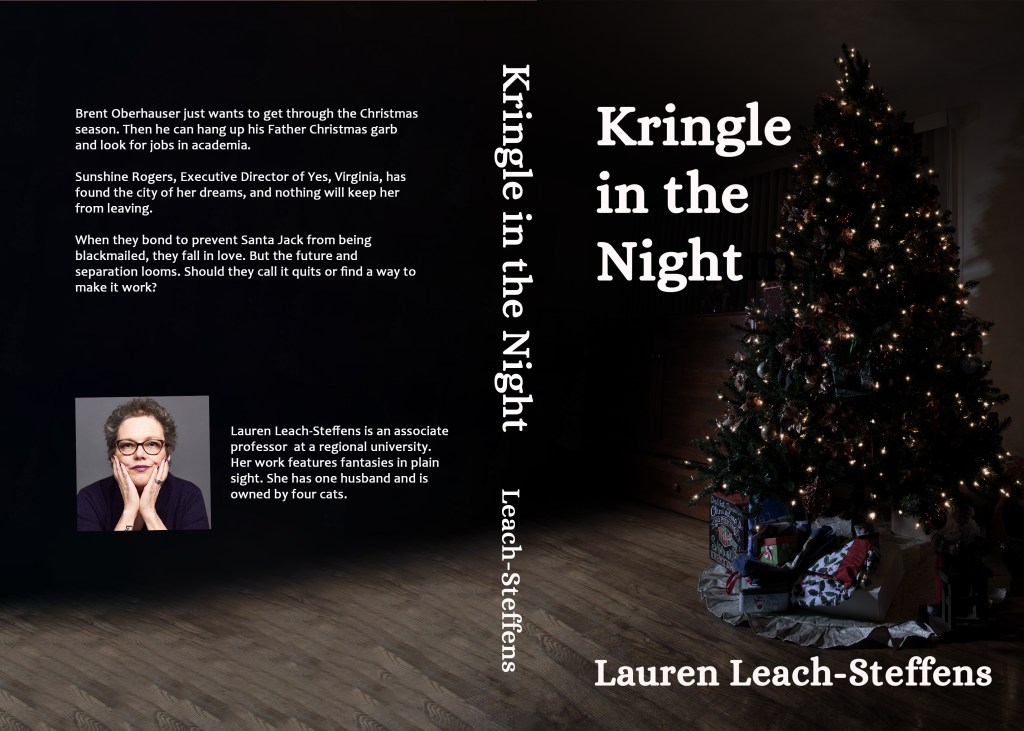
Yesterday I spent my morning making a book cover for this year’s Christmas romance, Kringle in the Dark. I can’t draw to save my life, but I can work pretty well with photos and Photoshop, which works fine with the Kringle novels. Get the rights to a picture, tweak the photo, set the photo just right. Make the back cover with cover blurb. Orient the spine title/author verbiage.

Here’s the mockup:

It was a stroke of luck getting the photo to expand to the back cover; I’m not sure I will ever be able to do that again.

“Where do you get your ideas?”

Photo by Pixabay on Pexels.com

This is the question every writer gets asked. Usually the response is vague dread, because many of us don’t know on the spot where we get our ideas. The answer comes only after a good session of introspection, and at the moment the question gets asked, we can’t reflect on the question rapidly.

Over the years I’ve done this introspection, and these are the answers I’ve come up with:

  • From other books I’ve read. But I need to be careful not to plagairize.
  • From dreams/daydreaming. This is my favorite source. I often take a dream and interpret it using Jungian methods, which I call interrogating the dream.
  • From conversations with my husband, which often start with “What if?”
  • From observation. I don’t know if I’ve ever written a story entirely from observation, but scenes and characters often come from this
  • From what I’ve written previously. Sequels!

Sometimes I don’t have any ideas. Right now I feel like I need to write a new novel (after revising a couple) and I don’t have any ideas. Ok, actually, I have three ideas based on series I have going, but I don’t know how excited I’m getting about them. Not all ideas are workable:

  • One of the books would require living in Poland for at least three months to get the flavor of the place. I have no money, no knowledge of the Polish language, and no tour guide.
  • Another which is part of my Archetype universe, and for some reason it’s not grabbing me.
  • Yet another in the Archetype universe that’s too nebulous to write about.

I think I need some dreams or daydreaming right now to inspire me. My dreams last night were stupid and not worth writing about. In my dreams, an actor friend of mine got a nose job and I got really angry because he had succumbed to dominant culture beauty standards. That’s it. Unless I’m writing a warped version of The Picture of Dorian Gray, I don’t see much use in this dream.

So where do I get my ideas? Sometimes, nowhere.

In Love with Social Media

I’m having two conversations at once — one with a woman I have never met, the other with a man who is 13 hours away. These are the wonders of social media.

It’s because of social media’s ability to transcend place and time that I survive through the COVID era of distance and extreme caution. I am not an extrovert, but I love real conversations, the ones where you get beyond “how are you” and into things like culture, beliefs, and stories.

I was on social media in the 80’s, before there was social media as we know it. In college, I spent time on the PLATO system, which was mostly an educational system with functions that were used as social media as well as instructional communication. We had what we called “notesfiles” (which became Lotus Notes, and influenced later social media) which would be equivalent to Facebook’s Groups and subreddits. We had chat, known as term-talk, group chats — anything familiar to today’s social media user.

What PLATO didn’t have was a beautiful visual interface, instead having a line command interface much like pre-Windows computer; the ability to go to other sites to do research, and access to dating sites (although this is arguable; I had gone on two or three blind PLATO dates before Match.com existed. We didn’t worry about this, because were were a close-knit community, even though some of us were states away.)

Today, social media is so much more amazing than I expected it would be. Beautiful visual web pages, sites and apps that can facilitate sharing lives (Facebook), sharing pictures (Instagram), bond with video clips (TikTok), date (numerous, but I met my husband on Match.com), or become a base and despicable being (4chan).

And today I can open up the world with social media. I become just a little more cosmopolitan, vicariously.

My Wedding Anniversary

Today I have been married for 14 years. Given that I’m 57, that means I got into the game relatively late. This is not surprising, because I’ve always been a late bloomer.

I probably haven’t introduced my husband sufficiently. Richard is five years younger than me, and another late bloomer. He’s a delightful match for me, being nerdy, bookish, funny, and very tolerant of my mood swings. Here is a picture of us from our wedding. We look older now.

We got married on St. Patrick’s Day, mostly because it was the first Saturday of Spring Break for me. I’m part Irish (and part everything else in the Caucasian category) and Richard is not Irish, being biracial Chinese/German. So we made Richard an honorary Irish person. Our engagement rings are Claddagh, and our wedding rings are Celtic knotwork in honor of the wedding date. Richard laughs when anyone asks him if he’s Irish, though.

It’s been an interesting 14 years. Three job losses, one psychiatric hospitalization, one house move, and COVID. A lot of laughter, house projects, and trying out Asian restaurants. Eight cats, three dying cats to stand vigil over, both our mothers dying. Bad puns. Problems solved.

It’s been an adventure so far, which is what marriage should be. Someone to help survive the hard moments, to grow with, someone to share the good moments with, someone to grow with. I finally found this with Richard.