Self-Sabotage?

I am 15 days from my latest not-so-big audacious goal, writing in this blog for 365 straight days. Yet I keep forgetting to write! Luckily, I catch myself before the day is over, but all it would take is one day of forgetting entirely, and I would be back at zero.

I don’t really like all or nothing goals like this. They’re less about performance than persistence. ButI’ve been doing this blogging for 350 days, so…

200 Days in a Row

I have posted in my blog for 200 consecutive days. I have learned something from the process, mostly that if it weren’t for the post topic prompts in WordPress, I would never have written in my blog for 200 consecutive days. My mind doesn’t have that many topics to write about, especially in a busy semester.

Photo by Alexander Grey on Pexels.com

I have also learned that the badge that I get daily: “You’re on a 200 day streak on Words Like Me!” is a far better motivator than I had guessed. Gamification is real. The tyranny of this little message drives me to post another day.

I don’t know how much longer I am going to write daily. I feel sometimes like I have nothing to say, or that people don’t care what I’m saying. Writing is a lot like that, though, sending words out into the world not knowing what impact, if any, they will have. On the other hand, 200 days is an awesome streak, and who wants to ruin that?

WordPress is a Mystery

How popular is WordPress as a blog, anyhow?

According to this source, WordPress.com users published over 52.3 million blog posts and more than 4.9 million web pages in January 2024. That’s nearly 2 million a day.

I didn’t realize that WordPress was so big. How does anyone get their posts seen? How do people occasionally find my page? I guess it’s all about hashtags, but I don’t know that my hashtags are all that special; yet I sometimes have those moments where sixty-something people find me. Even yesterday, 15 people found an older post of mine. How did that happen?

I suspect to really be seen, I would have to spend money on their SEO tools and advertising. I don’t have the budget for that, especially for the fact that this is not where I advertise books (at least not very often). I’d have to be a lot more serious and intentional for this blog to be something I promote. I guess WordPress’s workings will just have to be a mystery to me.


Hostinger Tutorials. (2024). Top 23 WordPress Statistics: Defining Trends and Insights for 2024. Available: https://www.hostinger.com/tutorials/wordpress-statistics?gad_source=1&gclid=CjwKCAjwl6-3BhBWEiwApN6_kgCefZ7YZq2h_l318pel9KTNgBKulOMO8vnDd-9-fbWuZwLA7sNG_hoCPdYQAvD_BwE [September 19, 2024].

A Lack of Pattern

I’m trying to analyze which posts of mine are most successful — prompted posts? My own ideas? Short posts? Long post? Personal posts? Posts about writing? I have come to the conclusion that I can’t predict what will get me more viewers.

Dice on grey background

I’ve always thought prompted posts performed better than non-prompted posts, long posts better than shorter posts, and posts about writing better than personal posts.

Yesterday, a short prompted post about what personality traits I disliked — with no title — performed better than any post I’ve had in the past couple weeks. This is expected because the prompted posts appear to get more circulation. Yet I’ve had other prompted posts only get as many likes as one I’ve written without a prompt.

My best performing post of all time had to do with my wedding anniversary. Other posts (even about birthdays) have gotten little attention.

There seems to be a randomness to what plays well and what does not, which means I’m learning nothing about how to improve my traffic.

The Tyranny of the 24-day Writing Streak

In WordPress, I click on the purple bell at the right corner of my home page to find the announcement:

You’re on a 24-day streak on Words Like Me!

I never intended to blog for 24 days straight. Normally, I don’t have enough ideas for 24 days in a row of content. But after the first four days of steady content, I found I didn’t want to break my writing streak, and so I kept writing. Now I’m looking at my 25th day, and I feel chained to my laptop for the next update.

I am naturally a competitive person, and the person I vie with is myself. Write a novel? (There was a time when I had never written one, and that was only 12 years ago at age 48.) Walk 60 miles in three days? (I’ve done that too, at age 40.) So that writing streak counter in WordPress makes me want to write another day.

The horrible part is that if I decide to not write one day, my streak goes down to zero. That didn’t bother me when I only wrote every other day. A 1-day writing streak broken doesn’t feel like a tragedy. A 100-day streak? Or even a 20-day streak? Much more impactful.

Oh, no! What if I run out of words?

My husband assures me I will never run out of words, as I have never managed to during long car trips. (He’s correct.) But what more do I have to say about writing?

I haven’t let you read any of my writings lately. That’s certainly one thing I could blog about. I haven’t written down a character interrogation lately, either. Or talked about any one of a dozen other things. I want to stay interesting, though, which is a pressure that almost equals the pressure to write another day. Almost.

I’ll write daily as long as I can stay interesting, and I’ll try to write about writing as much as possible, because I think it’s more interesting than hearing about my very uneventful life.


Blogging as a Writing Ritual

Lately, I have been blogging in the morning before I write (or edit), intending to use it as a warm-up to those activities. So far, it has been working well.

One thing it yields is a daily blog, and my regular readership has increased from four people to ten. I’m not sure what it takes to get my readership up further. But I’ll take any improvement I can get, so thank you readers!

Another thing it yields is more reflection on writing as a discipline. This helps me to think of myself as a writer. It’s strange; I rarely think of myself as a writer, just as a person who has a habit of telling stories to myself. But saying “I write my blog as a ritual before I sit and edit” makes me feel like a writer.

But the biggest reason for the blogging ritual is that it warms up my mind for writing/editing. It signals to me I need to focus on words. Even the suggestions ProWritingAid makes to my writing help me warm up.

There are other ways I could warm up, but blogging efficiently yields a useful result. And you get to read it.

Sunday morning with coffee, cats, and blogging

ย I write this blog every day with coffee. I sit on the loveseat in my living room, surrounded by cats, sipping on my coffee (cream, no sugar) and typing.ย 

Today, on a Sunday, I move more leisurely because I don’t have to go to work. I get started writing a bit later, and I have more time to enjoy my coffee. The coffee, homeroasted, is aย Costa Rica Helsar Macho Arce with orange and walnut notes.ย 

This is the coffee we’re drinking.


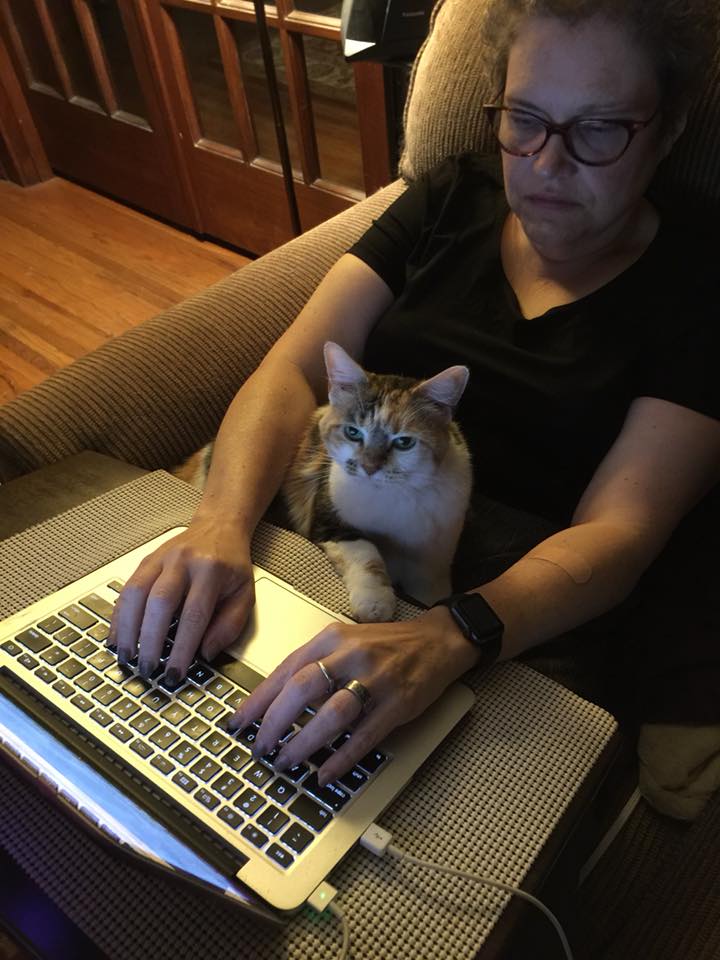
Right now, Girlie-Girl (a grumpy calico aged 15) sits to my right, next to the trackball. Chloe (the fiesty little tortoiseshell, plays at my feet. Me-Me (the needy dilute grey and white), jumps on and off the back of the couch. She’ll be back soon.) Chucky (the huge orange cat) minds his own business.

I don’t plan what I write; rather I search my mind and my soul on what I want to say. If I had to plan every day, I would not be writing every day. It would cease to be fun and relaxing. I have enough things in my life that aren’t fun and relaxing.

My husband updates me on the upcoming weather; it looks like we’re getting 8-12 inches of snow Monday and Tuesday. I work from home Monday; the storm may mean I work at home on Tuesday as well. Regardless, I will have my morning ritual of coffee and cats.

And here’s a picture of Girlie helping me write the blog.


So You Want to Write a Blog Part 2 (Personal Development)


So, I have a blog now. Do I just write?
Not exactly. You have to think about what you write. It needs to fit your theme and audience — if you’re writing to writers about writing, writing about politics will probably feel “off”.ย You can be an essayist in your blog and write about whatever crosses your mind, but it may be harder to convey a theme in your blog.ย ย On the other hand, John Scalzi, a science fiction writer with a multi-book contract, writes about everything from writing to politics. His blog, fittingly, is called Whatever. If you’re as big as John Scalzi, you can write whatever.

How do I know what to write?
If you have a theme and an audience, you’re doing them no favor by just free-writing. This is your personal/professional presence on the Internet. If you’re a writer, it’s a chance to market yourself. You can compose directly on the screen, but compose. cut and paste to make the document flow. Proofread. Read it aloud to yourself like any other document you want to write to impress people.ย 

The blog should not be too long, in order to cater to today’s readers. I’m divided on how excerpts of novels and short stories should be presented in blogs, but I think that short excerpts are the best.

The 29th Annual Edition Guide to Literary Agents 2020 (Brewer, 2019) suggests that one should have a list of topics for six months or a year. This works great if one writes weekly; I write daily (which is insane, but so be it). I do have a list of weekly topics, but intersperse those with more personal observations about being a writer.

Other suggested tricks
The 29th Annual Edition Guide to Literary Agents 2020 (Brewer, 2019) has a chapter that presents several other reader- and SEO-friendly suggestions for blogs:

  • Short paragraphs and headings, as you see here. This works well for informational blogs; not so much for narrative.
  • An SEO tag in the title. I have a few that I use for my blogs, although I sometimes forget these because they’re new to me.
There are probably more tricks, but I haven’t learned them yet. I am still working on getting readership for this blog, but it may increase after I get published (I hope).ย 


Reference:
Brewer, R.L., 2019.ย The 29th Annual Edition Guide to Literary Agents 2020. Writers’ Digest Books.

So You Want to Write a Blog Part 1 (Personal Development)


Writing a blog is an admirable pursuit. It’s also a lot of fun. But randomly throwing blog posts into the ether is not rewarding, and the thrill will be gone soon.

Over the next couple days, I want to explore the things you need to do to start a rewarding blog.

First, find a reason/theme/audience. These options have similar aims: to focus your writing. This gives your writing a particular “brand” for people to follow. For this blog, my theme is writing, and my audience is writers and potential readers. (This latter purpose will step up when I get published). Despite this theme and audience, however, I estimate 50% of my readers right now are not writers, but may be potential readers.

Commit to writing. Continuity is one reason that people come back to a blog. Many writers commit to weekly blogging; that’s a reasonable amount. For some reason, I write daily. I’m not sure this is a good thing, but one of my reasons for writing this blog (other than what’s given above) is to warm up and sharpen my writing skills.ย 

Find a platform. Commonly used platforms are Blogger (where this blog is), WordPress, Tumblr, and Wix. Each has advantages and disadvantages; some have access to more options in the paid version.ย  I have used Blogger and Wix; I use Blogger because of its simplicity and because, when I tried to migrate to Wix, my readers didn’t migrate with me even though Wix has a superior visual interface. But which one you choose is up to personal preference.

I will explore further blog-writing ideas and tips in the next installment and would welcome your ideas and tips in the comments or by email: lleachie@gmail.com

New Year — and changes in the blog

Happy New Year!
Welcome to 2020. I had a pretty peaceful year last year, and I’m hoping this one is more fruitful. How about you?ย 
ย ย 
What’s with the Headings?
You might have noticed the format of this blog post has changed.ย 
I’m trying to learn a new trick for the New Year, and that is more effective blog posts. I just got a copy of Robert Lee Brewer’sย  29th Annual Edition Guide to Literary Agents 2020ย (2019)* and I’m using his material to up my social media game.

A couple of things Brewer (2019) suggested in blogging were: 1) shorter sentences; 2) headings 3) clip art.ย 

How will this affect blogging?
So far, this has been a big change in my blogging, because I have to pause a lot more and think. It’s going to make blogging a lot different, because my almost stream of consciousness blogging will end. But I guess this caters to people’s actual attention spans online.

For you, the reader:

  1. Could you let me know how this is working for you? Like, dislike? I’d love to hear from you!
  2. Check out the book below. Here’s the link: Guide to Literary Agents 2020.


Reference:
Brewer, Robert Lee (2019) 29th Annual Edition Guide to Literary Agents 2020. Penguin Random House.ย ย 

* About that discrepancy in dates — American Psychological Association style requires the publication date included, and since today is January 1st, 2020, the book had to be published in 2019.