Writing about Writing about Writing

Sometimes I write about writing. I don’t do this nearly as often as I should, because I don’t have meta-thoughts about writing that often.

I could write about exposition, for example. What wisdom do I have about exposition? Only the big one: Show, don’t tell. And the not so big one: Conversations can be a form of exposition if you’re not writing things like “Did you hear about Betty? She ran off with the milkman last week.”

I could write about writing characters. Where do my characters come from? They come from an amalgam of people and stories I have known. Then I “interrogate” the character to see if they feel consistent in who they are. I have conversations with the characters, I put them in situations. I talk to my husband about characters — for example, “Would they talk back to the police?” Gideon would; he tends to be human and somewhat anti-authoritarian. Most of my Archetypes and Nephilim would never talk back lest they be discovered. They’re not quite immortal, after all, and they would alarm the authorities. Luke would talk around the cops, though. He’s a lawyer, after all.

I want to write about this guy next.

I could write about publishing. There are many steps to publishing yourself; some of them go surprisingly smoothly, like most of the process on Kindle Direct Publishing (KDP for those in the know). Others become a great source of frustration, like putting my book cover up on KDP.

I could write about hitting it big as a writer. No, I can’t, because I have not hit it big. Nor is it likely that I will, but that’s okay. I have a story to write, and it nags me at night. My characters (Sage Bertinelli and Forrest Gray at the moment) demand to be written.

I need to write more about writing, because there are so many topics … thank you, Hannah, for obliquely suggesting this!

… I need to write it anyhow.


I think I’m finally to the point where I can write about Jeanne and Josh’s unusual romance. I can tell because I’m getting a crush on Josh. Don’t you get crushes on your characters? 


Josh is not a typical romance hero — he’s slight, he’s young (25), he’s a mild-mannered instructor of English. He’s a pacifist, he has second Dan rank in aikido. He’s half-Chinese. He practices folk Shinto and believes in spirits.


Jeanne, to be sure, is not a typical romance heroine — she’s a professor of botany who climbs on her soapbox occasionally to rant against factory farms. She’s 45. She’s zaftig and can lift 50 pounds easily. She’s eminently practical.

I know they’re not the romance characters women want. But maybe they’re what we need. I wanted representation of the people we don’t see in romance novels — big women, slight men. Asian men. Brainy women. Some role reversal. Nerds in love. Unlikely heroes.

I know this will probably never sell, especially as it’s also fantasy. But I probably need to write it anyhow. 

A character sheet for Josh


Sunday morning, classical music playing, fresh-roasted-and-ground coffee (courtesy of my husband) and a cat next to me. What more could I want?


I want to get back to writing about Josh and Jeanne, and I’m still struggling. The old Josh was problematic, and so I’m doing some tweaks to the character, and I’m not sure who he is yet. I know his basic stats:

Age: 25

Appearance: about 5’7″, slender build but physically fit due to bike riding and aikido; brown-black hair that threatens to fall into his eyes, dark brown eyes, wide but almond-shaped. Half-Asian. Moves gracefully. (I have no picture of Josh. I know what he looks like from doing one of those fun internet searches that writers do, but I don’t think it’s right putting up a pic of a real person here.)

Speech: Thoughful, tenor voice; frequently tinged with humor

Personality: Calm, a little reserved, friendly. Perceived as “a really sweet person”.  Tends not to show anger — most of the time. A bit bookish; perhaps a little eccentric (see below)

World view: Josh believes in folk Shinto, a belief system where objects of nature, such as trees and rocks, possess spirits or kami. As such, he believes that Jeanne’s “green thumb” comes from kami who are attracted to her. This remains to be seen. As a practitioner of aikido, he is also a pacifist, but will defend himself and other people.

Vocation: He is an instructor of creative writing at the University where he did his undergraduate work. He’s pretty new at teaching, and makes hilarious mistakes at times. He is the faculty advisor of the Slam Poets club, having once been a member. He thinks about getting his PhD and becoming a professor, believing it will give him more flexibility in the job market.

Hobbies: As said before, he is a practitioner of Aikido, having reached 2nd Dan. He writes poetry and stories in his spare time, and uses a bike for transportation three seasons a year. 
Mannerisms: brushes hair out of eyes.

Favorite saying: Some things defy explanation.

Family: Only child. Father — Doctor; Mother — now working part-time at a florists shop. Mom is underemployed, as she is very artistic. Relationship to father is close but reserved; relationship to mother is slightly difficult because she can be nitpicky. He has cousins on both sides of the family, but both sides are older than him and not close.

************
This is all fine and good, but I have to make a more complete character out of him.

There’s more, there has to be more. This is the part I’m struggling with: this is a romance novel. How does he deal with falling in love? (I’m expecting he sits in the friend zone and things happen slowly until “Oh, wait a minute, where did this come from?”) But how romantic is that really? Does it matter?

I’m a bit more bewildered when it comes to sex (although I’m not going to get explicitly sexy in this book). I’m assuming he’s a virgin because he wanted to be deliberate in his choice and because he has the patience to wait. I also assume he’s read up on it. A lot. So he wouldn’t be totally ignorant, but a bit clumsy.

*************
What’s missing is actually writing in the character’s voice. I’m not sure I have a feel for that yet. 


The Incomplete Dev Edit

Right now I’m adding for chapters to the beginning of Prodigies, in order to reveal the character better and capture more of the spirit of Save the Cat (in other words, placing the character in her before life, setting a theme, introducing a debate).

What frustrates me is that this book went through a dev editor, and I in good faith thought that I had done what I needed to in the book, only to be tipped off by a thoughtful agent who rejected me: “I loved the beautiful description you started with, but I lost interest in the characters.” I had to figure out for myself, given what I recently learned about plotting from Save the Cat, what I needed to do. This is something I couldn’t have figured out myself, given my familiarity with the characters, and something I needed the dev editor to pick out for me.

I’m ashamed that I sent this out to query with this kind of flaw in it. I have found similar flaws in other books of mine — I start right into the action, and apparently this is bad. 

I wish someone had told me.

Meet Sunshine Walton

As I peered into my computer screen, a low and modulated voice broke into my reverie. “May I sit down?”

I look up, and the cafe became solid again. A tall, slender woman with brown skin and fine black braids pulled into a sleek bun stood with her hand on the back of the chair facing me. She is dressed in a red skirt suit with sensible black heels. Her air of calm competence left me feeling a bit awkward.

“Sure,” I said, nodding to the chair.

She reached down to shake my hand. “My name is Sunshine Walton. You asked to see me?”

Oh, I thought. Oh. Of course I had asked to see her. I had thought I needed to see my characters for my latest book more clearly. I hadn’t guessed … “Yes — yes. I did ask to see you. I just didn’t expect you so — quickly.”

Sunshine smiled bemusedly. “Did you want to ask me some questions?” She sat straight, almost primly, in her chair.

“Yes. What is your background?”

“I’m a military brat.” She sobered. “I think we moved five times by the time I finished high school — no, six. ” She chuckled, a low pleasant sound. “I got to see the world. It was a strange childhood. It was hard to get to know anyone outside my family, because then they’d leave, or we’d leave. It was a vivid and lonely childhood.”

“Any romances in your life?” I wasn’t sure that was a good question to ask, but I asked it anyhow.

“Oh, I had a grand romance in high school — that was ages ago …” Sunshine chuckled. “I was convinced he was the love of my life, and then — “

“Then what?” I asked impatiently.

“We moved again. Apparently it couldn’t last long-distance. He never wrote. Since then, I’ve been too busy to have a relationship — college, finding a job in my field …” Sunshine gazed in the distance, then shrugged.

“What is your field?”

“Accounting. But I also have some management skills. I think I have an innate talent for management, but I thought accounting was safer.”

“Safer?” I queried.

“More likely to get a job. I don’t like the thought of starving.” Sunshine raised her eyebrows. “That’s why my dad ended up in the military, I guess.”

“One more question,” I stated. “How do you feel about Santa Claus?”

Sunshine laughed. “I haven’t believed in Santa since I was seven. I guess he’s a good thing for the children. I suppose if I have kids, I’ll do the Santa thing with them, but …” Her voice trailed off as she gazed into the distance, then she shook herself.  She checked her watch. “I have to go — I have an appointment across town in fifteen minutes.”  She stood in an efficient motion, nodded to me, and strode out the door.

I smiled. Sunshine’s studied calm was about to be upended by a bit of Christmas magic.

Finding my Characters Again

I haven’t written much in a while. I find I’m barely writing more than a sentence at a time in either of my works in progress for at least a month. This is what depression and medication reactions (Today’s vocabulary word: Parasthesia) and rejections do to my motivation. No muses either. But I’m not going to whine about that.

I’m going to try to write today, though, because there’s not much else to do. A minor ice storm has packed a punch beyond its reputation, making roads slick enough that several semis and a MODOT (Missouri Department of Transportation) truck went into ditches. I wanted to go to Kansas City River Market to pick up some unusual Asian vegetables and see if I could find a Keiffer Lime tree, and to see if Planters had some intriguing plant stuff. It’s not happening today.

I think what I need to do is get introduced to my characters again.

In Prodigies, my main character is Grace Silverstein, a teenage mixed-heritage (black/Jewish) viola prodigy with a gift for influencing the emotions of her audiences. She’s been in residential music schools all her life and has had very little contact with her family before they died in a plane crash. She tends to be sardonic, probably as a cover for the very real loneliness she has faced all her life. She is currently on the run from shadowy forces that call themselves Second World Renaissance. They want to use Grace for her talent — or kill her if she will not cooperate.

Ichirou, another teen prodigy, has become her ally in their escapes. Ichirou, from Japan, is a former hikikomori, or recluse, which he entered into at a very young age.  Through the residential program Renesansu, he has developed skills and resilience, but he is still a soft-spoken introvert. He has the unusual talent of evoking states of comfort, threat, compliance, and others through computer graphics. He is also on the run from Second World Renaissance.

Ayana, Ichirou’s former teacher and “rental sister”, has aided Ichirou and Grace escape the repeated attempts by Second World Renaissance to capture them. She has keen strategies to help them evade, but she seems to be keeping a secret about why she’s involved.  Her demeanor is proper, as if she is still Ichirou’s schoolteacher, but hints of strong emotion sometimes leak through. She apparently has no unusual talents, but can speak several languages. She has never spoken of her past.

Greg, a mysterious man of mercurial mood and many disguises, appears to be an ally of Ayana’s, although it’s not clear how they met. He has rescued Grace and Ichirou from several scrapes, often unbeknownst to them. He hides many secrets, including his involvement with the group and a talent that causes him much grief.

I will leave the main character and one or two of the other characters for Hearts are Mountains later on. But I’m feeling better about writing today. And I’ll have plenty of time.

A Writing Day

I think I’m ready to have a writing day at the local Corporate Coffee. I’m ambitious about it right now because it’s a Saturday and the only other thing I must do this weekend is plant a flat of tomatoes, peppers, and eggplant. I’m cautious about it because I’m on a new medication with the usual bevy of unusual possible side effects, and I’m still coming off the depression. But sometimes I fake it till I make it.

I’m going back to adapting/changing/editing Whose Hearts are Mountains. The concepts I get to play around with are: How do you survive undetected through centuries, even millennium, if you’re effectively immortal? What tradeoffs are there for effective immortality, higher physical capabilities, and the ability to talk to each other telepathically? How do you relate — if you do — to humans? What “tells” are there that might give you away? What if you were one of these mythical beings and you didn’t know it? How would you react if you find out? Most of this is character, not plot, which figures. I love my characters most of all.

I don’t know if I will send any more queries out, to be truthful. Or if I do, where will I send them, because I’ve gone at least halfway through the fantasy agent list with only rejections to show. I’m still not considering self-publication, because the irony is that if you’ve self-published, you won’t be able to get that book published mainstream. I’m reconciling myself with the possibility that the world doesn’t need my books. But I will write anyhow.

Conversation with A Fictitious Author

I sat at an isolated seat in Starbucks sipping at a blonde espresso. My computer sat before me, unopened, as I wondered how to start writing again. I glanced up, and a man in his thirties, dressed like a professor in a red sweater and white Oxford shirt and jeans, strode toward me.  He didn’t look like any of my colleagues, although as time passed, it seemed I knew fewer and fewer of them. This man could have blended into a faculty reception without notice — of middling height and slight build, myopic brown eyes behind round steel-rimmed glasses —

I recognized him as he sat down, and understood why nobody else noticed him. The wide, vaguely almond-shaped eyes crinkled when he smiled at me —

“I figured I’d find you here.” Josh Young, chronicler of the sociomagical experiment known as Barn Swallows’ Dance — and writer of magical realism to the outside world — peered at me. “How’s progress on the book?”

“Books,” I corrected. “Two fiction and one not-so-fiction.” I studied my paper cup of espresso. “They’re not going well. I’m having trouble getting back to writing after my latest round of rejections, but you wouldn’t know that.”

The New York Times bestselling writer, who had won that distinction by the time he was thirty, suddenly seemed a little taller and more substantial. Of course — it was his connection to the earth-soul Gaia, to the sprinkling of trees that grew outside the library Starbucks. Nobody else, again, noticed. “Do you know why I’ve had the success in getting published?” I heard leaves whisper in his tenor voice.

“Because you’re really good at writing?” I met his gaze and his challenge.

“Because you wrote me that way. Because you wrote me as someone who studied writing fiction and wrote literary fiction and sent it to literary fiction agents.  You wrote me as someone who not only had great talent, but great luck.”

“I wrote you to be a better writer than me?” I stammered.

“I can’t be better than the person who’s writing me — you see?” Josh chuckled, a dry sound that reminded me of leaves again. “I will say, though, that you wrote some lofty aspirations for me. If this wasn’t fantasy, I’d get rejected just as much as you do. The idea is to tell your truth, and tell it over and over until someone listens.” Josh walked his fingers toward my espresso, and I tapped his hand with my spoon in warning.

“But what if no one listens?” I threw the rest of the quad espresso down my throat as if it were a shot of whiskey and slammed the paper cup on the table.

Josh raised his eyebrows and peered over his glasses at me. “Then that’s their problem, because if you don’t listen and discern, you don’t learn, you fail to adapt, and you die. The first law of nature.”

I remembered when Josh was a college student, a little more frail with spiked hair and bright t-shirts. This man, thirteen years later, was no less beautiful, but he had calmed from the black-clad, precocious poetry slam artist to an equally precocious, wry and weighty scholar. He glanced down at the table, breaking eye contact. “Yes?” I asked.

“There’s a question I need to ask.” He paused for a noticeable increment of time. “Will I outlive –“

I knew the end of that question, and why Josh wanted to know. The love of his life, Jeanne Beaumont-Young, was thirty years older than him, which I guessed made her about 63. Of course, I had written about the end of this committed couple’s life together.

“Jeanne will live an extremely long life,” I ventured slowly, “and she will outlive you, but by only six months.” I withheld his cause of death, an undetected aneurysm, because it would make no difference — the fatal defect would be inoperable.

Josh nodded. “You could have taken the easy way out and had us both die at the same time, or you could have made me wait twenty years.” He stood, shook my hand, and wandered off, looking like any other professor who frequented the campus Starbucks.

Soon, to my surprise, he returned, eyes twinkling, with another stout blond espresso. “Writers need their coffee,” he grinned, and faded into the crowded coffeehouse.

Meet Allan

In the current work in progress, I get to write a character I haven’t visited with for a while, a supporting character who I first started writing about when he was 26; he’s 41 in Whose Hearts are Mountains.

This interview takes place during the time period of Whose Hearts are Mountains, which is set in 2035.  I sit in the Great Hall of the collective Hard Promises, a large octagonal building, whitewashed inside and out, with quilts displayed on the walls. At the back is a kitchen with a pass-through window. I am reminded of the plainness of Quaker Meeting, where the meeting room could double as a dining room with no difficulty.

Allan Chang approaches me with a loose, unguarded stance. At forty-one, his long, deep-brown wavy hair has gone grey and a little bushy; he keeps it restrained with a leather thong. Of average height and a lean, almost fragile frame, he seems pretty ordinary, if a little unkempt, until he makes eye contact — then his dark eyes compel me to search my soul. Allan Chang has one foot in the ancient Chinese practice of Wu and one foot in what could only be called urban shamanism.

Me: Hi, Allan. It’s been ages since I’ve seen you last.

Allan: (hugs me): Yeah, it’s been forever.

Me: What’s with the hugging? You didn’t used to be a huggy person.

Allan: My Lady Tina’s been rubbing off on me. That girl hugs everyone. Besides, it’s good for a shaman to do that. You get a feel for people. And the otter likes it.

Me: How’s the otter doing?

(A chittering noise comes from the vicinity of Allan’s back. He turns and pulls up the wifebeater he’s wearing, and I examine a large blackwork tattoo of an otter across his back. It winks at me.)

Allan: Damn thing isn’t even fading, which is more than I can say about myself.

Me: You look —

Allan: Like a crazy prophet. Which isn’t so far from the truth. That’s what I get for shooting smack for five years.

Me: What have you been doing with yourself lately?

Allan: Barn Swallows’ Dance has been seeding other collectives. Valor started a neighborhood committee up in Altgeld Gardens, and they built a collective in Chicago on some park land. Call it Hard Promises. The Forest Preserve went bankrupt and sold them the parcel; Luke financed it with his arcane money tricks. Tina and I applied for membership and got it. It’s a cool place; their customs are founded on African diaspora folk stuff, which is cool to work with. They don’t mind having an Asian mongrel shaman.
Oh, yeah, and then the Oracle showed up in the Milwaukee Avenue subway station —

Me: An oracle?

Allan: Yeah. It speaks in your head. I have to go there with people to summon it, which is a weird thing altogether. If I ever train up a shaman to replace me, they’re gonna have to do their vision quest in an abandoned subway station. Totally glam.  Yeah.

Me: Do you have any prospects?

Allan: There’s these two kids, a boy and a girl. They like to fight with each other, and they’re regular comedians. I’m waiting for them to do crazy things, and then I’ll know they’re shamanic.

Me: Do shamans do crazy things?

Allan: Totally crazy. You have to be crazy to hear a sense in your head that something’s wrong and travel halfway across the state to answer it, and then get involved in a war for humanity.

Me: That was the Apocalypse, wasn’t it?

Allan: It’s so weird that we can’t talk to anyone else about it or else they’ll freak out. ‘Yeah, we saved your lives in 2020 and you didn’t even notice.’ But that’s what being a shaman is — you gotta be humble or else you’re the demon you’re trying to exorcise.

Me: Changing the subject — How are you and Celestine doing?

Allan: Me and Tina — still the best thing ever happened to me. When I get down, she picks me up — or kicks my ass; either way works. She doesn’t look a day older, and she competes in pretty down and dirty arena fighting.  You know, the scary kind on a rooftop with lots of cornstalk hootch. I’d kinda hoped she’d stick with dance instead of street fighting, but I doubt the dance studios are open right now.

Me: Do you know my future?

Allan: I don’t do futures without the Oracle. But I can tell you we have something in common — we both live our lives with our skin off, you know. We keep it real. (Gives me another hug). I gotta go — Celestine’s expecting me to pick her up from a fight in the Gardens.

Me: Bye, Allan

Allan: See ya.

Character Sheets and Why You Need Them

One of the best ways to keep your characters from becoming one big blur such that you can’t tell the difference is the character sheet. I have seen character sheets developed in a notebook in colored ink (What’re you up to these days, Ashley?), as templates for Word, or in software programs such as Scrivener.

At the very least, a character sheet for each main character will help you remember their traits and how they affect the story. Otherwise, it’s entirely possible to have one of your characters fall out of — well, character. For example, one of the themes in my writing is how pacifism has always been a minority position in the US. Therefore I have a lot of pacifistic characters living at the ecocollective that houses many of my novels, and other characters who are not pacifists but have agreed to non-violent rules to live in the collective. And then there’s Gideon, who was brought up by a Quaker mother, but couldn’t resist throwing a punch from time to time. I have to remember which ones are which to be consistent; thus, character sheets.

Character sheets also keep authors consistent from book to book. Case in point: One of my favorite books, one that makes me happy-weepy to read, is Tea with the Black Dragon, by R. A. MacAvoy. One of the protagonists is Oo Long, a mysterious Eurasian man who is more than he seems. Without giving away the plot, Oo Long, besides being the name of a tea, translates to “Black Dragon”.  One of my least favorite books is Twisting the Rope, the sequel to Tea with the Black Dragon. My reason for disliking the latter book is because the character of Oo Long changes drastically with no explanation. In fact, his skin is described as “black” in the latter book. At the very least, the author needs to explain why a protagonist has changed color.

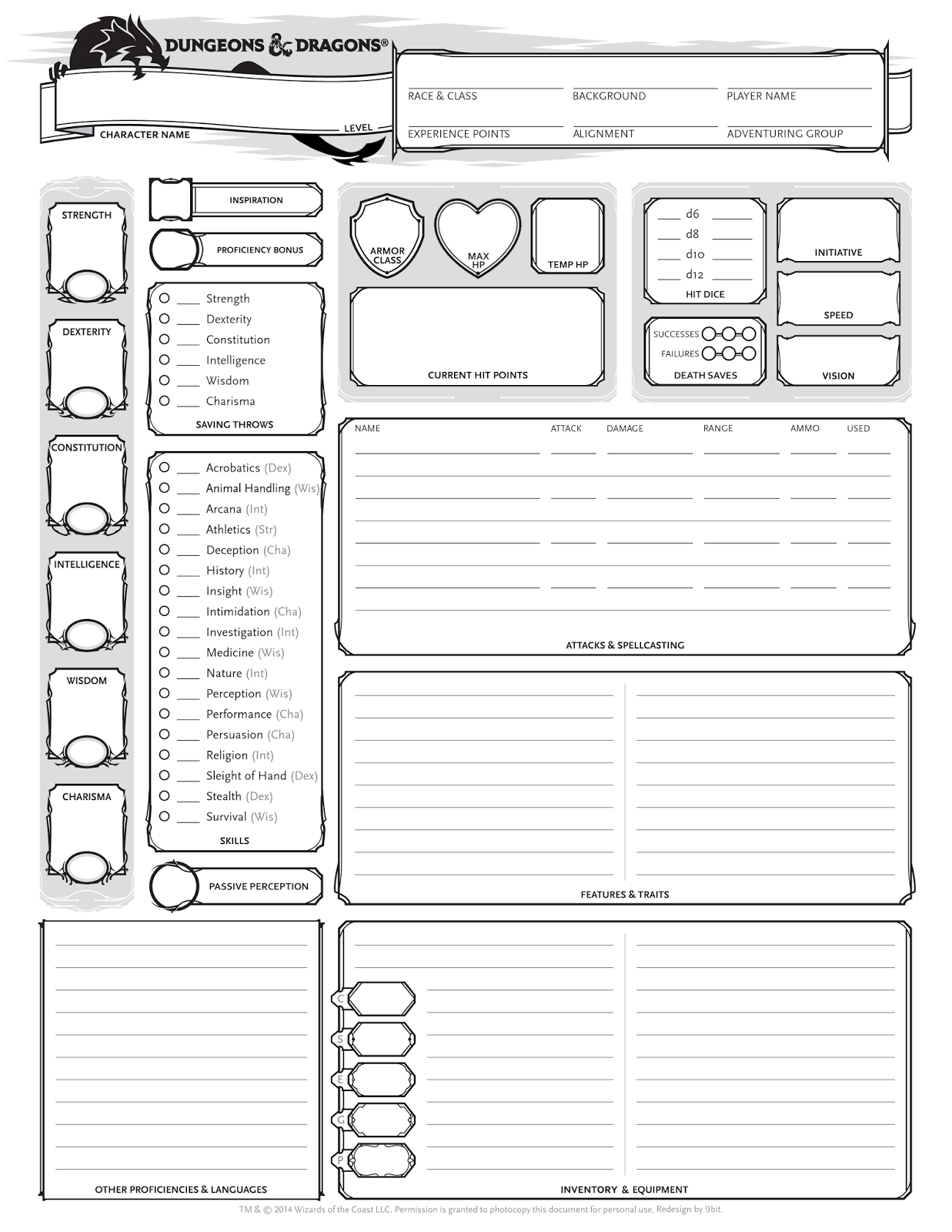
The first time I saw a character sheet was 30-some years ago, long before I started writing novels. It looked much like this: (Dungeons and Dragons, 2017).

Sorry for the mouse print. Anyone who has played an RPG recognizes this sheet, or something much like it.  (My character was a female half-elf wizard with extreme beauty and maxed-out charisma. Hello, wish fulfillment!)

More pertinent to the discussion — this character sheet does a pretty good job for writers despite its obsession on quantifying character skills and its focus on fighting. I could see this working for sword and sorcery or even urban dystopia with fight scenes.

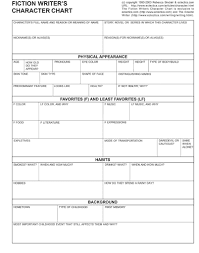
This next one I looked up on the Internet, a veritable treasure trove of character sheets. I love this sheet:

This sheet has so much detail, it would almost work as an intake assessment form in case management — all it’s missing is the mental status exam. I think I could use this form while discussing with my husband the fine points of a character over a three-hour coffee date. On the other hand, I have a novel with 65 characters, for which I have at least partial character sheets. Imagine filling this doc out for 65 characters!

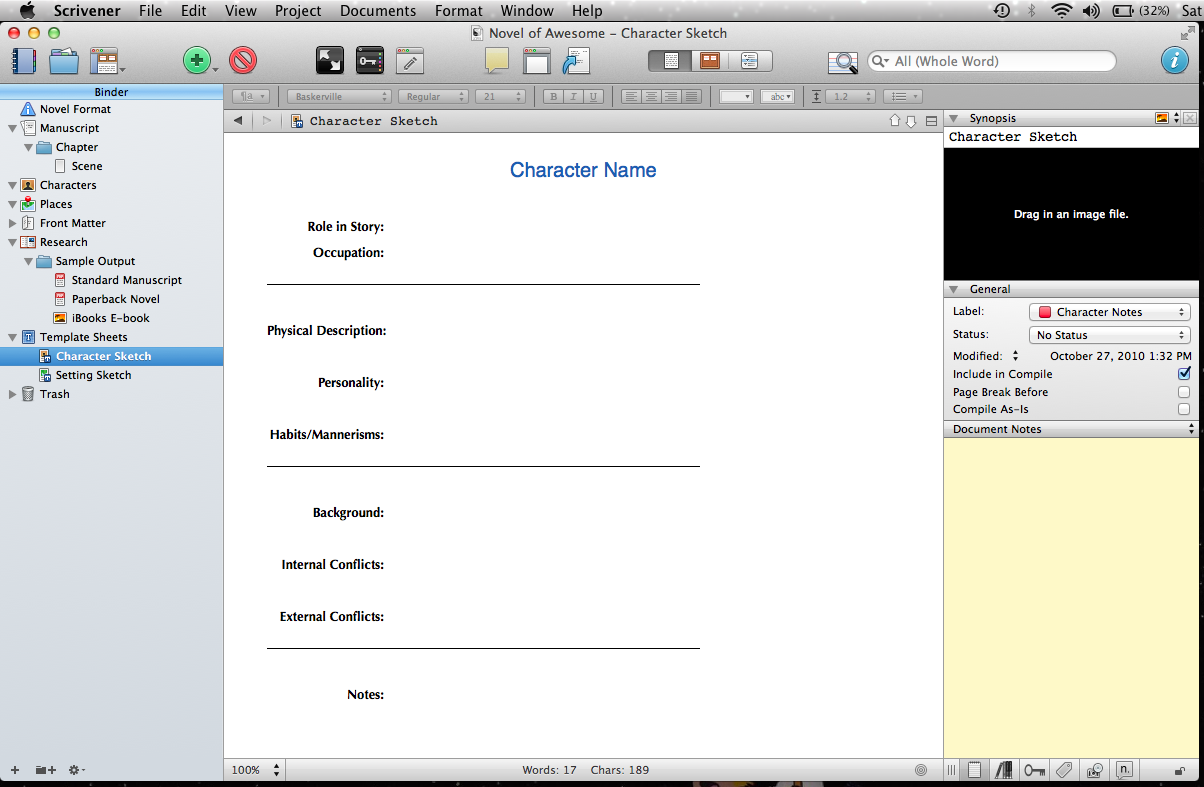
The third character sheet is what I use, because it’s electronic and because it’s bundled with my storywriting/formatting software, Scrivener:

I prefer the simplicity of this document — I can fill this out in 20 minutes or less and get back to writing. My favorite part of this document, however, is that I can drag and drop a picture to remind me of what the character looks like!

If you were to ask me, though, which character sheet/method is the best, I would not answer with Scrivener’s document, although it’s my favorite so far. As with many other things in life, the best character sheet is the one you’ll use.

As always, sources:

Dungeons and Dragons (2017). Character sheets. Available: http://dnd.wizards.com/articles/features/character_sheets [September 6, 2017].

Lerner, T. and Walker, K.  (2017). The epiguide.com guide to character sheets. Available: http://www.epiguide.com/ep101/writing/charchart.html

Scrivener [Computer software]. (2017). Retrieved from https://www.literatureandlatte.com/scrivener.php.