Avoiding Plagiarism

I was joking about the concept of Chekhov’s gun the other day, with the example of a cat that showed up early in the action and then turns around to save the day. That, in a phrase, is Chekhov’s cat.

Looking up Chekhov’s cat, I discovered that someone had gotten to the joke before me, a writer on Tumblr named The Bibliomancer, on a blog by the same name (The Bibliomancer, 2023, Nov. 10). They define Chekhov’s cat as when a cat appears in the story, it will play an important role later.

Photo by Pixabay on Pexels.com

It’s important that we credit the original thought of others with citations, such as what I’ve done above. I use American Psychological Association citation style here in addition to a linkback to the original site. Blogs generally use the linkback, but I want to make sure the originator gets the full credit, so I use academic citation style. The full citation will be at the bottom of this page.

I have been the victim of plagiarism. Once, I gave a colleague an assignment of mine as a guideline for structuring her own homework in a class; she published it as her own without giving me any credit. I still seethe over it, twenty-eight years later, because she stole an idea from me by not crediting me.

I think we on the Internet need to credit the sources we use to make our content. That way, maybe people will cite us.

The Bibliomancer (2023, Nov. 10). Chekhov’s Cat. Available on Tumblr: https://thebibliomancer.tumblr.com/post/733615519135039489. [August 28, 2024].
More or Less an Analysis

One of the things I wrestle too much with in my writing — am I telling the reader too little? Too much?

The first thing I think of is Chekhov’s Gun, the rule that if something is important to the plot, it should be introduced before it becomes important. My first segment, then, is a veritable Clue game (“Look! There’s the candlestick that Mr. Mustard will use to kill the deceased in the parlor!”), but is it too much? Or too little?

What do we know from yesterday’s post of the first segment (yesterday’s post)?

  • Annie’s mother is a cultural anthropologist who supposedly told Annie odd bedtime stories when she was a child;
  • Annie doesn’t remember her childhood;
  • Annie has chosen to follow her steps, focusing on urban legends;
  • Annie’s stepfather was/is a renowned cryptographer for the government, and kept possession of codes when he left his position and changed his identity;
  • Annie dabbles in cryptology and inherits his cipher box and codes;
  • Her parents die three months after that passage in a home invasion;
  • An unknown time has passed, and Annie is remembering the incident.
I worry about whether I’m doing the right thing by not explaining these things more, but the too little/too much dichotomy runs through my head when I reread it:
  • Are the items above too much for the first thousand words of a book? Should I put in more description so it doesn’t feel like an information dump?
  • Have I given too little reference to time, so that I strand the readers in limbo and give them no clue as how the segment fits in the book?
  • Does Annie not worry enough about coming into possession of what might be government secrets?
  • Can I just leave Annie’s casual mention of not having childhood memories (a rare thing to not have any before a certain age) as something she just accepts, or do I have to explain more?
  • And, most importantly, does this beginning make my readers want to read more of it?
Just under a thousand words, and I have this many questions to answer. In some ways, writing fiction reminds me of writing my dissertation way back when — I’m relieved when the number of comments in red in the margins finally becomes less than the number of words I’ve written.

More on Revising

I’m currently editing my first novel, Gaia’s Hands, for perhaps the fourth time. Most writers would have delegated this to a drawer forever, but I’m going to use it as a learning tool. And, damn it, I’m stubborn.

The biggest thing I have had to do so far is remove two main characters, Annie and Eric. Not completely, mind you — they remain in the story, but not as main characters. I had read somewhere that more than two main characters distracts from the story, because we experience the story through the main characters. So we’re down to the seemingly mismatched couple I’ve mentioned before — Josh Young, the English major exploring his Asian American heritage and Jeanne Beaumont, the much older college professor who lives in the world of science.

Removing the first person POV for two characters resulted in removing two subplots, which I could do. But it also lost maybe 15,000 words, and publishers in SF/Fantasy now expect 75,000-110,000 words in their submissions. (Tea with the Black Dragon, which was nominated for the Hugo and Nebula the year it came out, would not pass in today’s market).  Adding 15,000 words to an existing novel without it looking added on? Slapping two chapters in won’t do it. However, I’ve gotten the opportunity to look through the document with wiser — and older — eyes, identifying places where I erred in the following ways:

  • Loaded Chekhov’s Gun and dropped it (foreshadowing wasted)
  • Left plot holes (or as my grad advisor said, “I can’t grade you on what’s in your head”
  • Missed opportunities to develop secondary characters (although they’re not primary characters, they deserve not to be two-dimensional)
  • Added more menace (poor Jeanne. Death threats, rocks through her window, and a break-in at her greenhouse.)
The writer will never catch all of these in the writing stage, because the writing stage is about unabashed writing without the burden of editing. Of course, the writer can exercise some constraint — such as paring things that are out of character for a character. I’ve told you readers that I love the writing stage because I can restrain the part of me that says “flying robots? Really?” and write the flying robots in. (Ok, no flying robots, but I am inspired by the lack of restraint in shoujo anime.)
Lots of work, and I have temporarily abandoned a work in progress right after a major dramatic point to do so. Wish me luck — I need it!

Foreshadowing in the Forest

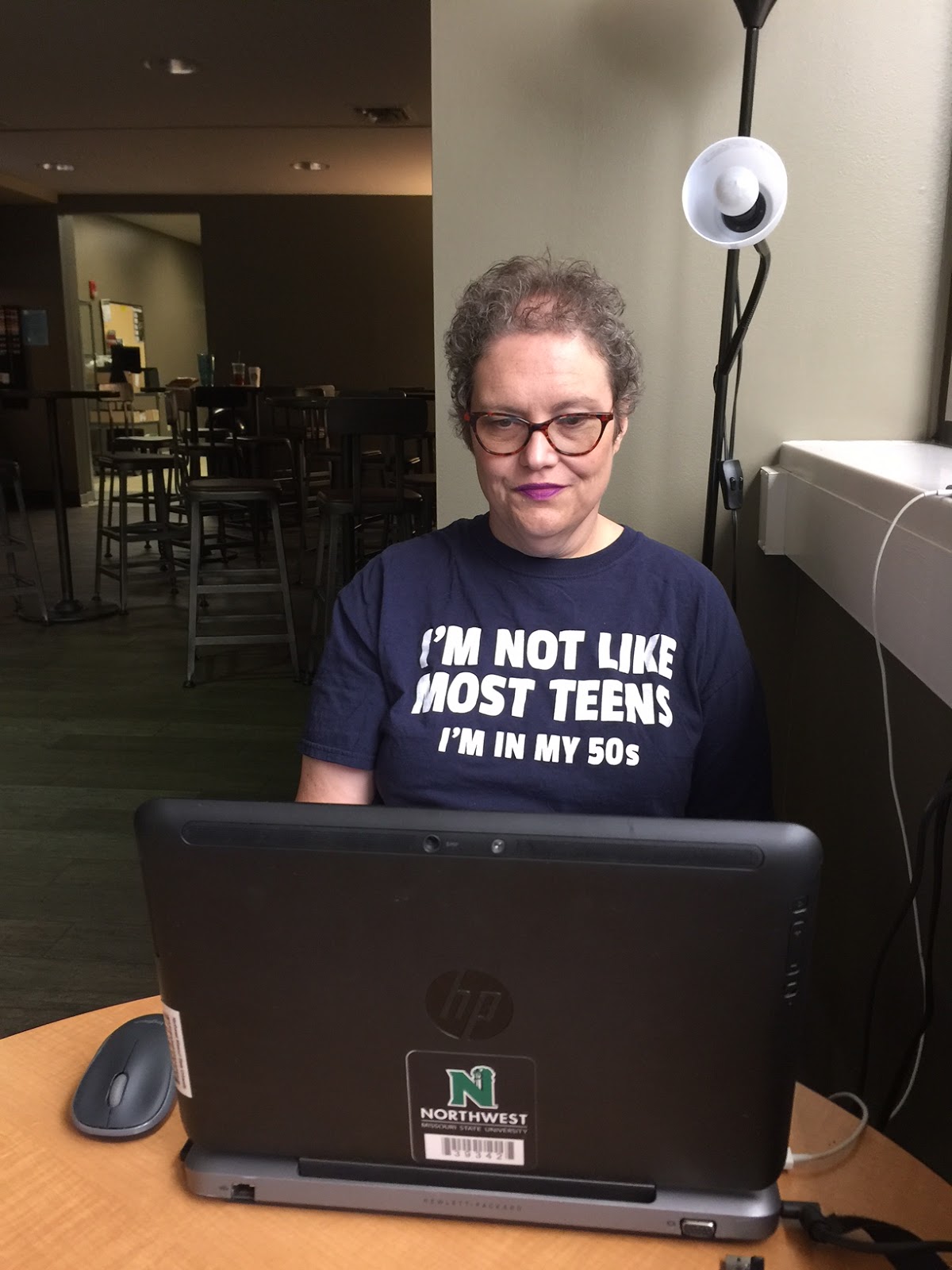
This was me at the library/coffee house at Northwest Missouri State University yesterday, soaking up ambience and writing on Prodigies (and not, as my husband suggested, pierogies.)

Grace has just been — liberated? abducted? by the prodigy Ichirou and his chaperone, Ayana. Not that Ichirou needs a chaperone, because the Ichirou that retrieves her from her dorm room has grown five inches and grown rather kawaii (cute) in the nine months since Grace last saw him. After officially withdrawing Grace from Interlochen Academy and helping her pack, the three embark on a tense van ride where Ayana refuses to discuss the reason they’re fleeing to a secluded cabin.

The three talk around the “elephant in the room” — or rather, van — which leads to discussions of cultural differences between Grace’s blunt questions and Ayana’s indirectness; discussions of how religion and death are perceived in Japan; and Grace’s revelation of how she lost her parents.

The most fun part to write was Ichirou’s brief speech about how men in Japan will not eat sweet desserts because they will be thought of as less masculine — while eating a plate of French toast swimming with butter, syrup, and whipped cream.

Obviously this took a lot of research on Google (best search of the day: Japanese death taboos). That’s not what I want to talk about today — instead, I want to talk about foreshadowing.

Foreshadowing is a storytelling technique where the writer hints about a later occurrence in the story. It’s best to do this with subtlety,  so the hint doesn’t tell the reader what to expect. Later, when the actual event happens, the astute reader will say, “Hey, wait a minute, didn’t I read earlier that — ?”

Chekhov’s Gun is a related principle of storytelling that advises the writer that any object introduced to the story that doesn’t have immediate purpose should be employed in the story later, and that things not important to the story should be trimmed away.  I’m not a strong proponent of this — if Tolkien took away any unnecessary scenery in The Lord of the Rings, the trilogy would be a brochure.

The reason I mentioned foreshadowing, though, is because what seems to be a conversation to develop characters further can also drop in bits of foreshadowing. In the section of my book I described briefly above, there were three bits of foreshadowing.  No, actually four. I know where those tidbits will blossom in the book, so I could foreshadow. (You may even remember reading about one earlier.) Wait a minute — that’s how foreshadowing works.