Unlovely Feelings

Feelings about writing I’d rather not have

Lately, I have written little. I’ve edited, edited, and edited (and frankly have at least two novels left to edit with ProWritingAid). But this means I now have writer’s block and haven’t done the very part of writing that gives me a high.

Photo by Anna Shvets on Pexels.com

The unlovely feelings I’ve harbored

Instead, the writing part of my life has become a series of unlovely and even petty feelings. I’m ashamed of the thoughts and cycle through them helplessly. In exposing them to the light, I hope I can exorcise them.

The cycle goes like this:

  • Being disappointed by my progress in writing/being read
  • Looking down at my talent
  • Being jealous of other people who have advanced in writing and being read

Self-pity and jealousy aren’t a good look, so I don’t let them out. Except here, I’m letting them out by owning them. By admitting them, rather than indulging them.

What do I do about this?

I think I need to go back to what I love, so I remember what I love about writing. And what I love about writing (other than getting attention, which I’ve already noted is failing) is actually writing. I need to create and then I’ll have the energy to do what I need to do — the promoting, which pushes me into the comparisons to others and the jealousy.

This is all very intellectual. but…

I’m analytical about this whole thing, which tells me one thing: I’m trying to stifle these unlovely feelings by managing them. Feelings are not to be managed without paying attention to them and letting them out constructively.

The way I learned to do this was through cognitive journaling. Without going into too much detail, cognitive journaling lets you document a feeling and its power over you, then examine the cognitive distortions that fuel those feelings. Many of our bad feelings come from inaccurate thoughts.

So that is what I need to do about my unlovely feelings — let myself listen to them and then find the truth.

I’ve got some work to do.
My Family’s Curse

I believe that families have curses; however, what I mean by curse is a way of thinking, believing, or acting that hinders coping, relationships, and outlook. For example, a family that keeps trauma bottled up creates a dysfunctional habit that will pass from generation to generation.

My family’s curse is a killing of joy, a pervasive belief that joy is dangerous because good things never happen. For example, suppose there is a child who is looking forward to their birthday. Their grandmother says in a sepulchral voice, “Don’t look forward to anything; you’ll only get disappointed.” The child integrates this world view and passes it to their optimistic children so that children strangle their joy and grow up with the dreary world view.

Photo by Karolina Grabowska on Pexels.com

I have only partially internalized the curse; I feel elation every time I write queries for a book of mine. And then the family curse wakens in my mother’s voice and version: “My grandmother said you should never look forward to anything, because you’ll only be disappointed.” Her version of the curse invokes a matriarch whom I have never met, but stands as the forgotten fairy at the christening delivering the curse.

The faulty curse wobbles around in me — I feel hope and elation, followed by guilt I should feel this way, and caution in my mother’s voice: “Don’t look forward …” I do not hug the family curse as a reality I should adopt, but it has not died in me either.

Day 17 Reflection: Possibility

I am positively drunk with possibility. To be drunk on possibility is to see an opportunity and combine it with hope, and recognize the potential of good things.

A blank computer screen, a seed, a fresh journal, a job application — all of these whisper possibilities in us, possibilities of creation, growth, sustenance. All we have to do is act. And wait.

A possibility is not a probability. Not even hard work brings us a guarantee. We have to act to bring the possibility to fruition, and then we have to wait. And sometimes we’re disappointed, but then we hear the whisper of possibility again, and our essential optimism risks disappointment again for the sake of pursuing opportunity.

Chronic disappointment leads to a dulling of that sense of possibility. People get drunk on substances out of a sense of hopelessness. Those who have not been provided opportunity lose trust in possibility, wanting to believe only in sure things. The unscrupulous prey on these disenchanted people. Con artists guarantee riches to unsuspecting victims, taking advantage of their dreams, their drunkenness on possibilities. The sign of a con, in fact, is this promise to make the possibility a lucrative reality. Real life seldom promises fulfillment of our possibilities. 

It’s too easy to chide people for being unrealistic, but believing in possibilities requires from all of us a certain recklessness, a certain desire to believe that a computer screen and keyboard will yield a novel and that a resume will get an interview. We all need to believe in possibilities, and we need to make more possibilities possible for those who face an impoverishment of opportunities. 

Because being drunk on possibilities is the best inebriation.

Becoming My Own Muse

What is the nature of a muse? A muse reaches into a creator’s soul and pulls forth the creator’s best work. As such, the muse is both the supporting angel and the demon lover, illustrated by the character of the Phantom in the musical Phantom of the Opera. Of course, all of this is in the mind of the creator; the muse himself might be a compelling person at the coffeehouse who asks about how the work in progress is doing and actually cares.

I had a muse once. Kind of a crazy thing, but he was an artistic type whose work appealed to me. And it didn’t hurt that he was beautiful in an ethereal way. He inspired me with his verve and his persistence, and my mind went on flights of fantasy and ended up in very vivid stories.

I had to give him up eventually. The problem with flights of fantasy is that they make one beholden to the subject. I had given the fantasy so much of my thoughts that I craved something back, even if it’s something as simple as recognition or support or friendship. Recognition, support, and friendship themselves feed creativity — anyone who creates needs connection and support, for creating is hard, lonely work sometimes. The muse remains a muse by being there.

My muse never made the transition.

In reality, though, people — even muses — will always disappoint us. In reality, people will not always be there when we need them. They will not understand what we need if we ourselves can’t articulate it. They can’t read our minds. They may not be able to see our beauty.

This is why I need to become my own muse.

Is it possible? The nature of a muse is intrigue and unpredictability and challenge, love and danger. How does one give that to oneself?

If ignorance is bliss

I should have been ecstatic about my blog stats yesterday, but I wasn’t:

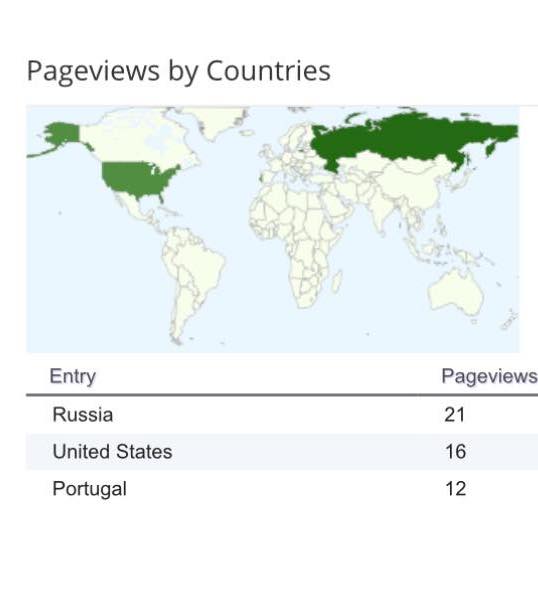
At about noon yesterday, I looked at my stats for this blog and saw more hits on my blog than I’d ever had before from two countries, Russia and Portugal. Russia and Portugal were semi-frequent (in the case of Russia) or frequent (in the case of Portugal) visitors to the blog.
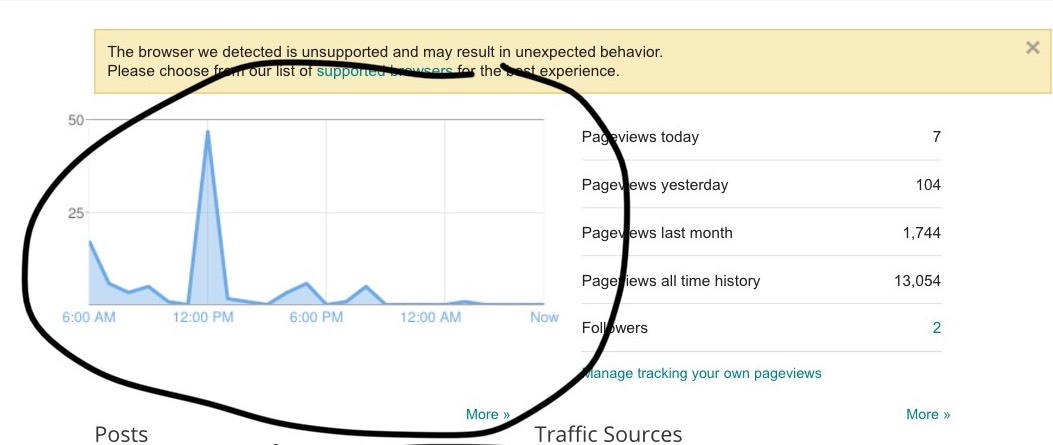
So, what’s the problem here? Webcrawlers. Bots. Robots. Spiders. Slimy bastards. Computer programs that investigate a blog to mine information, whether it be an email to send spam mail to (No, I don’t want to be a REAL man!) or who knows what purpose! If you look below at the circled diagram, you’ll note that the action started close to noon and peaked at noon, which is more activity than I get when I publish (see the spike at the far left). 

Russia, according to my friend Dann (hi, Dann!) is a hotbed of bot activity, whether to feed addresses to a spambot, influence US politics, or look for coded messages. I hope to heck Russia’s looking for coded messages, so at least I can get a good short story about mistaken identity out of it. I had always imagined Russia to be an adolescent female who wanted a writing career. I’m disappointed to find out she’s not.
The US is probably not using a bot — I actually do have at least 16 friends who read this blog. But I don’t know most of them.
Where this really disillusions me is Portugal. I know nobody in Portugal, so that was my favorite mystery. I imagined Portugal to be a Secret Admirer, which is really a silly thing for a fifty-something woman to fantasize about, isn’t it? A younger fellow who’s too shy to actually give you meaningful information but courts your curiosity, and elicits laughter but no jealousy from your significant other? Women my age are more likely to get “Hi, surrogate mommy!” which is not flattering at all. 
So I have lost a little spring in my step with the loss of my Secret Admirer fantasy. It’s okay — as I told Dann, I prefer the truth always. 
But the fantasy makes for better stories.